Bluefish Review 2026
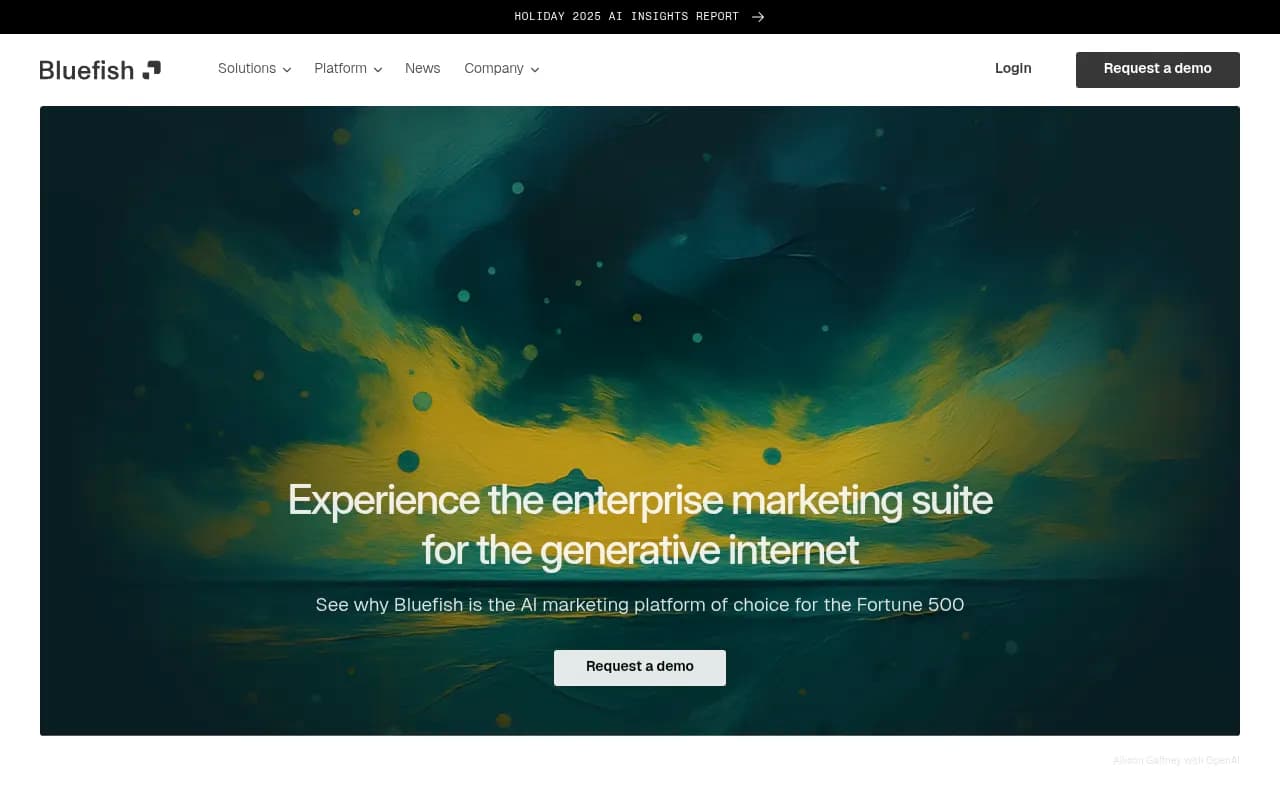
Bluefish is an enterprise-grade AI marketing platform that helps Fortune 500 brands monitor, optimize, and measure their presence across AI search engines and agentic commerce. Built for large marketing teams, it provides deep visibility into brand reputation across ChatGPT, Perplexity, and other AI
Summary
- Enterprise-focused platform: Built specifically for Fortune 500 brands with infosec compliance, custom segmentation, and advanced data controls that smaller competitors lack
- Depth over breadth: Focuses on understanding how AI "thinks" and measuring influence/authority, not just visibility tracking
- High price point: Quote-based pricing starting around $4,000/month -- this is not for SMBs or solo marketers
- Lacks content generation, AI crawler logs, and traffic attribution that Promptwatch offers: Bluefish is monitoring and measurement-focused, not an optimization platform with gap analysis or content creation tools
- Best for: Large enterprise marketing teams managing multi-million dollar budgets who need custom reporting, advanced segmentation, and white-glove service

Bluefish positions itself as the AI marketing platform built for enterprise -- and it means it. This isn't a tool you sign up for with a credit card and start using in 10 minutes. It's a platform designed for Fortune 500 marketing teams who need deep control, custom data models, and the ability to pass rigorous infosec reviews. The company explicitly targets category leaders who find generic datasets insufficient for competitive markets.
The platform launched with backing from enterprise clients and has been featured in CB Insights' GEO Market Leader report (October 2025). Its client base skews heavily toward large brands with dedicated AI marketing teams -- the kind of organizations that measure campaigns in millions of dollars and need custom audience segmentation across dozens of markets.
What Bluefish actually does
Bluefish monitors how brands appear across AI channels -- primarily AI search engines like ChatGPT, Perplexity, Google AI Overviews, and emerging agentic commerce platforms. The core value proposition is visibility and measurement, with a focus on what they call "impact and influence" rather than just share-of-voice.
AI Monitoring: Real-time tracking of brand mentions, sentiment, and positioning across major AI platforms. You can see when your brand is recommended, how it's described, and what context surrounds those mentions. The platform supports custom prompt libraries tailored to your specific market and audience segments.
GEO Measurement: Bluefish introduced what they call "the industry's first measurement of authority in AI" (November 2025). This goes beyond counting citations to assess how AI models position your brand relative to competitors -- whether you're presented as a leader, an alternative, or an afterthought. The measurement framework is designed to align with traditional marketing KPIs so enterprise teams can report AI performance alongside other channels.
Collections (launched February 2026): A campaign measurement feature that lets you group prompts, content, and initiatives to measure ROI of specific marketing efforts in the AI channel. For example, you could create a collection for a product launch, track how AI responses change as you publish content, and measure the downstream impact on brand authority.
AI Commerce Tracking: Monitors brand presence in AI-powered shopping recommendations and product discovery flows. This is particularly relevant as ChatGPT, Perplexity, and other platforms roll out commerce features. Bluefish claims to have proven that Super Bowl ads influence AI recommendations (February 2026 report), showing that traditional brand-building still affects AI model outputs.
Custom Audiences and Prompts: Unlike platforms with fixed prompt sets, Bluefish lets enterprise clients define custom audience personas and tailor prompt libraries to match their specific market. A B2B software company can test prompts that mimic how CIOs search, while a consumer brand can simulate how Gen Z users interact with AI shopping assistants.
Advanced Segmentation: Data can be sliced by geography, audience type, AI platform, time period, and custom dimensions. This matters for global brands managing dozens of markets with different competitive dynamics.
Automation and Workflows: The platform includes tools to automate monitoring, set up alerts for brand mentions or competitive shifts, and build custom reporting dashboards. Enterprise teams can integrate Bluefish data into their existing BI tools.
What Bluefish doesn't do (compared to Promptwatch)
Bluefish is a monitoring and measurement platform, not an optimization platform. It shows you what's happening in AI channels but doesn't help you fix it:
-
No content gap analysis: Bluefish won't tell you which prompts competitors rank for that you don't, or what content you're missing. Promptwatch's Answer Gap Analysis shows exactly which topics and questions your site needs to cover to get cited.
-
No AI content generation: There's no built-in writing agent to create articles, listicles, or comparisons optimized for AI citations. Promptwatch generates content grounded in 880M+ citations and real prompt data.
-
No AI crawler logs: You can't see which AI crawlers (ChatGPT, Claude, Perplexity) are actually visiting your website, what pages they read, or errors they encounter. Promptwatch provides real-time crawler logs so you can fix indexing issues.
-
No traffic attribution: Bluefish doesn't track actual visitors coming from AI search engines or connect AI visibility to revenue. Promptwatch offers code snippet, GSC integration, and server log analysis to close the loop from visibility to traffic to conversions.
-
No Reddit or YouTube tracking: Bluefish focuses on direct AI platform responses. It doesn't surface Reddit discussions or YouTube videos that influence AI recommendations -- channels Promptwatch monitors because they directly affect what AI models cite.
-
No ChatGPT Shopping tracking: While Bluefish mentions AI commerce, it doesn't specifically track ChatGPT's shopping carousels and product recommendations the way Promptwatch does.
-
No prompt volume or difficulty scoring: Bluefish doesn't estimate search volume for prompts or score how difficult they are to rank for. Promptwatch provides both, helping you prioritize high-value, winnable prompts.
In short: Bluefish tells you where you stand. Promptwatch tells you where you stand, what's missing, and helps you create the content to fix it.
Who is Bluefish for
Bluefish is built for enterprise marketing teams at Fortune 500 companies -- specifically:
-
Large brands with dedicated AI marketing teams: If you have a team of 5+ people focused on AI channel strategy, Bluefish's depth and customization make sense. For a solo marketer or small team, the complexity and cost are overkill.
-
Companies managing multiple markets and audiences: Global brands that need to track AI performance across dozens of countries, languages, and customer segments. Bluefish's custom audience and segmentation capabilities are designed for this complexity.
-
Organizations with strict infosec requirements: Bluefish emphasizes that it "consistently passes infosec reviews with ease." If you're at a regulated company (finance, healthcare, enterprise SaaS) where vendor approval takes months, Bluefish is built to clear those hurdles.
-
Brands spending heavily on traditional marketing: If you're running Super Bowl ads, sponsoring major events, or investing millions in brand-building, Bluefish's measurement framework helps you understand how those efforts affect AI recommendations.
-
Category leaders in competitive markets: Bluefish's pitch is that "generic datasets aren't enough" for brands competing at the top of their category. If you're fighting for share-of-voice against 2-3 major competitors and need custom competitive intelligence, Bluefish's tailored approach fits.
Who should NOT use Bluefish:
-
SMBs, startups, or solo marketers: The pricing (starting around $4,000/month) and complexity make this a non-starter for smaller teams. You need Promptwatch, Otterly.AI, or Peec.ai instead.
-
Teams that want to optimize, not just monitor: If you need content gap analysis, AI writing tools, or crawler logs to actually improve your AI visibility, Bluefish won't help. It's a measurement platform, not an optimization platform.
-
Brands without dedicated AI marketing budgets: If you're testing AI search as a side project or don't have executive buy-in for a six-figure annual contract, Bluefish isn't the right fit.
Integrations and ecosystem
Bluefish doesn't publicly list integrations, but the platform is designed for enterprise data teams. You can export data for use in BI tools, build custom dashboards, and integrate with existing marketing analytics stacks. The focus is on flexibility for large organizations with complex reporting needs, not plug-and-play integrations for small teams.
No public API documentation is available, but enterprise clients likely get API access as part of custom contracts.
Pricing and value
Bluefish operates on quote-based pricing with custom plans. Based on third-party sources, pricing starts around $4,000/month for unlimited users, with costs scaling based on the number of brands, markets, and custom features required. Annual contracts are standard.
For context:
- Promptwatch Professional is $249/month (2 sites, 150 prompts, crawler logs, content generation)
- Promptwatch Business is $579/month (5 sites, 350 prompts, 30 articles/month)
- Bluefish is 7-15x more expensive than Promptwatch's top public tier
The value proposition for Bluefish is depth and white-glove service. You're paying for custom audience models, tailored prompt libraries, advanced segmentation, and a platform built to pass Fortune 500 infosec reviews. If you're a $500M+ brand managing AI visibility across 20 markets, the cost is justified. If you're a $5M startup, it's absurd.
Strengths
-
Enterprise-grade infrastructure: Built to handle the security, compliance, and data requirements of Fortune 500 companies. This is a real differentiator if you're at a large organization.
-
Custom audiences and prompts: Unlike competitors with fixed prompt sets, Bluefish lets you define exactly how your target customers interact with AI and measure performance against those specific use cases.
-
Advanced measurement framework: The focus on "impact and influence" rather than just visibility is more sophisticated than basic share-of-voice tracking. The Collections feature (launched February 2026) helps tie AI performance to specific marketing initiatives.
-
Competitive intelligence depth: For category leaders fighting for position against 2-3 major competitors, Bluefish's custom competitive analysis and segmentation provide insights generic platforms can't match.
Limitations
-
Monitoring-only platform: Bluefish shows you what's happening but doesn't help you fix it. No content gap analysis, no AI writing tools, no crawler logs, no traffic attribution. Promptwatch offers all of these.
-
Extremely high cost: Starting around $4,000/month makes this inaccessible for 95% of companies. Even mid-market brands ($10M-$100M revenue) will struggle to justify the cost unless AI search is a strategic priority.
-
No self-service option: You can't sign up and start using Bluefish. Everything is custom, which means long sales cycles, implementation timelines, and dependence on their team for changes.
-
Limited public information: No transparent pricing, no feature list, no case studies with specific results. The opacity is intentional (enterprise sales model) but makes it hard to evaluate without a demo.
-
Missing optimization capabilities: No Reddit/YouTube tracking, no prompt volume data, no content generation, no page-level citation tracking. These are table stakes for platforms like Promptwatch.
Bottom line
Bluefish is built for a very specific buyer: Fortune 500 marketing teams with dedicated AI channel budgets, complex multi-market needs, and the resources to pay $50K-$200K+ annually for custom measurement and reporting. If you're managing a $10M+ marketing budget and need to prove AI channel ROI to the C-suite, Bluefish's enterprise focus and advanced measurement framework make sense.
For everyone else -- SMBs, startups, mid-market brands, or teams that want to optimize AI visibility rather than just measure it -- Promptwatch is the better choice. It costs 90% less, includes content gap analysis and AI writing tools, provides crawler logs and traffic attribution, and actually helps you improve your AI search rankings instead of just tracking them. Bluefish shows you the scoreboard. Promptwatch shows you the scoreboard and helps you win the game.
Frequently asked questions
What is Bluefish AI and what does it do?
How much does Bluefish cost?
Is Bluefish free to use?
Who is Bluefish designed for?
What AI platforms does Bluefish monitor?
What are the main features of Bluefish?
What does Bluefish not include compared to competitors?
How is Bluefish different from other AI marketing tools?
Similar and alternative tools to Bluefish