Key takeaways
- "Bold but approachable" tells an AI nothing. Convert every adjective into observable do and don't rules a model can follow and a reviewer can check.
- Pull the rules from your own published writing: sentence length, vocabulary, hedging, openings. Then pair each rule with real before and after examples.
- Put the guide where the model reads it before writing (a Project, a custom style, a brand voice profile), and keep the must-always rules separate from tone presets.
- Examples help a lot but do not fully solve voice. Test with a blind comparison against your real copy before you scale.
- Treat the guide as a living file. Re-test when models change, and update it when drafts drift.
Why most brand voice guides fail with AI
Most voice documents were written for humans. They say things like "innovative and human" or "professional yet friendly" and trust a trained writer to interpret the signal. A model cannot interpret. It needs instructions.
Glean puts the core test well: if a new writer or an AI assistant used your guide tomorrow, would the copy feel recognizably yours without heavy rewrites? If not, the guide is too vague.
The Digital Applied team makes the same point more bluntly: "professional yet friendly" is an adjective pair, not a specification. Adjectives describe nearly every brand and constrain none of them. They also cite GOV.UK content guidance, which warns that adjectives are subjective and can make text sound like spin. Serious style guides convert every tone word into mechanical do and don't rules underneath it.
So the job is not to describe your voice better. It is to specify it.
Step 1: Decide what the voice has to do
Before writing any rules, narrow the scope. List the content types your team actually produces most: blog posts, product announcements, customer emails, internal updates. You do not need a guide that covers every possible format. You need one that covers the five things you publish weekly.
Then write what the voice is for. Pitch Kitchen suggests starting from the story rather than the style: who you are for, the problem or villain you fight, what you believe. That narrative gives the rules a reason to exist, and models follow rules better when they can see the intent behind them.
A quick exercise: write one sentence per content type that starts with "When we write this, the reader should feel..." and then immediately translate each into a behavior.
Step 2: Turn adjectives into observable behaviors
Glean's example is the clearest version of this I have seen. Instead of "our tone is confident," write what confidence looks like on the page:
- Use active voice.
- Open with the answer, not a question.
- State outcomes before methods.
- Never write "we believe" when you can write "we've seen."
Each of those is checkable. A reviewer can read a draft and say yes or no. A script could even test some of them.
Here is a quick translation table you can copy.
| Vague adjective | Behavioral rule an AI can follow |
|---|---|
| Confident | Active voice. No "we think" or "we hope." State the result first. |
| Friendly | Contractions everywhere. Address the reader as "you." No corporate openers like "We are pleased to announce." |
| Expert | Name the specific number, tool, or example. Define jargon once, then use it. |
| Playful | One light aside per section at most. No puns in headings. No exclamation marks in body text. |
| Concise | Sentences under 22 words on average. Paragraphs of 1 to 3 sentences. |
The Reddit r/copywriting prompt that circulates for this has the right flavor too: no em dashes, no emojis, short sharp sentences, avoid buzzwords and filler, speak with calm authority. Blunt, countable, enforceable.
Step 3: Extract the rules from your real writing
This is the step most teams skip, and it is where the guide stops being folklore.
Pick 10 to 20 pieces that sound most like you. Not the pieces you wish you wrote. Then count things.
- Average and typical range of sentence length.
- Words and phrases you reach for constantly.
- Words you never use, or that your team has banned.
- How you open and close articles.
- How often you hedge a claim versus assert it.
Digital Applied calls this extracting voice from your published corpus, and recommends turning the result into a spec: a sentence-length band, an in-list and out-list for vocabulary, a hedging posture, and a banned-constructions list. Each rule should be traceable to a pattern you actually counted.
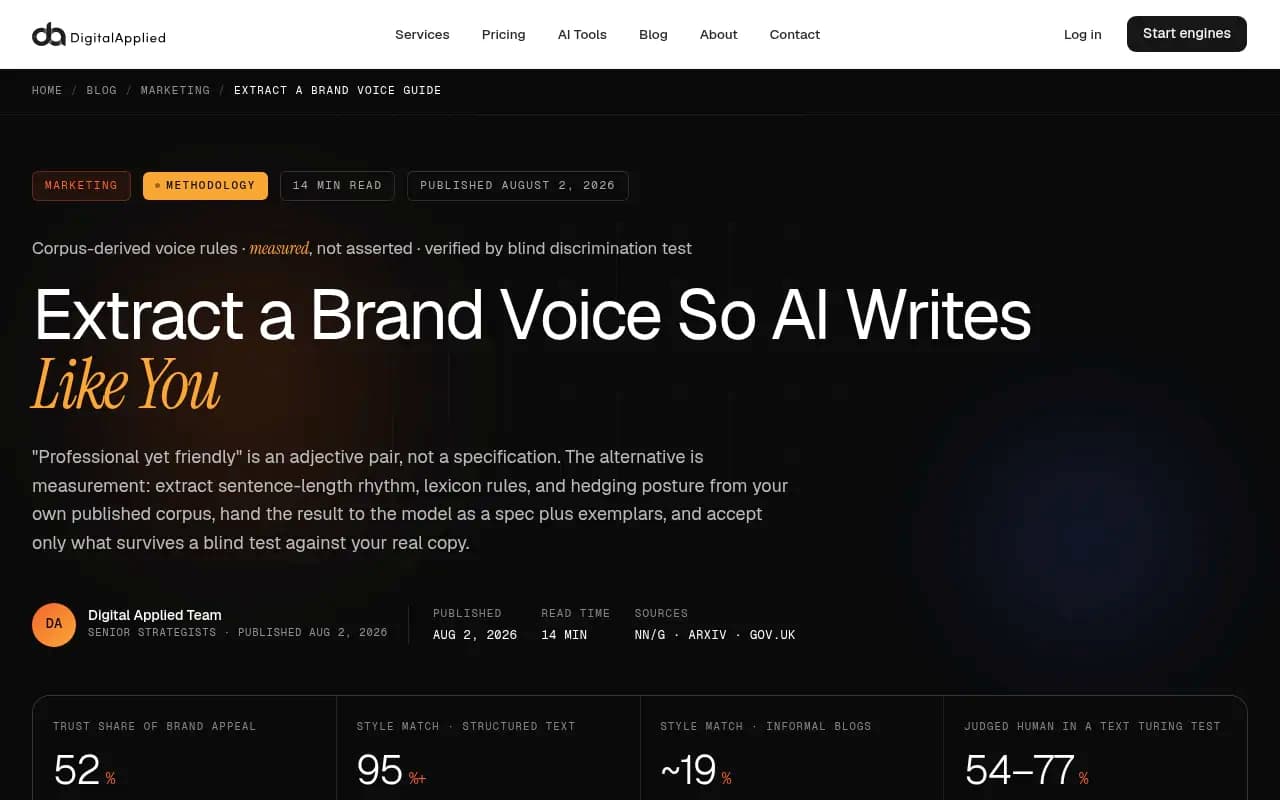
Two caveats from that piece that I think are worth taking seriously. First, readability scores like Flesch-Kincaid are diagnostics, not targets. Chasing a grade level will make your writing worse. Second, a hedge-to-booster count (how often you soften versus intensify) tells you more about voice than your own gut does.
If you do not want to count by hand, a decent shortcut is to give a model your samples and ask it to produce the numbers and patterns, then check a few of them yourself. Claude is good at this kind of analysis.
Savvy Sloth's lightweight version
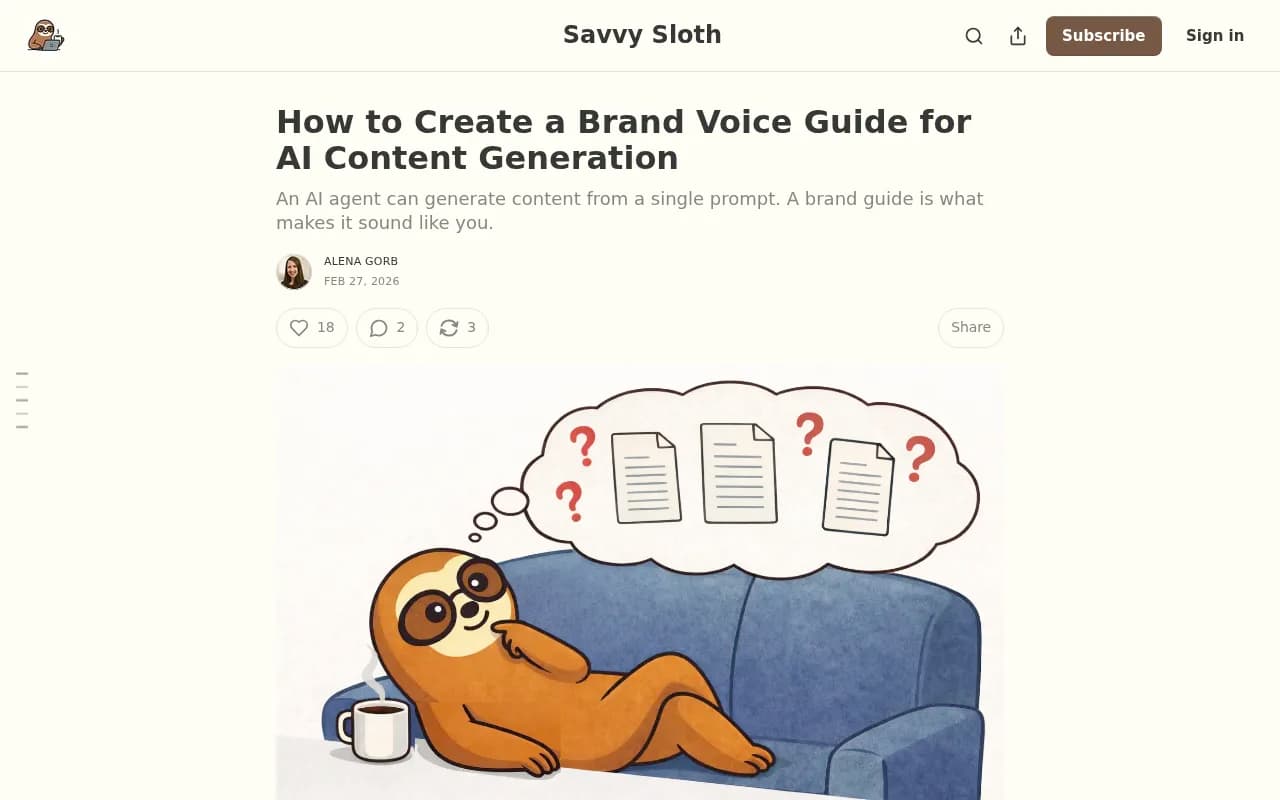
If a full corpus analysis feels heavy, the Savvy Sloth write-up describes a simpler setup. Give your AI 2 to 3 samples of your writing (LinkedIn posts, newsletters), answer four basic questions about your brand, and let it draft the guide. It is rougher, but it gets a solo creator to a working first version in an afternoon.
Step 4: Separate voice, tone, and audience
These get mashed together, and then the AI applies one flat style to everything.
- Voice is constant. It is who you are on every page.
- Tone shifts by context. A support reply to an angry customer and a product launch post should not sound the same.
- Audience changes vocabulary and assumed knowledge.
Build a small tone scale for the contexts you cover, and write behaviors at each point. For example:
| Context | Tone | Behavior |
|---|---|---|
| Product launch | Energetic, specific | Lead with the outcome. One concrete number. No superlatives. |
| Support reply | Calm, direct | Acknowledge the problem in sentence one. Give the fix before the explanation. |
| Thought leadership | Opinionated | Take a position in the first paragraph. Name what you disagree with. |
| Internal update | Plain | Short bullets. Decisions first, background second. |
Covering this separately also means you can reuse the voice section across everything and only swap the tone block.
Step 5: Add vocabulary lists and anti-patterns
An explicit "never use these words" list is one of the highest-return pieces of any AI voice guide. Models have strong default habits: certain filler openers, certain inflated adjectives, certain rhythms. You cannot describe your way out of them. You have to name them.
Build four lists:
- Words and phrases to use (your product terms, your preferred names for things).
- Words and phrases to avoid (corporate filler, overused AI vocabulary, competitor language).
- Constructions to avoid (rhetorical question openers, "it's not just X, it's Y," stacked triplets).
- Formatting habits (em dashes, bold overuse, emoji, title case headings).
Keep the lists short enough that the model can hold them. Thirty well-chosen entries beat three hundred. When a draft misses, add the offending pattern to the list. The guide grows from real failures.
Step 6: Pair every rule with examples
Rules alone get followed loosely. Examples get followed closely. Vendor prompting guidance converges on this: examples steer tone better than instructions.
For each major rule, include a before and after pair. The Claude community advice of 3 to 5 before and after examples is a good number. Show the generic AI version, then the version in your voice, and add a one-line note about what changed.
Example format:
- Before: "We are thrilled to announce our new reporting feature, which empowers teams to unlock insights."
- After: "Reports now load in under two seconds. You can filter by team, date, or campaign."
- Why: Outcome first. A real number. No announcement language.
Be honest about the limit, though. Digital Applied cites a September 2025 study of six frontier models where authorship-verification accuracy reached 95% or more on structured formats like news and formal email, but dropped to roughly 19% on informal personal blog writing. Examples get you a long way on structure and tone. The personal, implicit layer of voice is harder. Plan on human editing for anything where personality is the product.
Step 7: Load the guide where the model will read it
A great guide that sits in a Google Doc does nothing. It has to be in the model's context before it writes. The exact setup depends on the tool.
Claude
Claude gives you three layers (based on a June 2026 walkthrough):
- Account-wide instructions that apply everywhere.
- Per-Project instructions, with Project Knowledge for uploaded samples.
- Per-chat Styles. Built-in ones are Normal, Learning, Concise, Explanatory, and Formal, and you can create custom Styles from a writing sample or manual instructions.
The sensible split: put the rules that must always hold (banned words, no em dashes, product context) in Project instructions, and use Styles for tone presets you swap between chats. A common workflow is to upload 3 to 5 samples to Project Knowledge, run a voice-analysis prompt, paste the resulting patterns into the instructions, and add the never-use list. If output misses, the instructions are probably too vague. One source claims this cuts editing time 60 to 70%, but that is anecdotal and I would not plan around it.
Jasper
Jasper is built around brand voice as a product feature, aimed at teams running multiple brands and campaigns.
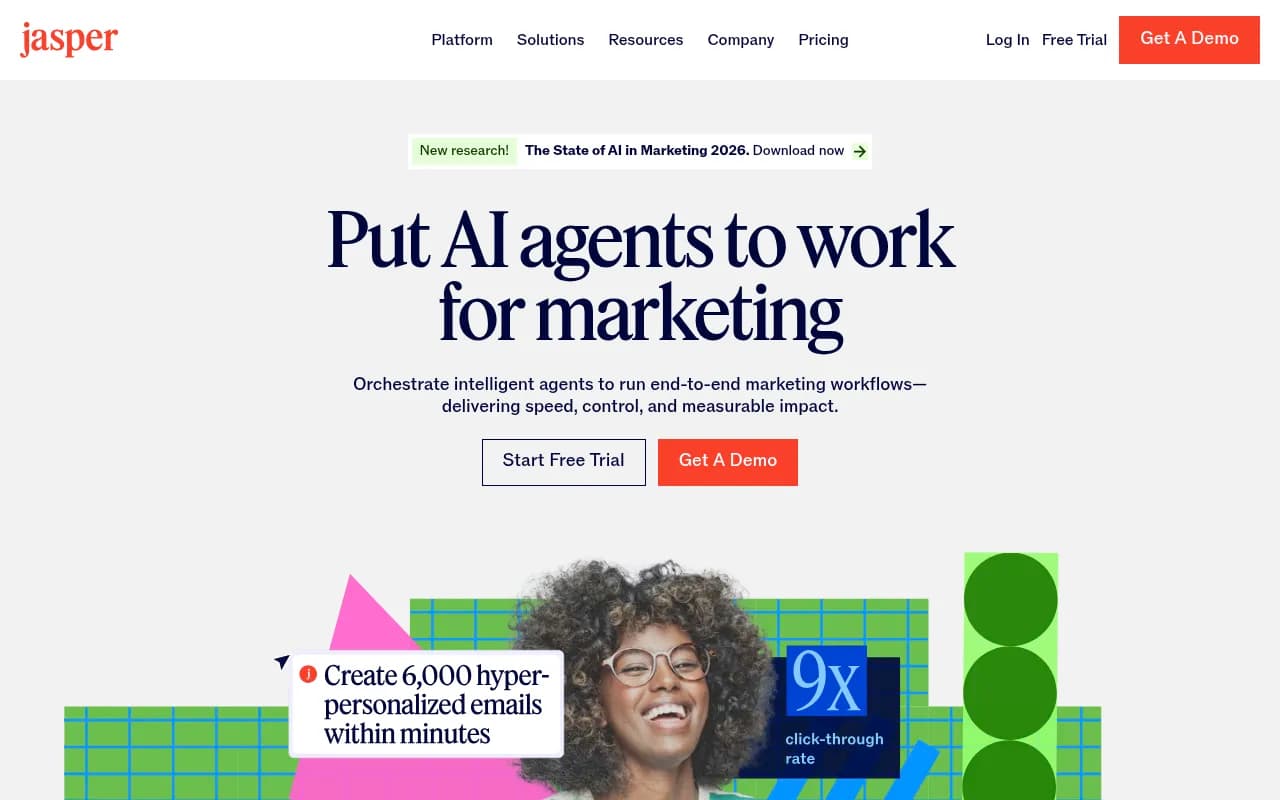
Pricing from the Jasper site lists Pro at $59/month billed yearly or $69/month billed monthly. Third-party sources disagree on how many Brand Voices Pro includes (two or three), so check the live pricing page before you plan around a number. Business is custom-priced with unlimited seats and Brand Voices, API, SSO, and admin controls.
Writer
Writer leans toward governance. Starter has a 14-day free trial and allows up to five users and one team personality profile. Enterprise adds departmental brand and voice profiles, the full Knowledge Graph, and advanced guardrails. Digital Applied's comparison describes its style-guide engine as strong but its brand-voice modeling as less deep than Jasper's, so it suits teams that care more about compliance and knowledge grounding than nuance. Writer cites a Forrester study showing 333% ROI over three years, but it was commissioned by Writer, so weigh it accordingly.
Other writers worth a look
If you already use a different AI writer, check for a voice profile or custom instructions feature before assuming you need a new tool. Copy.ai, Anyword, and Meet Sona all pitch voice-matching in some form, though I could not verify current pricing for Copy.ai.

Here is how the main options compare on voice control.
| Tool | Where the voice lives | Best for | Watch out for |
|---|---|---|---|
| Claude | Project instructions, Project Knowledge, custom Styles | Individuals and small teams who want control | You maintain the guide yourself |
| Jasper | Brand Voice profiles, Knowledge, Audiences | Marketing teams with several brands | Number of voices varies by plan |
| Writer | Personality profiles, style guide, Knowledge Graph | Enterprises that need guardrails | Voice modeling less deep, annual contracts |
| ChatGPT | A voice profile file in a Project or Custom GPT | Teams already in ChatGPT | I did not verify current limits |
A general principle from the cross-tool advice I found: put the voice profile where the model reads it before writing, such as a file in a ChatGPT Project. Same idea on every platform.
Step 8: Keep one source of truth
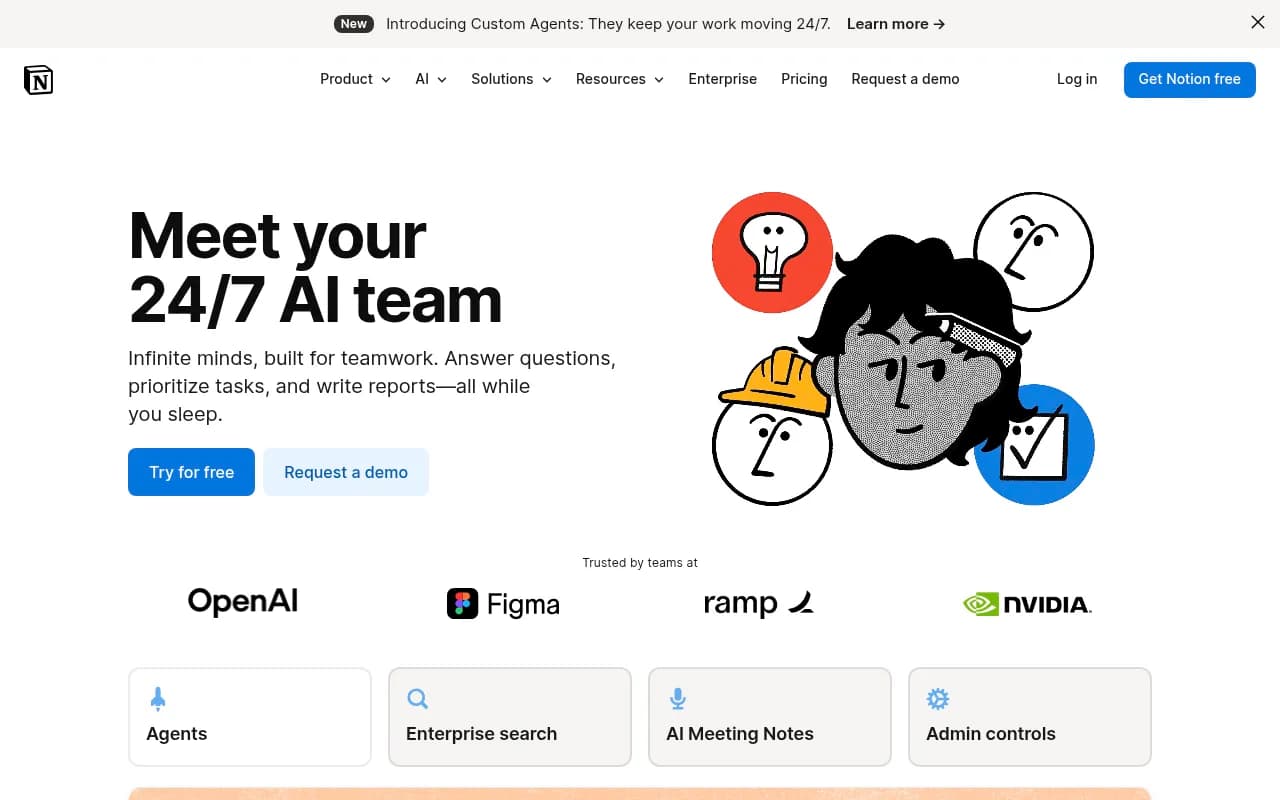
If the guide lives in six places, it will drift in six directions. Keep one master document, and treat the copies in each AI tool as deployments of it. Notion AI or a similar workspace works well as the home base, since your team and your AI can both pull from it.
Once several people and tools depend on it, give someone ownership. Version it. Note what changed and why.
Step 9: Test with a blind comparison
This is the part I find most convincing in the Digital Applied method, and the part almost nobody does.
Take a handful of AI drafts made with your guide and a handful of real pieces by your team. Strip the labels. Ask two or three people who know your brand to say which is which, and which they would publish.
If reviewers spot the AI drafts easily, the guide is not done. Look at what gave them away, then fix the rule, add a banned pattern, or add a new example. Re-run the test whenever the stakes justify it, and again after a major model update, since a new model version can change how it follows the same instructions.
A simpler ongoing check is a scorecard your editors fill in for each draft:
- Does it follow the opening rule?
- Any banned words or constructions?
- Sentence rhythm in the target band?
- Specific claims instead of vague ones?
- Would we publish this with light edits only?
Common mistakes
Writing a manifesto instead of a spec
Three pages on brand history and one line on style. Flip the ratio.
Too many rules
A 40-page guide gets partially ignored by people and models alike. Start with the 10 to 15 rules that matter most and grow from failures.
Rules without examples
The model reads "be concise" and shrugs. Show it what concise means for you.
Forgetting the guide when content is about AI search
If you are writing content meant to get cited by ChatGPT or Google AI Overviews, voice is only half of it. You also want to know which pages actually earn citations. Tools like Promptwatch can show which of your pages AI platforms cite, so you can check whether on-voice content is also being picked up.

Never revisiting it
Your product changes, your audience changes, the models change. Schedule a review every quarter.
A starter template
Here is a seven-part skeleton you can fill in this week.
- Purpose: one paragraph on who we write for and what we want the reader to do.
- Voice rules: 8 to 12 observable behaviors.
- Tone scale: a table by context.
- Vocabulary: use list, avoid list.
- Banned constructions and formatting habits.
- Examples: 3 to 5 before and after pairs per major content type.
- Review checklist: the scorecard your editors use.
Paste it into your AI tool's instructions, run five drafts, and see where it misses. The misses are your next edits.
Final thoughts
A brand voice AI can follow is one you can measure. Start from your own writing, turn adjectives into behaviors, name what to avoid, show examples, and test blind. It takes a day or two to build and a few weeks of misses to get right, and after that every draft starts closer to done.
If you want to compare more writing and content tools, the directory at surferstack.com is a good place to browse.