Key takeaways
- Agencies average roughly $3,200/month for traditional SEO (Ahrefs survey data). AI-specific retainers run from about $1,000 to $12,000+ depending on scope, and those AI figures come from vendor sources, so treat them as indicative.
- AI SEO tools cost a fraction of that, but most of them measure. They do not write, publish, fix or earn links for you.
- Most of what wins AI citations is execution: product pages, landing pages, comparisons, docs and third-party listicles. Someone has to do that work.
- The best answer for most teams is a hybrid: a tool for measurement, and either an in-house person or an agency for execution.
- Keep commitments small and reversible. Start with an audit or a monthly tool plan before signing a 12-month retainer.
The real question behind the decision
People frame this as agency versus software. I think that is the wrong split. The real split is measurement versus execution.
An AI visibility tool tells you whether ChatGPT, Perplexity or Google AI Overviews mention you, which sources they cite, and how that changes week to week. An agency (or a freelancer, or an in-house hire) does the work that changes the answer. Some newer platforms try to do both, which blurs the line, and I will get to those.
So before comparing prices, figure out which of the two you are short on. Plenty of teams already have capable writers and developers but no data. Others have data from three dashboards and nobody with time to act on it.
What SEO and AI SEO services cost in 2026
Traditional SEO benchmarks
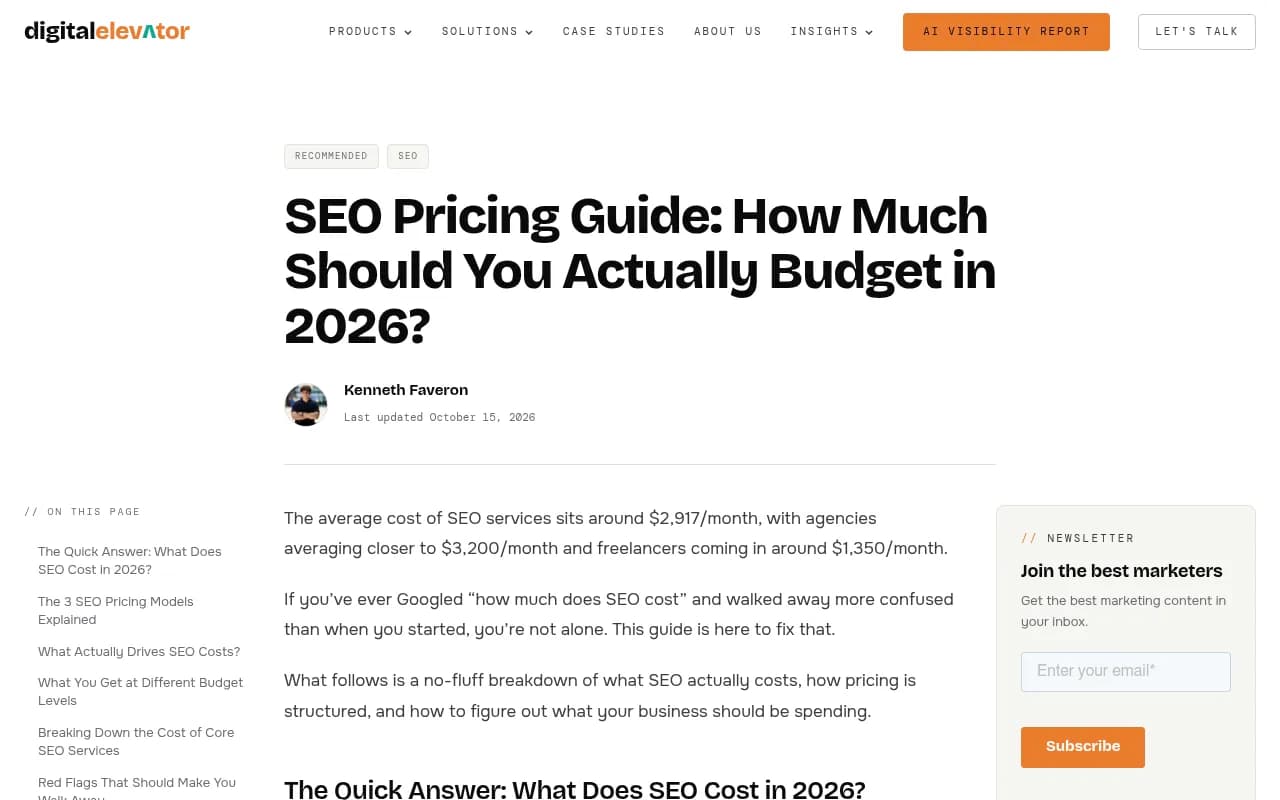
According to Ahrefs survey data, summarized in Digital Elevator's 2026 pricing guide, the average SEO spend is about $2,917/month. Agencies average roughly $3,200/month and freelancers about $1,350/month. About 63% of businesses spend between $500 and $5,000 per month.
| Pricing model | Typical range | Best for |
|---|---|---|
| Monthly retainer | $1,500 to $10,000+/mo | Ongoing growth |
| Hourly consulting | $100 to $300/hr | Strategy sessions, audits |
| Project-based | $2,500 to $30,000 | Migrations, technical overhauls |
| Local SEO | $1,000 to $3,000/mo | Single or multi-location businesses |
These numbers are not AI-specific. They are the baseline you already pay, or would pay, for ordinary SEO.
AI SEO agency pricing
Few agencies publish rates. The most detailed breakdown I found is in GEO Toolbox's buyer's guide, and a caveat applies: GEO Toolbox sells its own audit and retainer, so read its ranges as a rough guide, not a neutral benchmark.
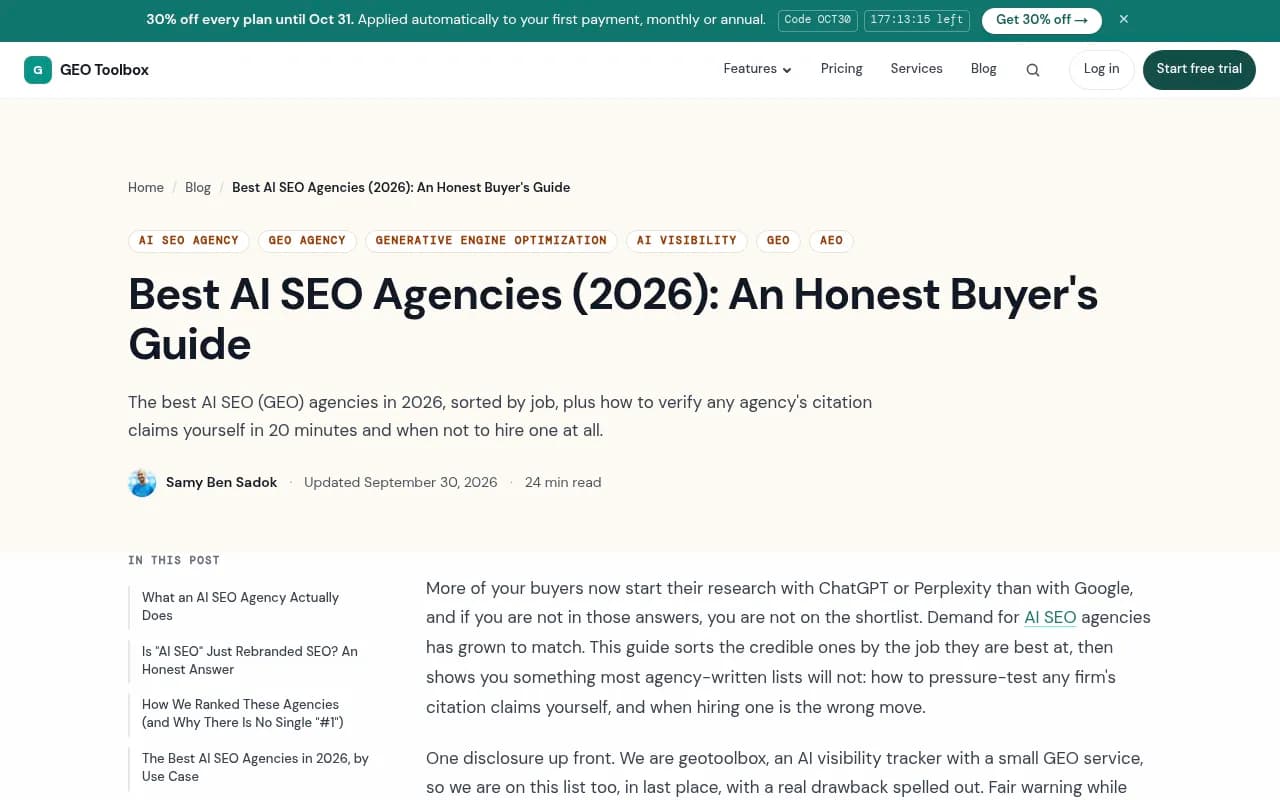
| Engagement | Typical cost | Time to results |
|---|---|---|
| One-off audit | $1,000 to $10,000 once | Days |
| Small or local | $1,000 to $5,000 | Citations in 2 to 4 weeks |
| Mid-market | $5,000 to $12,000 | Movement in 3 to 6 months |
| Enterprise | $12,000 to $50,000+ | Revenue impact in 6 to 12 months |
| Freelancer | $75 to $150/hr or $1,500 to $4,000/mo | Varies |
| In-house hire | $70,000 to $110,000/yr plus tools | Slow to hire, then ongoing |
Two more numbers worth remembering. Adding GEO to an existing SEO retainer commonly costs a 20 to 30% uplift rather than a second invoice. And anything under about $1,000/month is usually thin, automated work, a warning sign several agency guides agree on.
A quote is really a scope. Two "$5,000 a month" proposals can describe completely different amounts of work, so compare line by line: how many pages, whether new content is included, how much digital PR and off-site citation work is in scope, and how deep the technical and entity work goes.
The DIY cost people forget
Doing it yourself is not free. One local-SEO pricing guide estimates tools at $100 to $500/month, 10 to 20 hours of your time monthly, and a 6 to 12 month learning curve. Its total for fully accounted DIY lands at $1,500 to $3,000+/month. That guide is written by an agency, so it leans toward hiring, but the time cost is real. If your hour is worth $75, ten hours is $750.
What AI SEO tools cost and what they actually do
Tool pricing varies enormously and changes often, so confirm everything on the vendor's pricing page. In general the market has three tiers.
- Cheap trackers. Prompt monitoring across a handful of AI engines, usually tens of dollars to low hundreds per month. Examples in our catalog include Otterly.AI and Peec AI.
- SEO suites with AI add-ons. Semrush, Ahrefs Brand Radar, SE Ranking and similar. Convenient if you already pay for them, but the AI data is often shallower.
- Optimization platforms. These add crawler logs, traffic attribution, content generation and publishing. Pricing runs from about $100 to several hundred dollars per month at the entry levels, and enterprise plans are custom.



Overrank claims automation tools cost 50 to 90% less than agencies. That is probably true on the invoice. Whether they deliver similar results depends entirely on whether the tool executes or just reports.
Why monitoring alone does not close the gap
Look at what actually earns citations. In Promptwatch Data's analysis of which content types ChatGPT cites (Sep 28 to Oct 4, 2026), product pages took 22.4% of citations and landing pages 16.8%. Listicles got 13.6%, how-tos 8.7%, documentation 7.5% and comparisons 5.9%. For commercial prompts, product pages, landing pages, listicles and comparisons together made up almost 70% of citations.
All of that is work. You write and restructure pages, you get included in third-party best-of lists, you fix documentation. A dashboard showing a 12% visibility score does none of it.
There is also a maintenance bill. Promptwatch's content half-life report found that, among pages ChatGPT cited on July 6, 2026, news lost half its pages within 36 days, while landing pages and docs held on far longer. So part of any retainer or content workflow goes to defending citations you already have. Ask any provider to split maintenance from growth work.
Agency versus tool, side by side
| Factor | SEO or AI SEO agency | Monitoring-only tool | Optimization platform |
|---|---|---|---|
| Typical monthly cost | $1,000 to $12,000+ | Roughly $30 to $300 | Roughly $100 to $600, higher for enterprise |
| Tells you where you are visible | Yes, usually via a tool | Yes | Yes |
| Writes and publishes content | Yes | No | Often, depending on plan |
| Digital PR and link building | Yes | No | No |
| Technical fixes | Yes | No | Flags issues, you or a developer fix them |
| Your time required | 1 to 2 hours/month | 5+ hours/month | 3 to 8 hours/month |
| Lock-in | Often 6 to 12 months | Monthly | Monthly or annual |
| Risk | Vague scope, vanity reporting | Insight with no action | Generated content needs review |
When an agency is the better buy
- Your technical foundation is shaky and nobody on staff can fix it.
- You need digital PR and third-party placements. No software does outreach well on its own.
- You have no content capacity and no one to manage a tool.
- The channel is large enough that a 20 to 30% GEO uplift on an existing retainer is easy to justify.
Be skeptical, though. Business.com's take is that a competent SEO provider should already be absorbing AI search work, and that a separate AI SEO retainer is hard to justify for most small businesses. Google itself has said that for its AI surfaces the work is ordinary SEO. My read: if your current agency shrugs at AI search, push them before you hire a second one.
Red flags are the usual ones. Guaranteed positions. Under $1,000/month for "full-service". Reports full of impressions and followers but no pipeline. An agency that sends recommendations but never publishes anything.
When tools are the better buy
- You have writers, a developer or an in-house marketer with spare capacity.
- Your budget is under about $1,500/month.
- You mainly need to know where you stand and what to fix first.
- You want to verify an agency's claims instead of trusting a monthly PDF.
If you pick a tool, choose one that connects to action. Crawler logs show whether AI bots can read your pages. Page-level citation data shows what is working. Traffic attribution shows whether any of it produces visits and conversions. Promptwatch covers that stack and also includes a Content Agent that plans, writes and publishes to Webflow, Framer or WordPress. Its Essential plan starts at $95/month, with Professional at $245 and Business at $579, and agency plans start at $199 (confirm on promptwatch.com/pricing).

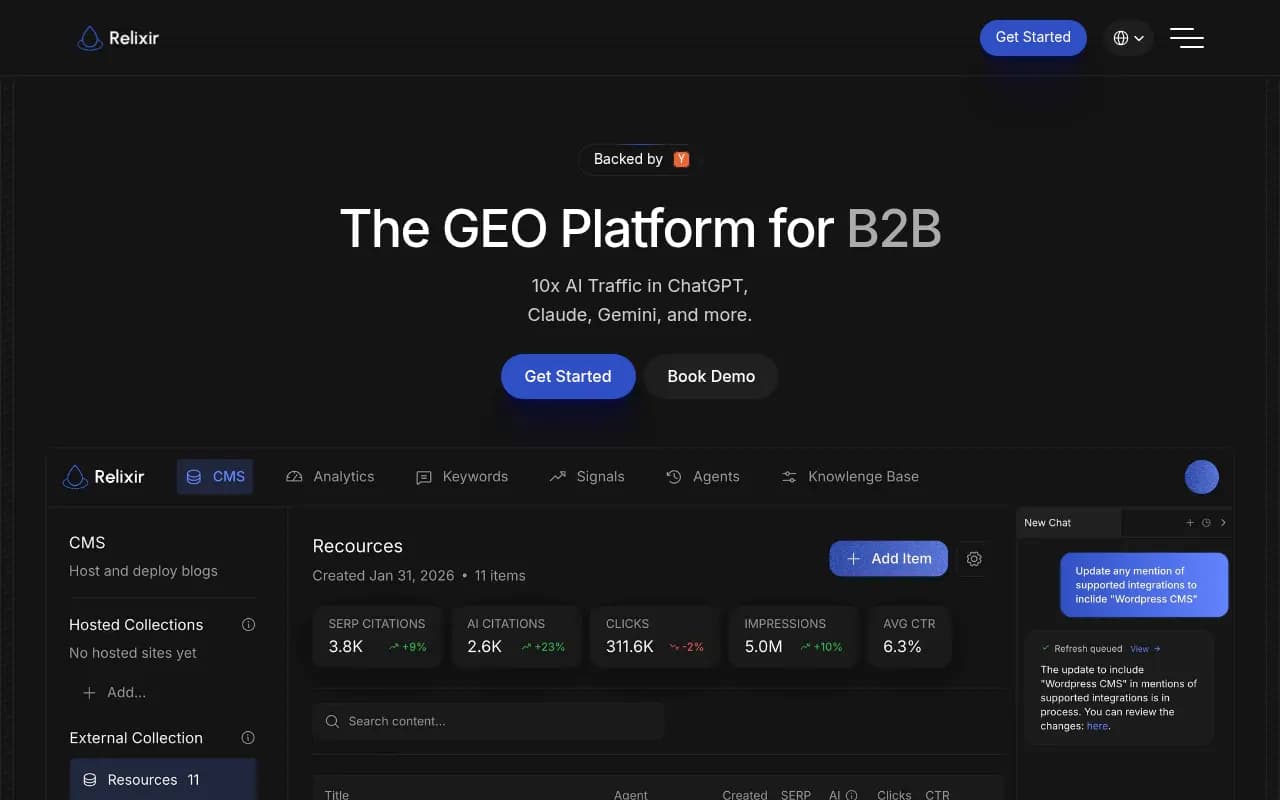
Other platforms that mix tracking with some execution include Profound, AthenaHQ, Scrunch and Relixir. Compare them on whether they publish, whether they log AI crawlers, and what they cost per response.


For a wider survey, the directory at bestgeosoftware.com lists GEO tools by category.
The hybrid model most teams should use
Here is the setup I would pick for a mid-sized B2B or ecommerce team spending $3,000 to $6,000 per month on SEO.
- Buy a tool first. Pay for one platform that tracks real AI answers, logs crawlers and ties citations to traffic. This costs hundreds, not thousands.
- Run a baseline for 30 days. Find which prompts you lose, which pages get cited, and whether AI crawlers hit errors.
- Decide what you cannot execute yourself. Usually that is digital PR, technical fixes or content volume.
- Hire narrowly. Give an agency or freelancer a scoped project against that baseline, not an open-ended retainer.
- Review at 90 days. Technical fixes can show citation pickup in weeks, but meaningful movement takes 3 to 6 months by most estimates.
This is also how 1001 SEO Media approaches client work: measurement first, then scoped execution across technical SEO, content and digital PR. It uses Promptwatch as its AI visibility platform. If you want an outside opinion on your baseline, that is the kind of audit and consulting work an agency can do in days.
Questions to ask before you sign anything
- What exactly will be published or fixed each month, in numbers?
- Which AI engines do you measure, and through real interfaces or APIs? User-facing answers can differ from API output.
- How do you separate maintenance of existing citations from new growth?
- Can I see crawler-level or traffic-level evidence, not just a visibility score?
- What is the exit clause? Prefer no long-term contracts.
- Who does the work? Senior specialists or a junior team behind a senior sales call?
On the tool side, ask whether the price includes the responses you need, whether country and language tracking is included, and whether you can export data.
A quick decision guide
| Your situation | Best starting point |
|---|---|
| Under $1,500/month budget, some in-house capacity | Optimization platform plus DIY |
| Existing SEO agency, AI search ignored | Ask for a 20 to 30% GEO scope, backed by a tool you control |
| No in-house team, $3,000+ budget | Audit first, then scoped agency work |
| Enterprise, multiple regions and teams | Platform for data plus agency or in-house team for execution |
| Local business whose buyers use Maps | Traditional local SEO first. AI is secondary |
| Agency yourself | Agency-tier tool plan with white-label reporting |
Bottom line
Software is cheaper, but only if someone on your side executes. Agencies cost more, but you buy the execution along with the advice. Neither is automatically better.
My recommendation: spend the first month and a few hundred dollars on measurement, then buy human help for the specific gaps the data exposes. You will negotiate better and you will know whether the work moved anything. For ongoing data on what AI engines cite, the Promptwatch Data hub publishes free reports you can use as benchmarks.