Key takeaways
- There is no universal answer. The right call depends on your technical foundation, your budget, how much AI-driven demand your category has, and whether leadership will back content for more than a quarter.
- In-house works best for evergreen assets and ongoing maintenance. Agencies work best for specialist gaps, speed, and off-site work like digital PR.
- Promptwatch Data shows product and landing pages earn 39% of ChatGPT citations, and those pages are usually owned by in-house teams, not agencies.
- Most teams end up with a hybrid: a small in-house core, tools for tracking and drafting, and an agency or specialist for the one channel holding growth back.
- Measure first. Baseline your AI visibility and crawler access before signing a retainer or hiring anyone.
The real question behind the question
People frame this as agency versus in-house. It is really three decisions stacked together: who owns strategy, who produces the content, and who fixes the technical and off-site layers that content depends on.
A third option has also become normal in 2026. AI writing and optimization tools let a two-person team publish what used to take six. That changes the math, but it does not remove the need for judgment. Scaled AI output with no editorial control is how you get lots of pages and no traffic.
One caveat before we go further. I have not verified current agency retainer pricing across the market or Google's latest stance on scaled AI content, so treat any dollar figures below as ranges to confirm with quotes, not benchmarks. The one hard number from our research is that in-house SEO hires run roughly $70,000 to $110,000 a year plus tools, per GEO Toolbox's buyer's guide.
What each model actually buys you
| Model | Typical cost | What you get | Main weakness |
|---|---|---|---|
| Full-service SEO or GEO agency | Monthly retainer, quote-based | Specialists, process, off-site work, speed | Less product knowledge, dependency, reporting that can drift from revenue |
| In-house hire | $70K-$110K/yr per head plus tools | Control, brand knowledge, daily focus | Slow to hire, narrow skill set per person |
| In-house with AI content tools | Salary plus tool subscriptions | High volume, fast iteration | Quality drift, thin or generic pages |
| Consultant or fractional lead | Hourly or project based | Strategy without a full retainer | You still need people to execute |
| Hybrid | Mix of the above | Core team plus a specialist | Needs clear ownership to avoid overlap |
The Optimist team makes a similar point in their agency vs in-house vs consultant breakdown: agencies sell scope and hours, consultants sell strategy. Know which one you are short of.
What AI search changes about the decision
Two years ago, the debate was mostly about Google rankings. Now you also need to show up inside ChatGPT, Gemini, Perplexity and AI Overviews. That shifts which content matters.
Promptwatch's data on which content types ChatGPT cites (Sep 28 to Oct 4, 2026) is worth reading before you plan any content budget:
- Product pages are the most cited type at 22.4% of classified citations, with landing pages next at 16.8%. Together that is 39% going to pages describing what a company sells.
- Editorial formats add up to 43%: listicles 13.6%, how-tos 8.7%, general articles 6.1%, comparisons 5.9%, news 5.7%, reviews 1.7%.
- For commercial prompts like "best CRM for small businesses", product pages hit 26.0%, landing pages 20.6%, listicles 15.0% and comparisons 7.9%.
The takeaway is a bit uncomfortable for content-heavy plans. Your blog is not the main citation surface. Your product and landing pages are. Nobody knows your product, pricing and positioning better than the people who work for you, which is a point for in-house.
Content decay favors maintenance
Promptwatch also tracked every page ChatGPT cited on July 6, 2026 for 90 days in its content half-life report:
- After 30 days, ChatGPT still cited 78% of landing pages and 76% of docs. After 60 days, 69% and 67%.
- Comparisons held at 72% after 30 days and 63% after 60.
- Product pages, reviews and how-tos reach half-life after roughly 74 to 77 days.
- News decays fastest. Half of cited news pages are gone after 36 days.
That has a direct implication. High-volume, news-style content is short-lived, so a pure volume play burns money. Evergreen assets keep earning, but only if prices, specs and availability stay accurate. Ongoing upkeep like that is cheap for an internal team and expensive on an hourly retainer.
When hiring an agency makes sense
An agency is the right call in a handful of fairly specific situations.
- You have a skill gap you cannot hire for quickly. Technical SEO for a large site, digital PR, or GEO strategy are all hard to recruit.
- You need off-site work. Getting your brand named on third-party pages that AI systems cite is outreach-heavy and hard to do with one marketer.
- You want speed. A mature agency has process, templates and relationships on day one.
- Leadership treats search as a core growth channel and will fund it over the medium term. Minuttia's own fit guide puts it bluntly: agencies do their best work when leadership sees content as core, not as a box to tick.
- You already have an SEO program and want AI search layered on with real attribution.
If you are evaluating agencies, ask hard questions. OGTool's line is worth borrowing: the best agency publishes content and proves outcomes, not just sends reports and recommendations. Ask whether they work with your developers and existing team, how they measure success, and whether they tie visibility to revenue. Also look at industry fit. Specialists need less ramp-up time on your audience and terminology.
Agencies that cover both classic SEO and generative engine optimization are worth a look if you need the whole stack. 1001 SEO Media, for example, combines technical SEO, content, digital PR and GEO, with no long-term contracts and monthly reporting. The same buyer checks apply to them as to anyone else: ask what success looks like and how it is measured.
For a wider shortlist, see the Minuttia and GEO Toolbox roundups:
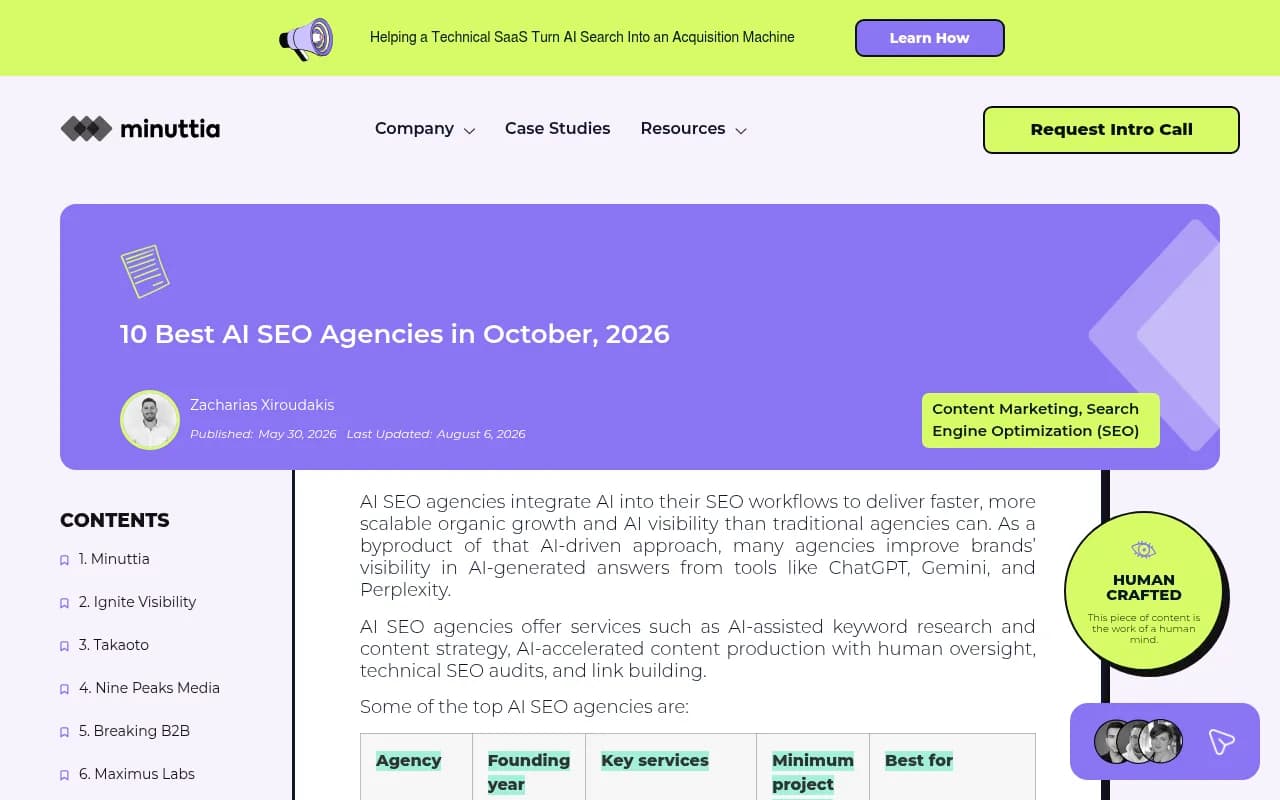
Roundups like these are written by agencies that appear on their own lists, so use them for criteria, not rankings.
When you should not hire one
GEO Toolbox has a section most agency lists skip: when not to hire. I agree with most of it.
- Your buyers are on Google Maps, not ChatGPT. For local businesses, spend on local SEO first.
- Your site is not crawlable. Paying for off-site citation building while AI crawlers cannot reach your pages is buying the roof before the walls. That is often in-house or developer work.
- Your category has no AI demand yet. If no engine returns brands like yours, there is little to optimize toward.
- You can run the basics yourself. If your team can freeze a prompt set, fix schema and write clear answer-first pages, you may only need a tracker.
- You need everything. If organic, paid, social and PR are all gaps, a GEO-only boutique is the wrong shape.
An agency that tells you that you are not ready is one worth remembering.
When scaling in-house makes sense
Building internally is the better move when:
- Your product is complex and accuracy matters. Wrong specs or pricing in a page AI keeps citing is a real cost.
- You have steady content needs, not a burst. Salaried people are cheaper than retainers over a long horizon.
- You want institutional knowledge to compound. Brand voice, customer language and proprietary data stay inside the company.
- Your technical foundation is the bottleneck. Fixing crawler access, schema and site health is internal engineering work.
The risk is the hiring gap. A strong SEO lead takes months to find, and one person cannot be a technical expert, a writer, a PR contact and an analyst.
Where AI content tools fit
AI writing tools are what make a small in-house team viable. The trick is using them for drafting and optimization, with humans owning facts, angle and review.
Tools in this space split into a few groups:
- Content optimization and briefs, like Surfer SEO, Clearscope and Frase.
- AI writers and automated publishers, like Byword, Jasper and Scalenut.
- Platforms that tie content to AI citation data, such as AirOps and Promptwatch.
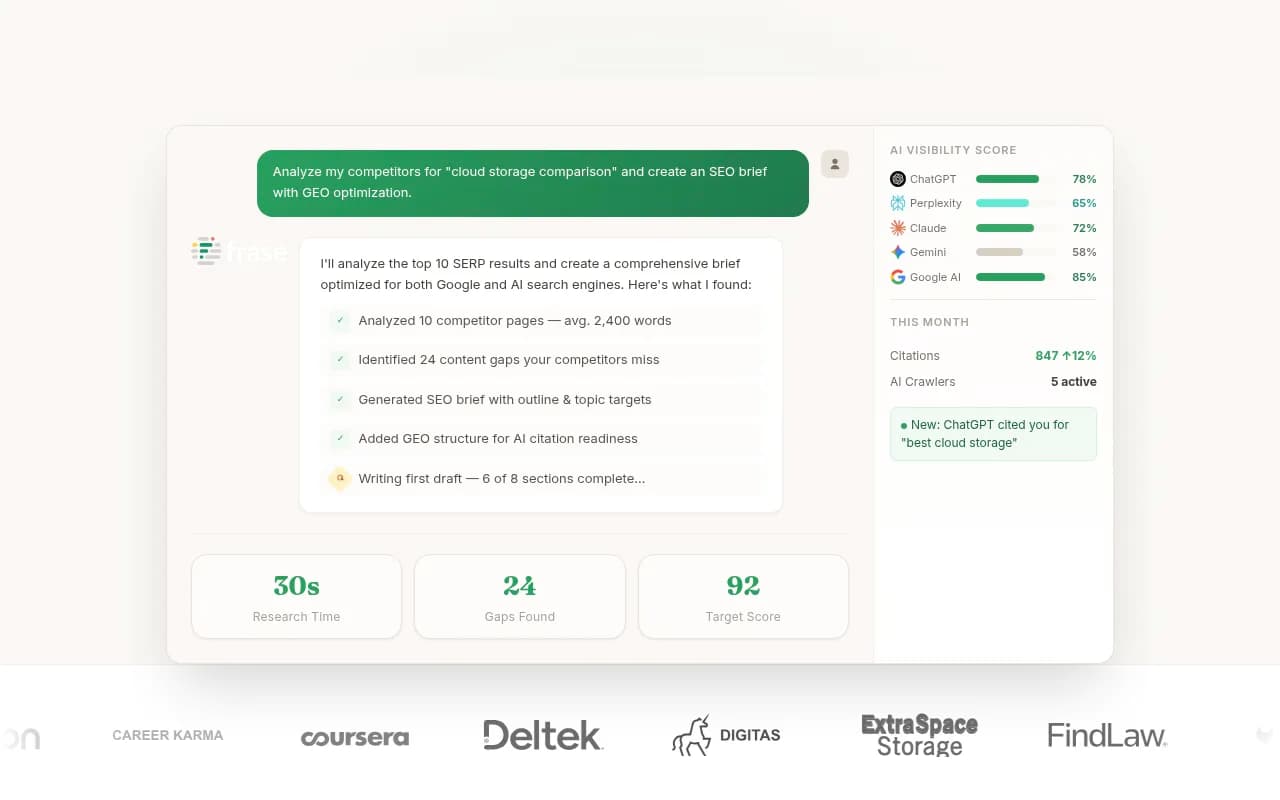
Optimization and writing tools without visibility data guess at what to write. Visibility tools without content help tell you the problem and leave the fix to you. If you are going in-house, you want both halves. Promptwatch is one option that does both: it tracks prompts across ChatGPT, AI Overviews, Gemini, Perplexity and others, shows content gaps, and its Content Agent writes and publishes against them to Webflow, Framer or WordPress. It also logs AI crawler visits, which helps with the "can AI even read our site" question before you spend anything else.

If you want to compare more trackers and GEO platforms before choosing, the GEO software directory at bestgeosoftware.com lists a lot of them.
The risk with scaled AI content
I would be cautious about any plan that says "publish 30 AI articles a month" with no human in the loop. I did not verify Google's current spam policy language for this guide, so check it directly. But the logic from the citation data is already clear: AI engines pull from pages that describe real products, real comparisons and real documentation. Generic volume content is the least durable category, going by the half-life numbers above.
A sensible guardrail for in-house AI content:
- Start from a gap, not a keyword list. Pick prompts where competitors are cited and you are not.
- Put your own data, pricing and product detail in every page.
- Have a subject-matter owner review every draft.
- Refresh evergreen pages on a schedule instead of publishing endless new ones.
- Track whether each page gets crawled, cited and clicked, and cut what does not.
A decision framework
| Your situation | Likely best fit |
|---|---|
| Early stage, small budget, no AI demand in your niche | Founder or one generalist plus basic tools |
| Technical problems on a large site | Specialist agency or consultant, plus your developers |
| Steady content needs, complex product | In-house team with AI drafting tools |
| Strong SEO team, new AI search gap | Tracking platform plus a GEO specialist for strategy |
| Need SEO, paid, social and PR together | Integrated agency |
| Local business | Local SEO first, agency or freelancer, AI later |
| Enterprise with many markets | Hybrid: internal owners, agency for scale and PR |
Five questions to settle it
- Can AI crawlers read your site today? If you do not know, find out first. Crawler logs or a site audit will tell you.
- Do your buyers use AI to research your category? Test a few real prompts.
- Who will own this in 12 months? If the answer is nobody, an agency will not fix that.
- What does success mean in revenue terms? Insist that any vendor reports against that, not just mentions.
- Can you commit for at least six months? Both routes need time.
A practical way to start
Do not choose yet. Spend two to four weeks on a baseline.
- Freeze a set of 30 to 50 prompts that reflect real buyer questions.
- Record where you appear, where competitors appear, and which pages get cited.
- Check crawler access and site health.
- Map your gaps to content types: product pages, comparisons, how-tos, reviews.
- Estimate what you could fix internally in a quarter.
Whatever is left over after that exercise is your agency brief. It will be specific, you will be able to judge proposals against it, and you will pay for gaps instead of for everything. For more on how AI engines pick sources, browse the research hub at Promptwatch Data.
Bottom line
If your site is technically sound, your product is complex and you can fund a couple of strong hires with the right tools, build in-house and keep the product and landing pages close to home. If you have a skill gap, need off-site authority or want speed, hire a specialist for that gap rather than a generalist for everything. Most teams in 2026 land in the middle, and that is fine.