Frase Review 2026
Frase is an agentic SEO and GEO platform that researches your market, creates optimized content, and tracks your visibility across Google, ChatGPT, Perplexity, and other AI search engines. Used by thousands of content teams at companies like Microsoft, GitLab, and ActiveCampaign, it combines competi
Summary
- Strong dual optimization: One of the few platforms that optimizes content for both traditional SEO and GEO (AI search engines) in a single editor with real-time scoring for both
- Monitoring-only AI tracking: Lacks content generation, AI crawler logs, and traffic attribution that Promptwatch offers -- shows you where you stand in AI search but doesn't help you fix gaps or create optimized content
- Best for content teams: Ideal for marketing teams producing 10-50 articles/month who want competitive research, AI writing assistance, and basic AI visibility tracking in one tool
- Pricing starts low: $39/mo entry point makes it accessible for small teams, though AI tracking is limited to 2 platforms on the Starter plan
- Workflow consolidation: Replaces multiple tools (SEMrush research + Jasper writing + Surfer optimization) with one platform, though some specialists may prefer best-of-breed tools

Frase positions itself as an "agentic SEO & GEO platform" -- a content operations tool that handles research, writing, optimization, and visibility tracking across both Google and AI search engines like ChatGPT and Perplexity. Founded as an SEO content optimization tool, Frase has evolved into a broader platform that now includes AI search visibility tracking alongside its core content creation features. The company serves thousands of content and marketing teams at brands including Microsoft, GitLab, ActiveCampaign, and Oracle.
The platform's core pitch is workflow consolidation. Instead of juggling SEMrush for research, Jasper for writing, Surfer for optimization, and separate tools for AI tracking, Frase bundles all these capabilities into one workspace. The AI Agent feature brings 80+ specialized skills that handle everything from competitive analysis to content atomization (turning one blog post into social media assets). For teams drowning in tool sprawl and context switching, this consolidation is the main selling point.
SERP Research and Competitive Analysis
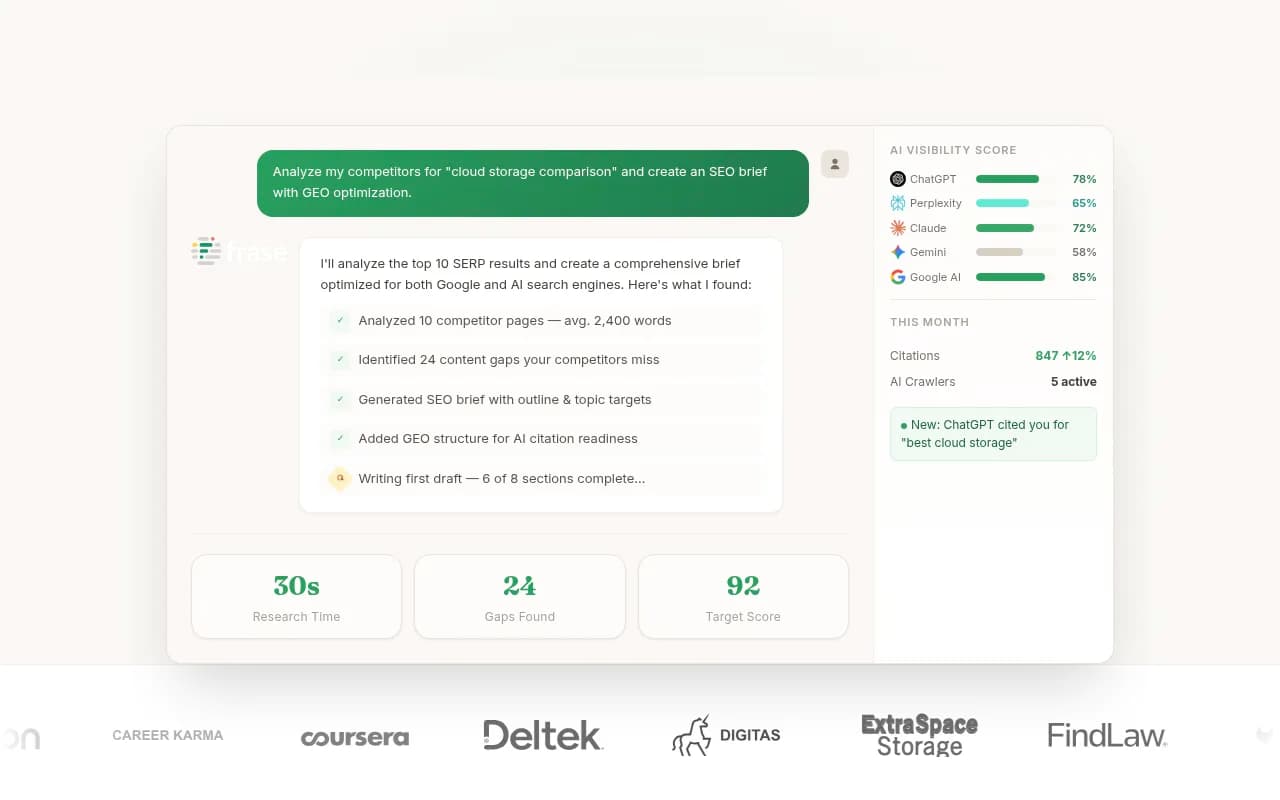
Frase's research engine analyzes the top 10 Google results for your target keyword in about 30 seconds. It extracts topics, questions, headings, and patterns from competitor content, then generates a content brief with an outline that fills the gaps. The system shows you which topics appear most frequently across top-ranking pages, which questions competitors answer, and what you're missing. This is standard SERP analysis, similar to what Surfer SEO, Clearscope, and MarketMuse offer, but Frase's interface makes it fast to scan and act on the data.
The research view displays competitor word counts, topic coverage, and heading structures side by side. You can see that the #1 result covers 22 topics while #3 only covers 15, giving you a clear target for comprehensiveness. The tool identifies content gaps -- topics that some competitors mention but others miss -- and flags them as opportunities. This gap analysis is useful for finding angles that differentiate your content from the pack.
One limitation: Frase's research is keyword-focused and SERP-dependent. It doesn't surface broader topic clusters or semantic relationships the way MarketMuse does with its content inventory analysis. You're optimizing for one keyword at a time rather than building topical authority across a content cluster. The platform does offer a Content Clusters feature for mapping pillar pages and supporting content, but it's a separate workflow from the core research tool.
AI Writing and Content Generation
Frase includes an AI writing assistant that drafts content based on your research brief. You can generate full articles, individual sections, or specific content types like introductions, FAQs, and listicles. The AI pulls from the competitive research data, so the output is grounded in what's already ranking rather than generic filler. You set the tone, target length, and key points, then review and edit the draft.
The writing quality is solid but not exceptional. It produces serviceable first drafts that need human editing to add personality, specific examples, and original insights. This is typical of most AI writing tools in 2026 -- they handle structure and basic information well but struggle with nuance and voice. Frase's advantage is that the AI knows what topics and questions to cover because it's working from the SERP analysis, so you're less likely to miss important points.
The real-time optimization scoring is where Frase shines during the writing process. As you draft (or as the AI generates content), a content score climbs from 40 to 90+ based on how well you're covering target topics, using relevant keywords, and matching competitor depth. The editor highlights missing topics in the sidebar and suggests where to add them. This live feedback loop helps you hit optimization targets without constantly switching between tools.
SEO and GEO Optimization Scoring
Frase provides separate scores for SEO (traditional Google ranking factors) and GEO (AI search engine optimization). The SEO score tracks keyword usage, topic coverage, content length, and readability against top-ranking competitors. The GEO score evaluates structure, citations, formatting, and other signals that make content more likely to be cited by ChatGPT, Perplexity, and Claude.
This dual scoring is Frase's main differentiator in 2026. Most SEO tools still focus exclusively on Google, while dedicated GEO platforms like Promptwatch, Otterly.AI, and Peec.ai focus only on AI search. Frase attempts to bridge both worlds in one editor. You can see at a glance whether your content is optimized for traditional search, AI search, or both.
The GEO scoring is less sophisticated than what dedicated platforms offer. Frase checks for basic structural elements (clear headings, bullet points, citations) and formatting patterns that AI models prefer, but it doesn't provide the depth of analysis you'd get from Promptwatch's Answer Gap Analysis or citation tracking. You won't see which specific prompts your content should target, how competitors are being cited, or what content gaps are preventing AI visibility. Frase tells you if your content is "GEO-ready" but not why it's missing citations or how to fix specific gaps.
AI Search Visibility Tracking
Frase tracks your brand's appearance across 8 AI platforms: ChatGPT, Perplexity, Claude, Gemini, and others. The dashboard shows share of voice (how often you're mentioned vs competitors), appearance rate (percentage of relevant queries where you show up), authority rate (how often you're cited as a primary source), and momentum (visibility trends over time).
This is monitoring-only functionality. Frase shows you where you stand but doesn't help you improve. You can see that your appearance rate dropped from 40% to 28% last month, but the platform doesn't tell you which prompts you lost visibility for, what content gaps caused the drop, or how to create content that gets cited. Competitors like Promptwatch provide Answer Gap Analysis that shows exactly which prompts competitors rank for but you don't, then help you generate content to fill those gaps. Frase's AI tracking is a dashboard, not an optimization tool.
The tracking is also limited by plan tier. The Starter plan ($39/mo) tracks only 2 AI platforms. You need the Professional plan ($103/mo annual) to track all 8 platforms and get historical data beyond 30 days. For serious AI visibility work, this means you're effectively locked into the higher-tier plans.
Content Opportunities and Site Audits
Frase's Content Opportunities feature scans your existing content and surfaces prioritized recommendations: pages declining in rankings ("Fix"), pages with quick-win potential ("Boost"), and content gaps where competitors rank but you don't ("Fill"). Each opportunity includes estimated traffic impact, so you can prioritize based on potential ROI.
This is useful for ongoing content maintenance. Instead of manually tracking rankings and guessing which pages need attention, Frase flags the high-impact moves. The "Fix" recommendations catch declining pages before they tank completely. The "Fill" recommendations identify keyword gaps where you're missing content that competitors have.
The traffic estimates are directional, not precise. Frase uses search volume and current rankings to project potential traffic, but actual results depend on dozens of factors the tool can't account for. Treat the numbers as prioritization signals rather than guarantees.
Content Atomization and Repurposing
Frase can turn one blog post into multiple formats: LinkedIn carousels, Twitter threads, newsletters, Instagram posts, and more. You write the long-form content once, then let Frase generate social assets automatically. This saves 4+ hours per piece according to Frase's own estimates, though the quality of the repurposed content varies.
The social media outputs are decent starting points but need editing. A Twitter thread generated from a 2,000-word article will hit the main points but often lacks the punchy, conversational tone that performs well on Twitter. The LinkedIn carousels are better -- they pull key stats and quotes into a visual format that works well for that platform. You're still doing manual cleanup, but you're starting from 70% done instead of 0%.
This feature is most valuable for teams that already produce long-form content and want to maximize distribution without hiring a dedicated social media manager. If you're a solo creator or small team, the time savings are real. Larger teams with dedicated social staff may find the outputs too generic and prefer to create platform-specific content from scratch.
Programmatic SEO and Bulk Content Generation
Frase supports programmatic SEO workflows where you generate hundreds or thousands of pages from structured data. Use cases include location pages ("plumber in [city]"), product comparisons ("[product A] vs [product B]"), and directory listings. You create a template once, feed in your data (CSV or API), and Frase generates all the pages.
This is an enterprise feature that most small teams won't use, but it's powerful for companies with large product catalogs or multi-location businesses. Teams have built 10,000+ pages in a single workflow using Frase's programmatic tools. The quality depends entirely on your template and data -- garbage in, garbage out -- but the automation itself works smoothly.
One caveat: programmatic SEO is increasingly risky in 2026. Google's helpful content updates have targeted thin, templated pages, and AI search engines ignore low-value programmatic content entirely. If you're generating thousands of pages, make sure each one provides unique value beyond just swapping in city names or product specs. Frase gives you the tools to scale, but it won't save you from creating spam.
Brand Governance and Voice Consistency
Frase includes brand governance features that enforce terminology, tone, and style across all AI-generated content. You upload brand voice profiles, reference documents, and terminology guides, and Frase applies them automatically to every piece of content the AI creates. This ensures your 20th article sounds as on-brand as your first without manual review.
This is critical for agencies and enterprise teams managing multiple brands or clients. Without governance, AI-generated content drifts toward generic corporate speak. With governance, you can maintain distinct voices for different brands while still using the same platform. Frase's implementation is straightforward -- upload your guidelines once, and they apply everywhere.
The governance features are available at all price tiers, which is unusual. Most platforms reserve advanced brand controls for enterprise plans. Frase includes them even on the $39/mo Starter plan, making it accessible for small agencies and in-house teams.
Integrations and Publishing
Frase integrates with WordPress, allowing you to publish directly from the editor. You can also export to Google Docs, Webflow, and other platforms. The WordPress integration is one-click -- write in Frase, hit publish, and the content appears on your site with proper formatting, images, and meta tags.
The platform includes an API for custom integrations and workflows. Developer documentation is available, though not as extensive as what you'd get from dedicated API-first platforms. Most teams use the built-in integrations rather than building custom connections.
One notable gap: Frase doesn't integrate with Google Search Console for traffic attribution or performance tracking. You can see rankings and opportunities within Frase, but you can't connect actual traffic and conversion data to measure content ROI. Promptwatch offers GSC integration and server log analysis to close this loop. Frase keeps content creation and performance measurement separate.
Who Should Use Frase
Frase is best for content and marketing teams producing 10-50 articles per month who want to consolidate research, writing, and optimization into one platform. Ideal users include:
- In-house content teams at SaaS companies managing a blog, knowledge base, and resource center. You need consistent output, SEO optimization, and basic AI visibility tracking without juggling five tools.
- Digital marketing agencies managing 5-15 clients who need to produce competitive content quickly. The brand governance features let you maintain distinct voices for each client while using the same workflow.
- Solo content creators and freelancers who want professional-grade SEO tools without enterprise pricing. The $39/mo Starter plan gives you research, writing, and optimization capabilities that used to require $200+/mo in separate subscriptions.
- SEO teams at mid-market companies (50-500 employees) who need to scale content production without hiring more writers. Frase helps junior writers produce expert-level SEO content by guiding them through research and optimization.
Frase is less suitable for:
- Enterprise SEO teams managing 1,000+ pages who need advanced technical SEO, content inventory analysis, and custom reporting. MarketMuse or Conductor are better fits for this scale and complexity.
- Teams focused primarily on AI search visibility who need deep GEO optimization, citation tracking, and content gap analysis. Promptwatch provides Answer Gap Analysis, AI crawler logs, and traffic attribution that Frase lacks.
- Writers who prefer best-of-breed tools and don't mind managing multiple subscriptions. Frase's writing quality is good but not as strong as dedicated tools like Jasper or Copy.ai. Its SEO analysis is solid but not as deep as Clearscope or MarketMuse.
Pricing and Plans
Frase offers four plans:
- Starter: $39/mo (annual) or $49/mo (monthly). 1 seat, 10 articles/month, 2 AI platforms tracked, basic features.
- Professional: $103/mo (annual) or $129/mo (monthly). 3 seats, 30 articles/month, 8 AI platforms tracked, content clusters, programmatic SEO.
- Team: $206/mo (annual) or $259/mo (monthly). Unlimited seats, 100 articles/month, all features, priority support.
- Enterprise: Custom pricing. Unlimited everything, dedicated account manager, custom integrations, SLA.
All plans include the full AI Agent, SERP research, content optimization, AI visibility tracking, and publishing tools. The main differences are article limits, number of AI platforms tracked, and advanced features like programmatic SEO.
The pricing is competitive for what you get. Comparable tools cost more: Clearscope starts at $170/mo, MarketMuse at $149/mo (with limited features), and Surfer SEO at $89/mo. Frase's $39/mo entry point makes it accessible for small teams and freelancers, though serious users will likely need the Professional plan at $103/mo to unlock full AI tracking and advanced features.
One gotcha: article limits are strict. If you hit your monthly limit, you can't create new documents until the next billing cycle or you upgrade. For teams with unpredictable content volume, this can be frustrating. Competitors like Surfer SEO charge per article on-demand rather than imposing monthly caps.
Frase offers a 7-day free trial with no credit card required. You get full access to all features during the trial, so you can test the research tools, AI writing, optimization scoring, and AI tracking before committing.
Strengths and Limitations
Strengths:
- Dual SEO and GEO optimization in one editor with real-time scoring for both traditional and AI search
- Fast SERP research that identifies content gaps and generates actionable briefs in 30 seconds
- Workflow consolidation replaces 3-5 separate tools (research, writing, optimization, tracking) with one platform
- Brand governance features available at all price tiers, not just enterprise plans
- Accessible pricing starting at $39/mo makes professional SEO tools available to small teams and freelancers
Limitations:
- AI visibility tracking is monitoring-only -- shows you where you stand but doesn't help you fix gaps or create optimized content. Lacks Answer Gap Analysis, AI crawler logs, prompt volume data, and traffic attribution that Promptwatch provides.
- No Google Search Console integration means you can't connect content performance to actual traffic and conversions. Content creation and measurement are separate workflows.
- Article limits per plan can be restrictive for teams with variable content volume. You're locked out if you hit your monthly cap.
- GEO optimization is surface-level -- checks for basic structural elements but doesn't provide the depth of citation tracking, query fan-outs, or Reddit/YouTube insights that dedicated GEO platforms offer.
- SERP research is keyword-focused and doesn't build broader topical authority the way MarketMuse's content inventory analysis does.
- AI writing quality is serviceable but not exceptional -- produces first drafts that need significant human editing for voice and originality.
Bottom Line
Frase is a solid all-in-one platform for content teams who want to consolidate SEO research, AI writing, and basic optimization into one workspace. The dual SEO/GEO scoring is useful for teams that care about both traditional and AI search visibility, and the $39/mo entry point makes it accessible for small teams and freelancers. The workflow consolidation is real -- you can replace SEMrush + Jasper + Surfer with one tool and one login.
But the AI visibility tracking is shallow. Frase shows you where you stand in ChatGPT and Perplexity but doesn't help you improve. If AI search visibility is a priority, Promptwatch provides the Answer Gap Analysis, content generation, AI crawler logs, and traffic attribution you need to actually optimize for AI citations. Frase is a content creation tool with AI tracking bolted on. Promptwatch is an AI visibility platform that helps you create content specifically to get cited.
Best use case in one sentence: In-house content teams at SaaS companies producing 10-50 articles/month who want competitive research, AI writing assistance, and basic AI visibility tracking in one affordable platform.
Frequently asked questions
What is Frase and what does it do?
How much does Frase cost?
Does Frase offer a free plan?
Who is Frase best for?
What is the difference between SEO and GEO in Frase?
What tools does Frase replace?
How many articles can I create with Frase per month?
Does Frase track AI search engine visibility?
Similar and alternative tools to Frase