OpenLens Review 2026
Multi-tenant AI visibility platform tracking brand mentions across ChatGPT, Claude, Gemini and Perplexity, with per-client workspaces for agencies.
Key takeaways
- OpenLens is an agency-first AI visibility tracker covering seven platforms (ChatGPT, Claude, Gemini, Google AI, Perplexity, Grok, DeepSeek), with a real free plan and paid tiers from $39.99/mo.
- Free, unlimited read-only client logins are the standout feature for agencies that need to show clients live dashboards without paying per viewer.
- It is mostly a measurement tool with fix recommendations. Compared with Promptwatch, it lacks IP-verified AI crawler logs, a Content Agent with CMS publishing, prompt volumes and difficulty scoring, Reddit/YouTube/LinkedIn citation tracking, and AI Shopping and Ads Radar.
- The credit system is the catch: Claude costs 100 credits per output and Grok 50, versus 1 for most platforms, and both are locked to the $299.99/mo Agency plan.
- Best for small and mid-size agencies that want cheap multi-client monitoring. Weak fit for teams that want automated content production and traffic attribution.
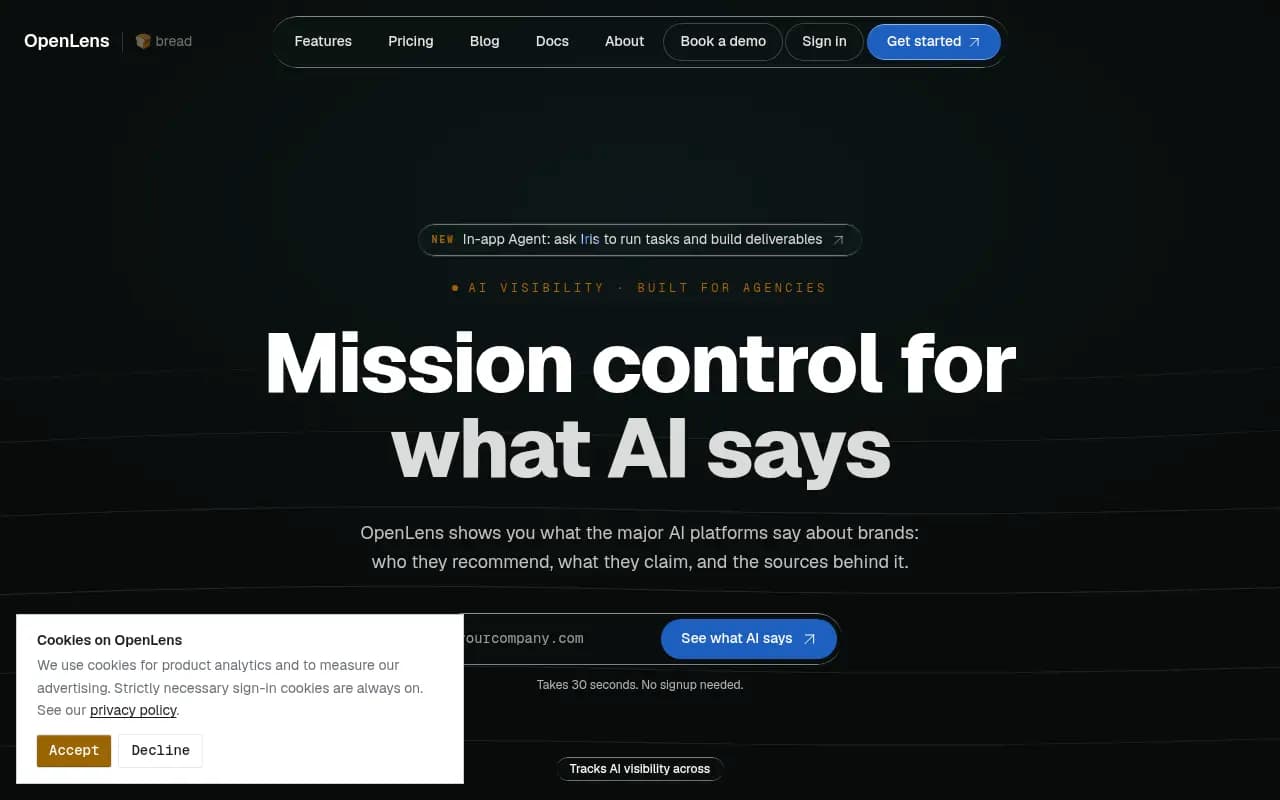
OpenLens is an AI visibility platform built by Bread Technologies. It sends the questions your customers ask to up to seven AI platforms, parses each answer for mentions, position, sentiment and cited sources, and rolls everything into a dashboard per brand. The homepage calls it "mission control for what AI says," and the pitch is aimed squarely at agencies managing a roster of clients rather than a single in-house brand.
The product launched with a free plan and a press release on Barchart, and it has been shipping fast. The changelog shows four releases between August and October 2026 (v1.8.0 to v1.8.3), including a rebuilt Site Readiness workspace, guided onboarding and an in-app agent called Iris. The GitHub repository linked from the project is only a feedback and issue tracker, not source code, so this is not an open-source tool. And no, it has nothing to do with the Kubernetes IDE of the same name.
The interesting bet is price and structure. Most competitors in this space charge a premium and gate multi-client features. OpenLens gives you a free tier with three projects, then charges per editor seat while leaving viewers free.
Key features
Seven-platform tracking. OpenLens monitors ChatGPT, Claude, Gemini, Google AI, Perplexity, Grok and DeepSeek from one view. You enter a domain and its competitors, and the setup flow builds the brand and topic structure for you. Since v1.8.2, setup researches the whole market to suggest competitors, so niche brands now get useful suggestions instead of an empty list. Analysis takes about 15 seconds. You can review prompts before the first run, and bulk prompt imports are supported.
Per-topic drill-downs. Each topic page shows visibility, position by platform, competitor share and the raw responses. Reading raw answers matters more than people admit, because a visibility score alone hides whether the AI is describing the brand accurately. Brand matching now handles more languages, and duplicate mentions and citations get consolidated.
Competitive comparison. Share of voice, mention position and sentiment by attribute are broken down per platform, side by side with every competitor. The attribute view (what the AI associates with each brand) is a nice touch for positioning work.
Source Intelligence. This lists the URLs AI models cite across the industries you track. It is useful for deciding where to pursue coverage, guest posts or digital PR. It does not break citations out by Reddit, YouTube or LinkedIn the way some competitors do.
Site Readiness and AI Indexing. Rebuilt in v1.8.0 as a technical SEO workspace, Readiness follows a journey of Discover, Fetch, Render, Index, Experience and Appear. It groups repeated page problems into root causes and produces evidence-backed fix packages or engineering briefs. It does not edit your site for you. AI Indexing checks whether AI retrieval surfaces can see a client's exact pages. Allowances scale by plan: 150 readiness pages a month on Free, 5,000 per seat on Starter, 200,000 per seat on Agency.
Search Console and GA4 alongside AI data. Connecting these puts classic search and traffic data next to AI visibility. It is handy for reporting, though it falls short of IP-verified crawler logs or true AI traffic attribution.
Client logins. A live, read-only dashboard per client, free and unlimited on every plan. Only write-capable members count as paid seats. For an agency with 30 clients, this is the single biggest cost advantage.
Iris, MCP and API. Iris is the in-app agent that runs tasks and builds deliverables. Everything is also reachable through an MCP server and REST API. Monthly call limits are modest: MCP 50 / 500 / 2,000 and API 100 / 500 / 2,500 for Free / Starter / Agency, and they draw from a shared org allowance.
Reporting and geography. PDF reports got a cleanup in v1.8.3, and geographic AI visibility arrived in v1.8.0. Live prompt-run results and per-run scope control give you some flexibility on what gets queried.
How the credit system works
Every output (one platform answering one prompt) costs 1 credit, except Claude at 100 and Grok at 50. The docs say this is because those two are reached through direct official APIs. Scheduled tracking reserves credits up front: a weekly prompt on one standard platform uses about 4.33 credits a month, and a daily one uses 30. Credit pools reset on the 1st of each month (UTC): 1,000 plus 75 per project on Free, 8,000 per seat plus 200 per project on Starter, and 50,000 per seat plus 500 per project on Agency.
In practice, that means you can track plenty of prompts on ChatGPT, Perplexity and Google AI cheaply, but running Claude on a large prompt set eats the pool fast. Plan your prompt list carefully.
Data source caveat
Since v1.8.1, new Perplexity Agent API requests use GLM 5.3 Flash, so some Perplexity data now comes from an API model, not the consumer interface. OpenLens labels these responses in run details and PDFs, which is the honest thing to do, but it is worth knowing. Tools that capture the real consumer UI can show different answers and citations than API calls do.
Who is it for
The sweet spot is a boutique or mid-size SEO or content agency with 5 to 50 clients that wants to add AI visibility reporting without a four-figure software bill. Think a five-person agency that needs a monthly "here is how ChatGPT and Perplexity talk about your brand" slide for each retainer client. Free client logins mean you can hand out dashboards without counting seats.
It also fits freelancers and in-house marketers who want to test the waters. The free plan (2 seats, 3 projects, ChatGPT, Perplexity and Google AI) is usable for real work, not a crippled demo. Developers who like automation will appreciate the MCP and API access included on every tier.
Who should skip it? Brands that need an end-to-end optimization loop will outgrow it. There is no content generation, no CMS publishing and no AI crawler log analysis. Enterprise teams needing SSO-grade governance should talk to the sales team about the custom tier first. And anyone who needs Claude or Grok coverage on a small budget will feel the credit weights.
Integrations and ecosystem
- Google Search Console and GA4 for search and traffic data next to AI visibility.
- MCP server and REST API on every plan, with monthly call caps.
- Iris, the built-in agent, for running tasks and building deliverables.
- PDF reports and a live client dashboard for sharing.
- Bulk prompt imports for loading existing keyword lists.
I found no native Slack, Looker Studio or CMS publishing integrations in the materials. There is no browser extension or mobile app mentioned either. Documentation lives at docs.openlens.com and is reasonably thorough, including a plain-language page on plan limits.
Pricing and value
- Free, $0: 2 seats, 3 projects, weekly and monthly tracking, ChatGPT, Perplexity and Google AI, entry-level readiness, AI indexing and content audit runs. No credit card.
- Starter, $39.99/mo: one paid editor seat, +$31.99 per extra seat, up to 5 seats and 5 projects. Adds DeepSeek, bigger credit pool, full readiness and indexing detail. 7-day free trial.
- Agency, $299.99/mo: one paid editor seat, +$239.99 per extra seat. Unlimited seats and projects (soft ceiling of 100 projects per seat), daily tracking, and the only tier with Gemini, Claude and Grok.
- Enterprise: custom seats, credits, MCP/API volumes, onboarding and invoicing.
Annual billing saves 15%. Manual runs are capped at 10 per day with a 5-minute cooldown per project. Confirm everything on the official pricing page, since limits are evolving.
Value is strong at the bottom of the range. For $39.99 you get a functioning multi-project tracker. The Agency tier is a bigger ask: $299.99 plus $239.99 for each extra seat adds up quickly for a four-person team (about $1,020 a month before annual discounts). Compared with Promptwatch, whose agency plans start at $199/mo with unlimited projects and 10 seats, OpenLens is cheaper at the entry level but not necessarily at scale, and Promptwatch includes far more tooling per dollar.
Strengths and limitations
Strengths
- Unlimited, free read-only client logins on every plan.
- A genuinely useful free tier with three platforms and three projects.
- Fast iteration: four meaningful releases in about three months.
- Clear documentation of credit costs and plan limits, plus transparent labeling of API-sourced Perplexity data.
- Site Readiness produces evidence-based engineering briefs instead of vague scores.
Limitations
- Claude and Grok are expensive in credits and locked to the Agency plan. Gemini is also Agency-only.
- Starter caps at 5 seats and 5 projects.
- Free hides most detail in readiness and AI indexing reports (only the first 2 failing checks per page).
- I found no independent third-party reviews. The only review-style source is OpenLens's own blog, so real-world reliability claims are unverified.
What it lacks compared with Promptwatch
OpenLens is a monitoring-and-audit tool. Promptwatch covers the full loop, and the gaps are specific:
- No IP-verified AI crawler logs or crawl-to-citation tracking.
- No Content Agent or CMS publishing to WordPress, Webflow or Framer, and no content gap analysis engine tied to published results.
- No prompt volume or difficulty scoring, and no query fan-out data.
- No dedicated Reddit, YouTube and LinkedIn citation reports.
- No AI Shopping tracking (ChatGPT, Amazon Alexa) or Ads Radar.
- No prioritized Action Board or Agent Chat with scheduled Slack delivery.
- No coding agent visibility (Codex, Claude Code, OpenCode), and some Perplexity data comes from an API model rather than the real UI.

For broader comparisons, the GEO software directory at bestgeosoftware.com lists more options.
Bottom line
OpenLens is a sensible, affordable pick for agencies that need to report on AI visibility across many clients and do not need the tool to do the optimization work. The free viewer logins and low entry price are its real edge. Its limits show up when you want Claude and Grok data cheaply, or when you want to act on the findings without stitching together other tools.
If you want optimization and not just monitoring, Promptwatch is the stronger choice: it finds the gaps, writes and publishes content, and tracks whether each page gets crawled, cited and clicked. Best use case for OpenLens: a small agency giving many clients a live AI visibility dashboard on a tight budget.
Frequently asked questions
What is OpenLens?
How much does OpenLens cost?
Is there a free plan?
Which AI platforms does OpenLens track?
Do clients need paid seats to view dashboards?
How does OpenLens compare to Promptwatch?
Similar and alternative tools to OpenLens