
Key takeaways
- Google's own guidance does not say AI use is a violation. It says using generative AI to produce many pages without adding value for users may violate the scaled content abuse policy.
- The test is value and intent, not the tool. A human-written content farm and an AI content farm are the same problem.
- Google tells site owners to manually fact-check and review AI output, including titles, meta descriptions, structured data and alt text.
- Merchant Center has specific labeling rules for AI-generated product images, titles and descriptions.
- Being cited by AI Overviews or ChatGPT is a separate question from penalties. Citation behavior is not a penalty signal.
The short answer
No, Google does not penalize content because AI wrote it. What it penalizes is spam, and spam is defined by what a page does for users and why it exists, not by what software typed the words.
That is a less comfortable answer than a flat yes or no. It means you can't hide behind "a human wrote it" if the pages are thin, and you can't assume "AI is banned" means you must avoid it entirely. Both positions are wrong, and I see both constantly.
A caveat on sourcing: I'm working from Google's gen AI guidance page (last updated 2026-10-01) and the headings of the spam policies page. I haven't quoted the exact scaled content abuse definition below, because I couldn't verify its wording. Read it yourself before you build a policy around it.
What Google's generative AI guidance says
Google Search Central has a dedicated page, Google Search's guidance on using generative AI content on your website. The main points:
- Generative AI "can be particularly useful when researching a topic, and to add structure to original content." That is an endorsement of a specific use, not a grudging tolerance.
- Using it "to generate many pages without adding value for users may violate Google's spam policy on scaled content abuse." Note the "may", and note that the trigger is many pages plus no added value.
- Site owners should meet Search Essentials and the spam policies.
- Nowhere on the page is AI use itself listed as a violation.
The older position, Google's February 2023 post Google Search and AI content, took the same line: appropriate use of AI is not against guidelines, but using automation primarily to manipulate rankings is.
Where AI content actually gets in trouble
The spam policies page lists a lot of sections. Here are the ones that matter for AI-assisted publishing.
| Policy | Why AI content runs into it | Typical example |
|---|---|---|
| Scaled content abuse | Mass production of pages with little value for users | Thousands of near-identical location or keyword pages |
| Scraping | Reworded copies of other sites' content | Auto-rewriting competitors' articles |
| Doorway abuse | Many pages funneling to the same destination | City-plus-service pages with swapped place names |
| Thin affiliation | Affiliate pages with no original value | Product roundups built from manufacturer feeds |
| Site reputation policy | Third-party content hosted on a strong domain to borrow its ranking | Programmatic coupon or review sections on an unrelated site |
| Expired domain abuse | Buying an old domain and filling it with AI pages | Revived domain publishing off-topic content |
| Keyword stuffing | Models can over-repeat target phrases | Unnatural repetition in generated copy |
The full list on the spam policies page also covers cloaking, hacked content, hidden text and links, link spam, machine-generated traffic, malicious practices, misleading functionality, sneaky redirects and user-generated spam. Most of those have nothing to do with how text is written.
Scaled content abuse in plain terms
Google's gen AI page points to the Search Quality Rater Guidelines, section 4.6.5 on scaled content abuse and section 4.6.6 on main content created with "little to no effort, little to no originality, and little to no added value."
Two details matter. First, Google says rater ratings don't directly influence ranking, and that the guidelines are not a guide to ranking first. Raters are a measurement tool, not a penalty trigger. Second, the language is about effort, originality and value. You can fail all three with a human typist.
The working test I use: if you removed the AI step and a freelancer produced the same page for $5, would it be fine? If not, the model isn't your problem.
Accuracy is your responsibility
Google is blunt here. "Generative models don't retrieve facts, but predict a likely sequence of words," so output can contain hallucinations. Its guidance says it is "critical to manually factcheck and review all AI-generated content" before publishing.
The review is not limited to the body text. It also applies to:
- title elements
- meta descriptions
- structured data (which must still meet general guidelines and the policies for each search feature)
- image alt text
This is where many teams quietly fail. They review the article and let a plugin auto-generate schema and alt text for 4,000 pages. A wrong price in structured data is a worse problem than a clumsy paragraph.
Disclosure and ecommerce rules
Google suggests being transparent about how content was created, for example how automation was used, and adding image metadata. That's a suggestion for readers' context, not a ranking factor I'd lean on.
For ecommerce it's stricter. Per Google's Merchant Center policies:
- AI-generated images must carry the IPTC
DigitalSourceTypevalueTrainedAlgorithmicMedia. - AI-generated product titles and descriptions must be specified separately and labeled as AI-generated.
If you run a catalog, build that labeling into your pipeline before you scale generation. Retrofitting it is painful.
A safe workflow for AI-assisted content
Here is what holds up in practice.
Start with something only you have
Original data, first-hand testing, customer quotes, internal benchmarks. Google's "add structure to original content" phrasing is the hint: AI works best organizing and polishing material that already has substance.
Cap volume by review capacity
Scaled content abuse is about scale without value. If your editors can properly review 20 pages a week, publishing 2,000 is the red flag, not the model you used.
Review every layer
Body copy, titles, descriptions, schema, alt text, internal links, and any numbers or claims. Check claims against primary sources.
Prune before you publish more
If a section of your site already has a pile of thin pages, merge, improve or remove them. Adding AI pages on top of a weak foundation compounds the problem.
Log what you did
Keep a record of who reviewed what. It's useful if you ever face a manual action and need to file a reconsideration request showing real changes.
Tools that help you stay on the right side
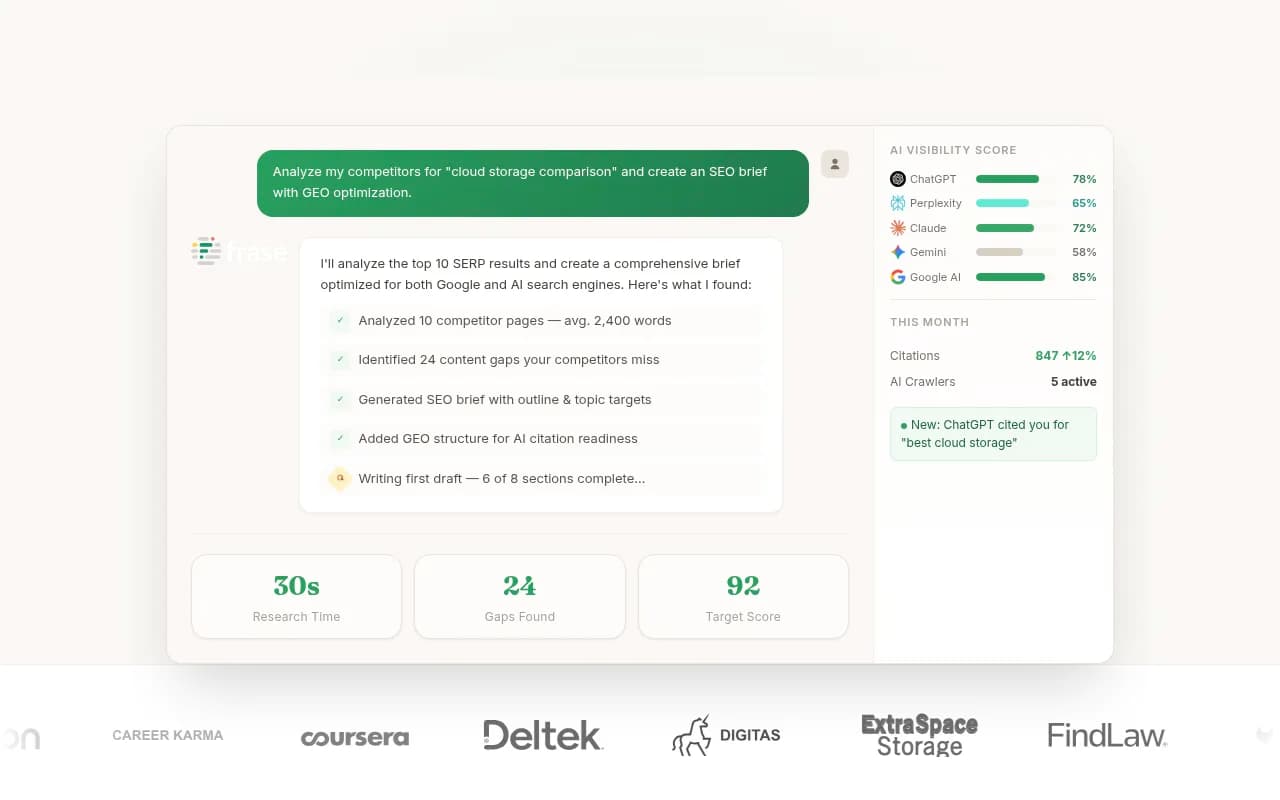
Content optimization tools can help with briefs and coverage, but none of them make a thin page valuable. Use them to structure research, not to replace it.


For technical hygiene, crawlers help you find the thin, duplicate and orphaned pages that tend to pile up when content scales fast.


High-volume generators exist too, and they are the category most likely to push you toward the scaled content problem if you use them without editorial control.
Nothing wrong with them in principle. The risk is the workflow around them.
| Tool type | Use it for | Watch out for |
|---|---|---|
| Content optimizers (Surfer SEO, Clearscope, Frase) | Briefs, coverage gaps, structure | Writing to a score instead of to a reader |
| Crawlers (Screaming Frog, Sitebulb) | Finding thin, duplicate, orphaned pages | Fixing issues without deciding what to prune |
| High-volume generators (Byword, SurgeGraph) | Drafting at speed | Publishing without review, which is the scaled content pattern |
AI content and AI search visibility are different questions
A separate worry is whether AI-written pages get cited in ChatGPT, Gemini or AI Overviews. That is a visibility question, not a penalty question. Promptwatch's data on AI Overviews citation types in July 2026 shows which formats get cited: listicles averaged about 18.0% of citations over the month, product pages 16.3%, how-tos 15.1% and news articles 13.5%, with product pages the most cited format every day from July 28. It says nothing about whether cited pages were AI-generated, so I wouldn't read it as a verdict either way. It does show that format and usefulness drive citation patterns.
If you want to see whether your content, human or AI-assisted, is actually being cited, a platform like Promptwatch tracks mentions and citations across ChatGPT, Gemini, Perplexity and Google AI Overviews, and its crawler logs show whether AI bots can even read your pages.

For more options in that category, the GEO software directory lists alternatives.
Common myths
"Google can detect AI text and demotes it"
Google's guidance doesn't say this, and the policy language is about value and scale. Detection of authorship method is not what the spam policies are built on. Don't build strategy on either assuming detection works or doesn't.
"Just add a human byline and you're safe"
A byline on a thin page is still a thin page.
"Disclosing AI use will hurt rankings"
Google itself suggests disclosing how content was created. I haven't seen a source showing disclosure is penalized.
"Small amounts of AI are fine, large amounts are not"
Volume of AI text isn't the criterion. Value per page and the pattern across the site are.
What to verify yourself
Two things I couldn't confirm and you should check before quoting them:
- The exact scaled content abuse definition and examples on the spam policies page, including any wording about content produced regardless of how it is created.
- Any recent spam update announcements or manual action data. Google's Search Status Dashboard is the place to look.
The spam policies page has also been adding sections recently, such as a back button hijacking FAQ under malicious practices, so reread it periodically rather than trusting a summary, including this one.
Bottom line
AI content is not penalized for being AI content. Pages are penalized, or just ignored, when they exist to rank rather than to help, and AI makes that kind of page cheaper to produce at scale. Use it to research, structure and draft. Verify everything. Publish only what you'd defend as useful if a human reviewer opened it cold.
If you'd rather hand the audit to specialists, 1001 SEO Media runs content audits and strategy work, and it is also the agency that publishes this site.
FAQ
Does Google have a policy against AI-generated content?
Not as such. Its guidance says generative AI used to create many pages without adding value may violate the scaled content abuse policy. The concern is low-value mass production.
Can AI content rank on Google?
Google's guidance treats AI as a legitimate way to research and structure content. Whether a page ranks depends on the same quality and relevance factors as any other page.
Do I need to label AI content?
For regular web pages, Google suggests disclosing how content was created, but it isn't framed as a requirement. For Merchant Center, AI-generated images and product text have specific labeling requirements.
What should I check before publishing AI-written pages?
Facts, titles, meta descriptions, structured data and alt text. Google says to manually review all of them.
Do Quality Rater Guidelines cause penalties?
No. Google says rater ratings don't directly influence ranking, and the guidelines are not a guide to ranking first. They are useful for understanding what Google considers low-effort, original and valuable content.