Clearscope Review 2026
Clearscope is a comprehensive content optimization and AI search visibility platform used by IBM, Webflow, and thousands of content teams. It combines traditional SEO optimization with Answer Engine Optimization (AEO), helping you track visibility across Google, ChatGPT, Gemini, and other AI platfor
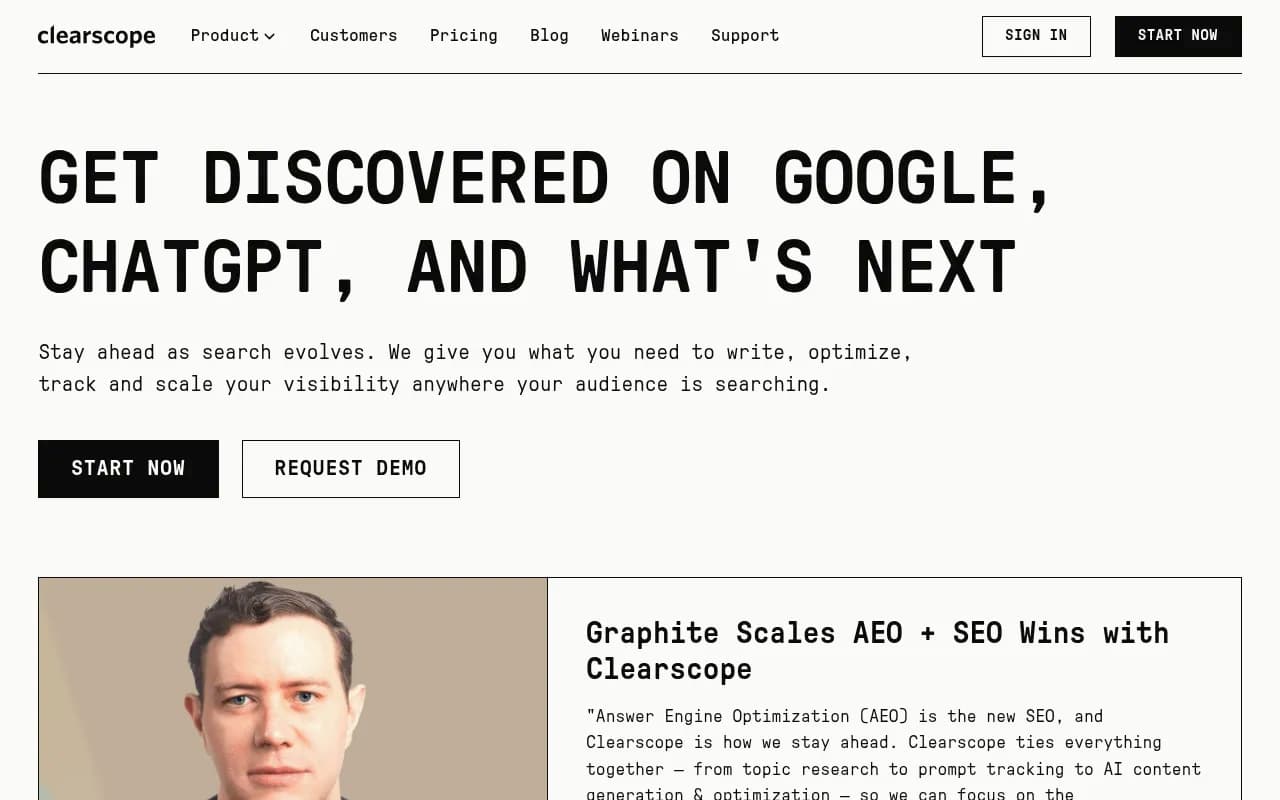
Summary
- Strong traditional SEO optimization: Best-in-class content grading, term suggestions, and readability scoring that have driven measurable traffic gains for years
- AI search tracking added: Now monitors visibility in ChatGPT, Gemini, and other LLMs, though lacks the depth of dedicated GEO platforms like Promptwatch
- Missing critical GEO capabilities: No content gap analysis, no AI crawler logs, no traffic attribution, no Reddit/YouTube tracking, and no prompt volume data that Promptwatch provides
- Best for: Content teams already invested in traditional SEO who want basic AI visibility monitoring as an add-on, not teams prioritizing AI search optimization
- Pricing: Starts at $189/month (Essentials), $399/month (Business), custom Enterprise pricing

Clearscope has been a fixture in the SEO content optimization space since its founding, building a reputation among enterprise content teams for helping them rank in Google search results. The platform was built around a core insight: comprehensive content that thoroughly covers a topic tends to outrank thin, keyword-stuffed articles. IBM, Webflow, Shopify, Deloitte, and thousands of other brands have used Clearscope to optimize blog posts, landing pages, and knowledge base articles for traditional search engines.
In 2024-2025, as ChatGPT, Perplexity, and Google's AI Overviews started eating into traditional search traffic, Clearscope added Answer Engine Optimization (AEO) features to track brand visibility in AI-generated answers. The pitch: one platform for both traditional SEO and the emerging world of AI search. But the execution reveals a fundamental tension -- Clearscope remains a traditional SEO tool with AI monitoring bolted on, not a purpose-built GEO platform.
Content Optimization and Grading
This is where Clearscope still shines. The content editor analyzes top-ranking pages for your target keyword and generates a list of relevant terms and concepts you should cover. As you write, a content grade (A+ to F) updates in real-time based on how comprehensively you're addressing the topic. The grading considers term usage, readability (Flesch-Kincaid scores), content structure, and word count relative to competitors.
The term suggestions are genuinely useful -- not just synonyms or related keywords, but semantic concepts that indicate topical depth. Writing about "project management software" might surface terms like "Gantt charts", "resource allocation", "milestone tracking", and "team collaboration" that you'd want to address naturally. The interface shows which terms you've already used and which are still missing, making it easy to ensure comprehensive coverage without keyword stuffing.
Readability scoring helps you balance comprehensiveness with accessibility. The tool flags overly complex sentences and suggests simplifications, though it doesn't rewrite for you. Integration with Google Docs, WordPress, and other content management systems means writers can optimize directly in their normal workflow.
AI-Powered Content Drafting
Clearscope added an AI writing assistant that generates first drafts based on your target keyword and the platform's content intelligence. You provide a keyword, select a tone and target audience, and the AI produces a structured article with an introduction, body sections, and conclusion. The drafts are competent but generic -- they read like every other AI-generated content piece, lacking the specific examples, data points, and unique angles that make content actually rank and convert.
The AI assistant is better used for breaking through writer's block or generating outlines than producing publish-ready content. You'll still need a human writer to add expertise, original research, and brand voice. The tool can also suggest section rewrites and expansions, which is more useful than full-draft generation for most professional content teams.
Topic Research and Exploration
The Topic Explorations feature maps out the semantic landscape around a subject, showing related subtopics, common questions, and content cluster opportunities. Enter a broad topic like "email marketing" and Clearscope surfaces dozens of related angles: "email automation", "subject line best practices", "deliverability optimization", "segmentation strategies", etc. Each subtopic shows estimated search volume and competition level.
This is valuable for content strategy and planning -- you can identify gaps in your existing content and build out comprehensive topic clusters that establish topical authority. The interface visualizes how subtopics relate to each other, making it easier to plan internal linking structures and content hierarchies. However, the data is entirely focused on traditional search volume and keyword difficulty. There's no information about which topics are trending in AI search, which prompts are driving AI citations, or what content gaps exist specifically for LLM visibility.
Search Intent Analysis
Clearscope analyzes the search intent behind keywords, categorizing them as informational, navigational, commercial, or transactional. The tool examines SERP features (featured snippets, people also ask boxes, video carousels) and top-ranking content types to help you understand what format and angle will perform best. Targeting "best CRM software" shows you need a comparison listicle with pricing tables and feature breakdowns, not a how-to guide.
The intent analysis is solid for traditional SEO but doesn't extend to AI search behavior. How people prompt ChatGPT differs from how they query Google -- prompts tend to be longer, more conversational, and often request specific formats ("give me a table comparing...", "explain like I'm five..."). Clearscope doesn't capture these nuances.
AI Search Visibility Tracking
This is the newest and weakest part of the platform. Clearscope now tracks whether your brand appears in responses from ChatGPT, Gemini, and other AI models when users ask questions related to your target keywords. You can see which prompts trigger citations of your content and monitor your "share of voice" in AI answers compared to competitors.
The tracking is basic. You get a dashboard showing citation counts and visibility percentages, but there's no depth beyond that. Critically missing:
-
No content gap analysis: Clearscope won't tell you which prompts competitors are visible for but you're not, or what specific content you need to create to close those gaps. Promptwatch's Answer Gap Analysis shows exactly which topics and angles your site is missing that AI models want to cite.
-
No AI crawler logs: You can't see when ChatGPT, Claude, or Perplexity crawlers hit your site, which pages they read, or whether they encountered errors. Promptwatch provides real-time logs of AI crawler activity so you can fix indexing issues and understand how AI engines discover your content.
-
No traffic attribution: Clearscope doesn't track actual visitor traffic from AI search engines or connect visibility to revenue. Promptwatch offers code snippet integration, Google Search Console connection, and server log analysis to show which AI citations drive real traffic and conversions.
-
No Reddit or YouTube tracking: AI models heavily cite Reddit discussions and YouTube videos in their responses, but Clearscope doesn't surface these sources. Promptwatch shows which Reddit threads and YouTube videos are influencing AI recommendations in your space.
-
No prompt intelligence: Clearscope doesn't provide volume estimates, difficulty scores, or query fan-outs for AI prompts. You're flying blind on which prompts are worth targeting. Promptwatch offers detailed prompt metrics so you can prioritize high-value, winnable opportunities.
-
No ChatGPT Shopping tracking: If you sell products, Clearscope won't tell you when your brand appears in ChatGPT's shopping recommendations. Promptwatch monitors product visibility in AI shopping carousels.
The AI visibility tracking feels like a checkbox feature added to keep up with market trends, not a core competency. Teams serious about AI search optimization will need a dedicated GEO platform.
Content Performance Monitoring
Clearscope's Content Inventory connects to Google Search Console and Google Analytics to track how your published content performs over time. You can see which pages are gaining or losing traffic, monitor keyword rankings, and identify content that needs refreshing. The platform flags pages with declining performance and suggests optimization opportunities based on SERP changes.
Custom content views let you segment your inventory by topic, author, publish date, or performance metrics. This is useful for large content libraries where you need to prioritize refresh efforts. The monitoring is entirely focused on traditional search metrics -- impressions, clicks, rankings, CTR. There's no tracking of how AI models are using your content or whether your visibility in AI answers is improving.
Integrations and Workflow
Clearscope integrates with Google Docs, WordPress, Contentful, and other content management systems. The Google Docs add-on is particularly smooth -- you can optimize content directly in Docs without switching tabs. WordPress integration allows you to pull optimization data into your CMS and track performance of published posts.
API access is available on Enterprise plans for custom integrations and data exports. The platform supports team collaboration with role-based permissions, content approval workflows, and shared optimization reports. Multiple team members can work on the same content brief simultaneously.
Who is Clearscope for?
Clearscope is built for established content teams at companies with significant SEO budgets. The ideal user is a content marketing manager at a B2B SaaS company, enterprise brand, or digital agency managing 50-200+ pieces of content per month. You have dedicated writers, editors, and SEO specialists who need a shared platform for content optimization and performance tracking.
The platform works best when you're already winning in traditional search and want to maintain those rankings while cautiously exploring AI search. If you're a 10-person marketing team at a Series B startup publishing 20 articles per month, Clearscope will help you optimize for Google and give you basic visibility into AI citations.
Clearscope is NOT the right choice if AI search optimization is your primary goal. The AI visibility features are too shallow for teams that need to actually compete in ChatGPT, Perplexity, and other AI platforms. If you're seeing traffic declines from AI answer boxes eating your clicks, or if you're in a competitive space where AI citations directly impact revenue, you need a purpose-built GEO platform like Promptwatch that provides content gap analysis, AI crawler monitoring, traffic attribution, and optimization tools specifically designed for AI search.
Solo content creators and small teams (1-3 people) will find Clearscope expensive for what it delivers. At $189/month minimum, you're paying for enterprise-grade features you may not need. Simpler tools like Surfer SEO or Frase offer similar traditional SEO optimization at lower price points.
Pricing and Value
Clearscope pricing starts at $189/month for the Essentials plan, which includes content optimization for unlimited keywords, AI drafting, topic research, and basic AI visibility tracking. The Business plan at $399/month adds advanced content inventory features, custom reporting, and priority support. Enterprise pricing is custom and includes SSO, dedicated account management, and API access.
There's no free trial, but Clearscope offers demos where their team walks you through the platform. Annual billing provides a discount. Compared to competitors, Clearscope is premium-priced. Surfer SEO starts at $99/month, Frase at $15/month, and MarketMuse at $149/month. You're paying for the brand reputation, enterprise features, and customer success support.
For traditional SEO optimization, the pricing is defensible if you're a large team producing high volumes of content. The time savings from streamlined optimization workflows and the traffic gains from better-ranking content can justify the cost. For AI search optimization, the value proposition is weak. Promptwatch starts at $99/month and provides far more comprehensive GEO capabilities -- content gap analysis, AI crawler logs, traffic attribution, Reddit/YouTube tracking, prompt intelligence, and multi-model monitoring across 10+ AI platforms. If AI visibility is your priority, Promptwatch delivers better ROI.
Strengths
-
Best-in-class traditional SEO optimization: The content grading, term suggestions, and readability analysis are genuinely useful and have driven measurable traffic gains for thousands of teams. The optimization recommendations are specific and actionable.
-
Enterprise-ready platform: Strong integrations, team collaboration features, role-based permissions, and dedicated customer success make it viable for large organizations with complex workflows.
-
Topic research and content strategy: The Topic Explorations feature helps you build comprehensive content clusters and identify gaps in your coverage. Useful for long-term content planning.
-
Proven track record: Clearscope has been around since 2016 and has case studies from IBM, Webflow, Shopify, and other major brands showing real traffic improvements from using the platform.
Limitations
Clearscope's AI search capabilities are monitoring-only and lack the depth needed for actual optimization. Compared to Promptwatch, Clearscope is missing:
- Content gap analysis: No way to identify which prompts competitors are visible for but you're not, or what content you need to create to close those gaps
- AI crawler logs: No visibility into when AI models crawl your site, which pages they read, or errors they encounter
- Traffic attribution: No tracking of actual visitor traffic from AI search engines or connection to revenue
- Reddit and YouTube tracking: No insights into discussions and videos that influence AI recommendations
- Prompt intelligence: No volume estimates, difficulty scores, or query fan-outs for AI prompts
- ChatGPT Shopping tracking: No monitoring of product visibility in AI shopping carousels
- Multi-model coverage: Limited AI platform support compared to Promptwatch's 10+ models (ChatGPT, Perplexity, Claude, Gemini, Grok, DeepSeek, Meta AI, Mistral, Copilot, Google AI Overviews)
The AI-generated content drafts are generic and require significant human editing to be publish-ready. The platform is expensive compared to alternatives offering similar traditional SEO features. No free trial makes it hard to evaluate before committing.
Bottom line
Clearscope remains a strong traditional SEO optimization platform with a proven track record among enterprise content teams. If you're primarily focused on Google rankings and want basic AI visibility monitoring as a secondary feature, Clearscope delivers solid value. The content grading, term suggestions, and topic research tools are genuinely useful for producing comprehensive, well-optimized content.
However, if AI search optimization is a priority -- if you're seeing traffic declines from AI answer boxes, if you need to compete for citations in ChatGPT and Perplexity, or if you want to proactively build visibility in AI platforms -- Clearscope's capabilities are too shallow. The AI features feel like an afterthought, lacking the content gap analysis, crawler monitoring, traffic attribution, and optimization tools that dedicated GEO platforms provide. For teams serious about AI search, Promptwatch is the stronger choice, offering comprehensive GEO capabilities at a lower starting price point while still supporting traditional SEO workflows.
Tags:
Frequently asked questions
What is Clearscope and what does it do?
How much does Clearscope cost?
Who uses Clearscope?
Does Clearscope track AI search visibility?
What are Clearscope's main features?
Is Clearscope good for traditional SEO?
Does Clearscope offer a free trial or free plan?
What is Answer Engine Optimization in Clearscope?
Similar and alternative tools to Clearscope