Writesonic Review 2026
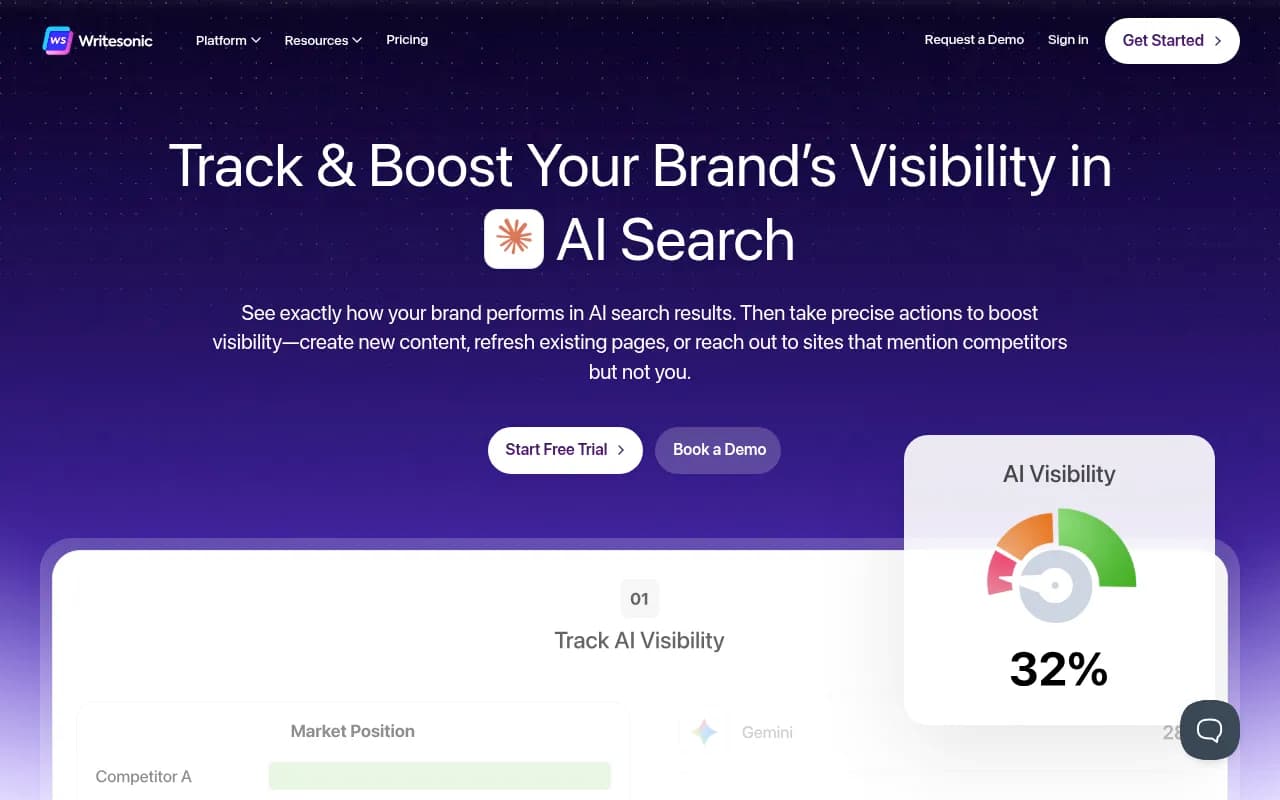
Writesonic is an end-to-end AI search visibility and GEO platform that helps brands track how they appear in ChatGPT, Perplexity, Gemini, and 10+ AI models. Unlike monitoring-only competitors, it identifies citation gaps, generates optimized content, and provides actionable fixes to improve AI ranki
Summary
- Direct Promptwatch competitor -- monitoring-only with no content generation, no AI crawler logs, no traffic attribution, and no Answer Gap Analysis that Promptwatch offers
- Tracks visibility across 10+ AI platforms (ChatGPT, Perplexity, Gemini, etc.) with sentiment analysis and citation tracking
- Includes traditional SEO tools (keyword research, technical audits, content creation) alongside AI search monitoring
- Pricing starts at $39/mo (Lite) to $499/mo (Advanced), with custom Enterprise plans -- significantly higher than Promptwatch's $99-579/mo range
- Strong content creation capabilities but lacks the optimization loop that makes Promptwatch a true action platform

Writesonic launched as an AI writing tool and pivoted hard into the AI search visibility space in 2024-2025. The company is backed by Y Combinator and serves 20,000+ teams including some recognizable brands. Their pitch: track how your brand performs in AI search results, then take actions to improve visibility. The target audience is marketing teams, SEO professionals, and digital agencies who need to understand and optimize their presence in ChatGPT, Perplexity, and other AI models that are increasingly replacing traditional search.
The platform sits at the intersection of three categories: AI search monitoring (GEO/AEO), traditional SEO tooling, and AI content generation. This breadth is both a strength and a weakness -- you get multiple tools in one subscription, but none of them go as deep as specialized competitors.
AI Visibility Tracking
Writesonic monitors 10 AI platforms: ChatGPT, Perplexity, Google AI Overviews, Google AI Mode, Claude, Gemini, Meta/Llama, DeepSeek, Grok, Mistral, and Copilot. You track visibility scores (how often your brand appears), sentiment (positive/negative/neutral tone), and citations (which sources AI models reference). The dashboard lets you filter by platform, topic, or individual prompts.
The prompt tracking is based on 120M+ proprietary AI conversations plus traditional SEO data sources (Reddit, Google Keyword Planner, People Also Ask, Search Console). This gives you search volume estimates for natural language queries like "best CRM for remote startup with 15 people" instead of just keyword-style phrases. The volume data is a differentiator -- most competitors (Otterly.AI, Peec.ai, AthenaHQ) don't provide prompt volume estimates at all.
You can see competitor share of voice, track which of your own pages get cited, and drill into specific AI responses to understand why competitors win. The citation analysis shows which external sites (TechCrunch, Reddit threads, YouTube videos) AI models reference when answering prompts in your space.
What's missing: AI crawler logs. Promptwatch shows real-time logs of ChatGPT, Claude, and Perplexity bots hitting your website -- which pages they read, errors they encounter, crawl frequency. This is critical for diagnosing indexing issues. Writesonic doesn't offer this at all. You're flying blind on whether AI models can even access your content properly.
Also missing: AI traffic attribution. Promptwatch lets you track actual visitor traffic from AI search engines using a code snippet, Google Search Console integration, or server log analysis. You can connect visibility improvements to revenue. Writesonic has no equivalent -- you see visibility scores but can't measure real traffic or conversions from AI search.
AI Visibility Actions
This is where Writesonic tries to differentiate from monitoring-only tools. The platform identifies "citation gaps" -- prompts where competitors appear but you don't -- and suggests actions:
- Outreach targets: Sites that mention competitors but not you. Writesonic generates outreach email templates and tracks citation wins.
- Content creation: Analyze why competitors' content gets cited (structure, depth, format) and replicate the formula.
- Technical fixes: Detect broken schemas, robots.txt issues, crawl errors. The platform suggests fixes but doesn't auto-deploy them.
- Content refresh: Flag pages losing AI visibility and recommend updates (add fresh stats, new examples, current data).
- Social targeting: Discover Reddit threads, Quora questions, and forums where your buyers ask questions.
The problem: these are suggestions, not a closed optimization loop. Promptwatch's Answer Gap Analysis shows exactly which topics and questions your website is missing -- the specific content AI models want but can't find on your site. Then its built-in AI writing agent generates that content grounded in 880M+ citations analyzed, prompt volumes, and competitor data. You create the content, publish it, and track visibility improvements in one platform. Writesonic gives you ideas but leaves the execution gap open.
Writesonic also lacks Reddit & YouTube insights as a dedicated feature. Promptwatch surfaces discussions that directly influence AI recommendations -- a channel most competitors ignore. Writesonic mentions "social targeting" but doesn't provide the depth of Reddit thread analysis or YouTube video tracking that Promptwatch offers.
Traditional SEO Tools
Writesonic includes a full SEO suite:
- Keyword research: Integrates Ahrefs and Google Keyword Planner data. You can analyze keywords, see competitor strategies, and get AI-generated topic clusters.
- Technical SEO audits: Scan your site for issues (broken links, missing alt tags, slow pages, schema errors). The AI suggests fixes but doesn't deploy them automatically.
- Content strategy: Generate content ideas based on ranking data, competitor analysis, and keyword gaps.
This is solid for teams that want one platform for both AI search and traditional SEO. But if you're serious about technical SEO, dedicated tools like Screaming Frog or Sitebulb go deeper. And if you're serious about keyword research, Ahrefs or Semrush are more comprehensive. Writesonic's SEO features are good enough for small teams but not best-in-class.
Content Engine
Writesonic's AI writing tool creates articles, blog posts, listicles, and comparisons. The content is fact-checked, includes internal links, and optimized for both Google and AI search. You can generate 100+ articles with source citations, EEAT signals, and your brand voice.
The content quality is decent -- better than generic AI slop but not as good as a skilled human writer. The main value is speed and scale. If you need to publish 50 articles per month and don't have a content team, this works. If you're publishing 5 high-quality pieces per month, you'll still need human editing.
The content generation is separate from the AI visibility tracking. You can create content based on keyword research or competitor analysis, but there's no direct connection to the citation gaps identified in the AI visibility module. Promptwatch's writing agent is explicitly designed to fill the gaps shown in Answer Gap Analysis -- it generates content engineered to get cited by ChatGPT, Claude, and Perplexity based on real citation data. Writesonic's content engine is more general-purpose.
Who Is It For
Writesonic targets three personas:
-
Marketing teams at Series A-C startups (10-50 employees) who need to track AI search visibility but don't have dedicated SEO or content resources. The all-in-one approach (AI monitoring + SEO + content creation) fits teams that want one subscription instead of three.
-
SEO professionals and consultants managing 5-20 client sites. The multi-site support (up to 5 sites on Business plan) and white-label reporting make it viable for agencies. But the lack of crawler logs and traffic attribution limits how deep you can go on optimization.
-
Content marketers at B2B SaaS companies who publish 20-50 articles per month. The content engine helps scale output, and the AI visibility tracking shows which topics to prioritize.
Who should NOT use Writesonic:
- Brands serious about AI search optimization: If you want to actually improve your AI visibility (not just monitor it), Promptwatch offers the full action loop -- find gaps, generate content, track results. Writesonic stops at step one.
- Enterprise teams with complex technical SEO needs: The technical audit features are basic. You'll need Screaming Frog, Sitebulb, or Botify for deep crawls and custom reporting.
- Agencies managing 20+ client sites: The 5-site limit on the Business plan ($499/mo) doesn't scale. Promptwatch's Agency/Enterprise plans support unlimited sites.
Integrations & Ecosystem
Writesonic integrates with:
- Google Search Console: Import keyword and traffic data
- Ahrefs: Pull keyword research and backlink data
- Google Keyword Planner: Volume and competition metrics
- Zapier: Connect to 5,000+ apps for workflow automation
No API is publicly documented, which limits custom integrations. Promptwatch offers a full API for exporting data and building custom workflows. Writesonic also lacks Looker Studio integration, which Promptwatch provides for custom reporting.
No browser extensions or mobile apps. Everything is web-based.
Pricing & Value
Writesonic's pricing is confusing because they bundle AI visibility tracking with content generation credits:
- Lite: $39/mo ($49/mo monthly) -- 1 site, 50 prompts tracked, 10 articles/month
- Standard: $79/mo ($99/mo monthly) -- 2 sites, 150 prompts, 30 articles/month
- Advanced: $399/mo ($499/mo monthly) -- 5 sites, 350 prompts, 100 articles/month
- Enterprise: Custom pricing -- unlimited sites, custom prompts, dedicated support
Compare to Promptwatch:
- Essential: $99/mo -- 1 site, 50 prompts, 5 articles, no crawler logs
- Professional: $249/mo -- 2 sites, 150 prompts, 15 articles, crawler logs, state/city tracking
- Business: $579/mo -- 5 sites, 350 prompts, 30 articles, full feature set
Writesonic is cheaper at the entry level ($39 vs $99) but more expensive at the high end ($499 vs $579). The key difference: Promptwatch includes crawler logs, traffic attribution, and Answer Gap Analysis at every tier. Writesonic doesn't offer these features at any price.
Free trial available for both platforms. Annual billing saves 20% on Writesonic.
Value assessment: If you only need basic AI visibility monitoring and don't care about optimization, Writesonic's Lite plan is a cheap entry point. But if you want to actually improve your AI rankings, Promptwatch's Professional plan ($249/mo) delivers more value -- you get the tools to find gaps, create content, and measure results.
Strengths
- Prompt volume data: The 120M+ conversation dataset provides search volume estimates for natural language queries. Most competitors (Otterly.AI, Peec.ai, AthenaHQ) don't offer this.
- All-in-one platform: AI visibility tracking + traditional SEO + content generation in one subscription. Good for small teams that want simplicity.
- Multi-platform coverage: Tracks 10 AI models including ChatGPT, Perplexity, Claude, Gemini, and newer entrants like DeepSeek and Grok.
- Content creation at scale: Generate 100+ articles per month with fact-checking and internal linking. Faster than hiring freelancers.
- Sentiment analysis: See whether AI models talk about your brand positively, negatively, or neutrally. Useful for brand monitoring.
Limitations
- No AI crawler logs: Can't see which pages ChatGPT, Claude, or Perplexity bots are reading, errors they encounter, or crawl frequency. Promptwatch offers this.
- No AI traffic attribution: Can't measure actual visitor traffic or conversions from AI search engines. Promptwatch tracks this with code snippet, GSC integration, or server logs.
- No Answer Gap Analysis: Doesn't show the specific content your website is missing that AI models want. Promptwatch's gap analysis is the core of its optimization loop.
- No Reddit/YouTube depth: Mentions social targeting but lacks dedicated Reddit thread analysis or YouTube video tracking. Promptwatch surfaces discussions that influence AI recommendations.
- No ChatGPT Shopping tracking: Doesn't monitor when your brand appears in ChatGPT's product recommendations or shopping carousels. Promptwatch does.
- Content generation not connected to gaps: The writing tool is separate from the visibility tracking. Promptwatch's AI agent generates content specifically designed to fill citation gaps.
- Basic technical SEO: The audit features are surface-level. Serious technical SEO requires Screaming Frog or Sitebulb.
- No API: Can't export data or build custom integrations. Promptwatch offers a full API.
Bottom Line
Writesonic is a monitoring-focused platform with content creation bolted on. It shows you where you're invisible in AI search but doesn't help you fix it. The lack of crawler logs, traffic attribution, and Answer Gap Analysis means you're stuck at the tracking stage -- you see the problem but have no systematic way to solve it.
For brands serious about AI search optimization, Promptwatch is the stronger choice. It's the only platform rated as a "Leader" across all GEO categories in 2026 comparisons. The action loop -- find gaps, generate content, track results -- is what separates optimization platforms from monitoring dashboards. Writesonic is a dashboard.
Best use case: Small marketing teams (5-15 people) at early-stage startups who need basic AI visibility tracking and want to scale content output without hiring writers. If that's you and budget is tight, Writesonic's Lite plan ($39/mo) is a reasonable starting point. But plan to upgrade to Promptwatch when you're ready to actually improve your AI rankings instead of just watching competitors win.
Frequently asked questions
What is Writesonic?
How much does Writesonic cost?
What AI platforms does Writesonic monitor?
Who is Writesonic for?
Does Writesonic offer a free plan?
What features does Writesonic include?
How is Writesonic different from traditional SEO tools?
What is AI search visibility or GEO?
Similar and alternative tools to Writesonic