Key Takeaways
- Completely different purposes: Writesonic is an AI search visibility platform (tracks how you appear in ChatGPT, Perplexity, etc.), while Copy.ai is a GTM automation platform (automates sales and marketing workflows). They barely overlap.
- Pricing gap: Writesonic starts at $39/mo for basic tracking. Copy.ai starts at $249/mo for workflow automation -- 6x more expensive at entry level.
- Target users: Writesonic is for SEO teams, content marketers, and agencies tracking AI search performance. Copy.ai is for sales ops, demand gen, and RevOps teams automating GTM motions.
- Content generation angle: Both generate content, but Writesonic optimizes for AI search citations and visibility. Copy.ai generates sales emails, sequences, and GTM collateral.
- Enterprise focus: Copy.ai is built for enterprise GTM teams (Siemens, Lenovo, Gong). Writesonic serves everyone from startups to Fortune 500 but focuses on marketing/SEO use cases.
- Bottom line: If you need AI search visibility and GEO optimization, Writesonic. If you need GTM workflow automation across sales and marketing, Copy.ai. They solve different problems.
Overview
Writesonic
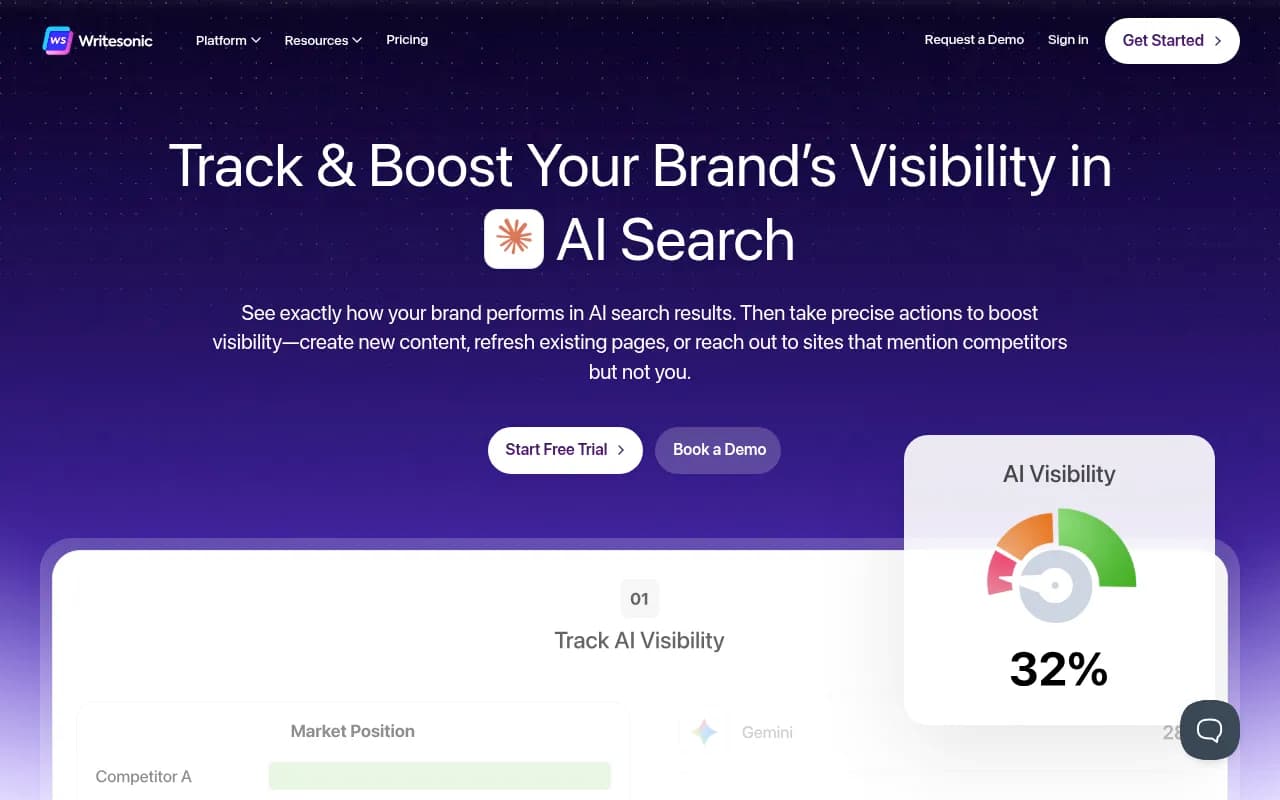
Writesonic is an end-to-end AI search visibility platform. It tracks how your brand appears across ChatGPT, Perplexity, Gemini, and 10+ AI models, identifies citation gaps, and helps you create optimized content to improve AI rankings. The platform combines monitoring (where you show up), analysis (why competitors outrank you), and action (content generation and optimization). Used by Series A startups to Fortune 500 companies that want to be visible when people search in AI engines instead of Google.
Copy.ai
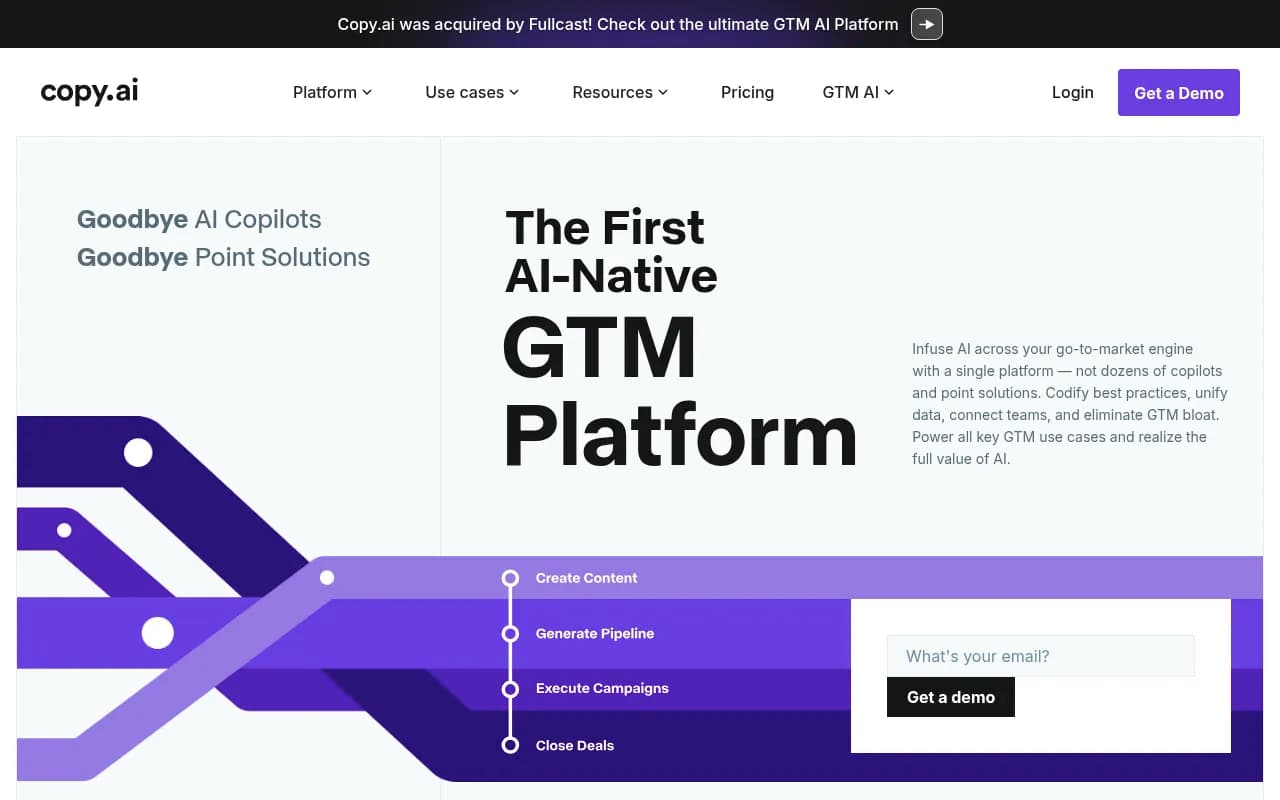
Copy.ai is an enterprise GTM AI platform that automates go-to-market workflows for sales, marketing, and operations teams. It replaces dozens of AI copilots with a unified platform for prospecting, lead processing, content creation, and workflow automation. Used by 17 million users at companies like Siemens, Lenovo, and Gong. The pitch: one platform to codify GTM best practices, unify data, and eliminate the bloat of multiple point solutions.
Side-by-side comparison
| Feature | Writesonic | Copy.ai |
|---|---|---|
| Primary use case | AI search visibility & GEO optimization | GTM workflow automation (sales, marketing, ops) |
| Starting price | $39/mo (Lite) | $249/mo (Professional) |
| Free tier | Free trial available | No free tier mentioned |
| AI models tracked | 10+ (ChatGPT, Perplexity, Gemini, Claude, etc.) | N/A (not a tracking tool) |
| Content generation | Optimized for AI search citations | Sales emails, sequences, GTM collateral |
| Workflow automation | No | Yes (core feature) |
| Citation gap analysis | Yes | No |
| CRM integration | Not emphasized | Yes (Salesforce, HubSpot, etc.) |
| Target audience | SEO teams, content marketers, agencies | Sales ops, demand gen, RevOps teams |
| Reddit/UGC tracking | Yes | No |
| Enterprise pricing | Custom | Custom |
| User base | Series A to Fortune 500 (marketing focus) | 17M users (GTM focus) |
What each tool actually does
Writesonic: AI search visibility platform
Writesonic answers one question: how visible is your brand when people search in AI engines like ChatGPT or Perplexity?
You track prompts (search queries), see which AI models cite you, and compare yourself to competitors. The platform shows citation gaps -- prompts where competitors get mentioned but you don't. Then it helps you fix those gaps by generating content optimized for AI search, refreshing existing pages, or identifying outreach opportunities (sites that mention competitors but not you).
Core capabilities:
- Track brand mentions across 10+ AI models
- Monitor specific prompts and see visibility scores
- Citation gap analysis (what content you're missing)
- AI content generation grounded in citation data
- Reddit and UGC forum tracking (AI models cite these heavily)
- Page-level tracking (which URLs get cited)
- Competitor heatmaps
The workflow: find gaps, create content, track results. It's GEO (Generative Engine Optimization) -- the AI search equivalent of SEO.
Copy.ai: GTM automation platform
Copy.ai automates repetitive go-to-market tasks across sales, marketing, and operations. The idea: replace dozens of AI copilots and point solutions with one platform that handles prospecting, lead enrichment, email sequences, content creation, and workflow orchestration.
Core capabilities:
- Workflow automation (trigger actions based on CRM data, form fills, etc.)
- Sales prospecting and lead enrichment
- Email sequence generation
- GTM content creation (sales decks, one-pagers, case studies)
- CRM integration (Salesforce, HubSpot)
- Team collaboration and workflow codification
- Data unification across GTM tools
The workflow: define a GTM motion (e.g. "when a lead hits MQL, enrich data, generate personalized email, add to sequence"), automate it, scale it. It's workflow orchestration with AI content generation baked in.
Head-to-head feature comparison
Use case alignment
Writesonic: You're a content marketer, SEO lead, or agency tracking how clients appear in AI search. You want to know if ChatGPT recommends your product when someone asks "best project management tools" or if Perplexity cites your blog when answering industry questions. You need data on what's working, what's missing, and how to improve.
Copy.ai: You're a sales ops manager, demand gen lead, or RevOps director drowning in manual GTM tasks. You want to automate lead enrichment, personalize outreach at scale, generate sales collateral, and connect all your GTM tools without building custom integrations. You need workflow automation, not search visibility.
Verdict: These tools solve completely different problems. Writesonic is a visibility and optimization platform. Copy.ai is a workflow automation platform. Minimal overlap.
Content generation
Both platforms generate content, but the purpose and output differ.
Writesonic: Generates blog posts, listicles, and comparison pages optimized for AI search citations. The content is grounded in citation data (what AI models actually cite), prompt volumes, and competitor analysis. The goal: create content that ChatGPT, Perplexity, and other AI models will reference when answering user queries. Think SEO content but for AI engines.
Copy.ai: Generates sales emails, cold outreach sequences, product descriptions, case studies, and GTM collateral. The content is personalized based on CRM data, lead attributes, and workflow triggers. The goal: automate repetitive writing tasks in sales and marketing. Think Jasper or Writesonic's original use case (AI copywriting) but integrated into GTM workflows.
| Content type | Writesonic | Copy.ai |
|---|---|---|
| Blog posts optimized for AI search | Yes | No |
| Sales emails | No | Yes |
| Cold outreach sequences | No | Yes |
| Product descriptions | Limited | Yes |
| Case studies | Limited | Yes |
| Listicles and comparisons | Yes | No |
| Citation-optimized content | Yes | No |
| Personalized GTM collateral | No | Yes |
Verdict: Writesonic for content that ranks in AI search. Copy.ai for sales and marketing collateral at scale.
Tracking and analytics
Writesonic: Built around tracking. You monitor how your brand appears across 10+ AI models (ChatGPT, Perplexity, Gemini, Claude, Meta AI, DeepSeek, Grok, Mistral, Copilot, Google AI Overviews). You see visibility scores, citation counts, competitor comparisons, and prompt-level performance. Page-level tracking shows which URLs get cited. Reddit and UGC tracking surfaces discussions that influence AI recommendations.
Copy.ai: Not a tracking tool. It has workflow analytics (how many leads processed, emails sent, sequences completed) but no AI search visibility metrics. The focus is on GTM execution, not brand monitoring.
Verdict: Writesonic is the only option if you need AI search tracking. Copy.ai doesn't compete here.
Workflow automation
Writesonic: No workflow automation. It's a visibility and content platform, not an orchestration tool. You manually create content, refresh pages, or export data for other tools.
Copy.ai: Workflow automation is the core product. You build multi-step workflows triggered by CRM events, form submissions, or manual actions. Example: "When a lead becomes an MQL, enrich their company data, generate a personalized email, add them to a nurture sequence, and notify the sales rep." It connects to Salesforce, HubSpot, and other GTM tools to unify data and automate handoffs.
Verdict: Copy.ai is the only option if you need GTM workflow automation. Writesonic doesn't compete here.
Integrations and ecosystem
Writesonic: Integrations focus on data export and reporting. Looker Studio integration for custom dashboards. API for custom workflows. No CRM or sales tool integrations -- it's not built for that.
Copy.ai: Deep CRM integrations (Salesforce, HubSpot) plus connections to marketing automation, data enrichment tools, and other GTM platforms. The goal: unify your GTM stack and eliminate data silos.
Verdict: Copy.ai wins if you need CRM and GTM tool integration. Writesonic wins if you need AI search data in your analytics stack.
Pricing structure
Writesonic:
- Lite: $39/mo (basic tracking, limited prompts)
- Advanced: $499/mo (more prompts, advanced features)
- Enterprise: Custom pricing
- Annual billing saves 20%
- Free trial available
Copy.ai:
- Professional: $249/mo (10k workflow credits)
- Enterprise: Custom pricing
- No free tier mentioned
- Pricing is per-seat or per-workflow-credit depending on plan
Verdict: Writesonic is 6x cheaper at entry level ($39 vs $249). Copy.ai's pricing reflects its enterprise GTM focus.
Target audience and positioning
Writesonic: SEO teams, content marketers, digital agencies, brand managers. Anyone who needs to track and improve how their brand appears in AI search results. Serves startups to Fortune 500 but the use case is consistent: AI search visibility.
Copy.ai: Sales ops, demand gen, RevOps, GTM leaders at mid-market and enterprise companies. The 17M user claim suggests broad adoption, but the platform is positioned for teams that need to automate complex GTM workflows.
Verdict: Completely different audiences. Writesonic for marketing/SEO. Copy.ai for sales/ops.
Pricing comparison
| Plan | Writesonic | Copy.ai |
|---|---|---|
| Entry tier | $39/mo (Lite) | $249/mo (Professional) |
| Mid tier | $499/mo (Advanced) | Not specified |
| Enterprise | Custom | Custom |
| Free trial | Yes | Not mentioned |
| Annual discount | 20% | Not specified |
Writesonic's pricing is transparent and starts low. Copy.ai's pricing is higher and less transparent -- you need to contact sales for details beyond the Professional tier.
Pros and cons
Writesonic pros
- Tracks AI search visibility across 10+ models (ChatGPT, Perplexity, Gemini, etc.)
- Citation gap analysis shows exactly what content you're missing
- AI content generation optimized for search visibility, not generic SEO filler
- Reddit and UGC tracking (AI models cite these heavily)
- Much cheaper entry point ($39/mo vs $249/mo)
- Free trial available
- Clear use case: if you need AI search visibility, this is the tool
Writesonic cons
- No workflow automation or CRM integration
- Not built for sales or GTM use cases
- Limited to marketing/SEO teams
- Newer platform (less brand recognition than Copy.ai)
Copy.ai pros
- Powerful GTM workflow automation (replaces multiple tools)
- Deep CRM integrations (Salesforce, HubSpot)
- 17M users, strong enterprise adoption (Siemens, Lenovo, Gong)
- Unified platform for sales, marketing, and ops teams
- Codifies best practices and eliminates GTM bloat
Copy.ai cons
- 6x more expensive than Writesonic at entry level
- No AI search visibility tracking (completely different use case)
- Pricing is opaque -- need to contact sales
- Overkill if you just need content generation or basic automation
Who should pick which tool
Pick Writesonic if:
- You're an SEO team, content marketer, or agency tracking AI search performance
- You need to know how your brand appears in ChatGPT, Perplexity, and other AI models
- You want citation gap analysis and content recommendations based on real AI search data
- You're optimizing for AI visibility (GEO/AEO), not traditional SEO
- You need Reddit and UGC tracking (AI models cite these sources heavily)
- You want a lower entry price and transparent pricing
Pick Copy.ai if:
- You're a sales ops, demand gen, or RevOps team automating GTM workflows
- You need to replace multiple AI copilots and point solutions with one platform
- You want deep CRM integration and workflow orchestration
- You're generating sales emails, sequences, and GTM collateral at scale
- You have the budget for enterprise GTM automation ($249/mo+)
- You need to unify data across your GTM stack
Pick neither if: You're looking for a general-purpose AI writing tool (Jasper, Rytr) or a traditional SEO platform (Semrush, Ahrefs). Writesonic and Copy.ai are specialized tools for specific use cases.
If you're tracking AI search visibility and also need GTM automation, you'd run both tools -- they don't overlap. Worth noting that tools like Promptwatch also cover the AI visibility angle with citation tracking, content gap analysis, and optimization features if you want to compare options in that space.

Final verdict
Writesonic and Copy.ai are not competitors. They solve completely different problems for completely different teams.
Writesonic is an AI search visibility platform. You use it to track how your brand appears in ChatGPT, Perplexity, and other AI models, identify content gaps, and optimize for AI citations. It's GEO (Generative Engine Optimization) -- the AI search equivalent of SEO. If you're a content marketer, SEO lead, or agency tracking AI search performance, Writesonic is purpose-built for you. Starting at $39/mo, it's accessible and focused.
Copy.ai is a GTM automation platform. You use it to automate sales prospecting, lead enrichment, email sequences, and workflow orchestration across your GTM stack. It's workflow automation with AI content generation baked in. If you're a sales ops manager, demand gen lead, or RevOps director automating GTM motions, Copy.ai is built for you. Starting at $249/mo, it's an enterprise investment.
The only overlap: both generate content. But Writesonic generates content optimized for AI search citations. Copy.ai generates sales and marketing collateral for GTM workflows. Different purposes, different outputs.
One sentence: Writesonic for AI search visibility, Copy.ai for GTM automation -- they don't compete, they serve different teams with different needs.