Copy.ai Review 2026
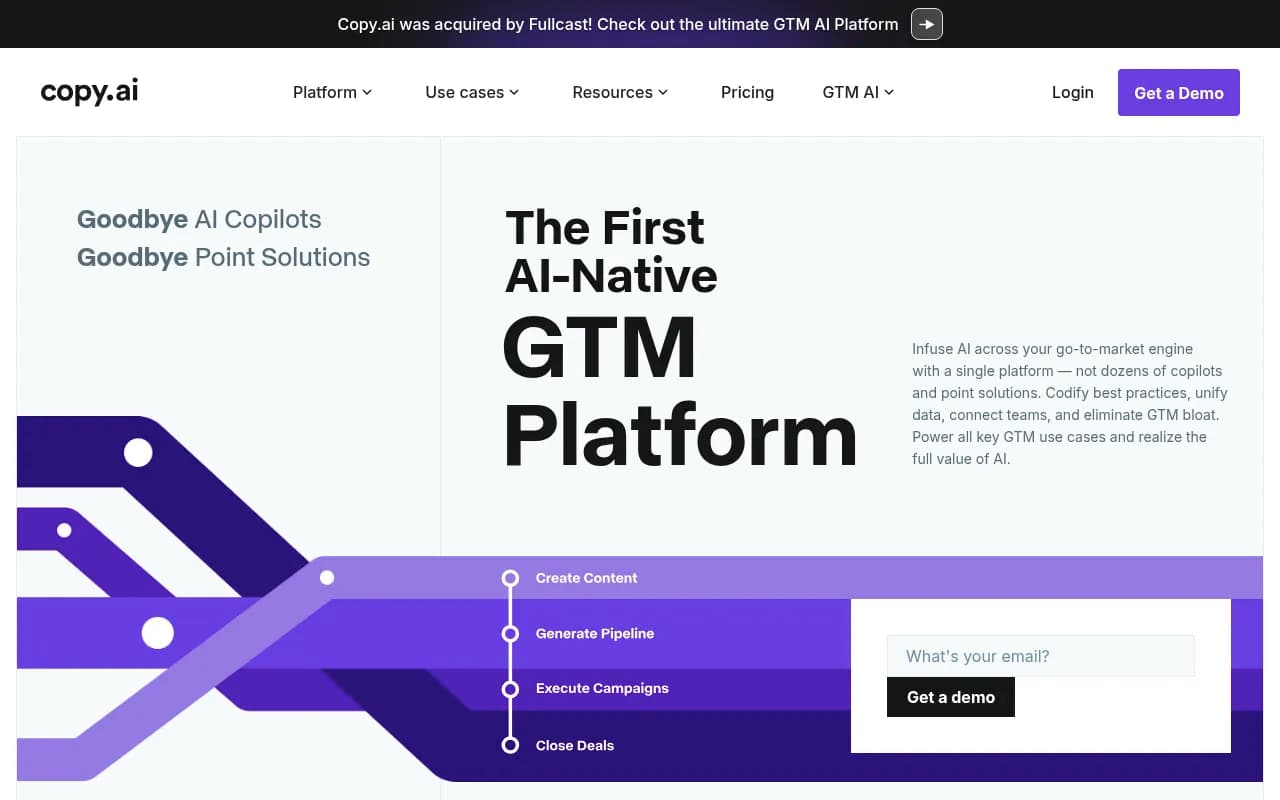
Copy.ai is an enterprise GTM AI platform that automates go-to-market workflows for sales, marketing, and operations teams. Used by 17 million users at companies like Siemens, Lenovo, and Gong, it replaces dozens of AI copilots with a unified platform for prospecting, content creation, lead processin
Summary
- Unified GTM platform: Copy.ai consolidates sales, marketing, and ops automation into one AI-native platform instead of forcing teams to juggle dozens of disconnected copilots and point solutions
- Enterprise-grade workflows: Powers prospecting research, content generation, lead enrichment, ABM campaigns, translation, and deal forecasting with pre-built workflows that codify best practices
- Proven at scale: 17 million users at companies like Siemens, Lenovo, Juniper Networks, and Gong. Lenovo reports $16M in cost savings from automating content workflows that previously required agencies
- Acquired by Fullcast: Copy.ai was acquired by Fullcast and now operates as part of "the ultimate GTM AI Platform" combining workflow automation with revenue operations capabilities
- Pricing starts at $249/mo: Professional tier includes 10k workflow credits monthly, content agent training, and access to core automation features. Enterprise pricing available for larger teams
Copy.ai started as an AI writing tool but evolved into something much bigger -- a full go-to-market automation platform that enterprise teams use to replace entire stacks of disconnected AI tools. The pitch is simple: instead of buying separate copilots for sales, marketing, and ops (each solving one narrow problem), you get a unified platform that automates entire GTM workflows end-to-end.
The company was acquired by Fullcast (a revenue operations platform) and now positions itself as "the world's first GTM AI platform." The combined entity serves 17 million users at brands like Siemens, Lenovo, Juniper Networks, Gong, ServiceNow, and Rubrik. That's not small-business territory -- this is enterprise software built for teams drowning in GTM bloat.
Core Platform Architecture
Copy.ai is built around six main components that work together:
Workflows are the heart of the system. These are AI-powered automations that codify your company's processes, plays, and best practices. Instead of manually executing a 12-step prospecting process (research account, find contacts, draft email, personalize, log in CRM), you build a workflow that does all of it automatically. Workflows connect cross-functional teams and unify disparate systems -- sales tools, marketing platforms, CRMs, data sources.
Actions are the building blocks of workflows. They're pre-built AI capabilities (research a company, generate content, enrich a lead, translate text) that non-technical users can chain together without being AI experts. Think of them as Lego bricks for automation.
Agents are autonomous AI workers that handle targeted tasks with proper guardrails. Unlike unconstrained AI agents that can go rogue, Copy.ai agents operate within defined workflows and decision trees. They make decisions (should this lead be prioritized? which email template fits this persona?) but stay on rails.
Tables act as a queryable data foundation. They consolidate data from Salesforce, HubSpot, your CRM, enrichment tools, and other sources into a unified layer that powers AI automation. This solves the "data scattered across 15 tools" problem that kills most automation attempts.
Chat is a prompting interface for one-off tasks. Need to quickly draft a cold email or summarize a call transcript? Chat handles ad-hoc requests without building a full workflow.
Infobase is a centralized repository for company information -- product details, positioning, case studies, competitive intel. When AI generates content, it pulls from Infobase to ensure accuracy and consistency.
Brand Voice defines your company's unique personality and tone. Every piece of AI-generated content (emails, blog posts, social updates) matches your brand guidelines automatically.
The platform integrates with 2,000+ tools via native connectors and Zapier. It's LLM-agnostic, meaning it works with OpenAI, Anthropic Claude, Google Gemini, and Perplexity -- you're not locked into one model. Security includes SOC 2 Type II, GDPR compliance, and SSO.
Key Use Cases (What Teams Actually Build)
Prospecting Cockpit: Sales reps use this to deeply research accounts and contacts, then draft high-quality outreach at scale. The workflow pulls firmographic data, recent news, tech stack info, and hiring signals, then generates personalized emails that reference specific pain points. Juniper Networks reports 5x more meetings booked using this approach. Instead of reps spending 30 minutes researching each prospect, the workflow does it in seconds.
Content Creation: Marketing teams automate SEO articles, thought leadership pieces, use cases, social posts, and more. Lenovo's Head of Global Digital Experience says Copy.ai saved them $16 million in 2025 by automating content workflows that previously required agencies and took weeks. The platform generates drafts in seconds, pulls from Infobase for accuracy, and maintains brand voice across all outputs.
Inbound Lead Processing: When a lead fills out a form, Copy.ai automatically enriches the record (company size, tech stack, intent signals), researches the account, scores the lead, and triggers personalized outreach -- all within seconds. This minimizes speed-to-lead (the time between form submission and sales contact) which directly impacts conversion rates.
Account-Based Marketing: ABM teams use Copy.ai to research target accounts, industries, and personas at scale, then generate hyper-relevant assets (one-pagers, case studies, email sequences) tailored to each account's specific context. Instead of generic "spray and pray" campaigns, you get true personalization without manual effort.
Translation and Localization: The platform produces native-speaker-level translations in real-time for a fraction of what translation agencies charge. This is critical for global companies launching campaigns in multiple markets simultaneously.
Deal Coaching and Forecasting: Sales ops teams feed call transcripts and deal data into workflows that score opportunities, suggest next steps, and predict close dates. This gives managers visibility into pipeline health without manually reviewing every deal.
Banzai's VP of Marketing put it well: "I didn't even know AI workflows were something I was lacking until someone said, 'Did you know you could do all of this with Copy.ai?'" The platform solves problems teams didn't realize were solvable.
Who This Is For
Copy.ai targets mid-market and enterprise go-to-market teams (sales, marketing, revenue ops) at B2B companies. Specifically:
- Sales teams at companies with 50-500 reps who need to scale personalized outreach without hiring more SDRs. If your reps spend hours researching prospects and drafting emails, this automates that.
- Marketing teams at global B2B brands producing content in multiple languages and formats. If you're paying agencies $50k per campaign or waiting weeks for content, Copy.ai replaces that.
- Revenue operations leaders drowning in GTM bloat -- too many tools, too many manual handoffs, too much data scattered across systems. Copy.ai consolidates and automates.
- ABM teams running targeted campaigns for high-value accounts. If you're trying to personalize at scale (the classic ABM paradox), workflows solve it.
This is NOT for:
- Small businesses or solopreneurs who just need a simple AI writing tool (Jasper or ChatGPT are cheaper)
- Teams without existing GTM systems (CRM, marketing automation, sales engagement tools) -- Copy.ai connects systems, it doesn't replace them
- Companies that want a plug-and-play solution with zero setup -- workflows require configuration and process design
Integrations and Ecosystem
Copy.ai connects to 2,000+ tools including:
- CRMs: Salesforce, HubSpot, Pipedrive
- Sales engagement: Outreach, SalesLoft, Apollo
- Conversation intelligence: Gong, Chorus
- Marketing automation: Marketo, Pardot, ActiveCampaign
- Data enrichment: Clearbit, ZoomInfo, 6sense
- Productivity: Slack, Microsoft Teams, Google Workspace
- Automation: Zapier, Make, custom API
The API allows developers to build custom integrations and trigger workflows programmatically. No mobile app or browser extension -- this is a web platform designed for team workflows, not individual productivity.
Pricing and Value
Copy.ai uses usage-based pricing tied to "workflow credits" (each AI action consumes credits based on complexity).
- Professional: $249/mo, includes 10k workflow credits, content agent training via Content Agent Studio, access to core workflows and actions. Billed monthly.
- Enterprise: Custom pricing based on team size, use cases, and credit volume. Includes dedicated support, custom workflows, advanced security, and SLAs.
The pricing model is flexible -- the sales team scopes your use cases and estimates credit consumption before you commit. For context, Lenovo's $16M in savings came from replacing agency work that cost thousands per project. At enterprise scale, the ROI is clear if you're currently paying agencies or have reps doing manual work that could be automated.
Compared to buying separate tools for prospecting (Apollo $99/user), content generation (Jasper $49/user), lead enrichment (Clearbit $99/user), and conversation intelligence (Gong $1200/user), Copy.ai's unified platform pricing is competitive for teams using multiple GTM tools.
Strengths
- Solves GTM bloat: Replaces dozens of disconnected copilots and point solutions with one unified platform. This is the core value prop and it resonates with enterprise teams drowning in tool sprawl.
- Enterprise-grade security and scale: SOC 2, GDPR, SSO, and proven at 17M users. Not a startup experiment -- this is production-ready for regulated industries.
- Pre-built workflows for common use cases: You don't start from scratch. Copy.ai provides templates for prospecting, content creation, lead processing, etc. that you customize to your process.
- LLM-agnostic: Works with OpenAI, Claude, Gemini, Perplexity. You're not locked into one model provider.
- Proven ROI at scale: Lenovo ($16M saved), Juniper (5x more meetings) -- these aren't vanity metrics, they're real business outcomes.
Limitations
- Requires GTM maturity: If you don't have defined processes, workflows, and systems in place, Copy.ai won't magically create them. You need to know what you want to automate before the platform can help.
- Setup and configuration required: This isn't a plug-and-play tool. Building workflows, connecting integrations, and training content agents takes time and expertise. Smaller teams may struggle without dedicated ops support.
- Pricing opacity: The "flexible, usage-based" model means you won't know exact costs until you talk to sales. Some teams prefer transparent, self-serve pricing.
- Acquired company uncertainty: Copy.ai was acquired by Fullcast in 2026. While the combined platform promises more capabilities, acquisitions always introduce risk around product roadmap, support, and focus.
Bottom Line
Copy.ai is the right choice for mid-market and enterprise B2B teams (50+ employees) with mature GTM systems who are drowning in tool sprawl and manual workflows. If your sales reps spend hours researching prospects, your marketers wait weeks for agency deliverables, or your ops team is duct-taping together 15 different tools, Copy.ai consolidates and automates all of it.
Best use case in one sentence: Enterprise sales and marketing teams at B2B companies who need to scale personalized, high-quality GTM motions without proportionally scaling headcount.
Don't buy this if you're a small team (under 20 people), don't have existing GTM systems to connect, or just need a simple AI writing assistant. For everyone else dealing with GTM bloat, Copy.ai is worth a demo.
Tags:
Frequently asked questions
What is Copy.ai?
How much does Copy.ai cost?
Does Copy.ai offer a free plan?
Who is Copy.ai designed for?
What are the main features of Copy.ai?
What is the difference between Copy.ai and other AI writing tools?
Who acquired Copy.ai?
What results have companies achieved with Copy.ai?
Similar and alternative tools to Copy.ai