Mention Review 2026
Brand monitoring platform tracking mentions across web, social media, and AI chatbots for comprehensive visibility management.
Key Takeaways
- Mention is a comprehensive media monitoring platform acquired by Agorapulse that tracks brand mentions across web, social media, and AI chatbots from over 1 billion sources in real-time
- Monitoring-only approach -- lacks content generation, AI crawler logs, and traffic attribution that Promptwatch offers for AI search optimization
- Strong for traditional PR and social listening use cases, but limited for brands wanting to optimize their AI search visibility and create content that ranks in ChatGPT, Perplexity, or Claude
- Pricing starts at $599/month on annual contracts, positioning it as an enterprise-level tool for established brands and agencies
- Best for PR teams and agencies focused on reputation management and social media monitoring, not for brands prioritizing AI search visibility
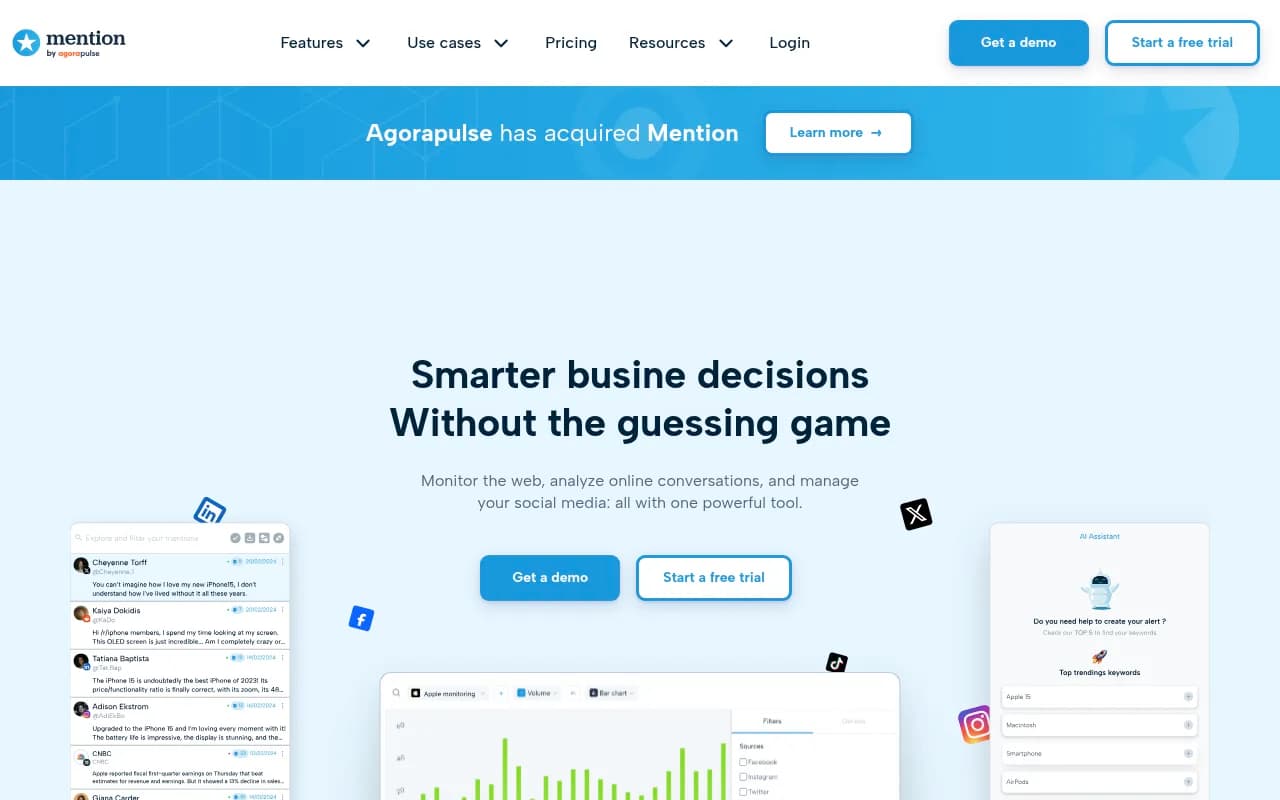
Mention is a media monitoring and social listening platform that tracks brand mentions across the web, social media, and -- as of recent updates -- AI chatbots. Originally founded as a standalone company, Mention was acquired by Agorapulse, a social media management platform, which has integrated its monitoring capabilities into a broader suite of social tools. The platform is used by brands like Microsoft, Hyundai, Stanford University, and Warner Bros to monitor online conversations, manage reputation, and respond to customers across channels.
The core value proposition is real-time visibility into what people are saying about your brand, competitors, or industry across over 1 billion sources. Mention positions itself as an all-in-one solution that combines monitoring, analytics, and social media publishing in a single dashboard. For PR teams managing multiple clients or brands tracking reputation across markets, this consolidation is appealing. But the platform is fundamentally a monitoring tool -- it shows you what's happening, not how to fix gaps in your visibility or optimize for emerging channels like AI search.
Monitor: Real-time brand tracking across 1 billion+ sources
Mention's monitoring engine is the heart of the product. You create keyword-based or page-based alerts that scan news sites, blogs, forums, social media platforms (Twitter, Facebook, Instagram, LinkedIn, Reddit, YouTube), and AI chatbots for mentions of your brand, competitors, or topics. The platform claims to monitor over 1 billion sources in real-time, though the exact source list and update frequency aren't publicly detailed.
Each mention includes metadata like influence score (how much reach the author has), sentiment (positive, neutral, negative), source type, and geographic location. You can filter mentions by date range, source, sentiment, language, or country. Real-time alerts notify you via email, Slack, or in-app when new mentions appear, which is useful for crisis management or catching PR opportunities early.
The query builder is straightforward -- you enter keywords, Boolean operators (AND, OR, NOT), and optional filters like language or domain exclusions. You can also set up page-based monitoring to track specific URLs (e.g. your product page or a competitor's landing page) and see who's linking to them. This is helpful for backlink analysis or understanding referral traffic sources.
What's missing: Mention doesn't provide prompt volume estimates, difficulty scoring, or query fan-outs like Promptwatch does for AI search. You see mentions as they happen, but you don't know which prompts or questions are driving high search volume in AI engines, or which ones you're missing entirely. There's no Answer Gap Analysis to show you what content competitors have that you don't, or what topics AI models want answers to but can't find on your site.
Analyze: Auto-updating reports and dashboards
Mention's analytics module turns raw mention data into visualizations and reports. You get metrics like total mention volume, reach (estimated audience size), sentiment breakdown, top sources, geographic distribution, and emotion analysis (joy, anger, fear, etc.). Charts include line graphs for volume over time, pie charts for sentiment distribution, and heat maps for geographic concentration.
The platform offers 10+ pre-built report templates based on use case (brand monitoring, competitor analysis, crisis management, PR campaign tracking) or you can build custom dashboards by dragging and dropping widgets. Reports auto-update as new mentions come in, so you're always looking at current data. You can export reports as PDFs or share live dashboard links with stakeholders.
Competitor comparison is a standout feature. You can track multiple brands in a single alert and compare their mention volume, sentiment, and reach side-by-side. This is useful for benchmarking your share of voice against competitors or identifying which brands dominate specific topics. For example, a SaaS company could track mentions of their product vs. three competitors and see who's getting more positive press or social media buzz.
Limitations: The analytics are descriptive, not prescriptive. Mention tells you what happened (volume spiked, sentiment dropped, competitor got more mentions), but it doesn't tell you why or what to do about it. There's no citation analysis to show which specific pages, Reddit threads, or YouTube videos AI models are pulling from when they mention (or don't mention) your brand. There's no content gap analysis to identify missing topics or angles. And there's no AI traffic attribution to connect visibility improvements to actual revenue or conversions.
Engage: Social media publishing and inbox management
Mention includes social media management features that let you curate, create, schedule, and publish content across major platforms (Facebook, Twitter, Instagram, LinkedIn). The content creation workflow includes AI-assisted writing tools (though specifics aren't detailed), a content library for storing reusable assets, and an approval workflow for team collaboration.
The unified social inbox combines messages, comments, and mentions from all connected accounts into a single feed, so you can respond to customers without switching between platforms. This is particularly useful for customer support teams or community managers handling high volumes of inbound messages. You can assign conversations to team members, tag them by topic, and track response times.
Content curation tools surface trending articles, images, and videos related to your keywords, which you can share directly to social channels. This is helpful for agencies managing multiple clients or brands that need a steady stream of relevant content but don't have dedicated content teams.
However, the social media features feel like an add-on rather than a core strength. Dedicated social media management platforms like Hootsuite, Buffer, or Sprout Social offer more robust scheduling, analytics, and collaboration features. Mention's social tools are functional but not best-in-class. If your primary need is social media management, you're better off with a specialized tool. If your primary need is monitoring with some basic publishing capabilities, Mention works.
AI chatbot monitoring: A recent addition with unclear depth
Mention's marketing materials highlight AI chatbot monitoring as a differentiator, claiming the platform tracks mentions in AI-generated responses. This is a response to the growing importance of AI search engines like ChatGPT, Perplexity, Claude, and Google AI Overviews. However, the specifics are vague. The website doesn't clarify which AI models are monitored, how often they're queried, or whether you can customize the prompts being tracked.
This is a critical gap. Effective AI search monitoring requires tracking specific prompts (e.g. "best CRM for small businesses", "Salesforce alternatives", "how to choose a CRM") across multiple AI models, understanding which prompts have high volume and low competition, and analyzing which pages, domains, and sources AI models cite in their responses. Mention's AI monitoring appears to be a surface-level feature -- you might see that your brand was mentioned in an AI response, but you won't get the depth of data needed to optimize your AI search strategy.
By contrast, Promptwatch monitors 10 AI models (ChatGPT, Perplexity, Google AI Overviews, Claude, Gemini, Meta AI, DeepSeek, Grok, Mistral, Copilot), provides prompt volume estimates and difficulty scores, shows citation and source analysis (which pages, Reddit threads, YouTube videos AI models cite), tracks AI crawler logs (which pages AI bots are reading on your site), and offers AI traffic attribution to connect visibility to revenue. Mention's AI monitoring is a checkbox feature; Promptwatch's is a complete optimization platform.
Who is Mention for?
Mention is built for PR teams, digital agencies, and brand managers at mid-to-large companies who need to monitor online conversations and manage social media from a single dashboard. Specific personas include:
- PR managers at enterprise brands (e.g. Microsoft, Hyundai) tracking media coverage, influencer mentions, and crisis signals across dozens of markets and languages
- Digital agencies managing 10-50 client accounts who need a scalable way to monitor brand mentions, competitor activity, and industry trends without switching between tools
- Social media managers at B2C brands (e.g. Dailymotion, NordVPN) who want to combine listening and publishing in one platform
- Market researchers analyzing consumer sentiment, emerging trends, or competitive positioning across industries
Mention is less suitable for:
- Brands prioritizing AI search visibility and wanting to optimize how they appear in ChatGPT, Perplexity, or Claude -- Mention's AI monitoring is too shallow for this use case
- Small businesses or startups on tight budgets -- at $599/month minimum, Mention is priced for established companies with dedicated PR or social teams
- SEO teams focused on traditional search rankings -- Mention doesn't track Google organic rankings, backlinks, or keyword positions like Ahrefs or Semrush
- Content teams needing AI-powered content generation to fill gaps in their AI search visibility -- Mention doesn't offer content creation tools beyond basic social media scheduling
Integrations and ecosystem
Mention integrates with Slack for real-time mention alerts, Zapier for connecting to 5,000+ apps, and Google Analytics for tracking referral traffic from monitored sources. The platform also connects to major social media platforms (Facebook, Twitter, Instagram, LinkedIn) for publishing and inbox management.
There's no public API documentation or developer resources, which limits customization and advanced workflows. If you need to export mention data to a data warehouse, build custom dashboards in Looker Studio, or integrate with proprietary tools, you're out of luck. This is a notable gap compared to competitors like Brandwatch or Meltwater, which offer robust APIs for enterprise customers.
Mention doesn't integrate with traditional SEO tools (Ahrefs, Semrush, Google Search Console) or AI search platforms (Promptwatch), so you can't combine traditional SEO data, AI search visibility, and social listening in a unified view. Each channel requires a separate tool.
Pricing and value
Mention's pricing starts at $599/month on an annual contract. The website doesn't break down what's included at this tier, but based on competitor pricing and the feature set, you likely get a limited number of alerts, mentions, and user seats. Higher tiers (Company Plan and above) are custom-priced and require a demo.
This pricing positions Mention as an enterprise-level tool. For context, Promptwatch starts at $99/month for AI search monitoring with 1 site, 50 prompts, and 5 AI-generated articles, scaling to $579/month for 5 sites, 350 prompts, and 30 articles. Mention's $599/month entry point is 6x higher than Promptwatch's base tier and 10x higher than basic social listening tools like Brand24 ($49/month) or Awario ($29/month).
The value proposition depends on your use case. If you're a large brand or agency managing dozens of clients and need a consolidated dashboard for monitoring, analytics, and social publishing, Mention's pricing is defensible. If you're a smaller brand focused on AI search visibility or looking for actionable insights (not just data), you're overpaying for features you don't need and missing capabilities you do.
Mention offers a free trial, though the duration and feature access aren't specified on the website. There's no freemium tier or self-serve pricing, which suggests the platform is designed for sales-assisted deals rather than product-led growth.
Strengths and limitations
Strengths:
- Comprehensive source coverage -- over 1 billion sources including web, social, forums, and AI chatbots
- Real-time alerts and monitoring for crisis management and PR opportunities
- Unified dashboard combining monitoring, analytics, and social media publishing
- Strong competitor comparison features for benchmarking share of voice
- Enterprise-grade reliability and customer support (used by Microsoft, Hyundai, Stanford)
Limitations:
- Monitoring-only approach -- no content gap analysis, AI content generation, or optimization tools like Promptwatch provides
- Shallow AI chatbot monitoring -- no prompt volume estimates, difficulty scoring, citation analysis, or AI crawler logs
- No AI traffic attribution to connect visibility improvements to revenue
- Missing Reddit and YouTube deep-dive insights that influence AI recommendations
- No API or developer resources for custom integrations
- High pricing ($599/month minimum) limits accessibility for small businesses and startups
- Social media features are functional but not best-in-class compared to dedicated tools
Bottom line
Mention is a solid choice for PR teams and agencies that need a consolidated dashboard for monitoring brand mentions, analyzing sentiment, and managing social media across multiple clients or markets. The platform's strength is breadth -- it covers a lot of sources and provides a unified view of online conversations. But it's fundamentally a monitoring tool, not an optimization platform.
If your goal is to understand what people are saying about your brand and respond quickly, Mention works. If your goal is to improve how your brand appears in AI search engines, identify content gaps, generate optimized content, and track the impact on traffic and revenue, you need a platform like Promptwatch that's built around taking action, not just observing. Mention shows you the data; Promptwatch helps you fix the gaps.
Tags:
Frequently asked questions
What is Mention and what does it do?
How much does Mention cost?
Does Mention offer a free plan?
Who is Mention best for?
Does Mention monitor AI chatbots like ChatGPT?
What is the difference between Mention and Promptwatch?
Can Mention help with AI search optimization?
Who owns Mention?
Similar and alternative tools to Mention