Key takeaways
- BrightEdge AI Catalyst is built for large enterprises already using BrightEdge's core SEO platform -- it extends that foundation into AI search visibility tracking and optimization.
- Real user reviews (Gartner Peer Insights) praise the depth of features but flag the credit-based pricing model as expensive at scale, particularly for global organizations monitoring hundreds of markets.
- BrightEdge's own data shows AI agent traffic reached 88% of human organic search activity by early 2026, with OpenAI driving 95% of that agent traffic -- which makes AI visibility a genuine business priority, not just a trend to watch.
- The platform lacks transparent public pricing; expect custom quotes and enterprise-level contracts.
- For teams that don't need the full BrightEdge stack, more focused AI visibility platforms offer comparable monitoring at a fraction of the cost.
What is BrightEdge AI Catalyst?
BrightEdge has been around since 2007. For most of its life, it was known as the enterprise SEO platform for Fortune 100 companies -- the kind of tool where you'd find Meta, Teradata, and Graco managing their organic search programs. It currently serves 1,700+ organizations and employs around 483 people.
AI Catalyst is BrightEdge's answer to the AI search shift. Launched as an extension of the core platform, it's positioned as "the only comprehensive view of AI presence and its impact across search" -- a claim that's worth examining carefully.
The pitch is straightforward: as AI models like ChatGPT, Perplexity, and Gemini increasingly mediate how customers find brands, companies need to understand where they appear (or don't appear) in those AI-generated responses. AI Catalyst is meant to give enterprise marketing teams that visibility, layered on top of BrightEdge's existing SEO infrastructure.
The data behind the urgency
BrightEdge released a notable data point in April 2026: AI agent requests had reached 88% of human organic search activity. Based on current growth trends, they project AI agent activity will surpass human-driven search by the end of 2026.
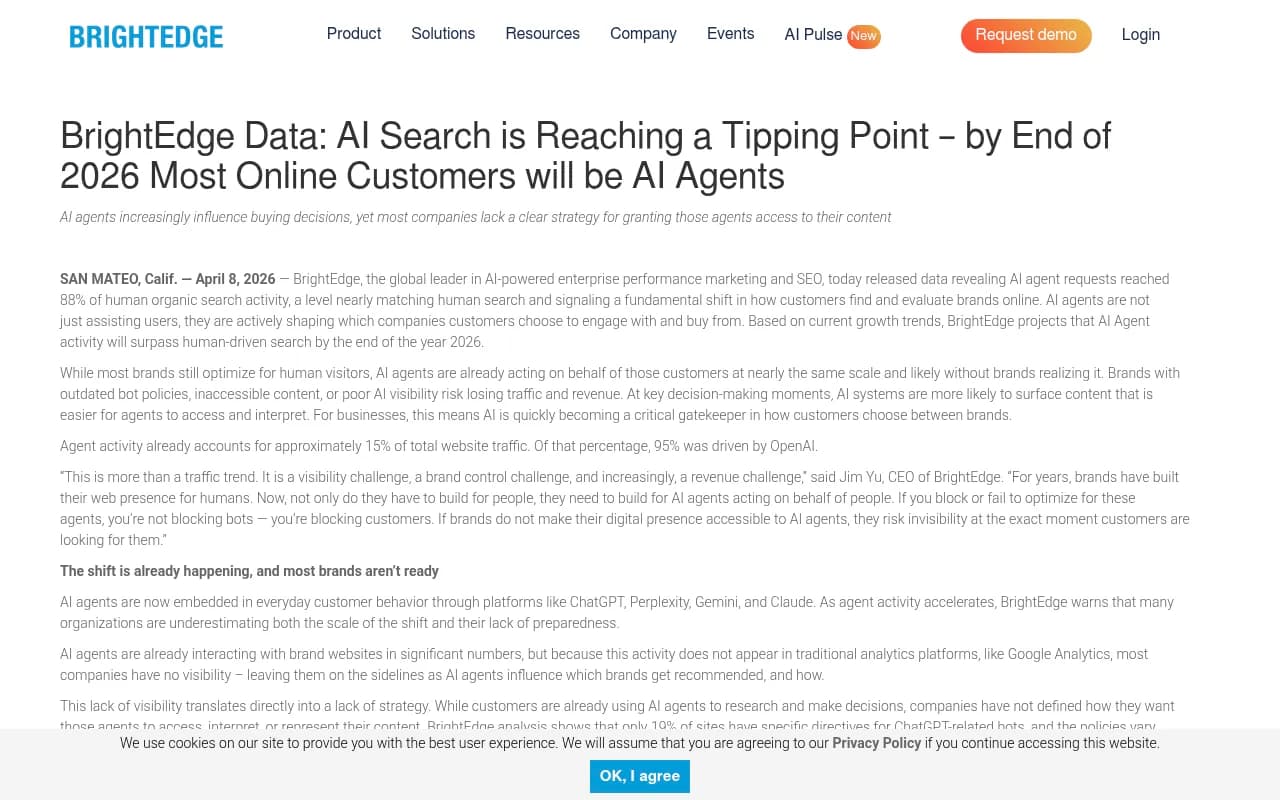
That number is striking. Agent activity already accounts for roughly 15% of total website traffic, and 95% of that is driven by OpenAI. Jim Yu, BrightEdge's CEO, put it bluntly: "If you block or fail to optimize for these agents, you're not blocking bots -- you're blocking customers."
The implication for brands is real. AI agents are already interacting with websites at scale, but because this activity doesn't appear in traditional analytics, most companies have no idea it's happening. That's the gap AI Catalyst is designed to address.
What AI Catalyst actually does
BrightEdge describes AI Catalyst as built on "18 years of proven innovation," which is a way of saying it sits on top of their existing data infrastructure. The core capabilities include:
AI search visibility tracking -- Monitor how your brand appears across AI-generated responses in platforms like ChatGPT, Perplexity, and Google AI Overviews. This is the baseline feature every AI visibility tool offers.
DataCube X integration -- BrightEdge's proprietary data engine, which indexes a large volume of search and content data, feeds into AI Catalyst's recommendations. This is one of the genuine differentiators vs. newer, lighter tools.
Content optimization recommendations -- The platform surfaces suggestions for improving AI visibility, though the depth of these recommendations varies based on your subscription tier.
AI-driven automations -- Workflow tools that help larger teams manage optimization tasks at scale, which matters when you're dealing with thousands of pages across multiple markets.
Competitive intelligence -- See how competitors are performing in AI search responses, which prompts they're appearing for, and where you're losing ground.
The platform also integrates with standard marketing and analytics systems, which is important for enterprise teams that need to connect SEO data to broader reporting workflows.
What real users say
Gartner Peer Insights has 16 verified reviews of BrightEdge as of 2026. The pattern is consistent: users who like it tend to be at companies where the full platform depth is actually needed. Users who are frustrated tend to be dealing with the cost structure.
One marketing manager at a $10-30B energy and utilities company gave it a 4/5 and wrote:
"BrightEdge is a powerful SEO platform that provides deep insights into both SEO performance and geolocation-specific visibility. Their customer service has been excellent -- very hands on, responsive, and proactive. Features like DataCube X, AI Catalyst, dashboards, and their suite of AI driven automations make BrightEdge a strong competitor against any major SEO tool on the market."
But the same reviewer flagged a real issue:
"BrightEdge's credit-based pricing model can become expensive quickly. Because the system uses one credit per keyword per SERP, monitoring keywords across 170 countries and all major search engines adds up fast."
A Senior Director of SEO at a media company was more blunt: "Good SEO performance platform, missing some of the more advanced features" -- 3/5.
The pattern here is familiar with enterprise software. The platform is genuinely capable, but the pricing model creates friction at scale, and some users feel it hasn't kept pace with newer, more specialized competitors on specific features.
Pricing: what to expect
BrightEdge doesn't publish pricing. It uses a custom quote model based on features selected, user seats, and keyword volume. The credit-based system means costs scale with usage -- which works fine for a focused deployment but gets expensive fast for global enterprises monitoring hundreds of markets.
If you're a Fortune 500 company with a dedicated SEO team and an existing BrightEdge relationship, AI Catalyst is a natural extension. If you're evaluating it fresh, budget for enterprise-level contracts and factor in the credit costs for your actual keyword and market scope.
How it compares to alternatives
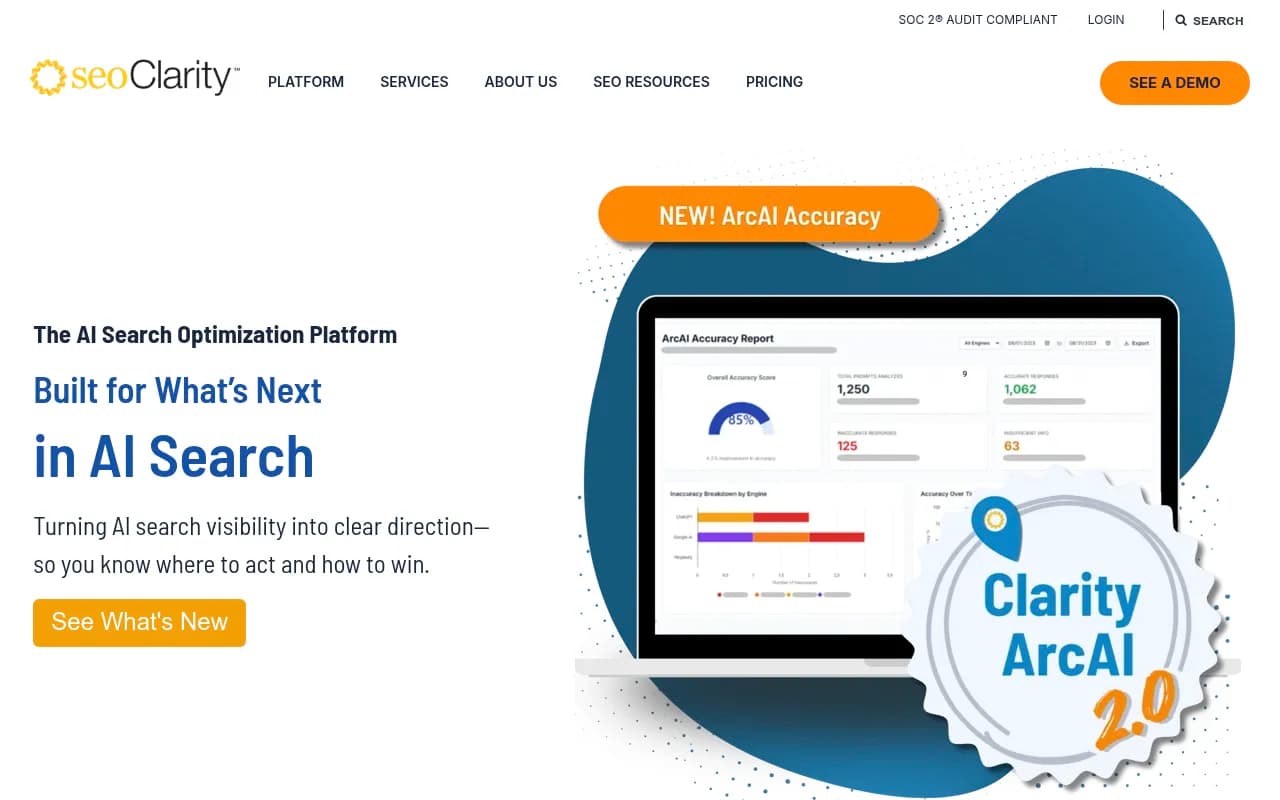
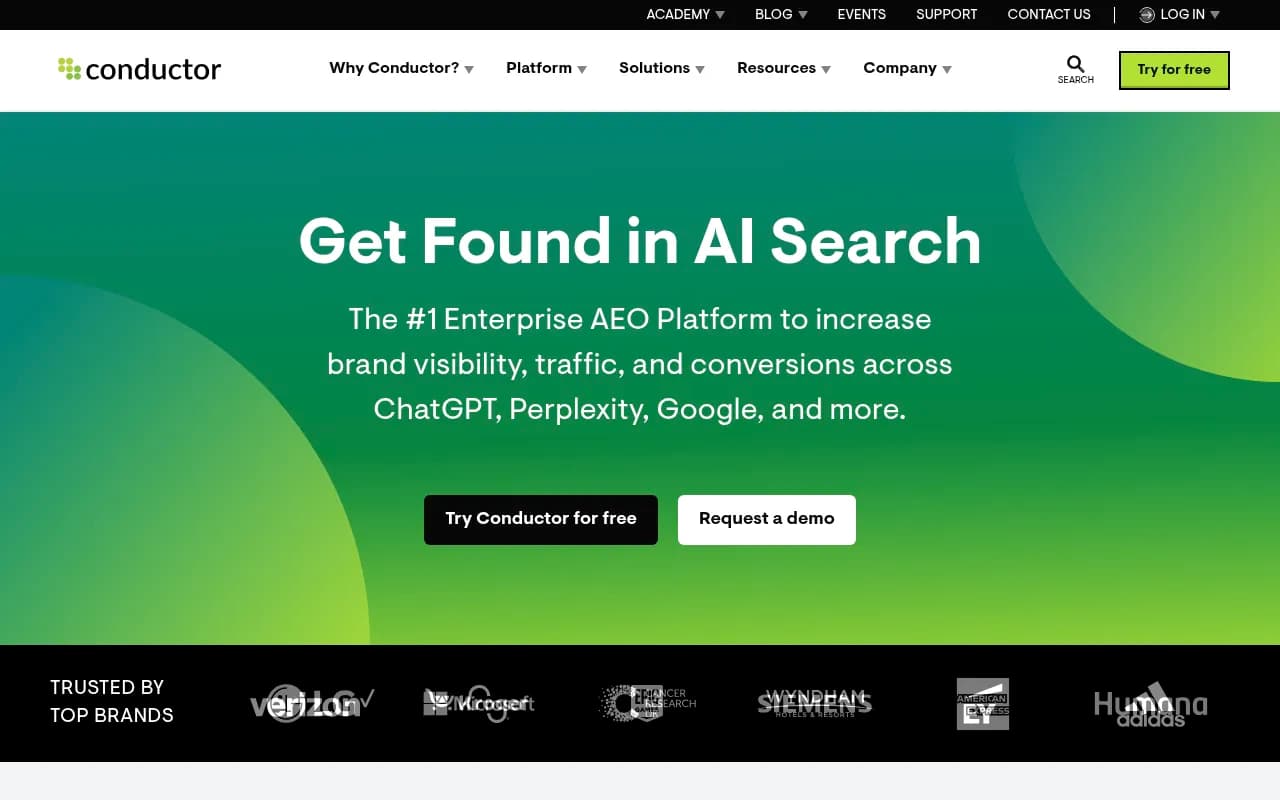
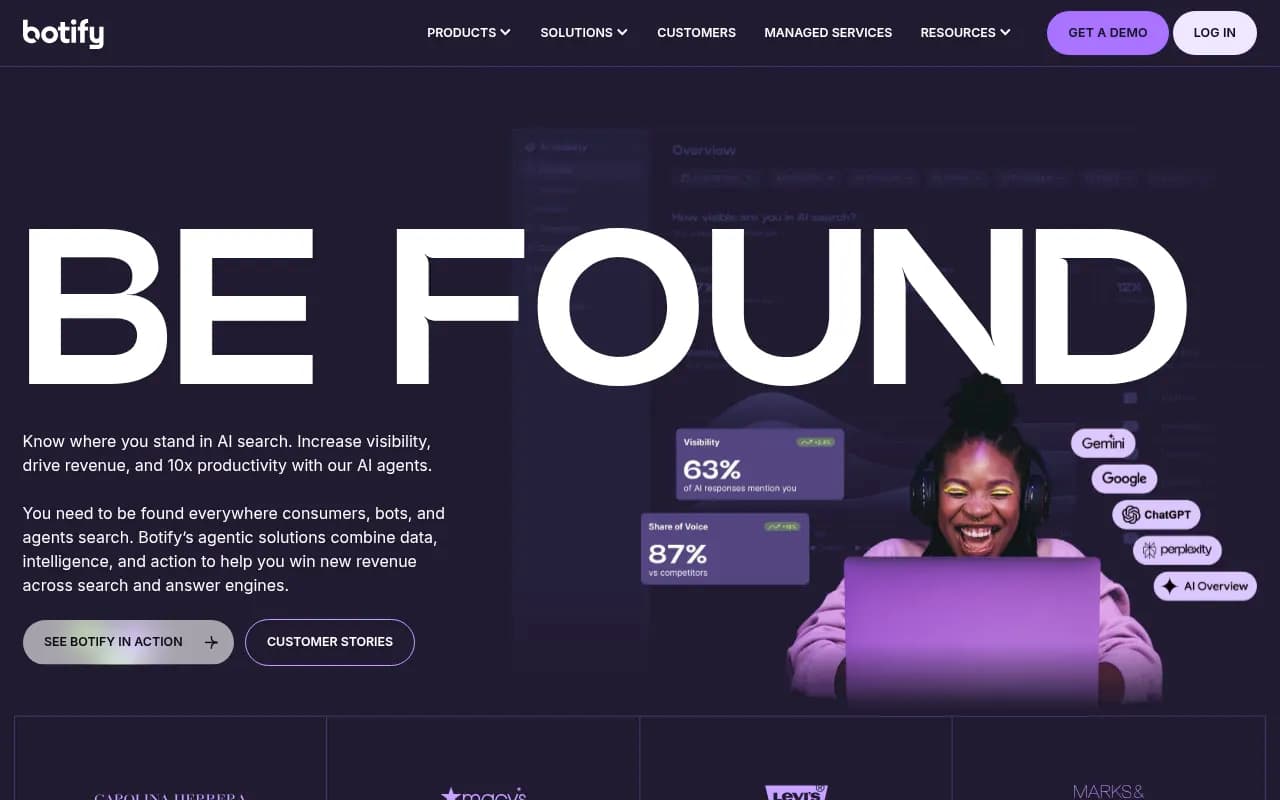
BrightEdge sits at the heavyweight end of the market. It's not competing with lightweight AI visibility trackers -- it's competing with platforms like seoClarity, Conductor, and Botify on the enterprise side, and with more focused AI visibility tools on the GEO/AEO side.
Here's how the landscape breaks down:
| Platform | Best for | AI visibility | Content generation | Pricing model | Crawler logs |
|---|---|---|---|---|---|
| BrightEdge AI Catalyst | Enterprise SEO teams | Yes | Limited | Custom/enterprise | No |
| Promptwatch | Marketing teams, agencies | Yes (10 models) | Yes (built-in) | $99-$579/mo public | Yes |
| seoClarity | Enterprise SEO | Yes | Limited | Custom | Partial |
| Conductor | Enterprise SEO | Yes | No | Custom | No |
| Semrush | Mid-market to enterprise | Limited | Via ContentShake | $140+/mo | No |
| Profound | Mid-market | Yes | No | Custom | No |
| AthenaHQ | Mid-market | Yes | No | Custom | No |

The honest comparison: BrightEdge AI Catalyst is strong if you're already embedded in the BrightEdge ecosystem and need AI visibility layered onto a mature enterprise SEO program. But if AI visibility is your primary concern -- tracking how your brand appears in ChatGPT, Claude, Perplexity, and other models, finding content gaps, and actually fixing them -- there are platforms built specifically for that job.
Promptwatch is worth mentioning here because it covers the full loop: find gaps, generate content, track results. It monitors 10 AI models, includes built-in content generation grounded in citation data, and has crawler logs showing exactly which AI agents are hitting your site and what they're reading. BrightEdge AI Catalyst monitors AI presence but doesn't close the loop in the same way.


The enterprise SEO context
One thing worth understanding about BrightEdge AI Catalyst: it's not a standalone product. It's an add-on to BrightEdge's core enterprise SEO platform. That means to get full value from it, you're buying into the broader BrightEdge stack -- DataCube X, the reporting infrastructure, the workflow tools.
For companies already using BrightEdge for traditional SEO, this is a reasonable extension. The AI visibility data sits alongside existing rank tracking, competitive intelligence, and content performance data in a unified interface. That integration has real value for teams that don't want to manage multiple platforms.
For companies evaluating BrightEdge fresh specifically for AI visibility, the calculus is different. You'd be paying for a lot of traditional SEO infrastructure to access the AI Catalyst features, when purpose-built AI visibility platforms might serve the specific need more efficiently.
Where BrightEdge AI Catalyst genuinely stands out
A few areas where BrightEdge has a real edge:
Data depth at scale. 18 years of search data and a large proprietary index (DataCube X) means BrightEdge has historical context that newer tools simply don't have. For trend analysis and competitive benchmarking, that history matters.
Enterprise support. Multiple reviewers specifically called out BrightEdge's customer success team. For large organizations with complex deployments, having hands-on support is worth something.
Unified platform. If your team needs traditional SEO, content performance, and AI visibility in one place, BrightEdge avoids the tool sprawl that comes with stitching together multiple point solutions.
Established credibility. Gartner recognizes BrightEdge in the Enterprise SEO Platforms market. For procurement teams at large companies, that validation matters.
Where it falls short
No transparent pricing. For teams trying to evaluate options quickly, the custom quote process adds friction. You can't self-serve into a trial.
Credit-based cost scaling. The per-keyword-per-SERP credit model creates unpredictable costs for global enterprises. One reviewer monitoring 170 countries found it "adds up fast."
AI visibility as an add-on, not a core. AI Catalyst feels like it was built onto an existing SEO platform rather than designed ground-up for the AI search era. That's not necessarily a dealbreaker, but it shows in some feature gaps.
Limited content generation. The platform surfaces optimization recommendations but doesn't have the kind of built-in AI content generation that purpose-built GEO platforms offer.
No crawler logs. Understanding which AI agents are crawling your site, which pages they're reading, and what errors they're hitting is increasingly important. BrightEdge doesn't surface this data in the way that tools built specifically for AI visibility do.
Who should consider BrightEdge AI Catalyst
It makes sense for:
- Large enterprises already using BrightEdge for SEO who want AI visibility without adding another vendor
- Companies with dedicated SEO teams that need deep competitive intelligence and historical data
- Organizations where procurement requires established vendors with Gartner recognition
- Teams managing complex multi-channel SEO programs where a unified platform justifies the cost
It probably doesn't make sense for:
- Teams whose primary goal is AI visibility tracking without a broader SEO program
- Companies that need transparent, predictable pricing
- Organizations that want to actively generate and optimize content for AI search, not just monitor it
- Smaller teams or agencies where enterprise pricing is prohibitive
The bigger picture
BrightEdge's own data makes the case for why this category matters. AI agent traffic at 88% of human search volume, with projections to surpass human search by end of 2026, is a real shift -- not a trend to monitor from a distance. The question isn't whether to invest in AI visibility; it's which platform is the right fit for your specific situation.
BrightEdge AI Catalyst is a credible answer for large enterprises with existing BrightEdge relationships. For everyone else, the market has matured enough that there are purpose-built alternatives worth evaluating before committing to an enterprise contract.
The right move is to be honest about what you actually need: if it's comprehensive AI visibility with content optimization capabilities at a predictable price point, look at platforms built specifically for that job. If it's AI visibility layered onto an existing enterprise SEO program, BrightEdge AI Catalyst is worth a serious look.