Key takeaways
- Rank tracking is now three jobs: classic SERP position, presence inside AI answers, and citation share. Most 2026 tool comparisons treat the last two as table stakes.
- Classic rank trackers (SE Ranking, Nightwatch, Advanced Web Ranking, Semrush) bolted on AI modules. Standalone AI trackers multiplied. Both groups are now being squeezed by platforms that also act on the data.
- Buyers have stopped asking "was I mentioned?" and started asking "what do I fix, and did the fix work?" Crawler logs, traffic attribution, and content execution are the new differentiators.
- Collection method matters. Real-UI monitoring and API collection can return different answers, and prompt-level tracking alone misses the query fan-outs that decide which pages get retrieved.
- Be skeptical of uncited benchmarks. Plenty of 2026 listicles quote mention-rate norms and ROI figures with no source.
What actually changed
For years, rank tracking meant one motion: pick a keyword, set a geo and device, watch a number on Google move. Every tool was built around that.
In 2026 that is one of three jobs. Analyze AI's May 2026 roundup frames it well: classic SERP position, AI answer presence (how often and in what tone you appear in ChatGPT, Perplexity, Gemini, Claude, Copilot, and Google AI Mode), and citation share (which of your URLs get cited, relative to competitors). A tool that only does the first now sees part of the picture.
The Pew Research Center's 2025 analysis, cited in Technova Partners' November 2026 review, found users who saw an AI summary clicked a traditional result in 8% of visits versus 15% without one. Whatever your exact numbers, the click you used to earn at position three is now partly decided before anyone sees your link.
Three things shifted in practice:
- Incumbents added AI modules. Technova Partners compared eight classic rank trackers in November 2026 and found seven of them track AI answers in some form, six in the entry plan. Only Wincher had none.
- Standalone AI trackers exploded. One Reddit r/SaaS guide summarized it bluntly: most tools do roughly the same core job, but pricing varies massively. A YouTube commenter on a popular 2026 tools video said half the tools reviewed did not exist a year earlier.
- Consolidation started. Mod AI's Q3 2026 review says the AI-visibility tooling market raised hundreds of millions of dollars and is already consolidating. That is a vendor's reading of the market, so treat the details loosely, but the direction matches what I see in the catalog: lots of near-identical dashboards and not many with a reason to exist.
The three tiers that emerged
Sorting tools by what they actually do, rather than what their landing pages claim, gives roughly three groups.
Tier 1: classic rank trackers with an AI add-on
These started with SERP positions and added prompt tracking. They are the safe pick if Google is still most of your traffic.
SE Ranking scored highest in Technova's November 2026 comparison (24/25). Its Core plan at EUR 109/month tracks 2,000 keywords daily and includes 25 daily AI prompts across five AI engines. Its AI quota is half of Nightwatch's.
Nightwatch (21/25) has the largest AI quota at entry price, 50 prompts on a EUR 79/month Starter plan, across ChatGPT, Claude, Gemini, and Perplexity. It also tracks in 107,000+ locations. The API, Looker Studio, and white-label reports start at EUR 159/month.
Advanced Web Ranking is the volume play at about EUR 0.02 per keyword, but only on weekly updates. Daily updates use seven times more keyword units, so do that arithmetic first.
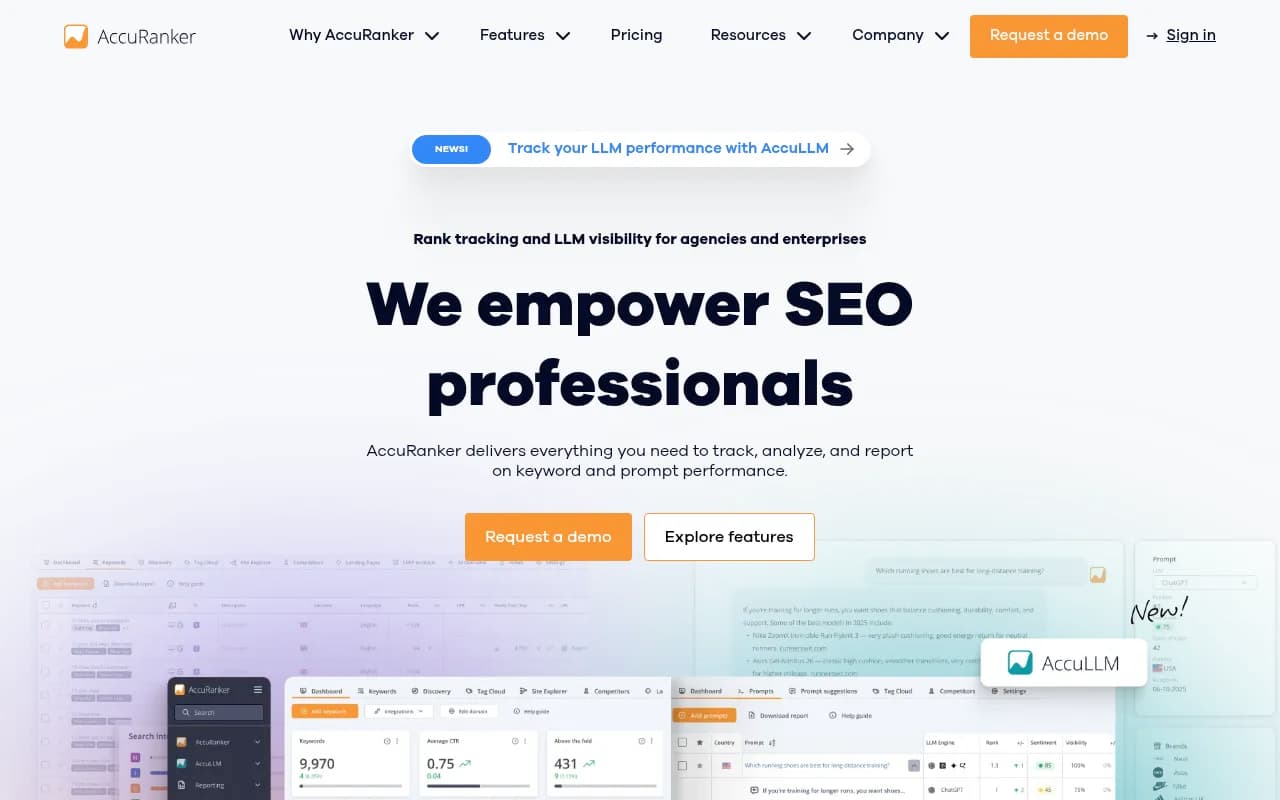
AccuRanker stays a pure tracker. Its AI monitoring (AccuLLM) is a separate product, and the API and Data Studio only unlock at EUR 809/month. [tool:wincher] is the cautionary tale: a good budget Google tracker with no AI answer tracking at all.
Tier 2: suite vendors bolting on AI visibility
Semrush, Ahrefs Brand Radar, Moz, and similar suites sell AI visibility as an add-on to something you may already pay for. The upside is one login. The downside, per Technova's scoring, is integration gating (Semrush lists the API only on its Advanced plan) and fixed prompt sets rather than prompts you design around your buyers. Analyze AI's roundup also flags Adobe's acquisition of Semrush as fine print worth reading before you commit.

Tier 3: dedicated AI visibility platforms
This is the crowded middle. Profound, Scrunch, Otterly.AI, Peec AI, AthenaHQ, Rankshift, Qwairy, LLM Pulse, and dozens of others live here. Most do the monitoring job competently. Where they split is on what happens next.




The full directory of AI rank trackers is at ai-rank-tools.com, and bestgeosoftware.com covers the broader GEO software category. If you want an overview of where each tool sits, start there rather than relying on any single vendor's "top 5" list.
Which tools survived, and what "survived" means
I can't give you a reliable list of shutdowns and acquisitions. Our research did not turn up verified closures, and I would rather say that than invent a body count. What I can say is how the survivors tend to look.
They own a data advantage. Tools collecting from real user interfaces, in specific countries and languages, produce different answers than tools calling APIs. User-facing answers, citations, and shopping recommendations can differ from API outputs. That is a structural gap, not a feature checkbox.
They go past the dashboard. Analyze AI's pitch is a programmable agent builder with 180+ nodes wired to GA4, Search Console, and DataForSEO. Other tools publish content, ship fixes, or generate action lists. The common thread: a score with no next step is easy to replace.
They are cheap or they are deep. Budget trackers (Otterly, Peec, Rankscale, Airefs and the long tail) compete on price. Platforms like Promptwatch compete on depth. The squeezed middle is a dashboard at a premium price with no extra data and no execution.
What buyers want now
Putting together the 2026 buyer-side signals (comparison scorecards, Reddit threads, YouTube comments), the requirements have shifted.
From "was I mentioned" to "why, and what do I do"
A mention count is a vanity metric by itself. Buyers want to know which pages get cited, where they land in the source list, what the model says about the brand, and what to publish. The metrics that locate problems are separate ones: share of voice (coverage), position (prominence), self-citation rate (content or crawlability), and sentiment (reputation).
Fan-out awareness
One point most tracker comparisons skip. Promptwatch's ChatGPT query fanout data shows a single prompt can trigger 3 to 8+ separate web searches, and average searches per response moved from 2.15 in early December to about 1.84 by early March 2026, with average fan-out query length shrinking from roughly 117 characters to the high 80s. The April data came back at 1.0 searches per response after a collection gap, so the numbers move with each ChatGPT update. The implication: tracking the prompt alone misses the sub-queries that decide which pages get retrieved. Buyers increasingly ask whether a tool surfaces fan-outs, and Promptwatch's ChatGPT Query Fan-Out Generator is a free way to see what that looks like. See the full ChatGPT query fanouts report.
Engine-specific expectations
Not every engine behaves the same, so equal weighting is a mistake. According to Promptwatch's average sources per response data (September 2025), ChatGPT cites about 5 sources per web-search answer, Google AI Overviews about 10, and Perplexity almost exactly 10 every day. Microsoft Copilot swung from under 2 to nearly 17 within weeks before settling low. Practical reading:
- Citation slots are scarcer in ChatGPT, so each one is worth more.
- Perplexity's steady count makes it a clean test bench: if your citations move, it is probably your content.
- Judge Copilot on monthly trends, not weekly snapshots.
Other Promptwatch Data reports add colour. In the October 2026 report, ChatGPT drew 0.46% of citations from social platforms while Google AI Overviews drew 12.2% (Sep 28 to Oct 4, 2026). And reddit.com's share of ChatGPT citations fell from about 4% to 0.5% on August 14, 2026. A tool that is not recalibrating for shifts like these is stale.
Crawler and traffic evidence
Buyers want to know whether AI bots can read their pages and whether AI sends visits that convert. Meta-WebIndexer, for instance, went from roughly 2% to nearly 38% of tracked AI crawler requests between mid-July and August 9, 2026. You only see that with IP-verified crawler logs. Add ChatGPT dropping its referrer on October 8, 2026, and traffic attribution becomes a real product requirement, not a nice-to-have. The attributing AI traffic guide walks through it.
Honest benchmarks
A lot of 2026 content recycles numbers with no source. The RankMonster guide, for example, claims a "good" mention rate is 20-40% across 30 queries, that Google-ranking content shows up in AI summaries 60-70% of the time, and that checking daily "adds noise." None of those are cited. Promptwatch's own daily data shows real day-to-day movement, so I would not accept the "weekly is enough" advice at face value. The guide also states that Google AI Overviews drives most AI search traffic and that tracking a handful of models per plan is typical; our research did not confirm that for any specific vendor, so check pricing pages yourself.
Comparison: how the tiers stack up
| Category | Examples | Strength | Gap |
|---|---|---|---|
| Classic trackers with AI add-on | SE Ranking, Nightwatch, AWR, AccuRanker | Daily SERP data, low cost per keyword | Small AI prompt quotas, little execution |
| Suite add-ons | Semrush, Ahrefs Brand Radar, Moz Pro | One login, familiar data | Fixed prompt sets, API gating |
| Monitoring-first AI tools | Otterly, Peec, Rankscale, Profound, Scrunch | Prompt-level visibility, competitor views | Few ship content, crawler logs, or traffic attribution |
| End-to-end platforms | Promptwatch, Analyze AI and a few others | Monitor, trace, act, measure loop | Higher entry price than budget trackers |
Where Promptwatch fits
Promptwatch is the platform 1001 SEO Media uses for AI visibility work, and I think it is the clearest example of the "act and verify" tier. It collects data from the real interfaces of ChatGPT, Google AI Overviews, Google AI Mode, Gemini, Perplexity, Copilot, Meta AI, and Amazon Alexa, then pairs that with IP-verified AI crawler logs, visitor analytics, and a Content Agent that writes and publishes pages to WordPress, Webflow, or Framer. Page Tracker and weekly audits then check whether the fix worked.

Pricing as listed on promptwatch.com/pricing: Essential is $95/month (50 prompts), Professional $245/month (150 prompts), and Business $579/month (350 prompts, plus the Content Agent, faster-than-daily tracking, and local targeting). Agency plans run $199, $399, and $799 per month. Confirm on the pricing page before buying, and note the Content Agent starts at Business. A 7-day free trial exists on monthly billing, and the free AI visibility report is a no-login way to see how it works. For a head-to-head view, see the 2026 platform comparison.
It is not the cheapest option. If you only want a lightweight weekly check on 20 prompts, a budget tracker will do.
How to pick in practice
If Google is still 90% of your traffic
Stay with a classic tracker that includes some AI quota. SE Ranking or Nightwatch cover both jobs for little money. Add a Google-only tool like AccuRanker only if you need huge keyword volumes.
If AI is already a visible channel
Pick a platform that shows citations, crawler access, and traffic, not just mentions. Run a trial against 30 to 50 real buyer prompts, in your actual country and language, and check whether the answers match what you see by hand in the live interfaces.
If you are an agency
Look for unlimited projects, pitch projects, white-label reporting, and API access. Compare per-client economics, not headline price. Promptwatch's agency plans and tools like Cairrot, OpenLens, and Rankability are aimed here.
If you are on a tight budget
The long tail of low-cost trackers (Otterly, Peec, Airefs, Rankscale, Radix AI, BrandAxis) is fine for baseline monitoring. Just know what you are not getting.
A short evaluation checklist
- Does it collect from real UIs or only APIs, and can you filter by country and language?
- Does it show query fan-outs, or only the prompt you typed?
- Can you see which URLs get cited and where they rank in the source list?
- Are there crawler logs, and are they IP-verified?
- Can it attribute AI-referred traffic after ChatGPT's referrer change?
- What does it do after reporting a gap: list, draft, publish, or nothing?
- What is the real cost per tracked prompt on the plan you would actually use?
What I would do next
Build a list of 30 to 50 prompts from Search Console queries and your sales calls. Run them through two tools for a month. Compare what each tool reports to what you see in the live ChatGPT and Perplexity interfaces. Then pick the one that tells you what to fix, not just where you stand. Rank tracking in 2026 is cheap to start and expensive to do badly, because a good dashboard with no action behind it is just a nicer way to watch competitors win.