Nightwatch Review 2026
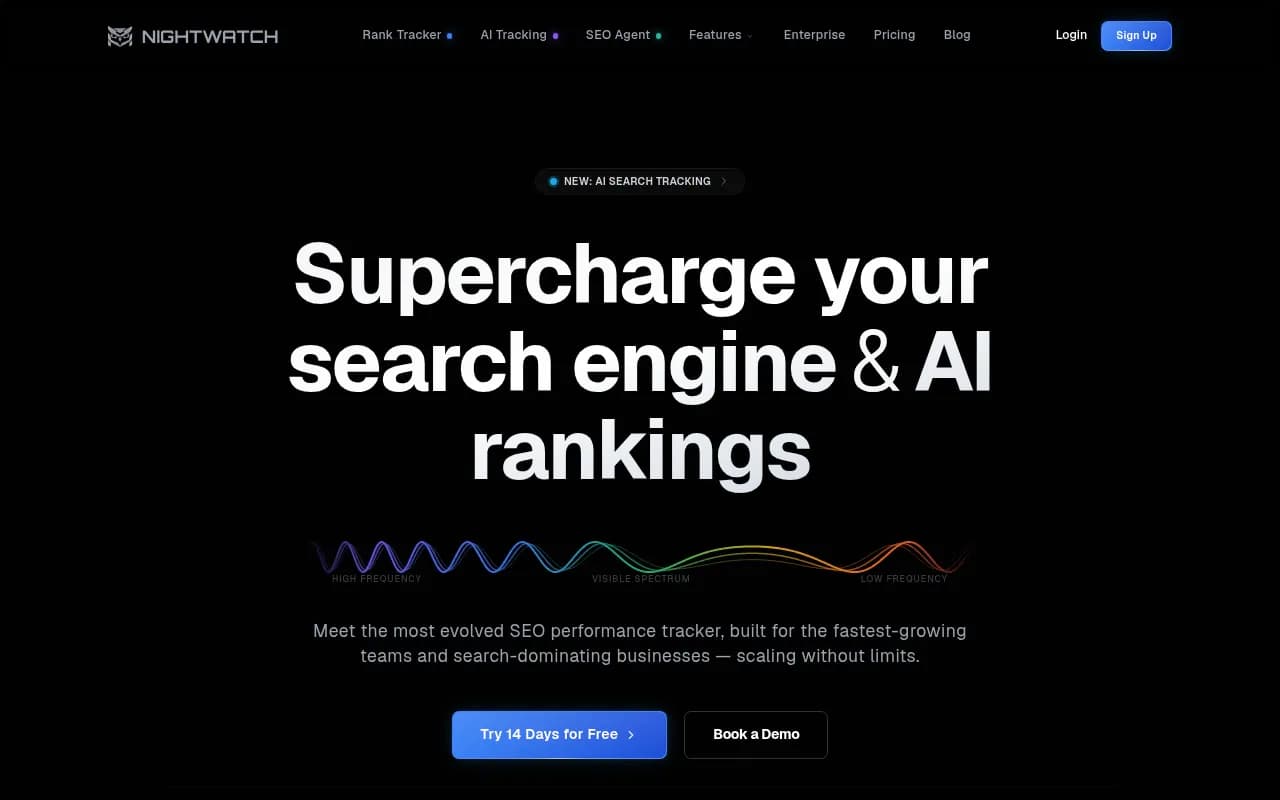
Marketing-focused AI search monitoring tool that tracks brand visibility and performance across AI-powered search engines.
Key Takeaways
- Nightwatch combines traditional rank tracking with AI search monitoring in one platform -- tracks Google, Bing, YouTube, plus ChatGPT, Claude, Gemini, and Perplexity
- Real-time rank updates and 190,000+ location tracking (down to zip code level) make it one of the most precise trackers available
- Lacks content gap analysis, AI content generation, crawler logs, and traffic attribution that Promptwatch offers -- this is a monitoring tool, not an optimization platform
- Strong for agencies managing multiple client sites with white-label reporting and API access
- Pricing starts at $32/month, making it accessible for small teams, but limited AI tracking on lower tiers

Nightwatch is a rank tracking and SEO monitoring platform that's been around since the mid-2010s, originally focused on traditional search engine rankings. In 2024-2025, they pivoted hard into AI search monitoring, adding support for ChatGPT, Claude, Gemini, and Perplexity alongside their existing Google/Bing/YouTube tracking. The pitch: you shouldn't need separate tools to track traditional search and AI visibility. One dashboard, one dataset, one source of truth.
The target audience is SEO agencies, in-house marketing teams at mid-sized companies, and consultants managing 5-50 client sites. If you're a solo blogger tracking 20 keywords, this is overkill. If you're an enterprise brand with 10,000+ keywords across multiple countries, you'll hit their Enterprise tier. The sweet spot is agencies billing $5k-$50k/month who need accurate data, white-label reports, and enough flexibility to handle diverse client needs without manual spreadsheet hell.
Nightwatch positions itself as the "high-performance" alternative to tools like SEMrush and Ahrefs -- more accurate data, faster updates, better localization, lower cost per keyword. Their accuracy claim (99.9% vs industry average 82.5%) is bold but backed by their infrastructure: they pull fresh data daily (or real-time on higher plans) instead of relying on cached estimates. Whether that 99.9% number holds up in practice is hard to verify independently, but user reviews consistently mention that Nightwatch rankings match what they see in actual SERPs more often than competitors.
Traditional Rank Tracking (The Core Product)
Nightwatch's bread and butter is keyword rank tracking across Google, Bing, Yahoo, DuckDuckGo, and YouTube. You add keywords, assign them to projects (websites), set locations and devices, and Nightwatch checks rankings daily. The interface shows average position, search visibility (estimated share of impressions), click potential (how many clicks you could get if you ranked #1 for everything), and traffic value (monetary equivalent based on CPC data).
Location Tracking: This is where Nightwatch separates itself from cheaper tools. They support 190,000+ locations worldwide, down to zip code level. Most rank trackers offer city-level or state-level tracking; Nightwatch goes granular. If you're a local business or agency managing multi-location clients (restaurants, dental practices, real estate), this matters. You can track "dentist near me" in specific neighborhoods, not just "New York City" as a blob. The UI lets you add locations in bulk or search by zip code, and you can segment reports by region.
Device Tracking: Desktop, mobile, and tablet. Standard feature, but Nightwatch actually checks all three separately instead of extrapolating mobile from desktop data (which some tools do to save API costs).
SERP Features: Nightwatch tracks whether you appear in Featured Snippets, Knowledge Panels, Local Packs, People Also Ask boxes, and other SERP features. The dashboard shows which keywords trigger these features and whether you own them. Useful for understanding where you're winning beyond just organic rankings.
Real-Time Updates: On higher-tier plans, you can refresh critical keywords on demand. Most tools update once per day; Nightwatch lets you hit "refresh now" if you just published a big piece of content or made technical changes and want to see immediate impact. This costs extra API calls, so it's throttled, but it's there.
Segment Analysis: You can tag keywords by intent (transactional, informational, commercial), funnel stage, product line, or custom labels. The dashboard then shows performance by segment -- e.g. "our transactional keywords are up 12% this month but informational is flat." This is basic but surprisingly rare in rank trackers. Most tools dump all keywords into one list; Nightwatch lets you organize and filter intelligently.
AI Search Monitoring (The New Differentiator)
In late 2024, Nightwatch added AI tracking for ChatGPT, Claude, Gemini, and Perplexity. The idea: these AI engines are becoming search engines. People ask ChatGPT "best CRM for small business" and get an answer without ever opening Google. If your brand isn't mentioned in that answer, you're invisible.
Nightwatch's AI tracking works by simulating user prompts and analyzing the responses. You add prompts (questions or queries your target audience would ask), and Nightwatch runs them through each AI model daily. It then parses the responses to see if your brand is mentioned, cited, or recommended. You get an "AI Visibility Score" (0-100) that represents your presence across all tracked prompts and models.
Share of Voice: For each prompt, Nightwatch shows which brands are mentioned and how often. If you're tracking "best project management software" and Asana appears in 80% of responses while you appear in 20%, your share of voice is 20%. This is useful for competitive benchmarking -- you can see who's dominating AI recommendations in your category.
Sentiment Analysis: Nightwatch attempts to classify whether AI mentions are positive, neutral, or negative. This is basic sentiment scoring (probably keyword-based, not deep NLP), but it flags if an AI model is recommending you vs warning against you.
Generative Rankings: For prompts that return a ranked list (e.g. "top 10 email marketing tools"), Nightwatch extracts your position. You might rank #1 in ChatGPT, #3 in Gemini, and not appear in Claude. The dashboard shows this side-by-side.
Active Citations: If an AI model cites a specific source (e.g. a blog post, Reddit thread, or review site), Nightwatch surfaces that. You can see which external content is influencing AI recommendations about your brand. This is where the tool starts to overlap with Promptwatch's citation tracking, but Nightwatch doesn't go as deep -- no Reddit/YouTube-specific insights, no crawler logs, no page-level attribution.
What's Missing vs Full GEO Platforms
Nightwatch is a monitoring tool. It shows you where you rank in AI search, but it doesn't help you improve those rankings. There's no content gap analysis (which prompts are competitors visible for that you're not), no AI content generation (no writing agent to create articles optimized for AI citations), no AI crawler logs (you can't see when ChatGPT or Perplexity crawled your site), and no traffic attribution (you can't connect AI visibility to actual website visitors or revenue).
Compare this to Promptwatch, which is built around the action loop: find gaps (Answer Gap Analysis), create content (AI writing agent grounded in 880M+ citations), track results (page-level citation tracking + traffic attribution). Nightwatch stops at step one. You see the data, but you're on your own to figure out what to do about it. For agencies that already have content teams and just need visibility metrics to report to clients, that's fine. For brands trying to actually optimize their AI presence, it's a gap.
Nightwatch also doesn't track prompt volumes or difficulty scores (how hard it is to rank for a given prompt), doesn't offer query fan-outs (how one prompt branches into sub-queries), and doesn't monitor ChatGPT Shopping or product recommendations. The AI tracking is broad but shallow -- good for awareness, not deep optimization.
Reporting and Integrations
Nightwatch's reporting is one of its strongest features. You can create white-label PDF reports with custom branding, logos, and commentary. Reports can be scheduled daily, weekly, or monthly and auto-emailed to clients. The templates are flexible -- you choose which metrics to include, which keywords to highlight, and how to visualize trends (line charts, bar charts, tables).
Looker Studio Integration: Nightwatch connects to Google Looker Studio (formerly Data Studio) so you can build custom dashboards. This is huge for agencies that want to combine Nightwatch data with Google Analytics, Search Console, and ad spend in one client-facing dashboard. The integration is native (not a third-party connector), so setup is straightforward.
API Access: Nightwatch has a developer-friendly REST API that lets you pull ranking data, audit results, and AI insights programmatically. This is useful for building custom internal dashboards or feeding data into BI tools like Tableau or Power BI. The API is well-documented and includes endpoints for bulk keyword imports, historical data exports, and real-time rank checks.
Google Analytics & Search Console: You can connect GA and GSC to Nightwatch to overlay traffic and click data on your rankings. This helps you see which keywords are driving actual visits vs just ranking well. It's not full attribution (you can't tie a specific AI mention to a conversion), but it's better than rank data in isolation.
Keyword Research and Site Audit
Nightwatch includes basic keyword research and site audit tools, but these feel like checkbox features rather than core strengths.
Keyword Research: You enter a seed keyword, and Nightwatch returns related keywords with search volume, CPC, and competition data. It's pulling from the same data sources as everyone else (likely Google Keyword Planner API), so the results are similar to Ahrefs, SEMrush, or Ubersuggest. The UI is clean, and you can add keywords directly to your tracking list, but there's no unique insight here.
Prompt Research: This is newer -- a database of common prompts people ask AI engines, with volume estimates. It's meant to help you discover which AI queries are relevant to your business. The data is thin compared to dedicated GEO tools (Promptwatch has 1.1 billion+ citations and prompts analyzed; Nightwatch's prompt database feels more like a beta feature), but it's a start.
Site Audit: Crawls your website and flags technical SEO issues (broken links, missing meta tags, slow pages, duplicate content). It's functional but not as comprehensive as Screaming Frog or Sitebulb. If you already have a dedicated audit tool, you won't switch to Nightwatch's. If you don't, it's a nice bonus.
Who Should Use Nightwatch
Nightwatch is best for SEO agencies and consultants managing 5-50 client websites who need accurate rank tracking, local visibility monitoring, and white-label reporting. It's also a fit for in-house marketing teams at mid-sized companies (50-500 employees) who want one tool for traditional search and AI visibility without paying enterprise prices.
Specific personas:
-
Local SEO agencies: The zip-code-level tracking and Local Pack monitoring make Nightwatch a strong choice for agencies managing multi-location clients (franchises, dental groups, real estate brokerages). You can track "plumber in [zip code]" across 50 locations and report on local pack rankings separately from organic.
-
SaaS marketing teams: If you're tracking 500-2000 keywords across multiple countries and want to see how you rank in AI search vs traditional search, Nightwatch gives you that unified view. The API and Looker Studio integration let you build custom dashboards for exec reporting.
-
E-commerce brands: The segment analysis (track product category keywords separately) and traffic value estimates help you prioritize which keywords to optimize for revenue impact. The AI tracking is less relevant here unless you're in a category where people ask AI for product recommendations (e.g. "best running shoes for flat feet").
Who should NOT use Nightwatch: Solo bloggers or small businesses tracking fewer than 100 keywords (too expensive, too complex). Enterprise brands with 10,000+ keywords and complex multi-brand tracking needs (you'll need the Enterprise plan, which is custom pricing and likely expensive). Brands that want to actively optimize their AI visibility, not just monitor it (you need a tool like Promptwatch that includes content gap analysis, AI content generation, and traffic attribution).
Pricing and Value
Nightwatch's pricing starts at $32/month (billed annually) for the Starter plan, which includes 200 keywords, 1 website, daily updates, and basic reporting. The Professional plan is $79/month (500 keywords, 3 websites, AI tracking, API access). The Agency plan is $199/month (2000 keywords, 10 websites, white-label reports, priority support). Enterprise is custom pricing.
Compared to competitors:
-
SEMrush: Starts at $139.95/month for 500 keywords. Nightwatch is cheaper, but SEMrush includes content marketing tools, PPC research, and a larger keyword database.
-
Ahrefs: Starts at $129/month for 750 keywords. Ahrefs has better backlink data and content explorer; Nightwatch has better local tracking and AI monitoring.
-
AccuRanker: Starts at $116/month for 1000 keywords. Similar accuracy claims, but no AI tracking. Nightwatch is more feature-complete.
-
Promptwatch: Starts at $99/month for 50 prompts, 1 site, AI tracking, content gap analysis, and AI content generation. Promptwatch is more expensive per keyword but includes optimization tools Nightwatch lacks. If you're serious about AI visibility, Promptwatch is the better investment. If you just need monitoring and already have a content strategy, Nightwatch is cheaper.
Nightwatch offers a 14-day free trial (no credit card required), which is generous. Most rank trackers give you 7 days or require payment upfront.
Strengths
-
Unified traditional + AI tracking: One dashboard for Google, Bing, YouTube, ChatGPT, Claude, Gemini, Perplexity. No need to toggle between tools.
-
Location precision: 190,000+ locations, zip-code-level tracking. Best-in-class for local SEO.
-
Real-time updates: On-demand rank refreshes for critical keywords (higher-tier plans).
-
White-label reporting: Agencies can brand reports with their own logo and send them directly to clients.
-
API and Looker Studio: Strong integrations for custom dashboards and data exports.
-
Accuracy: User reviews consistently mention that Nightwatch rankings match actual SERPs more closely than competitors.
Limitations
-
No content optimization: Nightwatch shows you where you rank in AI search but doesn't help you improve those rankings. Missing content gap analysis, AI content generation, crawler logs, and traffic attribution that Promptwatch provides.
-
Shallow AI insights: AI tracking is broad (covers multiple models) but not deep. No prompt volume data, no difficulty scoring, no query fan-outs, no Reddit/YouTube tracking, no ChatGPT Shopping monitoring.
-
Keyword research is basic: The keyword research tool pulls standard data; nothing unique or proprietary.
-
Site audit is lightweight: Functional but not as thorough as dedicated crawlers like Screaming Frog or Sitebulb.
-
AI tracking limited on lower tiers: The Starter plan ($32/month) doesn't include AI tracking. You need Professional ($79/month) or higher.
Bottom Line
Nightwatch is a solid rank tracking tool that's evolved to include AI search monitoring. It's best for agencies and in-house teams that need accurate, localized rank data across traditional search engines and AI platforms, with strong reporting and API access. The unified dashboard is convenient, and the pricing is competitive.
But it's a monitoring tool, not an optimization platform. If you want to actually improve your AI visibility -- not just track it -- you need content gap analysis, AI content generation, and traffic attribution. That's where Promptwatch comes in. Nightwatch tells you where you rank; Promptwatch helps you rank higher. For agencies that already have content teams and just need data to report to clients, Nightwatch works. For brands trying to dominate AI search, Promptwatch is the stronger choice.
Frequently asked questions
What is Nightwatch and what does it do?
How much does Nightwatch cost?
Does Nightwatch offer a free plan or trial?
Who is Nightwatch best for?
What AI search engines does Nightwatch track?
What are the main limitations of Nightwatch?
Similar and alternative tools to Nightwatch