Evertune Review 2026
Evertune is a Generative Engine Optimization (GEO) platform built for Fortune 500 brands and agencies to improve visibility across ChatGPT, Google AI Overviews, Gemini, Claude, and other AI search engines. It combines AI brand monitoring, website optimization for AI crawlers, data-driven content str
Summary
- Enterprise-focused GEO platform built for Fortune 500 brands (Miro, Roku, Virgin Voyages, WPP) with pricing starting at $3,000/month -- not for small businesses or solo marketers
- Comprehensive AI search monitoring across ChatGPT, Google AI Overviews, Gemini, Claude, Perplexity, Meta AI, DeepSeek, and Copilot with statistically significant brand analytics
- Lacks content generation and AI crawler logs that Promptwatch offers -- Evertune focuses on insights and partnerships, not automated content creation or technical optimization tools
- Unique AI retargeting capability through The Trade Desk and Index Exchange integration -- target users who click citations in AI responses, even if your brand wasn't recommended
- Best for enterprise marketing teams with budgets over $36K/year who need strategic consulting, source partnerships, and programmatic ad integration alongside GEO monitoring

Evertune positions itself as the GEO platform for enterprise brands that want to treat AI search as a serious growth channel. The company has raised $4 million in seed funding and works with recognizable names like Miro, Roku, Virgin Voyages, athenahealth, and WPP's Choreograph. This isn't a self-service tool you sign up for and start using -- it's a high-touch platform with strategic consulting baked in.
The target audience is clear: marketing directors and VPs at mid-market to enterprise companies (or agencies managing those accounts) who have the budget and organizational buy-in to invest seriously in AI search visibility. If you're a startup founder or small agency, the $3,000/month starting price will immediately rule this out. Evertune is competing for the same enterprise budgets that go to platforms like Semrush Enterprise or BrightEdge, not scrappy SEO tools.
AI Brand Monitoring
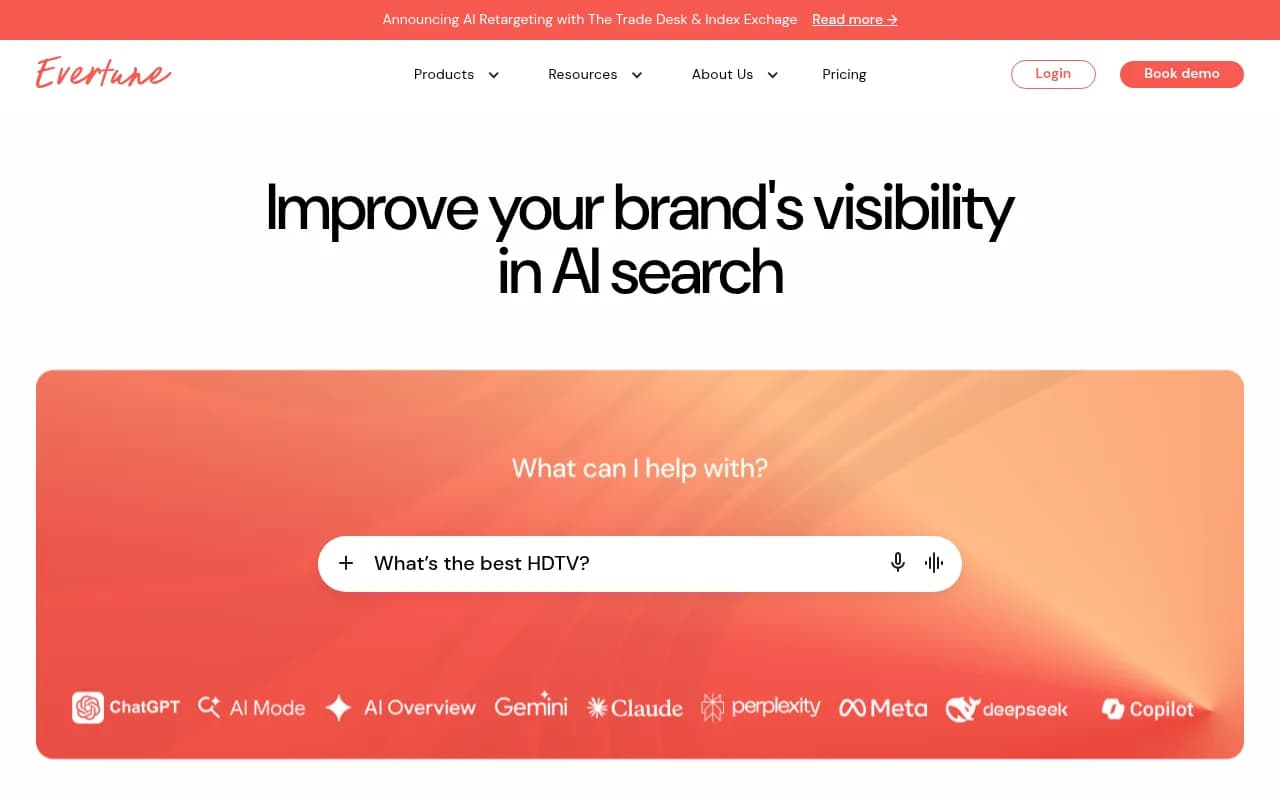
Evertune's core offering is tracking how your brand appears across major AI platforms. You get a dashboard showing your "AI Brand Index" -- essentially a visibility score that shows how often your brand gets mentioned or recommended compared to competitors. The platform monitors ChatGPT, Google AI Overviews, Google AI Mode, Claude, Gemini, Perplexity, Meta AI, DeepSeek, and Copilot.
What sets this apart from basic monitoring tools is the emphasis on statistical significance. Evertune claims to use "the most comprehensive and statistically significant AI brand analytics available" -- they're not just running a handful of prompts and calling it data. The platform shows you how you're being described, which competitors are stealing share of voice, and sentiment analysis across AI responses.
The competitive intelligence piece is particularly strong. You can see exactly where competitors are winning, which product attributes AI models associate with each brand, and how your positioning compares. For a brand manager trying to justify GEO investment to executives, this kind of benchmarking data is valuable.
AI Website Optimization
Evertune audits your website to see how AI crawlers interpret it. The platform identifies technical issues that prevent AI models from understanding your content, then provides specific recommendations to improve discoverability. This is similar to what traditional SEO tools do for Google's crawler, but adapted for the bots that power ChatGPT, Claude, and other AI assistants.
The audit covers things like structured data, content organization, and how well your site answers the questions AI models are likely to encounter. You get a prioritized list of fixes with explanations of why each matters. However, unlike Promptwatch, Evertune does not provide real-time AI crawler logs showing exactly when and how AI bots are accessing your site. You get audit results and recommendations, but not the raw technical data that would let your dev team debug indexing issues themselves.
AI Content Strategy
This is where Evertune's approach differs most from monitoring-only competitors. The platform analyzes which product attributes drive AI recommendations in your category, then maps which sources (websites, Reddit threads, YouTube videos, review sites) have the most influence on AI's perception of your brand.
For example, if you're a luxury SUV brand, Evertune might reveal that AI models heavily weight "safety ratings" and "interior quality" when making recommendations, and that sources like Car and Driver, Edmunds, and specific Reddit threads in r/cars are disproportionately influential. You get a radar chart showing attribute importance and a ranked list of influential sources.
The platform then helps you turn these insights into action through "Partner Connect" -- a feature that connects you directly with influential publishers and content partners. If Evertune identifies that a particular review site or industry blog is heavily cited by AI models, they can facilitate partnerships to get your brand featured there. This is a strategic consulting play, not a self-service tool.
What Evertune does NOT do: generate content for you. Unlike Promptwatch, which includes an AI writing agent that creates articles optimized for AI search based on citation data and content gap analysis, Evertune gives you the insights and partnerships but leaves the actual content creation to you or your agency. You get the playbook, not the execution.
AI Retargeting
This is Evertune's most unique feature and a clever workaround for brands that aren't getting recommended by AI. The logic: 12% of users click through from AI responses to validate sources before making decisions (according to Gener8 research). Even if your brand isn't in the AI response, you can still reach these high-intent buyers by running programmatic ads on the URLs that AI models cite most frequently.
Evertune identifies which URLs AI platforms cite in your category, then connects you to The Trade Desk and Index Exchange so you can run retargeting campaigns on those exact pages. When users click through to fact-check, your ads are waiting. Any Trade Desk or Index Exchange customer can also access Evertune's pre-built source lists and PMP deals covering 250+ product categories without needing an Evertune subscription.
This is a smart play that extends GEO beyond just "get your brand mentioned" to "capture intent even when you're not mentioned." It requires existing relationships with programmatic ad platforms and a media buying budget, which again signals this is built for enterprise marketers, not small businesses.
Who Is Evertune For
Evertune is built for enterprise marketing teams at mid-market to Fortune 500 companies, plus agencies managing those accounts. Specific personas:
- Brand marketing directors at consumer brands (CPG, automotive, travel, retail) who need to protect and grow brand awareness as search shifts to AI
- Growth marketing VPs at B2B SaaS companies (like Miro) who see competitors getting recommended by ChatGPT and want to catch up
- Agency strategists at holding company agencies (WPP, Publicis, etc.) who need a white-label GEO solution to offer enterprise clients
- Marketing ops leaders who want to integrate GEO data into existing analytics stacks and programmatic ad workflows
You need a marketing budget over $50K/year just for the platform (likely $36K+ annually at $3K/month), plus budget for content creation, partnerships, and programmatic ads to actually execute on the insights. If you're a startup, freelancer, or small agency, this is not for you. The platform assumes you have a content team, a media buying team, and executive buy-in to treat AI search as a strategic priority.
Evertune is NOT for: Solo marketers, early-stage startups, small agencies with SMB clients, or anyone who wants a self-service tool they can just log into and start optimizing. The high-touch, consulting-heavy model means you're paying for strategic guidance and partnership facilitation, not just software.
Integrations & Ecosystem
Evertune integrates directly with The Trade Desk and Index Exchange for AI retargeting campaigns. The platform also pulls data from "AI consumer app data, direct LLM integration, and EverPanel" (their proprietary consumer panel), though specifics on API access or other integrations aren't publicly detailed. This isn't a tool you'll plug into Zapier or your CMS -- it's a standalone platform with a dedicated customer success team.
No mention of browser extensions, mobile apps, or developer APIs for custom integrations. The platform is web-based and enterprise-focused, so expect to work through your account manager rather than self-serve integrations.
Pricing & Value
Pricing starts at $3,000/month according to their pricing page. No free trial or freemium tier. This is enterprise software sold through demos and annual contracts. For context, that's $36,000/year minimum, which puts Evertune in the same price range as Semrush Enterprise or BrightEdge.
What you get for that price isn't fully detailed publicly, but based on the feature set, you're paying for: AI brand monitoring across 9+ platforms, competitive benchmarking, website audit and optimization recommendations, source influence analysis, Partner Connect facilitation, and AI retargeting setup. You're also paying for strategic consulting and account management -- this isn't a self-service tool.
How does this compare to competitors? Promptwatch starts at $99/month for its Essential plan and $579/month for Business, making it 5-10x cheaper. Otterly.AI and Peec.ai are in the $200-500/month range. Evertune is priced for enterprise buyers who want a full-service solution, not DIY marketers.
Is it good value? If you're a Fortune 500 brand spending millions on digital marketing and you need strategic guidance plus partnership facilitation, the $36K+/year price tag is defensible. You're getting consulting and relationship-building, not just software. But if you're a mid-market company that just wants to track and optimize AI visibility yourself, you're paying a massive premium for services you may not need.
Strengths & Limitations
Strengths:
- Enterprise credibility and client roster -- working with Miro, Roku, WPP gives them legitimacy with other large brands
- AI retargeting capability is genuinely unique and clever -- no other GEO platform offers programmatic ad integration to capture intent from AI citations
- Source influence analysis and Partner Connect -- identifying which publishers matter and facilitating partnerships is valuable for brands that can afford it
- Statistical rigor -- emphasis on statistically significant data rather than anecdotal prompt testing
- Multi-platform coverage -- monitoring 9+ AI platforms including ChatGPT, Google AI Overviews, Claude, Gemini, Perplexity, Meta AI, DeepSeek, Copilot
Limitations:
- No content generation -- unlike Promptwatch, Evertune doesn't include an AI writing agent to actually create optimized content based on the insights. You get the strategy, but you have to execute it yourself or hire writers.
- No AI crawler logs -- you don't get real-time visibility into when and how AI bots are accessing your site, which makes technical debugging harder. Promptwatch offers this, Evertune does not.
- No traffic attribution or visitor analytics -- Evertune doesn't show you how much traffic or revenue is actually coming from AI search visibility. You're optimizing blind without conversion data.
- No content gap analysis -- the platform doesn't show you which specific prompts competitors rank for that you don't, or what content you're missing. Promptwatch's Answer Gap Analysis does this.
- Enterprise pricing locks out 95% of potential users -- at $3K/month minimum, this is only accessible to large companies with serious budgets
- High-touch model means slower execution -- you're dependent on account managers and partnership facilitation rather than being able to self-serve and move fast
Bottom Line
Evertune is the right choice for Fortune 500 brands and large agencies that want a strategic partner to help them navigate AI search, not just a monitoring dashboard. If you have a $50K+ annual budget for GEO, need help securing content partnerships with influential publishers, and want to integrate AI retargeting into your programmatic ad stack, Evertune delivers. The client roster (Miro, Roku, WPP) proves they can execute at scale.
But if you're a mid-market company, agency with SMB clients, or startup that wants to optimize AI visibility yourself without paying for consulting, Promptwatch is the better choice. You get content generation, AI crawler logs, traffic attribution, and content gap analysis at a fraction of the price ($99-579/month vs $3,000+/month). Evertune gives you insights and partnerships; Promptwatch gives you the tools to actually optimize and measure results yourself.
Best use case in one sentence: Enterprise brands with $50K+ budgets that want strategic consulting and publisher partnerships alongside AI search monitoring, and are willing to pay a premium for high-touch service.
Frequently asked questions
What is Evertune and what does it do?
How much does Evertune cost?
Who is Evertune designed for?
Does Evertune offer a free plan or trial?
What AI platforms does Evertune monitor?
What is Evertune's unique AI retargeting feature?
Does Evertune generate content automatically?
Similar and alternative tools to Evertune