Key takeaways
- In ChatGPT, automotive citations go mostly to marketplaces and review sites, not to dealer or manufacturer sites. Autotrader.com holds 5% and Cars.com 4.6% (Promptwatch Data, August 2026).
- Marketplaces and review sites together earn 27.27% of automotive citations, against 7.92% for manufacturer sites. Only one individual dealership domain made the top 31.
- The right platform depends on who you are: a single-rooftop dealer, a dealer group, an OEM, or an agency serving all of them.
- Look for tools that show which third-party pages AI cites, not just whether your name appeared. Monitoring alone will not fix a marketplace problem.
- Treat vendor stats (market share figures, dealer surveys) with caution until you verify them.
Why automotive is a different AI visibility problem
Most AI visibility advice is written for SaaS companies. Cars are different. A shopper asks "best electric SUV under 50k" or "honest used car dealers near me," and the answer is stitched together from listing sites, review aggregators, and a few manufacturer pages. Your own website is often a minor character.
The numbers back this up. Promptwatch Data's automotive report covers real automotive prompts run through ChatGPT from Aug 1 to Aug 31, 2026:
- Autotrader.com is the top cited domain at 5% of automotive citations, with Cars.com second at 4.6%.
- Seven of the top eight domains are marketplaces or research and review sites.
- Chevrolet.com is the only manufacturer in the top eight, ranking fourth at 2.62%.
- Reddit sits ninth at 1.34%.
- Only one dealership domain, birchwoodgroup.co.uk at 0.28%, shows up in the top 31.
By source type, marketplaces and listings take 14.65% and reviews and research 12.62%. Manufacturer sites get 7.92%. Community and news, dealerships, and service and finance sites combined get 2.12%.
That last number is the one dealers should stare at. If you are a dealer, ChatGPT is mostly not citing you. It is citing the places that list you. So the job splits in two: be visible where AI already looks, and make your own pages worth citing for the questions where they can win (local availability, trim details, ownership costs).
There is also a split by AI engine. In Promptwatch's social media citation data for Sep 28 to Oct 4, 2026, ChatGPT drew just 0.46% of citations from social platforms while Google AI Overviews drew 12.2%. A Reddit-heavy strategy may help in one engine and do almost nothing in another. Context on the Reddit shift is in the data on Reddit citations dropping in ChatGPT.
What dealers and brands should actually look for
A feature checklist copied from a SaaS roundup will mislead you. For automotive, I would weigh these things:
- Citation source visibility. Can you see which domains and pages AI cites for "best dealer near me" or "most reliable SUV"? If the answer is Autotrader and DealerRater, that is where your work goes.
- Multi-engine coverage with real interfaces. ChatGPT, Google AI Overviews, AI Mode, Gemini and Perplexity answer differently. API-only tracking can differ from what shoppers see.
- Location tracking. Dealer queries are local. City-level tracking matters far more here than in most industries.
- Competitor and model benchmarking. OEMs want model-versus-model comparisons (your crossover against three rivals). Dealers want share of voice against the dealer down the road.
- Sentiment. What language AI uses about your service department or pricing practices is a reputation issue.
- An action layer. Reports are cheap. Something that tells you what to fix, or drafts it, is where the value is.
- Multi-brand and multi-location support. Dealer groups and OEMs with sub-brands need clean separation.
- Agency features. White-label reporting and many client workspaces if you serve dealerships.
The shortlist
Here is how I would group the options. Pricing changes often, so confirm it on each vendor's site.
Promptwatch: best for tracking plus fixing
Promptwatch is the one I would start with if you want the full loop. It tracks the real interfaces of ChatGPT, Google AI Overviews, AI Mode, Gemini, Perplexity, Copilot and more, with country tracking on every paid plan and state and city tracking from the Business plan. That local layer matters for dealers.
For automotive specifically, the useful parts are citation analytics (which marketplace and review pages AI pulls from), offsite mention tracking (third-party pages naming your dealership with no link), and content gap analysis for the model, trim, pricing and local-availability questions the Promptwatch Data report recommends building pages for. The Content Agent can draft and publish to WordPress, Webflow or Framer, and IP-verified crawler logs show whether AI bots can read your inventory pages at all.

Plans run from a free Explore tier to Essential at $95/mo, Professional at $245/mo and Business at $579/mo, with agency plans from $199/mo. Check promptwatch.com/pricing for current details.
Finseo: built-in automotive positioning
Finseo has a dedicated automotive page and frames its product around vehicle recommendation tracking: which models AI recommends by segment, spec accuracy across platforms, and head-to-head comparisons against brands like Tesla, BMW and Mercedes. That suits OEM marketing teams.
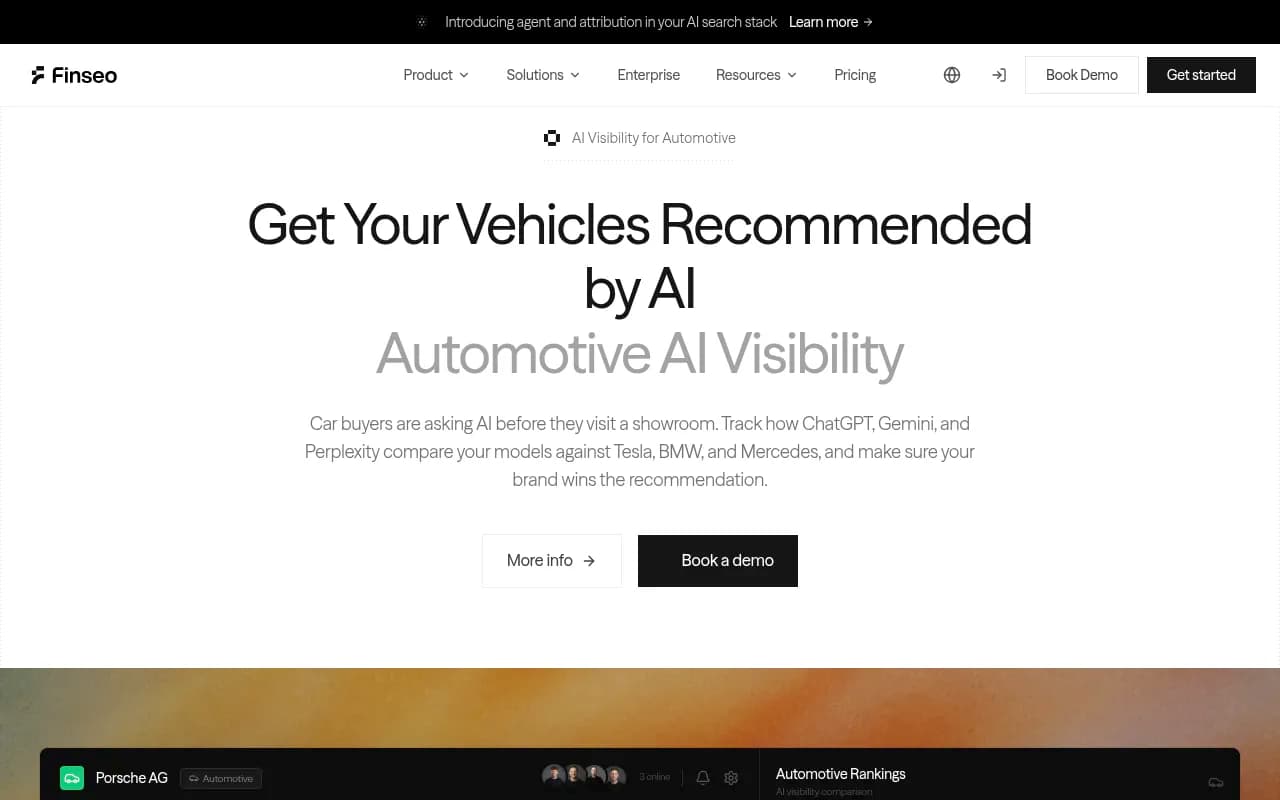
Treat the page's statistics with care. It cites Fullpath and Cox Automotive figures (ChatGPT 89% share, Gemini 6.5%, Perplexity 4%; 63% of dealers say AI is critical but only 15% embed it), and I could not verify them. The dashboard numbers shown are marketing mock-ups, not benchmarks.
Evertune: enterprise brand perception
Evertune lists automotive among its verticals and focuses on how models perceive and represent a brand over time. It is a better fit for large manufacturers that care about brand perception across LLMs than for a single dealership.
Profound: enterprise monitoring and agents
Profound is a well-known enterprise option, with agent workflows, Search Console and Semrush nodes, and a partnership aimed at attributing AI citations to revenue. Its own research across 15,155 brand configurations found a median 8-point visibility gap between a brand's best and worst Google model (Gemini, AI Overviews, AI Mode). That finding is a useful reminder to track each Google surface separately. Expect enterprise-level pricing.

Topify and other dealer-focused tools
Topify has a use-case page aimed at auto dealerships, with a brand sentiment checker that shows how AI models describe your dealership. It frames prompts the way real buyers type them, like "Best Toyota dealer near me with good reviews" or "Honest used car dealers [city] Reddit." It is not in our catalog, so check it directly on topify.ai if the dealer-specific framing appeals.
Reputation and listing tools that feed AI answers
Because review and listing sites dominate citations, tools that manage those profiles matter too. Birdeye is called out in the Promptwatch automotive report as a profile to keep complete, and Yext manages business listings that feed search and AI answers.
Budget and lightweight trackers
If you just want to see whether your dealership appears at all, simpler trackers work. Otterly.AI and Peec AI are common starting points. They monitor prompts but generally lack crawler logs, visitor analytics and content workflows.


Traditional SEO suites with AI add-ons
If your team already lives in Semrush or Ahrefs, their AI tracking is convenient. Expect fixed prompt sets and shallower AI-specific data than a dedicated platform.
Comparison table
| Platform | Best for | Local (city) tracking | Automotive angle | Action layer |
|---|---|---|---|---|
| Promptwatch | Dealers, groups, agencies, OEMs | Yes, from Business plan | Citation sources, offsite mentions, content gaps | Content Agent, Action Board, CMS publishing |
| Finseo | OEM model tracking | Check with vendor | Dedicated automotive page, spec accuracy | Monitoring focus |
| Evertune | Large manufacturers | Check with vendor | Automotive listed among verticals | Optimization and content features |
| Profound | Enterprise brands | Check with vendor | General enterprise | Agents, integrations |
| Topify | Single dealerships | Check with vendor | Dealer prompt framing, sentiment | Check with vendor |
| Otterly.AI / Peec AI | Basic monitoring | Limited | General | None to minimal |
Which one for which buyer
Single-rooftop dealers
Start with a free scan or a low tier. You mostly need to know what AI says about you for "near me" prompts, and which review and listing sites it pulls from. The cheapest plan with city tracking is the right fit, because a national average tells you nothing.
Dealer groups
You need multi-location tracking and a way to separate stores. Prioritize competitor comparison by market and reporting you can hand to general managers. Weekly site audits help too, since a group site with thin or duplicated vehicle pages gives AI little to cite.
OEMs and brand teams
Your questions are about models: which SUV does ChatGPT recommend, and how does it describe your EV range versus a rival's? Look for model-level prompt sets, sentiment, and spec accuracy. Remember that Chevrolet is the only manufacturer in the top eight citations, so most brands live or die by third-party coverage, not their own domain.
Agencies serving dealers
White-label reports, many client workspaces and per-client pricing matter more than any single feature. If you would rather outsource the strategy, an SEO and GEO partner like 1001 SEO Media handles the technical, content and digital PR work and uses Promptwatch for AI visibility measurement.
A practical first 30 days
- Build a prompt set from real buyer language. Include model comparisons, "best dealer in [city]," price and ownership-cost questions, and used-car trust queries.
- Run it across at least ChatGPT, AI Overviews and Gemini. Record who gets named and which sources are cited.
- Audit the third-party footprint first. Per the Promptwatch Data report, check your inventory, pricing, specs and dealer info on the big marketplaces, and keep complete profiles on DealerRater, Birdeye and BBB.
- Fix your own pages second. Give every model and trim a stable page with clear headings and structured specs. Add focused pages for pricing, ownership cost and local availability.
- Check crawler access. If AI bots hit errors on your inventory pages, nothing else matters.
- Re-measure monthly. Citation patterns move. ChatGPT's behavior changed sharply in 2026, including the August 8 shift to the site: operator, so a one-time audit goes stale.
For how long pages stay cited, see Promptwatch's content half-life data: landing pages and docs last longest, while news loses half its pages within 36 days. Stable model and trim pages are a better bet than one-off news posts.
Mistakes I see dealers make
- Tracking only brand-name prompts. Shoppers rarely type your dealership name first.
- Ignoring the marketplaces because they are "not our site." They are the cited site.
- Trusting a single national visibility score for a local business.
- Buying a monitoring-only tool and then having nobody own the fixes.
If you want to compare more options beyond this shortlist, the GEO software directory at bestgeosoftware.com lists many more platforms.
Bottom line
For automotive, the best AI visibility platform is the one that shows where AI actually gets its answers and helps you act on it. Marketplaces and review sites take over a quarter of ChatGPT's automotive citations; dealerships and community sites share about 2%. Pick a tool with local tracking, citation source visibility and an action layer, then spend your first month cleaning up the listings and review profiles AI already trusts.
Full report: ChatGPT citation share in the automotive industry, August 2026.