Yext Review 2026
Manages and syncs brand facts across search engines, directories and AI platforms so answers stay accurate.
Key takeaways
- Yext has fully repositioned from local listings management into an "enterprise agentic marketing platform," built around its Knowledge Graph, direct publishing to 200+ publishers, and an AI agent suite (Scout, Listings, Reputation, Social, and Knowledge Graph agents)
- Scout, its AI search visibility product, analyzes roughly 10 billion signals monthly across Google, Google Maps, AI Overviews, ChatGPT, Gemini, Claude, and Perplexity, with 150 visibility metrics per scan — genuinely strong competitive intelligence for multi-location brands
- Pricing is now custom-quoted enterprise only; the old published tiers ($199–$999/year per location) survive on third-party sites but no longer reflect how Yext actually sells, and reviewers consistently flag billing and cancellation friction
- Compared with Promptwatch, Yext lacks AI crawler logs, AI traffic attribution, Reddit and YouTube citation tracking, ChatGPT Shopping insights, and prompt-level volume and difficulty data — Scout is competitive intelligence, not a full GEO optimization loop
- Best fit: large multi-location enterprises in healthcare, financial services, retail, and hospitality. Small businesses and lean SEO teams will find the cost and contract structure hard to justify
What Yext actually is now
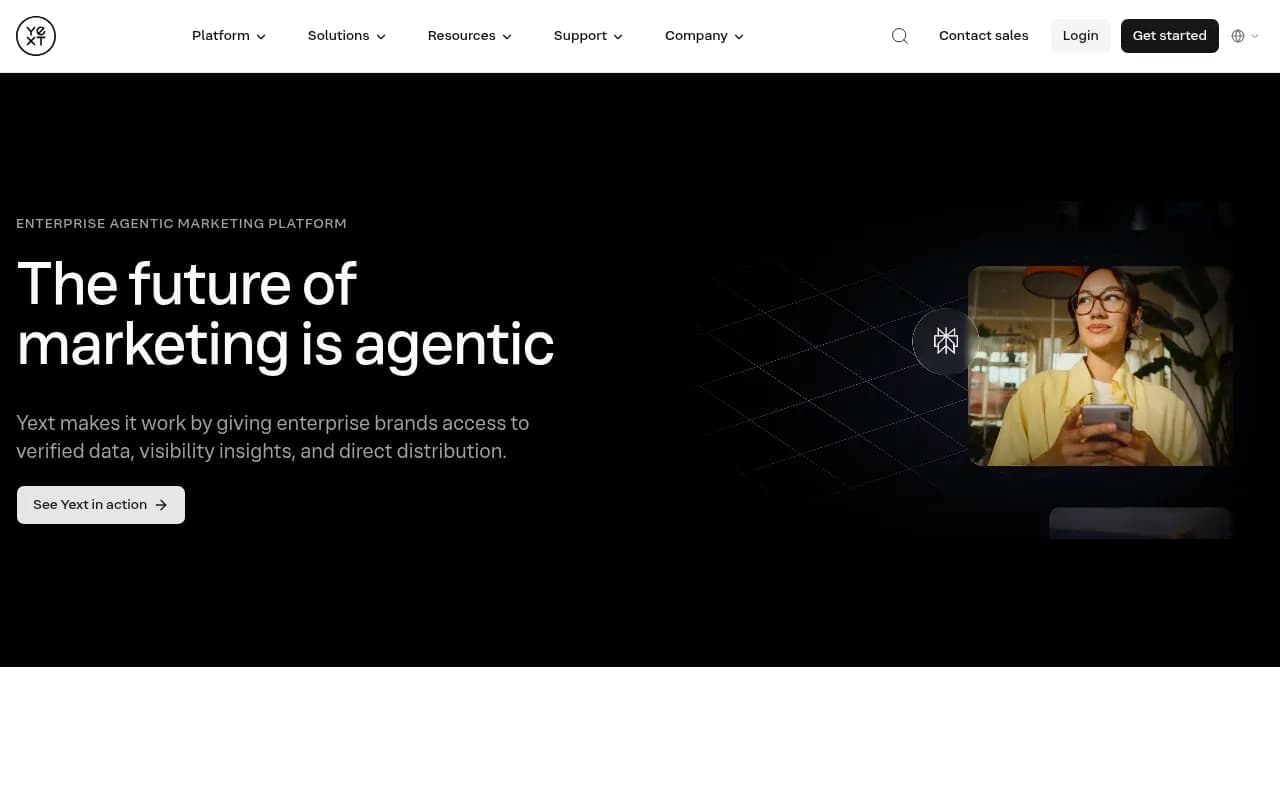
If you last looked at Yext five years ago, forget what you remember. The company that built its name on syncing business listings to directories has recast itself as an "enterprise agentic marketing platform." The homepage barely mentions listings anymore. The pitch is now structured data, AI agents, and distribution — the idea being that AI agents are only as reliable as the data underneath them, and Yext wants to be that data layer.
The core of the platform is still the Knowledge Graph: a structured, verified record of brand facts (locations, hours, services, people, products) that feeds everything else. On top of that sit agents — Scout for visibility intelligence, a Listings Agent that detects and fixes errors across 200+ publishers, a Reputation Agent for review generation and responses, and a Social Agent for localized content. There's a centralized Action Center for human oversight, which is the right governance call. Agents that publish without review make enterprise legal teams nervous, and Yext clearly knows its audience.
The scale claims are real, if hard to independently verify: brands managing 4M+ locations worldwide, and Scout claiming coverage of 12M+ locations. Yext is a public company (NYSE: YEXT), which at least means the numbers get some scrutiny.
Scout: the AI visibility piece
Scout is the part most relevant to anyone evaluating GEO tools. Launched in March 2025 and opened up to partners via MCP and API in May 2026, it tracks visibility across Google Search, Google Maps, Google AI Overviews, ChatGPT, Gemini, Claude, and Perplexity, surfacing 150 visibility metrics across up to 20 competitors per scan. The competitive framing is its strength: you can see, per location, where a rival is outranking you in high-intent moments.
Yext has also added content generation to Scout — creating brand and third-party content to improve AI visibility — which moves it beyond pure monitoring. And their citation behavior study, covering 17.2 million citations, correctly concludes there's no single AI search strategy because every model cites differently. That matches what independent data shows: in June 2026, Reddit was ChatGPT Search's top-cited domain at 3.71% of citations, down from 6.11% in May — a roughly 40% drop in a month, per Promptwatch's ChatGPT citation share data. That kind of volatility is exactly why continuous monitoring matters, and it also shows why per-model, per-source tracking beats any single "AI visibility score."
Pricing: the part nobody enjoys
Yext no longer publishes pricing. The official packages page is a 404, and everything routes through contact sales. Third-party trackers still list legacy tiers — Emerging at $199/year per location, Essential at $449, Complete at $499, Premium at $999 — but treat these as historical artifacts. Real pricing varies by solution mix, business size, and location count, and reviewers describe it as negotiated and inconsistent between customers.
The pricing complaints in reviews are worth taking seriously. Capterra reviewers describe being charged after contract end despite assurances, difficulty canceling, and a value-for-money score of just 3.8/5. One enterprise TrustRadius reviewer switched away because "for our use case, it was too expensive to have a positive ROI." When a vendor's own customer base says the sales process is better than the post-purchase experience, that's a pattern, not an outlier.
Strengths
The Knowledge Graph is genuinely differentiated. Most GEO tools optimize content and hope; Yext controls the underlying structured data that AI systems increasingly pull from. Direct integrations with Google Business Profile and Apple Maps — including a feature that surfaces Apple Maps-initiated changes for review rather than letting them silently overwrite your data — are things smaller competitors simply can't offer. Publishing directly to 200+ publishers without an aggregator in the middle is a real operational advantage for brands with hundreds or thousands of locations.
The G2 standing backs this up: 1,124 reviews, an Enterprise Leader in SEO Tools for Spring 2026, and top rankings across dozens of G2 Grid categories. For multi-location enterprises, the combination of listings, reviews, social, and AI visibility in one governed platform reduces vendor sprawl.
Limitations
Here's where Yext falls short for anyone buying it specifically for AI search visibility:
- No AI crawler logs. You can't see when ChatGPTBot or ClaudeBot hits your pages, what they read, or whether they hit errors — the "why" behind visibility scores stays hidden. Promptwatch's Agent Analytics covers 400+ crawlers; Yext offers nothing comparable.
- No AI traffic attribution. Scout tells you where you're visible, not whether that visibility drives actual visits and conversions to your site.
- No Reddit or YouTube citation tracking, despite Reddit being the single most-cited domain in ChatGPT Search as of mid-2026.
- No ChatGPT Shopping or ads tracking, no prompt-level volume and difficulty scoring, and no query fan-out data — the prompt intelligence layer that tells you which prompts are worth fighting for.
- The content generation is newer and less proven than Promptwatch's Content Agents, which plan, write, and publish GEO-optimized content directly to Webflow, Framer, or WordPress with a review inbox.
Beyond feature gaps, the operational friction is real: reviewers describe an interface that's "anything but intuitive," slow support that requires scheduled 30-minute windows, and onboarding that's hard to train agency staff on. The X (Twitter) integration was removed entirely in July 2025, which trimmed the social publishing footprint.
Who it's for
Buy Yext if you're a multi-location enterprise — healthcare systems, banks, retail chains, franchise groups — that needs one governed platform for listings, reputation, and AI visibility, and you have the budget and procurement patience for enterprise contracts. The Knowledge Graph plus direct publisher network is a legitimate moat at that scale.
Skip it if you're an SMB (the old per-location pricing world is gone), or if your primary goal is GEO specifically. For SEO teams and brands that want to understand why they're invisible in AI answers and fix it — crawler logs, citation sources, traffic attribution, content gap analysis, automated publishing — Promptwatch covers that full loop at published prices starting at $95/month, with a free tier to test. Yext's Scout is strong competitive benchmarking; it isn't an end-to-end GEO workflow.

Bottom line
Yext is a serious platform for a specific buyer: the enterprise multi-location brand that needs verified data, direct distribution, and now AI visibility intelligence in one place. The repositioning toward agents is coherent and the Knowledge Graph remains one of the best structured-data assets in the industry. But the opaque pricing, contract friction, and support complaints are consistent across review sites, and for AI search optimization specifically, Scout monitors without closing the loop. Teams buying primarily for GEO will get a more complete, more transparent, and far cheaper stack from Promptwatch — crawler logs, traffic attribution, Reddit and YouTube tracking, and agents that actually publish the fixes. Yext wins on enterprise data infrastructure; Promptwatch wins on the GEO workflow itself.
Tags:
Frequently asked questions
How much does Yext cost?
Does Yext track AI search visibility?
Is Yext good for small businesses?
What is the Yext Knowledge Graph?
Similar and alternative tools to Yext