Key takeaways
- Birdeye AI Search is built around the physical location. It reports visibility score and share of voice per location, for brands with roughly 100 to 10,000+ locations.
- Promptwatch is built around prompts and geography. You pin a monitor to exact coordinates (accuracy radius 20 m to 5 km), then connect results to crawler logs, AI-referred traffic and content work.
- Birdeye's pricing is custom and not public. Promptwatch publishes prices, and local targeting at exact coordinates starts on the $579/month Business plan.
- Both vendors' comparison posts rank themselves first. I found no independent head-to-head test, so treat every superiority claim, including mine, as vendor-sourced.
- Pick Birdeye if your pain is inconsistent listings and reviews across hundreds of stores. Pick Promptwatch if you want to measure and fix AI visibility across your site, content and traffic, with local sampling included.
Why local GEO tracking is a different problem
A national brand can be well represented in ChatGPT and still be invisible when someone in one specific suburb asks for "emergency dental care near me". AI answer engines pull from listings, reviews, local pages and third-party citations, and those signals differ from one location to the next.
So "local GEO tracking" really bundles two questions:
- Does each physical location show up when people search from around it?
- When it doesn't, what do you fix, and where?
Birdeye and Promptwatch answer those differently. Birdeye starts from the location record. Promptwatch starts from the prompt and the place it is asked from. Neither is wrong. They suit different organizations.
A caveat before the details. Both vendors wrote the comparison pages I drew on, and both rank themselves first. Birdeye's own post calls its product the best tool for multi-location brands. Promptwatch's own post ranks Promptwatch first among seven GEO tools. Read both as marketing with useful facts inside.
How Birdeye AI Search handles location-level reporting
Birdeye is a customer experience and reputation platform, and AI Search extends that into AI answers.

From Birdeye's AI Search page and blog, here is what it does:
- Reports visibility score and share of voice at both brand level and location level.
- Runs location-specific prompts such as "best [service] near me" and shows which competitors get recommended instead, location by location.
- Covers ChatGPT, Gemini, Perplexity, Google AI Overviews, AI Mode, Claude and Grok.
- Shows citations, accuracy and website signals as the causes behind each score.
- Includes an AI Search Optimization Agent (named "Jay") that ranks fixes by impact and then deploys Listings, Blog Page or Reviews agents.
Birdeye's own example is a good illustration. A drop for "emergency dental care near me" gets traced to a wrong listing field and a missing content theme, and the listings and blog agents then fix both. That is the strength of an approach rooted in listings and reviews: the tracker and the fix live in the same system that already manages your location data.
Birdeye's research claims
Birdeye publishes "The Location Blind Spot in AI Search 2026". Its figures, which are vendor data and which I could not verify independently:
- 1,762 multi-location brands analysed across 16,240 location-level scans.
- About 1 in 5 locations is invisible in AI search.
- Up to a 50-point visibility gap between a brand's best and worst location.
Its State of AI Search 2026 report adds that 80% of brands are cited at least once, but only 15% secure the top citation position with their own domain. If those numbers hold, the practical takeaway is that brand-level averages hide a lot. I would take that part seriously even without trusting the exact figures.
Pricing and fit
Pricing is custom, based on queries tracked, locations and LLMs. I found no public price. Birdeye's own blog positions the product for brands with 100 to 10,000+ locations, so a five-location business will likely feel like an awkward fit.
How Promptwatch handles local GEO tracking
Promptwatch approaches local from the prompt side. You build a monitor, which is a panel of prompts run daily across the models, countries and languages you choose, and then pin it to a place.

The local features, as documented:
- Pin a monitor to exact coordinates by searching a place or dropping a pin, with an accuracy radius from 20 m to 5 km.
- ChatGPT, Google AI Overviews and Google AI Mode then answer as if asked from that spot.
- State and city tracking from the Business plan; country tracking on every paid plan.
- Available on Business, Agency Scale and Enterprise, and also via the REST API and MCP server.
- Data comes from the real interface of each engine, collected through geo-located residential proxies with matched browser locale and timezone, rather than from API outputs alone.
That last point matters for local work. Answers shown to users can differ from API responses, and local answers are exactly where the difference tends to show.
What sits around the local data
This is where the two products diverge. Promptwatch's pitch is the full loop, not just the score:
- IP-verified AI crawler logs show which pages GPTBot, OAI-SearchBot, ClaudeBot, PerplexityBot and others actually read, and where they hit errors.
- Visitor analytics attribute real traffic and conversions from AI platforms to your site.
- Content gap analysis maps your pages against the prompts AI answers, and the Content Agent plans, writes and publishes to WordPress, Webflow or Framer.
- The Action Board turns findings into a prioritized to-do list, and Agent Chat lets you query the data conversationally.
- Metrics include Visibility Score (0 to 100), Share of Voice, position in the answer, sentiment and citation rank.
If you also want the broader category, the GEO software directory at bestgeosoftware.com lists other platforms.
What I could not confirm
I could not verify that Promptwatch produces store-level scorecards, meaning a ranked report per physical location with listing-accuracy diagnostics. Coordinate-pinned monitors give you location-aware sampling. A per-location dashboard that ties results to individual business profiles is a different thing, and Promptwatch's own materials don't describe it. If that is your core requirement, ask for a demo and test it with your own location list.
Promptwatch's public numbers are a 4.7/5 G2 rating and 1,840+ brands and agencies, with ISO/IEC 27001 certification. Those are vendor-reported too.
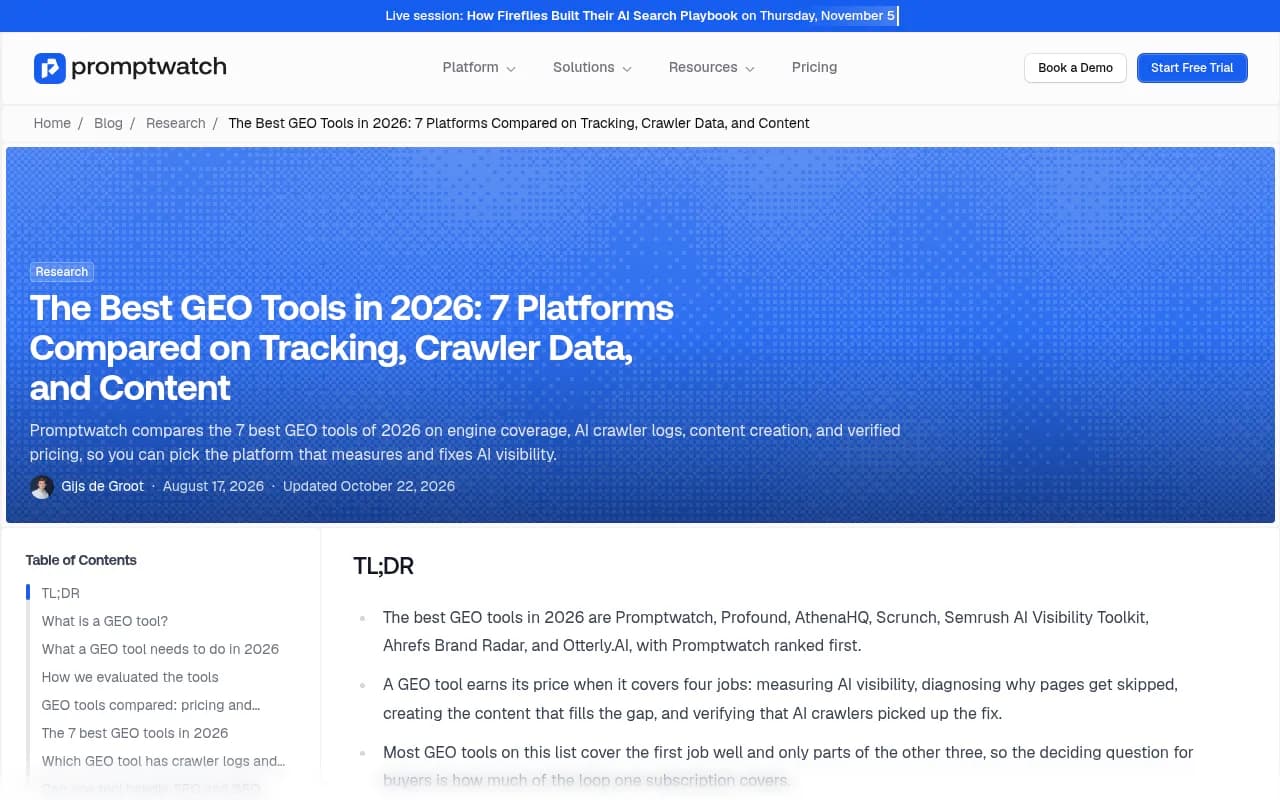
Side-by-side comparison
| Dimension | Birdeye AI Search | Promptwatch |
|---|---|---|
| Core unit of reporting | The physical location | The prompt, sampled from a place |
| Location-level scores | Yes, visibility and share of voice per location | Coordinate-pinned monitors; per-store scorecards unconfirmed |
| Engines | ChatGPT, Gemini, Perplexity, AI Overviews, AI Mode, Claude, Grok | 12+ platforms incl. ChatGPT, AI Overviews, AI Mode, Gemini, Perplexity, Copilot, Meta AI, Alexa, Claude |
| Local targeting method | Location-specific prompts such as "near me" | Exact coordinates, 20 m to 5 km radius; state and city tracking |
| Why-you-are-missing diagnosis | Citations, accuracy, website signals | Crawler logs, citation analytics, site audit, 360 Insights |
| Fix execution | Listings, Blog Page and Reviews agents | Content Agent, Content Refresh, Action Board, CMS publishing |
| AI traffic and conversions | Not documented in sources I found | Visitor analytics on every plan |
| AI crawler logs | Not documented in sources I found | IP-verified, from the Professional plan |
| Target size | 100 to 10,000+ locations | Single sites through enterprises and agencies |
| Pricing | Custom, not public | Public; Business is $579/month |
The blanks are not proof Birdeye lacks crawler logs or traffic attribution. They mean my sources didn't mention them. Ask.
Pricing reality
Birdeye quotes by queries, locations and LLMs. For a large chain that is normal enterprise procurement, and you will need a sales call to get a number.
Promptwatch's published tiers (confirm at promptwatch.com/pricing):
| Plan | Monthly price | Local relevance |
|---|---|---|
| Essential | $95 | Country tracking, 50 prompts |
| Professional | $245 | Country tracking, 150 prompts, crawler logs |
| Business | $579 | State/city tracking and exact-coordinate local targeting, 350 prompts, Content Agent |
| Agency Kick-off / Growth / Scale | $199 / $399 / $799 | Country/state/city tracking; local GEO/SEO targeting on Scale |
| Enterprise | Custom | Custom volumes, SSO, dedicated success manager |
A practical wrinkle: prompt budgets count. If you track 300 locations with 20 prompts each, that is 6,000 prompt-location pairs, far beyond a 350-prompt Business allowance. For true per-store coverage at that scale, Promptwatch would mean an Enterprise conversation or a smaller sampled set of representative locations. Birdeye is priced for the many-location case from the start.
Which one should you choose
Choose Birdeye AI Search if
- You run hundreds or thousands of locations and need a score for each.
- Your visibility problems are mostly listing accuracy, review volume and local page coverage.
- You already use Birdeye for reviews or listings and want the AI layer in the same system.
- You want agents that edit listings directly instead of producing a report.
Choose Promptwatch if
- You have a manageable number of markets, regions or key branches, not thousands of stores.
- You want to know why AI skips your pages, using crawler logs and citation data.
- You care about traffic and conversions from AI, not only mentions.
- You want the content gap closed by an agent that publishes to your CMS, and tracked afterwards.
- You are an agency running local checks for several clients; the Agency plans include state and city tracking.
Consider using both
They overlap less than the marketing suggests. A franchise brand could use Birdeye to manage location records and reviews, and Promptwatch to track how the brand and its content perform in city-specific prompts and to see whether AI crawlers can read the corporate site. That is a judgment call on my part, not a tested setup.
How to test them fairly
Because no independent comparison exists, run your own pilot:
- Pick 10 locations: your best, your worst and some in between.
- Write 15 prompts per location, mixing "near me", service plus city, and brand-specific queries.
- Ask each vendor to run them and share raw responses, not only scores.
- Check whether the competitors each tool lists are actually the ones appearing.
- Compare cadence. Daily runs catch volatility that weekly snapshots miss.
- Ask what the fix workflow looks like for one failing location, end to end.
Also confirm how each tool samples location. Prompts that merely include a city name are not the same as answers generated for a user standing in that city. Promptwatch's coordinate pinning addresses the second case. Ask Birdeye how its location prompts are executed.
For general background on how ChatGPT chooses sources, Promptwatch Data's content type citation share report found product pages were the most cited type at 22.4% of citations (Sep 28 to Oct 4, 2026), and its unique domains report shows almost half of ChatGPT responses cite 10 or more domains in the same period. Neither is local-specific, so don't read them as local benchmarks. They do suggest local pages compete with many other sources in any single answer.
Other tools worth a look
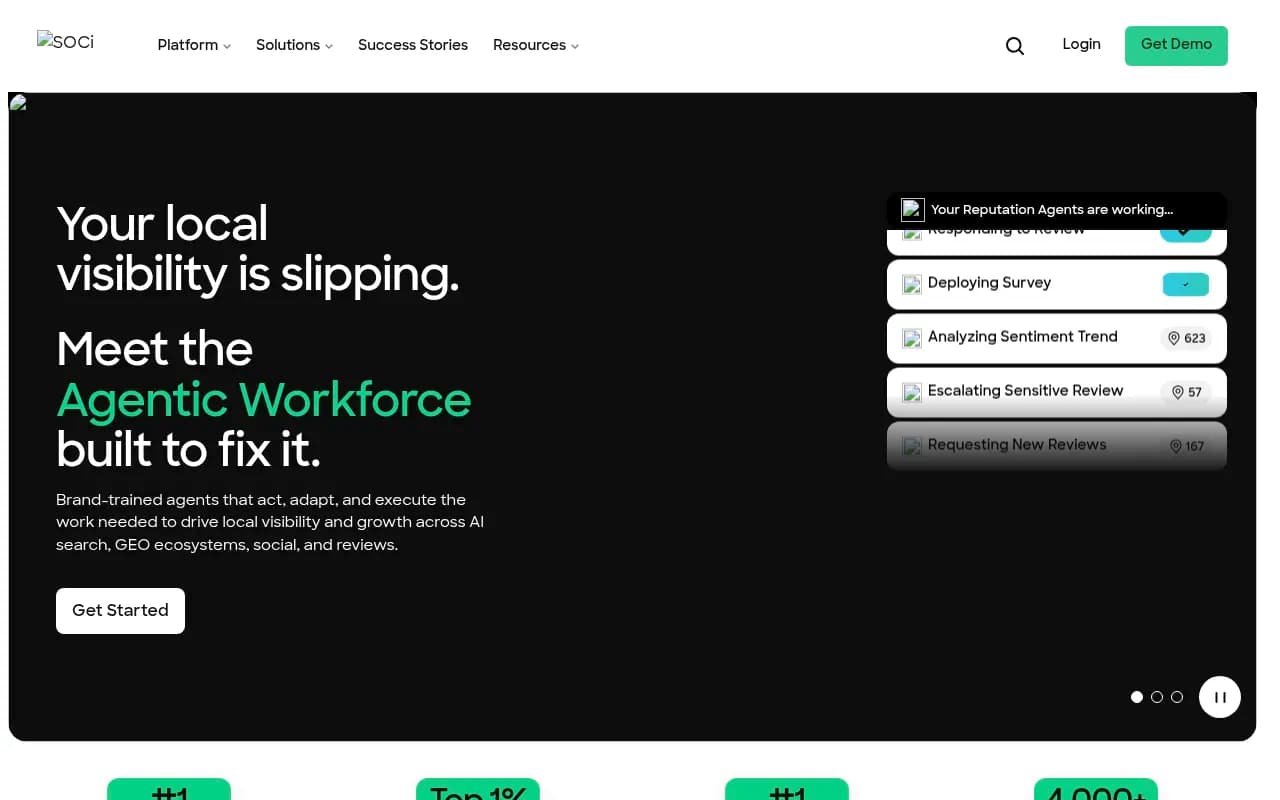
If neither fits, a few others in the catalog touch local or multi-location visibility. SOCi focuses on local search, social and reviews for multi-location brands, and Yext is a long-standing digital presence platform.
For wider monitoring, Profound and Otterly.AI are common picks, with OtterlyAI notably listing Birdeye seventh in its own roundup while tracking 50+ countries itself. For more options, the rank tracker directory at ai-rank-tools.com is a reasonable starting point.


The bottom line
Birdeye is the better-matched product if your unit of work is the store and you have a lot of them. Promptwatch is the better match if your unit of work is the prompt, the page and the revenue it drives, with local sampling layered on top. The open question for Promptwatch is store-level scorecards. The open question for Birdeye is everything outside the location record, such as crawler access and traffic attribution. Run the 10-location pilot and let your own data decide.