Key takeaways
- A franchise local SEO stack has four jobs: keep listings accurate, manage Google Business Profiles, handle reviews, and track visibility, now including inside AI answers.
- Birdeye, Yext, SOCi, Semrush Local, BrightLocal and Moz-style tools cover listings and reviews. Most of them treat AI visibility as an add-on.
- Google rankings do not guarantee AI mentions. Listing accuracy, review volume and cross-platform consistency matter more to AI answers than most teams expect.
- ChatGPT and Google AI Overviews cite very different sources. AI Overviews pulls 12.2% of citations from social platforms, ChatGPT 0.46%.
- Most franchises need one operations platform for listings and reviews plus one dedicated AI visibility tool, not one tool that does everything badly.
Why franchises need a different local SEO stack
A single-location business can get by with a Google Business Profile and a spreadsheet. A franchise with 300 locations cannot. Each location has its own profile, hours, phone number, reviews, photos and local page. Franchisor, franchisee and regional marketers all touch that data, and small mismatches pile up fast.
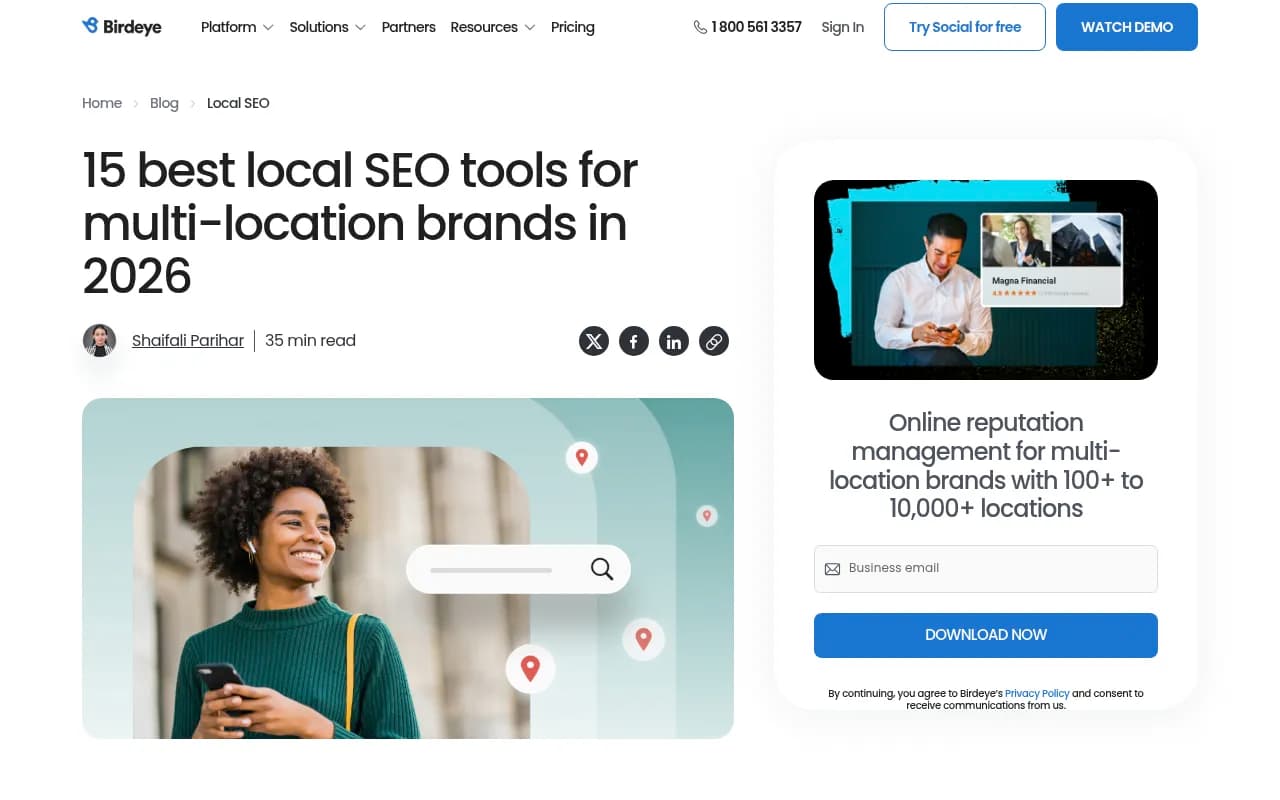
The tools below fall into four groups: all-in-one local platforms, listings and reputation specialists, map rank trackers, and AI visibility trackers. A caveat first: most of the vendor comparisons online are written by vendors. Birdeye's "15 best local SEO tools" list ranks Birdeye first, so I treat its rankings as marketing and use it mainly for feature facts. Verify pricing and features directly with each vendor before you buy. I did not independently test every platform here.
How AI search changes local visibility
Rankings, citations, Google Business Profile optimization and reviews still matter. What changed is that AI engines now summarize and recommend businesses inside the answer, using those same signals as raw material.
Birdeye's State of AI Search 2026 report (vendor-reported) says 80% of brands are cited at least once in AI answers, but only 15% hold the number one spot with their own domain. Treat the exact numbers with some caution, but the direction is believable: AI answers lean on third-party sources, so your listings, reviews and directory presence do a lot of the talking for you.
SeoProfy's local guide makes a similar point: high Google rankings do not guarantee mentions by LLMs, and AI discovery leans harder on data accuracy, review response rate and cross-platform consistency than classic local SEO does.
Two findings from Promptwatch Data matter for franchises specifically:
- In Promptwatch's report on unique domains per ChatGPT response (Sep 28 to Oct 4, 2026), 47.6% of cited responses cited 10 or more domains, and 52.5% of organic prompts with no brand named did. Your location is one of many sources competing for a slot. For brand-specific prompts, only 21.3% cited 10 or more domains, so your own site carries more weight once someone searches your name.
- In Promptwatch's social media citations report for the same week, Google AI Overviews took 12.2% of citations from social platforms, with Facebook at 2.38% and Instagram at 1.61%. ChatGPT took 0.46%. My inference, not the report's: location-level Facebook and Instagram pages deserve to stay accurate, because AI Overviews cites them far more than ChatGPT does.
The local SEO tools worth shortlisting
Birdeye
Birdeye is the broadest platform in this group. It covers listings across Google and 100+ sites, reviews across 200+ sites, social, messaging, an Insights product for location-level reputation trends, and a Search AI module that reports on how a brand shows up in Google, ChatGPT, Gemini and Perplexity. It targets brands from 100 to 10,000+ locations.
The case for it is consolidation: fewer vendors, one dashboard, brand governance across regions. The case against is the usual one for suites, since individual modules may be shallower than a specialist. Its own AI visibility module is also one product among many, so compare it against a dedicated tracker.
Yext
Yext is the long-standing listings and structured-data platform. It pushes location data to a network of publishers, maps and AI answer sources, and positions itself around search and AI answers. It tends to suit large enterprises with centralized data governance and the budget for it.
SOCi
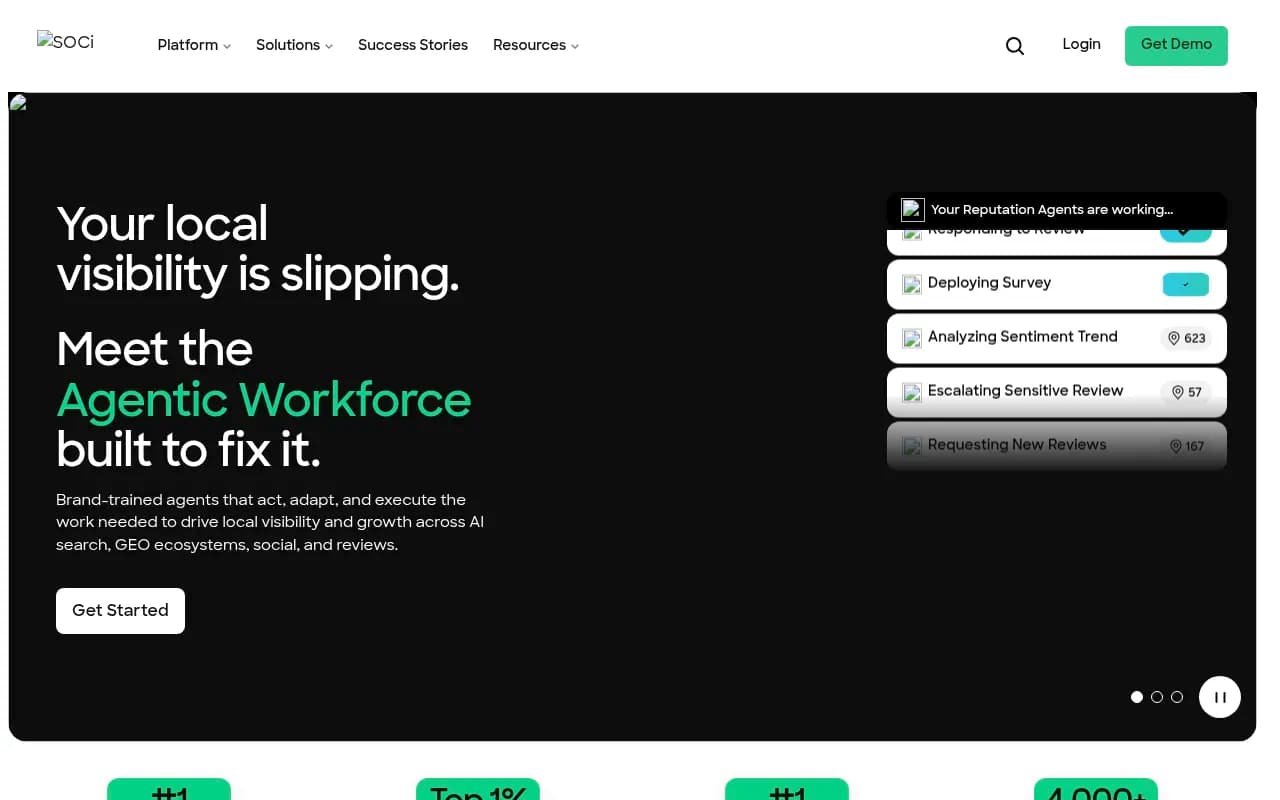
SOCi is built specifically for multi-location brands and runs local search, social and reviews, with agentic automation. Franchisors that want corporate-approved content flowing to franchisee-level profiles will find it relevant.
Semrush Local
Semrush Local is a good fit when local sits inside a broader search program. Research from the roundups lists listing management across 150+ directories, review management across Google, Facebook and Yelp, and a map rank tracker. If your team already lives in Semrush, adding local is a smaller step than buying a new platform.
BrightLocal, Whitespark and Moz Local
HackerNoon's agency roundup rated BrightLocal, Whitespark, Moz Local and Yext equally on listing and citation coverage, and called BrightLocal the best all-round local SEO and reporting platform. These are strong for agencies serving several clients and for franchises that want audits, citations and reports without a full suite. Moz Local is the simplest option for straightforward listings management. Moz Pro is in our catalog if you want the broader SEO toolkit.
Local Falcon, Localo and Grid My Business
Local Falcon is the dedicated map-rank visualization tool, showing a grid of where a location ranks across a geography, and some roundups note it tracks AI Overviews and ChatGPT mentions too. Localo is aimed at guided Google Business Profile optimization with prioritized tasks, and starts at roughly $29 a month per location according to one roundup. Grid My Business was named best value for small and mid-sized agencies. These three are not enterprise governance tools. They are sharp instruments for specific jobs, and agencies often run them alongside a bigger platform.
Synup
Synup handles listings, review collection and AI-generated post ideas per location. It sits in the same all-in-one tier as Semrush Local and BrightLocal, aimed at mid-sized multi-location setups.
Comparison at a glance
| Tool | Strongest at | Typical scale | AI visibility angle |
|---|---|---|---|
| Birdeye | Listings, reviews, messaging in one suite | 100 to 10,000+ locations | Built-in Search AI module |
| Yext | Structured location data and publisher network | Large enterprise | Positions around AI answers |
| SOCi | Local social, search and reviews for franchises | Franchise and multi-location | Agentic automation |
| Semrush Local | Listings plus map rank tracking inside an SEO suite | Small to mid-size | Semrush AI visibility features separate |
| BrightLocal | Audits, citations, client reporting | Agencies, small chains | Limited |
| Moz Local | Simple listings management | Small to mid-size | Limited |
| Local Falcon | Grid-based map rank visualization | Any, per-location | Some AI mention tracking |
| Localo | Guided GBP tasks | Small businesses, few locations | AI-assisted recommendations |
Pricing changes often and many of these are quote-based. Confirm on each vendor's site.
What to evaluate before you buy
Birdeye's own checklist asks sensible questions, and I would add a few:
- Where are listings inconsistent, duplicated or incomplete across locations? A good audit answers this in the first week.
- Which locations need more reviews, faster responses or stronger sentiment? Location-level reporting matters more than a brand-wide average.
- Can franchisees edit anything, and can corporate approve or lock fields? Governance is the real franchise problem.
- How does the tool push data to Apple Maps, Bing Places and the directories that AI engines pull from?
- Does it integrate with your CRM, call tracking and reporting setup?
- How does it handle AI-generated review responses? Brand voice and approval workflows matter, and Google's spam policies are tightening around templated, scaled content.
One trap I see often: teams buy a suite because the AI visibility module appears on the feature list, then discover it tracks a handful of prompts at brand level. Franchise AI visibility is a location-level problem. "Best pizza near me" is a different prompt from your brand name.
Adding a dedicated AI visibility layer
Local SEO suites tell you what your listings and reviews look like. They are less able to tell you what ChatGPT, Google AI Overviews, Gemini and Perplexity actually say when a customer asks about your category in a given city, which sources they cite, and whether your own location pages are getting crawled.
That is where a dedicated tracker helps. Tools like Promptwatch monitor the real interfaces of ChatGPT, Google AI Overviews, AI Mode, Gemini and Perplexity per country and language. On Business plans they support state and city tracking and local targeting pinned to exact coordinates, so a monitor can see answers as if asked from a given store. Its crawler logs show whether AI bots can read your location pages, and its content tools help close gaps.

Other options in our catalog include Profound, Peec AI, Otterly.AI and AthenaHQ for monitoring, and Semrush One if you want AI tracking inside an existing SEO suite.



If you want to compare more options, the GEO software directory at bestgeosoftware.com lists tools by feature set.
A practical stack by franchise size
Under 50 locations
Use BrightLocal, Semrush Local or Localo for listings, reviews and rank grids. Add a free or entry-level AI check on a handful of local prompts per market. Keep it light.
50 to 500 locations
This is the range where a suite like Birdeye, SOCi or Synup starts paying for itself, because governance and review workflows become the bottleneck. Pair it with a map rank tool like Local Falcon for the markets that matter most, and a dedicated AI visibility platform.
500+ locations
Expect enterprise contracts with Yext, Birdeye or SOCi, strict approval workflows, and a separate AI visibility and crawler analytics layer. Run a pilot in a few markets before rolling out.
Agencies serving franchises
Prioritize white-label reporting, multi-client dashboards and pricing that scales. BrightLocal and Grid My Business are common here. Agencies that want help with the strategy layer can talk to 1001 SEO Media, which publishes this directory and runs local SEO and GEO programs.
A 30-day rollout plan
- Week one: audit every location for NAP consistency, duplicates, missing categories and unclaimed profiles.
- Week two: fix the top offenders, set up review request flows and define who responds to what.
- Week three: publish or improve location pages with real local detail (staff, services, local photos), not templated copy with a swapped city name.
- Week four: set up AI visibility monitoring on 20 to 50 local prompts per priority market, record a baseline, and compare it against your map rank grids.
Then review monthly. Where a location ranks well in Maps but never appears in AI answers, look at reviews, third-party mentions and whether the location page can be crawled.
Bottom line
Pick your operations platform first (Birdeye, Yext, SOCi, Semrush Local or BrightLocal depending on scale and budget), then add rank-grid and AI visibility tools for the questions it cannot answer. The suite handles data hygiene. The AI layer tells you whether anyone is hearing about it. For a broader catalogue of software, browse SurferStack."}