Key takeaways
- Local search is not being replaced. It is forking into a map pack and an AI answer that often show different businesses for the same query.
- Synup's September 2026 study of 2,862 "best [category] in [city]" searches found 64% of map-pack businesses were named in the AI answer, but 67% of businesses named in AI answers were not in the map three-pack (a smaller subset of 714 searches).
- Whitespark found AI Overviews on only 15% of classic local-intent queries, against Local Packs on 93%. Hybrid and informational queries are where AI takes over.
- Report the two surfaces separately. A single "local visibility" number hides which one is moving.
- The fix is mostly operational: consistent entity data, recent specific reviews, clean web mentions, and pages that answer real questions in plain text.
The short version of the argument
You will read two loud takes this year. One says the map pack is dead. The other says AI hasn't touched local search. Both are partly right and both are lazy.
The data says something more boring and more useful. For a lot of searches, the map and an AI answer sit on the same page, naming overlapping but different sets of businesses. That is a split, not a replacement. And a split means you now have two scoreboards.
What the Synup study actually found
Synup collected 12,250 searches in the form "best [category] in [city]", covering 49 categories and 250 US cities, on desktop in US English. The main snapshot is from the week of September 22, 2026. Of those, 2,862 searches had both a map and an AI answer captured. That matters: this is not an estimate of how often AI answers appear. It only describes pages where both showed up.
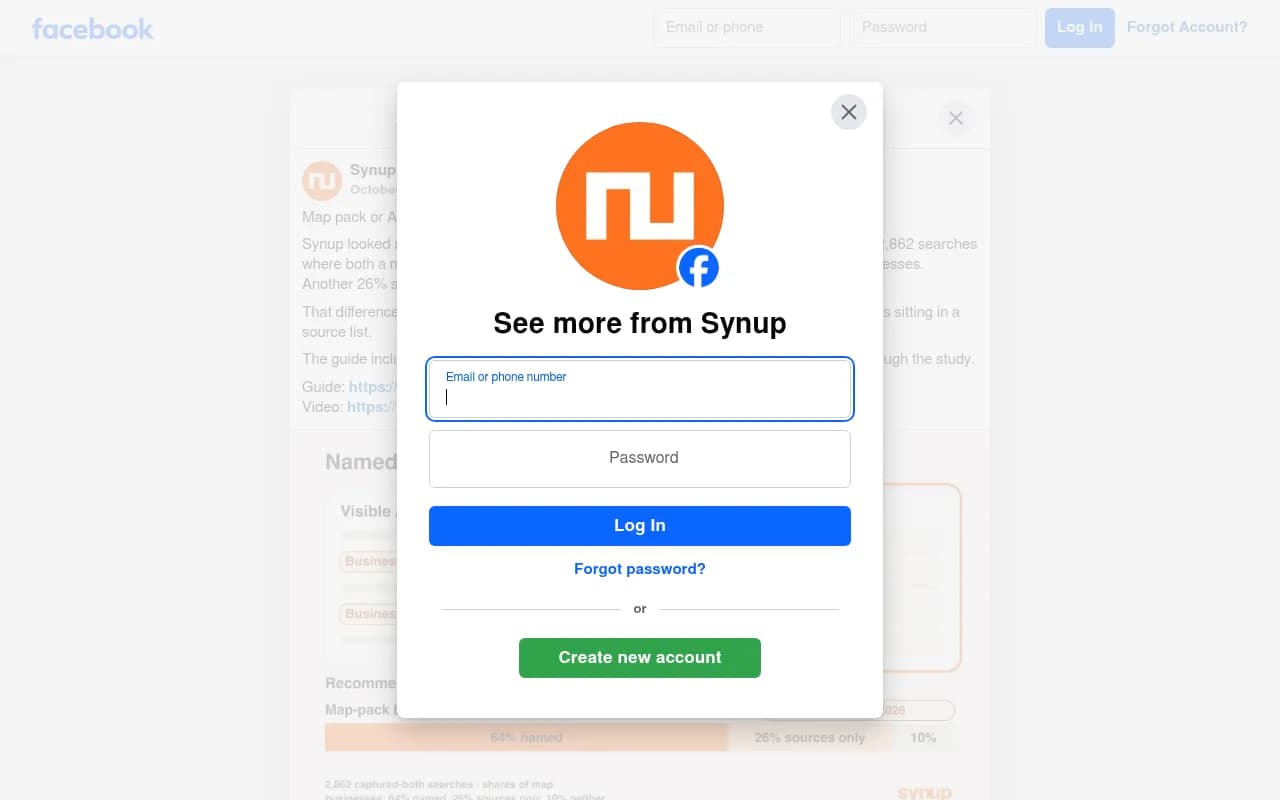
The headline numbers:
- 64% of map-pack businesses were also named in the AI answer.
- 88% of the 2,862 pages had an AI answer naming at least one map business.
- 67% of businesses named in AI answers were not in the map three-pack. That figure comes from a subset of 714 searches where every map business had a matchable street address.
Don't treat 67% as the mirror image of 64%. They use different denominators. Read them as two separate facts: most map businesses get some recognition in the AI answer, and most AI-named businesses are strangers to the map.
Synup also split map businesses into three states. 64% were named in the visible answer. 26% showed up only in the source panel, labelled "consulted". 10% appeared in neither. That middle bucket is the interesting one. Google read those businesses and didn't name them.
A few caveats worth keeping on a sticky note. The study measured what appeared on the page, not clicks, calls or purchases. Collection tools can miss AI answers, so counts are minimums. Some AI results came from the wrong city. And the study does not show that editing your business information secures an AI recommendation. It describes overlap, not cause.
Why the two surfaces disagree
The map pack and the AI answer are built from different evidence.
The map pack still follows Google's published local factors: relevance, distance and prominence. Whitespark's 2026 Local Search Ranking Factors survey weights Business Profile signals, on-page signals, reviews, links, behavioral signals and citations. It is a ranking of many listings with proximity doing a lot of the work.
An AI answer is a justification. A model has to explain why a business fits, and it names a handful. Rich Sanger's testing of Google's Ask Maps found it surfaces roughly three to eight businesses where a map scroll used to offer twenty-plus. Reviews supply quotable evidence, the website gets read when the question is complex, and the wider web fills gaps. Whether that wider web is accurate is not the model's problem. Mike Blumenthal described Ask Maps pulling a 2015 listicle to describe a jeweler's current stock.
So a business can win the map on proximity and prominence, then get skipped in the answer because its profile is thin, its reviews are generic, or its website says nothing a model can quote. The reverse happens too: a farther-away business with sharp, specific reviews and clean entity data gets named.
How much of local is actually AI now?
It depends on the intent of the query, and this is where the "map pack is dead" headlines fall apart.
Whitespark's study of AI Overviews in local-business searches split queries three ways:
| Query type | Example | AI Overviews appeared | Local Pack appeared |
|---|---|---|---|
| Local | "personal injury lawyers in Phoenix" | 15% | 93% |
| Informational | "how much does a new roof cost" | 92% | 6% |
| Hybrid | mixed research and local intent | 97% | 17% |
Same customer, different moment. "Roofing company near me" gets a map. "How much does a new roof cost" gets an AI answer. A buyer typically asks both before calling anyone, which is exactly why you need to be present in both places.
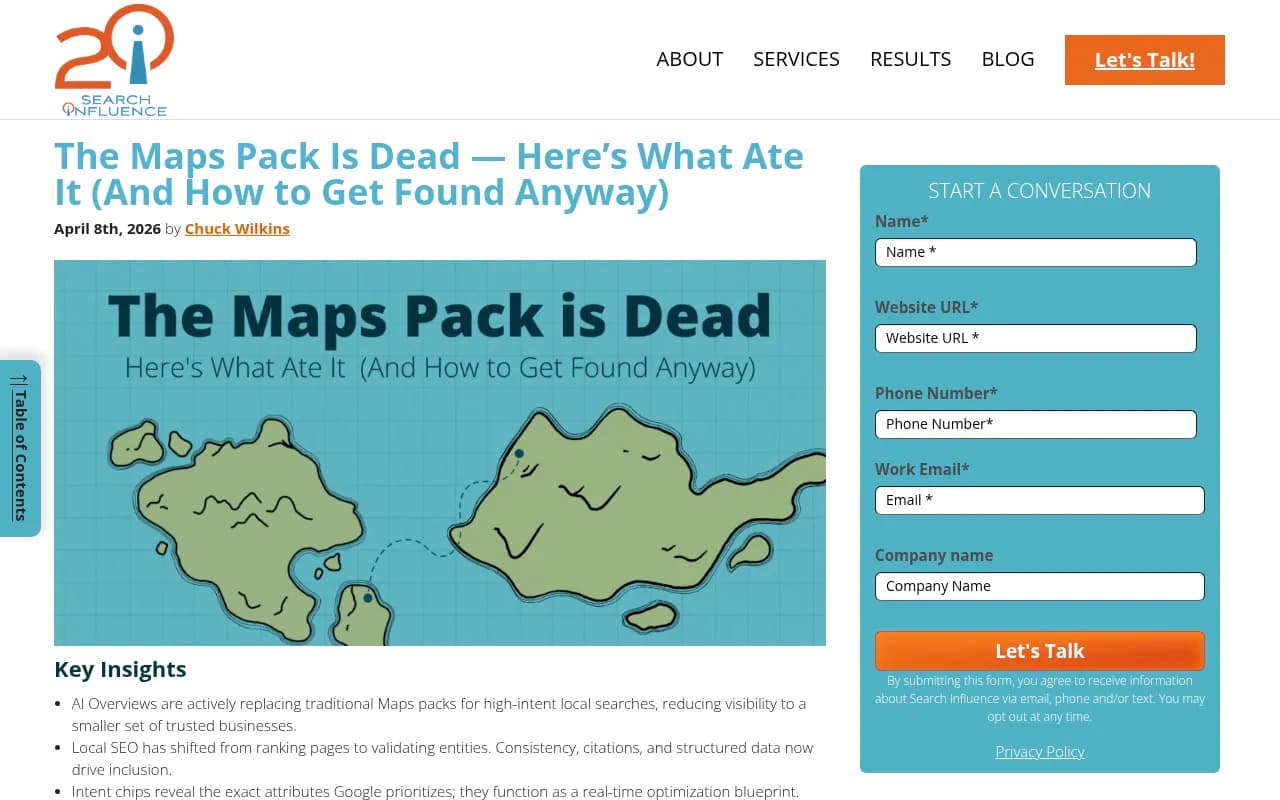
Search Influence reports the opposite experience on competitive queries: a Chicago limo search that returned an AI Overview labelled "Top-Rated Limo Companies in Chicago" with no map at all. That is an agency anecdote, and the post's "The Maps Pack Is Dead" title is hyperbole. Still, it is a real pattern for some high-intent categories. They also cite BirdEye data via Near Media that Business Profile impressions are down 54% industry-wide while actions hold steady. Treat that as a directional signal: fewer impressions, similar actions, so each remaining impression is worth more.
On the consumer side, BrightLocal's 2026 Local Consumer Review Survey found use of ChatGPT and other generative AI tools for local recommendations rose from 6% to 45% in a year. That number is why ignoring AI is a bad bet even if the map still dominates classic queries.
Not all AI engines treat local the same way
Ask Maps leans on Google's own place data. ChatGPT works differently. A Pluspoint analysis of who decides which local businesses AI names found ChatGPT never cited a Google, Bing, Apple or Yelp page as its reason for naming anyone. It gets there through the open web.
That tracks with what Promptwatch sees in its first-party data. In Promptwatch Data's social media citations report for Sep 28 to Oct 4, 2026, social platforms were 12.2% of Google AI Overviews citations but only 0.46% of ChatGPT's. Facebook was 2.38% of AI Overviews citations and Instagram 1.61%. For a local business, that means a complete, active public Facebook and Instagram profile can matter for Google's AI surfaces and do close to nothing for ChatGPT.
Similarly, Promptwatch's data shows reddit.com's share of ChatGPT citations fell from about 4% to 0.5% on August 14, 2026. If your local AI strategy was "get mentioned on Reddit so ChatGPT picks it up", that plan got weaker overnight.
What does ChatGPT cite instead? Promptwatch's citation share by content type report (Sep 28 to Oct 4, 2026) has product pages at 22.4%, landing pages at 16.8%, listicles at 13.6% and reviews at 1.7% of classified citations. For commercial "best X" prompts, product pages hit 26.0% and listicles 15.0%. The local translation: service and location landing pages and credible "best of" lists are the surfaces that get cited. Verticals lean on aggregators too. In automotive, marketplaces like Autotrader and Cars.com outrank every car brand, so being listed on the right directory can beat polishing your own site.
One more detail for anyone writing pages: Promptwatch's ChatGPT query fanout data shows average fanout query length falling from about 117 to about 53 characters between December 2025 and early 2026. Short, keyword-like headings with the category and city up front match how the model searches.
Build a two-scoreboard report
This is the practical core of the Synup advice. Track the map and the AI answer separately, because they move for different reasons.
What to log per query
Synup's worksheet fields are a decent template:
- Date, exact query, intended city, device and locale
- Whether an AI answer was captured (record "no answer" as its own status and verify it live)
- Whether you are in the map pack
- Whether you are named in the answer, only in the source panel, or neither
- The description text the answer uses for you
- An identity check: is the name, address and services right?
- Evidence for the claim and a next step
The identity check is the one most teams skip. If the AI describes you with a discontinued service or the wrong neighborhood, that is a data problem you can fix. If it's from the wrong city entirely, verify the address before you panic.
Four states, four meanings
| State | Map pack | AI answer | Likely issue |
|---|---|---|---|
| Strong on both | In | Named | Maintain, protect reviews |
| Map only | In | Absent or source-panel only | Weak evidence for a model: thin reviews, vague site, stale web mentions |
| AI only | Out | Named | Proximity or prominence gap; consider more locations or GBP strength |
| Absent | Out | Absent | Entity or eligibility problem, start with consistency |
The "map only" row is where the 26% consulted-but-not-named businesses live. That is your fastest win list.
Tools for the tracking itself
A spreadsheet works for ten prompts in a few markets. Past that, automation helps. Pluspoint suggests budgeting around twenty minutes per market for ten prompts if you do it by hand. For AI-side monitoring across ChatGPT, Gemini, Perplexity and Google's AI surfaces, tools like Promptwatch can pin monitors to exact coordinates so ChatGPT and Google's AI answer as if asked from a specific spot, which is the point for multi-location brands.

For the local-listing and reputation side, a few catalog tools are worth knowing:
Yext handles listing and entity data distribution, Birdeye handles reviews and customer experience, and SOCi runs local search, social and reviews across many locations. Treat them as inputs to the entity consistency work below, not as ranking guarantees.
If you only need rank history and AI mode checks alongside classic tracking, general platforms cover part of it:
For a broader view of AI tracking options, the GEO software directory at bestgeosoftware.com lists more.
What to do about it, in order
The Ask Maps playbook from Pluspoint and the Whitespark findings agree on most of this. None of it is exotic. It is just rarely finished.
1. Fix entity consistency first
Search Influence's framing is useful: local SEO is shifting from ranking pages to validating entities. Will Scott put it this way in Search Engine Land: LLMs can give wrong information, so disambiguation through context matters and consistency across sources matters a lot. Check name, address, phone, hours (including holidays) and category across your Business Profile, website and major directories. Conflicting hours read as unreliable data, and unreliable data gets skipped.
2. Fill every Business Profile attribute
Accessibility, seating, Wi-Fi, parking, payments. Each blank field is a question an AI can't match you against. This is cheap and nobody gets excited about it, which is why it works.
3. Earn recent, specific reviews
BrightLocal's 2026 survey found 47% of consumers won't use a business with fewer than 20 reviews, and 32% look for reviews from the last two weeks, up from 20% a year earlier. More to the point for AI: models quote review sentences. "Quiet patio, fast Wi-Fi, gluten-free menu" is matchable evidence. "Great service!" matches nothing. Ask customers about the specific thing they came for, and reply to every review without a template.
4. Make the website answer plain-text questions
Ask Maps reads websites when a question is complex or high stakes. The questions people ask nearby skew toward price, policy and hours. Build a service-and-location page for each real offering, put the answer in the first lines, and use headings that read like short searches. Whitespark's Darren Shaw has also pointed at a shift toward succinct, structured writing that LLMs can parse, layered with conversion copy for humans.
5. Audit what the old internet says about you
Stale menus, discontinued services, a "best of 2019" list. Any of it can be repeated to a customer as current fact. Search your own name and category, find the old pages, and either update them or ask for corrections. Citations never stopped mattering; Whitespark's survey puts "best of" list inclusion and prominence on industry-relevant domains among the top AI visibility factors.
6. Keep Facebook and Instagram alive for Google's AI
Per the Promptwatch social-citations data, AI Overviews cites Facebook and Instagram far more than ChatGPT does. A complete, active public profile is low effort. Don't build a Reddit program around ChatGPT right now.
7. Add structured data, but don't oversell it
Schema is worth doing as hygiene. The claim you'll see around that it lifts AI visibility 30 to 40% comes from an agency post without a cited source, so I wouldn't quote it to a client. Do it because it removes ambiguity, not because of a number.
What I'd tell a client this quarter
I'd resist two instincts. Don't pull budget from Business Profile work because "AI is eating the pack". For classic local queries, Whitespark's 93% versus 15% is hard to argue with. And don't ignore the AI side because the pack still shows, since the 64% and 67% overlap numbers say you can win one and lose the other without noticing.
A reasonable sequence:
- Build the two-scoreboard worksheet for your ten most valuable queries in your top three markets.
- Mark every query as strong on both, map only, AI only, or absent.
- Fix identity errors first, then consulted-but-not-named gaps.
- Re-run monthly. Log it like rank positions used to be logged.
If you'd rather hand the AI search side to specialists, an agency like 1001 SEO Media covers local SEO alongside GEO work, but the worksheet above is a perfectly good place to start on your own.
What we still don't know
The Synup study measures what's on the page, not what people do about it. Nobody in this research set has published click or call data split by map versus AI answer. The Whitespark and Synup numbers also come from different query sets, so you can't merge them into one statistic. And Google keeps changing the interface: Synup noted the map's website links no longer show each business's address, which forced matching by name and street instead.
So hold the conclusions loosely, measure both surfaces, and expect to revise the worksheet. The split is real. How far it goes is still an open question.
FAQ
Is the Google map pack going away?
No. Whitespark found Local Packs on 93% of classic local-intent queries and AI Overviews on 15%. It shows up less on competitive or hybrid queries, where AI-generated lists are replacing it in some categories.
Should I track the map pack and AI answers in one report?
Track them as separate lines. Synup's study found 64% of map-pack businesses named in the AI answer, but many AI-named businesses are not in the pack at all, so a combined number hides which surface changed.
Does optimizing my Business Profile help me show up in AI answers?
Probably, since Google's AI reads place data, reviews and your site. But the Synup study does not prove that editing business information secures a recommendation, so measure before and after rather than assuming.
Which AI engine matters most for local?
Google's AI surfaces (AI Overviews, AI Mode and Ask Maps) sit closest to the map. ChatGPT reaches the same customers through the open web instead of Google's place data, so it needs different evidence: landing pages, credible lists and consistent mentions. Track both.