Key takeaways
- BrightLocal is the only one of the four with a published, self-serve AI visibility feature: Local AI Visibility covers ChatGPT, Google AI Mode and Google AI Overviews, and is included in all plans from $31/month.
- Synup positions itself as an agent-led platform (its agent is called Sydekick) and has an AEO feature, but it is built around fixing things, and pricing details conflict between sources.
- SOCi pushes hardest on AI visibility as a thesis (its Local Visibility Index), and is aimed at multi-location brands. Pricing is quote-only.
- Chatmeter is strongest on reviews, sentiment and listings (140+ directories). I could not find public details on its ChatGPT or AI Overviews tracking, so verify that in a demo.
- Listings tools mostly fix the inputs AI engines read. None of them replace a dedicated AI visibility tracker if you need broad model coverage.
What "handling AI search" should mean for a listings platform
Local listings platforms were built to keep your name, address and phone number consistent across directories. That job still matters, because AI engines pull from the same web of sources. But "AI search support" is now a marketing phrase every vendor uses, and it covers very different things.
I think there are three layers worth separating:
- Data hygiene. Accurate listings, duplicate suppression, consistent hours and categories across Google Business Profile, Apple, Bing and directories.
- Measurement. Do you show up when someone asks ChatGPT or Google AI Mode for a plumber near them? What is your share of voice versus competitors?
- Action. When you are missing, does the tool fix something, or just report it?
Most of these four platforms are strong on layer one, uneven on layer two, and only starting on layer three.
One piece of context before the comparison. SOCi's 2026 Local Visibility Index, a vendor study covering 350,000+ locations across 2,751 multi-location brands, says ChatGPT visibility is about 30x harder to earn than a strong Google local ranking. BrightLocal repeats that stat on its own statistics page. Treat it as a directional claim from a vendor with a stake in the answer, but it matches what most local SEOs are seeing: AI engines recommend far fewer businesses than a map pack does.
Quick comparison
| Platform | AI search measurement | Listings coverage | Pricing transparency | Best for |
|---|---|---|---|---|
| BrightLocal | Local AI Visibility: ChatGPT, Google AI Mode, AI Overviews. 0-100 score, 20 prompts per location | Citation Builder (manual) plus Active Sync for core profiles | Published, from $31/month for AI visibility, Manage plan from $40/month | SMBs, consultants, small agencies |
| Synup | AEO feature checks ChatGPT, Perplexity, AI Overviews (vendor claim). Sydekick agent takes actions | 75+ to 100+ directories (varies by source) | Partly published, sources conflict | Agencies that want white label |
| Chatmeter | Pulse AI for sentiment and topics. AI-search tracking not confirmed in my research | 140+ directories | Quote only | Multi-location brands, healthcare networks |
| SOCi | Genius Agents for local and AI search, GEO, social, reviews | Part of a broader marketing suite | Quote only | Franchises and enterprise multi-location |
BrightLocal
BrightLocal is the most concrete answer to the question in the title, mostly because it publishes what it does.
Its Local AI Visibility feature tracks ChatGPT, Google AI Mode and Google AI Overviews. You get a 0-100 visibility score benchmarked against competitors, prompt-level results (branded and unbranded) with sentiment and recommendation strength, and up to 20 prompts per location. Competitor comparison covers mention rate, share of voice and average position. There is also an "AI sources leaderboard" showing which domains AI cites for your category. It is included in all plans from $31/month with a 14-day free trial.
The part I like most is the loop: citation gaps route straight into Citation Builder. If AI keeps citing a directory where you are not listed, you can order the submission from the same screen. That is a small but real step from measurement to action.
Limits to know about:
- Only three AI surfaces today. Perplexity and Gemini are not included. BrightLocal says more models are coming in "V2".
- Twenty prompts per location is fine for a single-location business and thin if you want to track many service lines.
- Active Sync covers Google Business Profile, Facebook, Bing, Apple Maps and Yelp in the US and Canada. Everything else is manual citation work, charged at $3.20 per submitted site (as low as $2 with bulk credits).
On pricing, the Manage plan starts at $40/month, and the review management add-on is listed at $44 per location per month, falling to about $6.74 per location at 100 locations. A third-party reviewer (SocialPilot) puts the Grow plan at $65 for one location and $131 for ten, so check current numbers on the site.
Synup
Synup now calls itself an "AI-agent-led local marketing platform". Its agent, Sydekick, performs tasks like fixing listings, replying to reviews and posting to social, instead of only producing reports. Its AEO feature is described as checking how a business appears in ChatGPT, Perplexity and AI Overviews, flagging gaps, and strengthening structured data and content. All of that is vendor description, so ask for a live demo on one of your own locations.
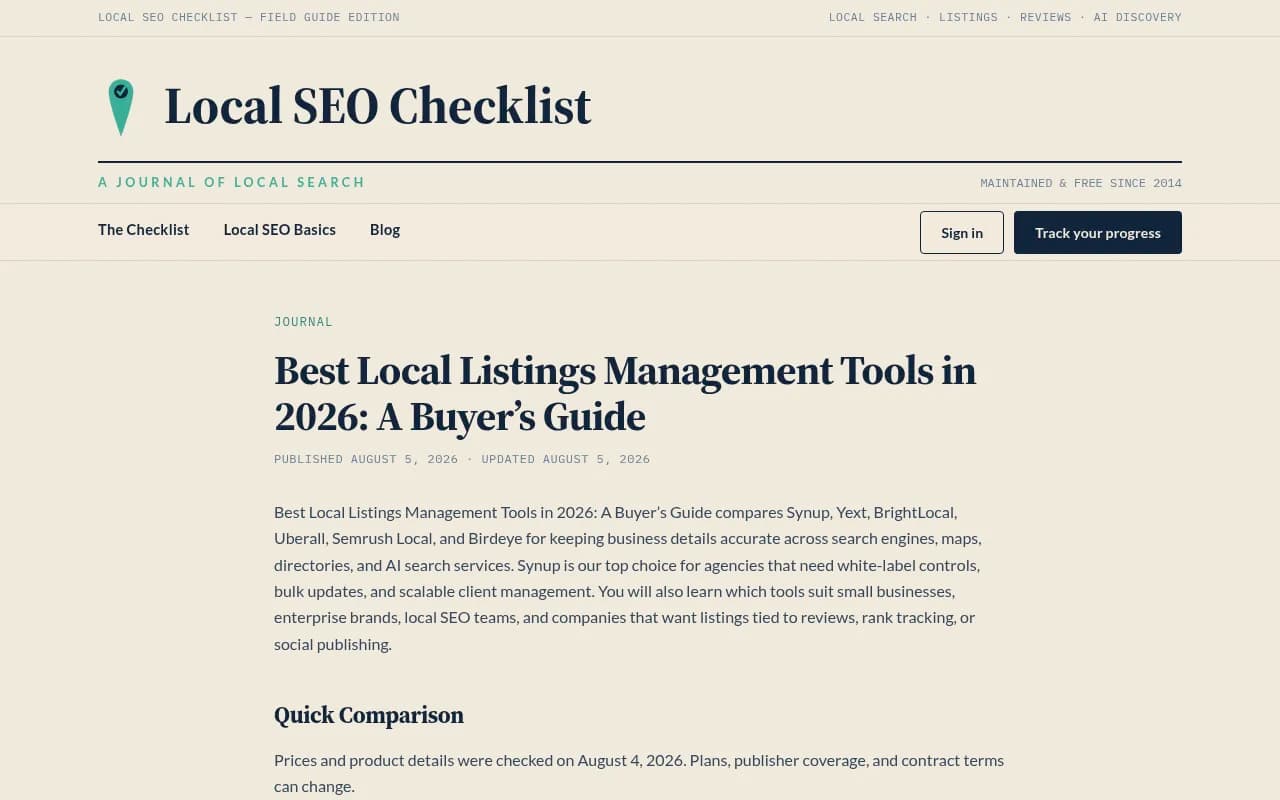
The independent listings guide from Local SEO Checklist (August 2026) ranks Synup first for agencies. Its reasons are practical: Listings Pro pushes data to 75+ directories, supports bulk edits, suppresses duplicates, tracks indexation, and Synup OS adds client accounts, API and MCP connections, proposals, billing and white-label dashboards. Synup's own claim is bigger (100+ publishers, 50+ countries, 5,000+ agency and brand partners).
Synup pricing is messy
I found conflicting numbers, so here they are with their sources:
- Local SEO Checklist (checked Aug 4, 2026): OS from $79/month billed annually, Listings Pro at $35 per location per month.
- BrightLocal's comparison page (a competitor's account): review monitoring from $79/month on an annual plan for up to 25 locations, agency packages from $199/month, review responses at $20 per location, review generation at $50 per location.
- SocialPilot (third party): credit-based agent tiers of $49 (1 location), $299 (up to 10, white label), $499 (up to 25), $899 (up to 50).
These probably describe different products or different dates. Get a written quote. Also note Synup monitors 20+ review sites against BrightLocal's 80+, which matters if reviews are a big part of your AI visibility story.
Synup publishes comparison pages against BrightLocal, Chatmeter and SOCi. They are vendor-authored, so read them as sales material.
Chatmeter
Chatmeter is a reputation-first platform for chains, healthcare networks and other multi-location businesses. Team Lewis ranks it "Best for Multi-location Brands", and its own comparison article scores itself 5/5 on features (take that with salt, since Chatmeter wrote it).
What it does well, based on SocialPilot's review and Chatmeter's materials:
- Pulse AI for review sentiment and topic analysis.
- Signals, which lets you query reviews, social posts and survey data in natural language.
- A Local Brand Visibility Score that compares locations.
- Listings management across 140+ directories, the widest number in this group.
Here is my honest caveat. I did not find Chatmeter-specific details on tracking ChatGPT, Gemini or AI Overviews. The AI in Chatmeter appears to be AI applied to your reviews, not measurement of how AI engines describe you. That may have changed, so ask directly: which AI engines do you query, how many prompts per location, and can I see the raw answers?
Pricing is per location with unlimited users, built as a modular quote. There is no self-serve entry point.
Reviews do matter for AI answers, though. Promptwatch Data (Sep 28 to Oct 4, 2026) shows that for branded ChatGPT prompts, reviews rise to 5.6% of citations, compared with 1.7% across all prompts. When someone asks about your business by name, review sources carry more weight. See the full ChatGPT citation share by content type report.
SOCi
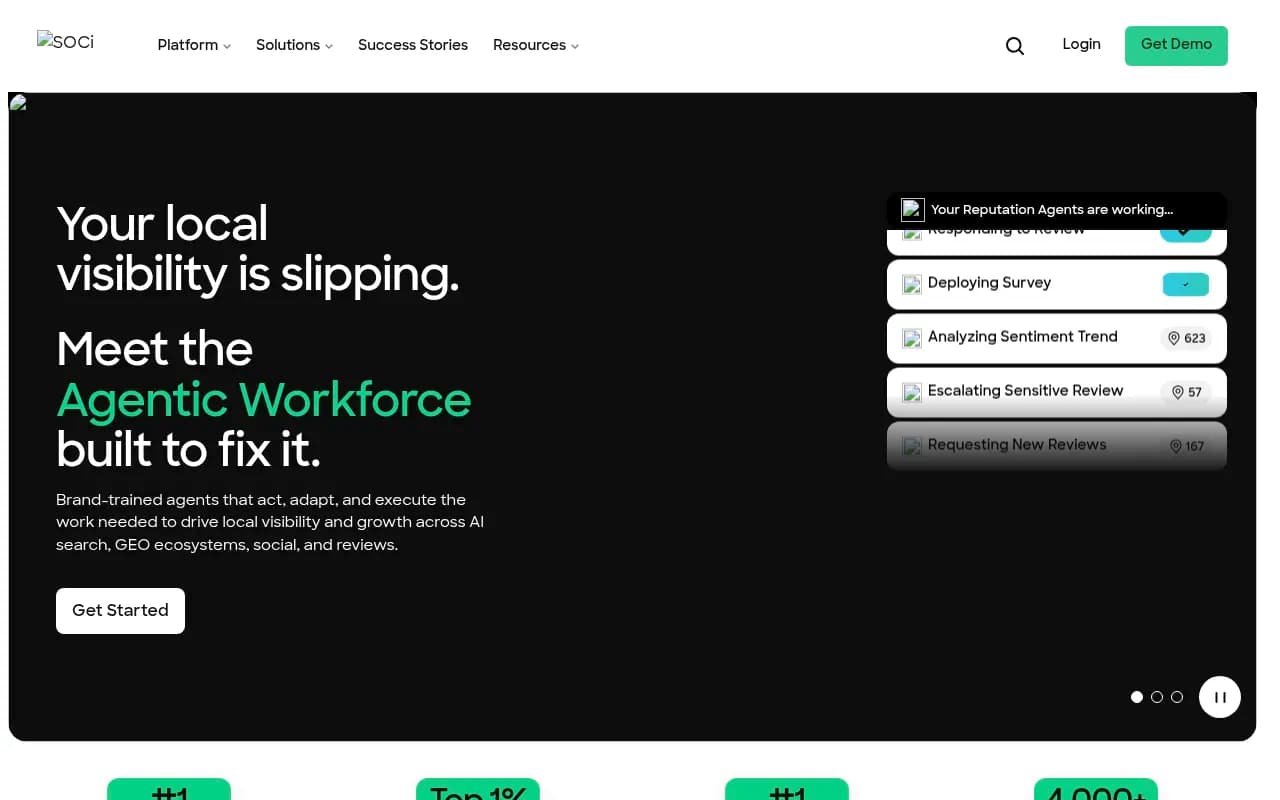
SOCi is the loudest of the four on AI. It calls itself the "world's first agentic workforce", with Genius Agents handling local and AI search visibility, GEO, social and reviews for multi-location brands. The Genius suite also includes Genius Search, Genius Social, Genius Reputation and Pages for SEO-optimized landing pages.
The Local Visibility Index is the research hook. Its findings (vendor-authored):
- ChatGPT, Gemini and Perplexity are far more selective than traditional search.
- In retail, only 45% of the brands most visible in traditional local search overlap with the brands AI platforms recommend most.
- ChatGPT visibility is roughly 30x harder to earn than a strong Google local ranking.
That 45% overlap is the number I would pay attention to. It suggests that winning the map pack does not translate to winning AI recommendations, which is exactly why you need AI-specific measurement.
Trade-offs: pricing is on request, the platform is built for enterprise and franchise buyers, and BrightLocal's comparison table lists SOCi as monitoring only 5 review sites (again, a competitor's claim). SOCi's G2 count is large (about 3,270 reviews at 4.5 in Chatmeter's roundup), which makes it the most widely reviewed of the four.
Which social and review signals actually matter for AI?
Listings platforms bundle social profile sync and review tools, so it helps to know what AI engines really cite. Promptwatch Data for Sep 28 to Oct 4, 2026 shows large differences between models:
| AI model | Share of citations from social platforms |
|---|---|
| Google AI Overviews | 12.2% (YouTube 4.28%, Facebook 2.38%, Reddit 2.15%, Instagram 1.61%, LinkedIn 1.55%) |
| Perplexity | 2.7% |
| ChatGPT | 0.46% |
Source: Promptwatch's social media citations by AI model report. The practical read: keeping Facebook and Instagram profiles complete matters for Google AI Overviews and barely at all for ChatGPT. A platform that spends its AI pitch on social posting is helping one surface, not all of them.
The same dataset says product pages (22.4%) and landing pages (16.8%) take about 39% of ChatGPT citations. For local businesses, that translates into accurate location pages, service pages and FAQs on your own site. That is where SOCi's Pages product and a good CMS matter more than directory count.
How to choose
Single location or a handful
BrightLocal. It has the lowest entry price, published AI tracking, and the audit-to-citation workflow. You will outgrow the 20-prompt limit only if you have many service lines.
Agency managing many small clients
Synup, if white label and bulk operations matter, with BrightLocal as the alternative for audits and rank tracking. Verify pricing in writing and test the AEO feature on a real client.
Franchise or multi-location brand
SOCi or Chatmeter. SOCi leans toward marketing execution (social, search, agents). Chatmeter leans toward reputation analytics and wide listings coverage. For both, demand a pilot that shows AI-engine results, not only dashboards.
Questions to ask every vendor
- Which AI engines do you query, and through the real consumer interface or an API? Answers can differ between the two.
- How many prompts per location, and are they refreshed daily or weekly?
- Can I see the raw responses and citations, not just a score?
- Does the tool fix issues itself, or hand me a to-do list?
- What happens to my listings if I cancel?
Where a dedicated AI visibility tool fits
BrightLocal covers three AI surfaces. Synup claims a few more. None of these four is primarily built around AI search measurement. If you need coverage across ChatGPT, Gemini, Perplexity, Claude, Copilot and AI Overviews, plus crawler logs and traffic attribution, a dedicated platform is the better fit, and it can sit alongside your listings tool. Promptwatch tracks the real interfaces of these models by country and location, and its local targeting lets you pin a monitor to exact coordinates so answers reflect a "near me" query from a specific spot.

For a wider shortlist, the GEO software directory at bestgeosoftware.com lists the alternatives.
Verdict
If I had to pick based only on what I could verify, BrightLocal wins on AI search for smaller teams: it publishes the feature, the price, and the model list, and it connects gaps to fixes. Synup is the pick for agencies who value white label and an action-oriented agent, once the pricing is nailed down. SOCi has the strongest AI narrative and research for enterprise brands, but you are buying on trust and a demo. Chatmeter is a solid reputation and listings platform whose AI-search capabilities I could not confirm.
Buy none of them on the AI claim alone. Run the same ten prompts for one of your locations in ChatGPT and Google AI Mode before and after a pilot, and see whether anything actually moved.
Prices and features above come from vendor pages and third-party reviews gathered in 2026, and several are vendor-authored. Confirm everything directly before you sign.