Key takeaways
- The same prompt can return different answers and different cited sources depending on the country and the language of the query. A single global number hides most of that.
- Language seems to matter more than geography. Profound's March 2026 study of 3.25 billion citations found that the language of a query rewires which domains get cited, and how often social sources show up.
- Run an identical prompt set in each market, then compare share of citations, not a yes/no "cited" flag. Promptwatch Data shows almost half of ChatGPT responses cite 10 or more domains, so answers are crowded.
- Treat any single-source Reddit or social figure with suspicion. ChatGPT's citation behavior changed sharply in August 2026, and third-party numbers use different methods and periods.
- You need a tool that tracks real ChatGPT output per country and language, stores the cited URLs, and lets you segment. Manual spot checks stop working at around 10 prompts.
Why country and language change ChatGPT citations
If you only ever check ChatGPT from your own laptop, you are looking at one slice of reality. The same question asked from Madrid in Spanish, from Mexico City in Spanish, and from Chicago in English can produce different brand lists and different sources underneath them.
There are a few reasons. ChatGPT Search retrieves live web pages, and what is available, indexed and ranked differs by region. Local competitors dominate local queries. Language-specific content simply exists in different quantities. A query like "best accounting software in Spain" will surface Spanish providers that never appear in the English answer.
Two things get conflated in most discussions, so keep them separate:
- Country is where the request appears to come from. It affects local results, regional retailers, and which domains are available and trusted.
- Language is how the prompt is written. It affects which sources get pulled, and the effect can be larger than the country effect.
Profound tested this directly. In March 2026 it analyzed 3.25 billion citations across 7 AI models and 14 countries, keeping only prompts written in each country's native language (Portuguese for Brazil, Japanese for Japan, and so on). It reported that a country's geography is secondary to the language of the query, though the size of the effect varies by model. Social citations alone ranged from 15.3% of citations in Google AI Overviews to 3.6% in Gemini.
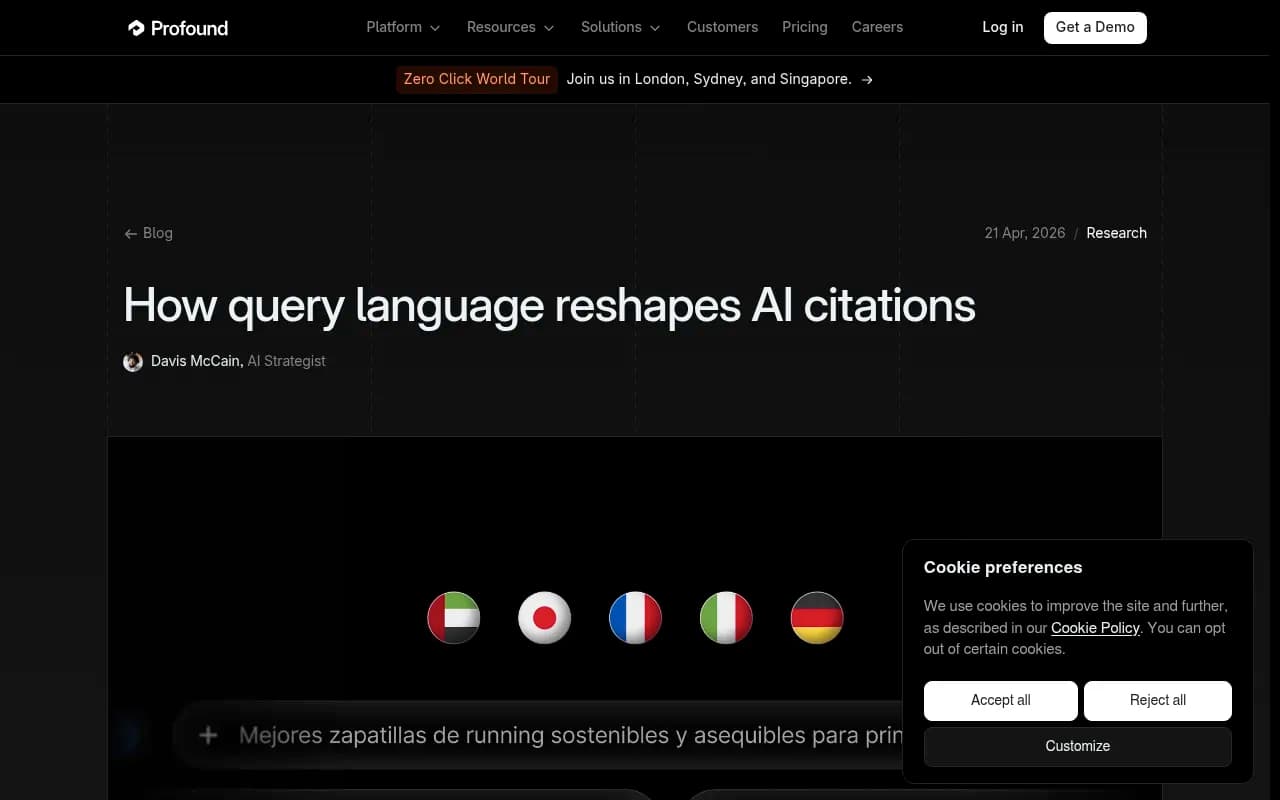
The takeaway is not that you should copy their numbers. It is that translated or localized content does not automatically earn citations equally across markets, and you will only know by measuring each one.
A caution on third-party citation numbers
Before you benchmark anything, know that the numbers floating around disagree, partly because the ground moved.
Promptwatch's data shows reddit.com's share of ChatGPT citations falling from about 4% to 0.5% on August 14, 2026, while AI Overviews and AI Mode declined more gradually (Reddit citations are dropping in ChatGPT). Otterly measured 16 brand reports and found ChatGPT's Reddit citations fell by at least 73% in mid-August while total ChatGPT citation volume rose 3.5%. And in Promptwatch's October report, ChatGPT drew just 0.46% of its citations from social platforms between Sep 28 and Oct 4, 2026, against 12.2% for Google AI Overviews (Social media citations by AI model, October 2026).
Compare that to older or differently defined figures, such as an Ahrefs Brand Radar ranking putting reddit.com at 16.8% of ChatGPT citations in the US, or Profound's per-country figures where Reddit makes up 50-76% of ChatGPT's social citations. These are not necessarily wrong. They measure different things (share of all citations versus share of the social slice) over different periods, and several predate the August change.
Practical rule: always record the date range, the market, the language and the definition next to every number you collect. A country-level Reddit percentage from spring 2026 tells you little about October.
Step 1: define your markets as country plus language pairs
Do not list "Spain" and "Mexico" as one Spanish market. List pairs:
- Spain + Spanish
- Mexico + Spanish
- US + Spanish (often forgotten, and sizable)
- Belgium + French, Belgium + Dutch
- India + English, India + Hindi
Start with the markets that already earn revenue, plus one or two you are planning to enter. Five to eight pairs is manageable. Each pair is its own monitor with its own baseline.
If you serve local or multi-location customers, decide whether country is granular enough. Some platforms let you go to state or city level, and a few can pin a monitor to exact coordinates for "near me" queries.
Step 2: build one prompt set and localize it properly
The goal is comparability. Write a core set of 30 to 50 prompts in your primary language, covering three types:
- Organic prompts where no brand is named ("best project management software for agencies")
- Competitor comparison prompts ("X vs Y")
- Brand-specific prompts ("is X worth it")
This split matters. Promptwatch's research on unique domains per response (Sep 28 to Oct 4, 2026) found that 52.5% of organic responses cite 10 or more domains, while only 21.3% of brand-specific responses do, with 5 domains the most common count at 14.9% (How many unique domains does ChatGPT cite per response?). Mixing the types into one average will blur everything.
Then localize, do not just translate. A literal translation of an English prompt often is not how a French or Japanese buyer would phrase it. Have a native speaker rewrite each prompt the way people there actually ask, keep a mapping so you know which local prompt corresponds to which core prompt, and swap in local competitors where the market is different.
One hypothesis worth testing yourself: ChatGPT runs its own web searches (query fanouts) behind a response, and those may be issued in a different language than the user's prompt. Promptwatch's fanout data shows these queries are short and keyword-like (about 53 characters from April 2026), but it has not verified the cross-language behavior. If your tool exposes fanout queries, check a sample per market. If not, that is a reason to want one that does.
Step 3: collect real ChatGPT output per market
There are two ways to get data, and they are not equal.
- API calls are cheap and easy to automate, but the API model's answer can differ from what a person sees in the ChatGPT interface, including citations.
- UI-level collection captures what a user in that country and language actually sees, including cited sources.
For citation tracking, you want the second. Ask any vendor how they set the country, whether they use the actual ChatGPT interface, and how often prompts run. Daily runs matter because answers shift run to run, not just market to market.
Promptwatch's advice for tracking is worth following whatever tool you use: measure across many prompts because a single prompt tells you little, track position and how ChatGPT describes you rather than only whether you are cited, and check which competitors appear in the same responses.
Step 4: pick metrics that survive a multi-market comparison
A binary "were we cited?" is almost useless when nearly half of responses list 10+ domains. Use these instead:
| Metric | What it tells you | Watch out for |
|---|---|---|
| Citation share per market | Your cited URLs as a share of all citations on the prompt set | Compare like for like prompt sets |
| Mention rate | How often your brand is named, cited or not | Mentions without citations suggest a content or crawlability gap |
| Position in answer | Whether you are first or buried | Varies by prompt type |
| Competitor share | Who is cited next to you in each market | Local competitors differ per country |
| Source type mix | Reddit, news, docs, marketplaces, your own site | Definitions differ by tool |
| Language gap | Citation share in translated prompts vs original | The clearest signal for localization problems |
The language gap is the metric I would watch most closely. If your English share is 18% and your German share is 3% on equivalent prompts, you have a localization or content-availability problem, not a ChatGPT problem.
Step 5: read the results by market
With a few weeks of data, look for patterns per country and language pair:
- Which domains win each market. Marketplaces, local review sites, regional publishers and government sources vary a lot by country. Promptwatch's vertical reports show the pattern in English: for travel prompts Skyscanner, Going and Tripadvisor lead, and for automotive in August 2026 marketplaces like Autotrader and Cars.com outrank every car brand (travel, automotive). Expect the local equivalents in other markets.
- Which content types get cited. In Promptwatch's data, product pages were the most cited type at 22.4% of ChatGPT citations (Sep 28 to Oct 4, 2026) (content type report). Check whether your localized site even has comparable pages in each language.
- Whether your own domain is cited at all. Mentions without self-citations point at content or crawlability. Check that AI crawlers can reach each language version, and that hreflang and URL structures are sane.
- How fast citations decay. Promptwatch found that landing pages and docs stay cited longest, while news lost half its pages within 36 days (content half-life). Localized evergreen pages are the safer investment.
Do not read too much into a single week. ChatGPT's citation behavior can change overnight, as the August 8 site: operator shift and the August 14 Reddit drop showed (site: operator data). Annotate your charts with known platform changes so you do not blame your content for something the platform did.
Tools for tracking ChatGPT by country and language
I did not verify per-country pricing for every vendor below, so confirm country and language limits on each pricing page before you commit. Here is how the options group.
Promptwatch tracks the real interfaces of ChatGPT, Google AI Overviews, AI Mode, Gemini, Perplexity and others per country and language, with state and city tracking on Business plans and above. Its crawler logs and visitor analytics help tie citation gaps in a given market back to whether AI bots can read that language version, and its content gap analysis and Content Agent help fix gaps. Country tracking is on every paid plan, starting at $95/month (confirm at promptwatch.com/pricing).

Omnia advertises unlimited countries and languages without extra fees and daily tracking of exact citation URLs.
Peec AI is positioned around multi-language tracking, so it is a natural shortlist item for European teams.

Profound publishes the largest language study I know of and offers enterprise-grade tracking.

Otterly.AI is an affordable monitor, useful for smaller teams that need a basic prompt tracker.

Ahrefs Brand Radar and Semrush bolt AI tracking onto familiar SEO suites, which is convenient if you already live in them, though prompt sets tend to be less flexible.

| Tool | Country and language coverage | Best for |
|---|---|---|
| Promptwatch | Country on all paid plans; state/city on Business+; real-UI tracking | Teams that want to fix gaps, not just see them |
| Omnia | Marketed as unlimited countries and languages | Multi-market brands watching cost |
| Peec AI | Multi-language focus | European and multilingual teams |
| Profound | Broad enterprise coverage | Large brands with research needs |
| Otterly.AI | Basic locale tracking | Small teams on a budget |
| Ahrefs Brand Radar / Semrush | Depends on plan | Teams already in those suites |
For wider comparisons, the GEO software directory at bestgeosoftware.com lists more options.
A weekly routine that does not eat your calendar
- Monday: review citation share and competitor share per market. Flag any market that moved more than a few points.
- Midweek: open the cited URLs for the flagged market. Who replaced you, and what type of page is it?
- Thursday: ship one fix per weak market, usually a localized page, an updated comparison, or a technical crawl fix.
- Monthly: recompute the language gap and recheck your localized prompts for natural phrasing.
Common mistakes
- Treating Spanish as one market when Spain, Mexico and the US Spanish audience see different sources.
- Translating prompts word for word instead of rewriting them for local use.
- Using a binary cited metric in an answer space where 10+ domains is normal.
- Comparing numbers across studies without checking the date and definition.
- Ignoring crawler access for non-English versions of your site.
Bottom line
Track country and language as separate dimensions, run the same localized prompt set daily on real ChatGPT output, and measure citation share rather than mere presence. Then compare your language gap market by market. That one number will tell you where to put your next localization budget.