Omnia Review 2026
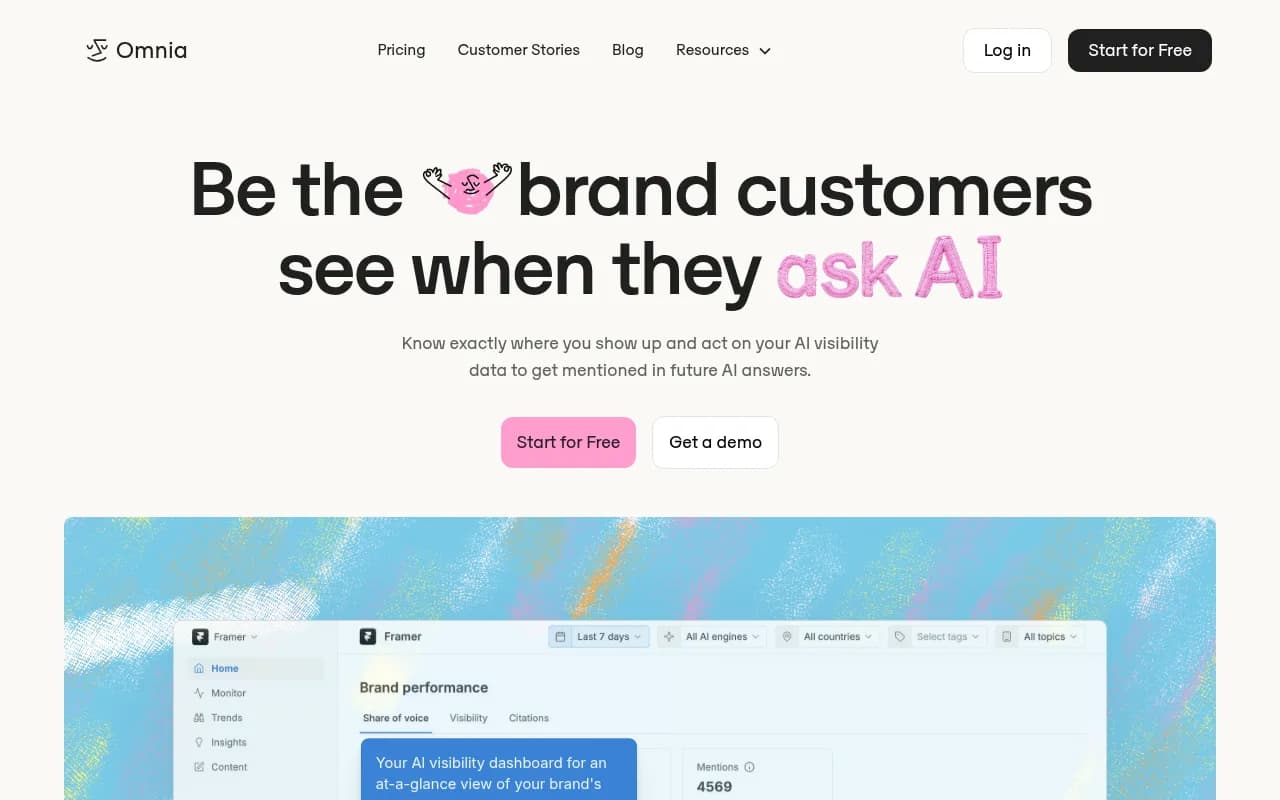
Provides share of voice analytics and visibility tracking across AI platforms, helping brands understand their competitive position in AI search.
Key Takeaways:
- Omnia tracks brand mentions across ChatGPT, Perplexity, Google AI Overviews, and Google AI mode with daily refresh cycles
- Goes beyond monitoring by generating personalized action plans and content recommendations based on citation analysis
- Lacks AI crawler logs, traffic attribution, Reddit/YouTube tracking, and multi-model coverage that Promptwatch offers
- Best for brands wanting basic AI visibility tracking with some optimization guidance, but limited compared to full-featured platforms
- Pricing available on request with a free trial; no transparent pricing tiers listed publicly

Omnia positions itself as an AI visibility platform that doesn't just show you data -- it tells you what to do with it. The pitch is simple: most tools dump tracking metrics on you and leave you stuck. Omnia analyzes your brand's presence in AI search engines like ChatGPT and Perplexity, then generates a step-by-step roadmap to improve your visibility. It's a solid concept, but the execution reveals gaps when you compare it to more comprehensive platforms.
The company targets SEO teams and marketing professionals at mid-sized brands. Clients include Exoticca, Ironhack, OkTicket, and Pleo. They've built case studies around quick wins -- OkTicket claims a 30% increase in leads from AI search, and Indya moved from position 11 to position 2 in seven days. Those are impressive numbers if they hold up, but the platform's feature set suggests it's still early in its development.
Prompt Discovery and Monitoring
Omnia's core feature is prompt tracking. You tell it what topics or products to monitor, and it runs those prompts daily across four AI engines: ChatGPT, Perplexity, Google AI Overviews, and Google AI mode. That's a narrow set compared to platforms that track 10+ models including Claude, Gemini, DeepSeek, Grok, and Mistral. The daily refresh is standard -- not slow, but not real-time either.
The prompt discovery tool suggests questions customers are asking about your industry or product. This is useful for finding monitoring targets, but it's unclear how Omnia sources these prompts. Does it pull from search query data? User behavior? The site doesn't say. Without prompt volume estimates or difficulty scoring, you're guessing which prompts are worth tracking.
Share of Voice and Competitor Benchmarking
Omnia shows where your brand appears in AI answers and how you stack up against competitors. You get share of voice metrics -- what percentage of tracked prompts mention your brand versus competitors. This is table stakes for any AI visibility tool. The interface includes heatmaps that compare your visibility across different AI engines, which is a nice visual touch.
Citation tracking shows which sources AI engines pull from when they mention your brand. Omnia analyzes these citations to find patterns -- for example, if competitors are consistently cited from Reddit threads or YouTube videos, that's a signal. But here's where it falls short: Omnia doesn't actually track Reddit or YouTube directly. You see citations after the fact, but you're not monitoring those channels proactively like you would with a platform that has dedicated Reddit and YouTube tracking modules.
Action Plans and Content Recommendations
This is where Omnia tries to differentiate itself. Instead of just showing you data, it generates a "highly-personalized AI visibility action plan" based on your tracking results. The roadmap includes content creation suggestions, technical SEO fixes, and content placement strategies. In practice, this means Omnia identifies gaps -- prompts where competitors appear but you don't -- and recommends topics to cover.
The platform includes a content generation feature that creates "ready-to-review content" designed to get cited in AI answers. This is a step in the right direction, but the details are vague. How does the AI writer work? Does it ground content in citation data? Does it optimize for specific AI models? The site doesn't explain the methodology. Compare this to platforms that generate content based on 880M+ analyzed citations and prompt volumes -- there's a difference between generic AI writing and content engineered to rank in AI search.
What's Missing
Omnia covers the basics of AI visibility tracking, but it's missing several capabilities that more mature platforms offer:
- AI Crawler Logs: No visibility into which AI crawlers are hitting your site, how often, or what errors they encounter. You can't see if ChatGPT or Perplexity are even indexing your content.
- Traffic Attribution: No way to connect AI visibility to actual website traffic or revenue. You're tracking mentions, but you don't know if they're driving business results.
- Reddit and YouTube Tracking: Citations from these platforms are mentioned, but there's no dedicated monitoring. You're reacting to citations, not proactively tracking discussions.
- ChatGPT Shopping: No tracking of product recommendations in ChatGPT's shopping carousels, which is increasingly important for e-commerce brands.
- Prompt Intelligence: No volume estimates, difficulty scores, or query fan-outs. You're flying blind on which prompts are high-value versus low-priority.
- Multi-Model Coverage: Only four AI engines tracked. Missing Claude, Gemini, DeepSeek, Grok, Mistral, and others that are gaining traction.
- API and Integrations: No mention of API access, Looker Studio integration, or GSC connectivity. Data stays in Omnia's dashboard.
Who Is It For
Omnia works for brands that are just getting started with AI visibility tracking and want some guidance on what to do next. If you're a marketing team at a mid-sized SaaS company or e-commerce brand, and you've never monitored AI search before, Omnia gives you a starting point. The action plans are helpful if you don't have internal expertise in AEO.
It's less suitable for:
- SEO agencies managing multiple clients who need robust reporting and API access
- Enterprise brands that require comprehensive multi-model tracking and traffic attribution
- Teams that want to optimize aggressively with content gap analysis, crawler log monitoring, and real-time feedback loops
- Anyone who needs to track more than four AI engines or wants Reddit/YouTube visibility
Pricing and Value
Omnia's pricing is not publicly listed. The site says "flexible pricing" and "start for free," but you have to request a quote. There's a free trial available, and a "Pro Plan" is mentioned for users who want to "monitor more prompts and go deeper with data exports." Without transparent pricing tiers, it's hard to assess value. Most competitors in this space publish their pricing -- Essential plans around $99/mo, Professional around $249/mo, Business around $579/mo.
The lack of pricing transparency is a red flag. It suggests either the pricing is highly variable (which complicates budgeting) or the company is still figuring out its pricing model. For comparison, Promptwatch publishes clear tiers: Essential $99/mo (1 site, 50 prompts, 5 articles), Professional $249/mo (2 sites, 150 prompts, 15 articles, crawler logs), Business $579/mo (5 sites, 350 prompts, 30 articles).
Strengths and Limitations
What Omnia does well:
- Daily prompt tracking with share of voice metrics
- Competitor benchmarking across four AI engines
- Action plans that translate data into next steps
- Content generation feature for gap-filling
- Quick results -- case studies show visibility improvements in 7-30 days
Where it falls short:
- Limited to four AI engines (ChatGPT, Perplexity, Google AI Overviews, Google AI mode) -- missing Claude, Gemini, DeepSeek, Grok, Mistral
- No AI crawler logs to see if AI engines are even indexing your site
- No traffic attribution to connect visibility to business outcomes
- No Reddit or YouTube tracking despite citing their importance
- No prompt volume or difficulty data to prioritize high-value queries
- No API or integrations for custom reporting
- Pricing not publicly available
- Content generation lacks detail on methodology and citation grounding
Compared to Promptwatch, Omnia is a monitoring-first tool with basic optimization features. Promptwatch offers the full action loop: Answer Gap Analysis to find missing content, an AI writing agent grounded in 880M+ citations, crawler logs, traffic attribution, Reddit/YouTube tracking, ChatGPT Shopping monitoring, prompt volumes and difficulty scoring, and coverage of 10+ AI models. Omnia gives you a roadmap; Promptwatch gives you the tools to execute it.
Bottom Line
Omnia is a decent entry-level AI visibility tool for brands that want to start tracking their presence in ChatGPT and Perplexity without getting overwhelmed. The action plans are a nice touch if you need hand-holding. But the limited model coverage, missing crawler logs and traffic attribution, and lack of transparent pricing make it hard to recommend over more comprehensive platforms. If you're serious about optimizing for AI search -- not just monitoring it -- you'll outgrow Omnia quickly and need a platform like Promptwatch that offers content gap analysis, AI crawler logs, traffic attribution, and multi-model coverage. Best use case: a mid-sized brand dipping its toes into AEO and willing to pay for basic tracking plus some optimization guidance.
Frequently asked questions
What is Omnia and what does it do?
How much does Omnia cost?
Which AI platforms does Omnia track?
Is Omnia free to use?
Who is Omnia designed for?
What makes Omnia different from other AI visibility tracking tools?
How often does Omnia update its tracking data?
What results have companies achieved using Omnia?
Similar and alternative tools to Omnia