Key Takeaways
- Whitebox positions itself as an "agentic GEO" platform that generates and ships fixes automatically, while Omnia focuses on monitoring and providing actionable insights you implement yourself
- Whitebox targets enterprise clients with custom pricing and no public tiers; Omnia offers a free trial and Pro plan with transparent pricing on request
- Omnia includes prompt discovery tools that surface real customer questions, while Whitebox emphasizes scientific analysis of how AI systems interpret your brand
- Both platforms track citations across major AI engines (ChatGPT, Perplexity, Gemini, Copilot), but their approaches to optimization differ significantly
- Whitebox's client roster includes major enterprises like Palo Alto Networks, Wiz, and eToro; Omnia serves marketing teams at companies like Exoticca, Ironhack, and Pleo
- Neither platform publicly discloses full feature lists or pricing, making direct comparison challenging without requesting demos
Overview
Whitebox: Agentic AI presence management
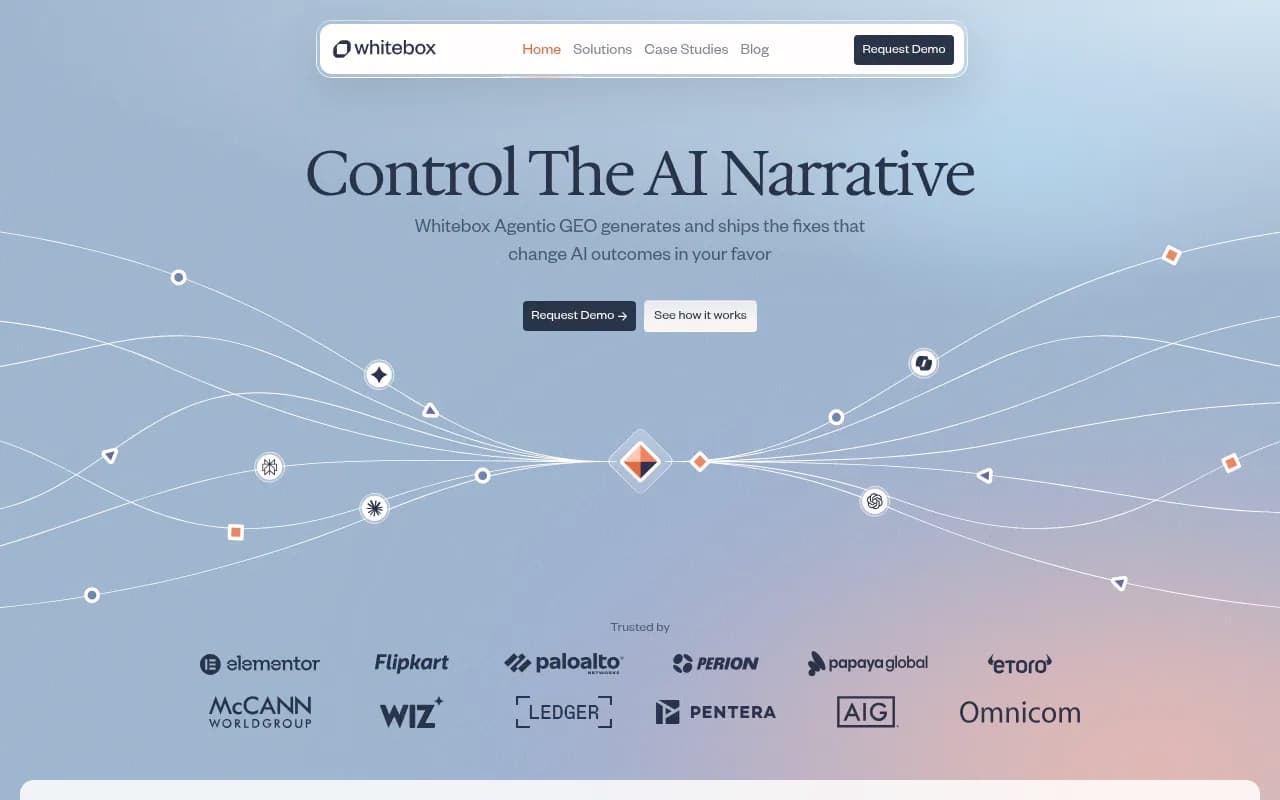
Whitebox bills itself as an "agentic GEO" platform -- meaning it doesn't just show you problems, it generates and ships the fixes. The platform promises to help you "control the AI narrative" by analyzing how AI systems interpret your brand, measuring real-time perception shifts, and strategically influencing outcomes. Their client list includes heavyweight enterprise names like Palo Alto Networks, Flipkart, Wiz, AIG, and Omnicom, suggesting a focus on large organizations with complex brand management needs.
The platform emphasizes three core capabilities: seeing "the truth" about how AI interprets your brand, getting "the solutions" through real-time measurement, and influencing outcomes strategically. What sets Whitebox apart is the promise of automation -- the platform generates fixes rather than just identifying problems.
Omnia: Share of voice analytics for marketing teams
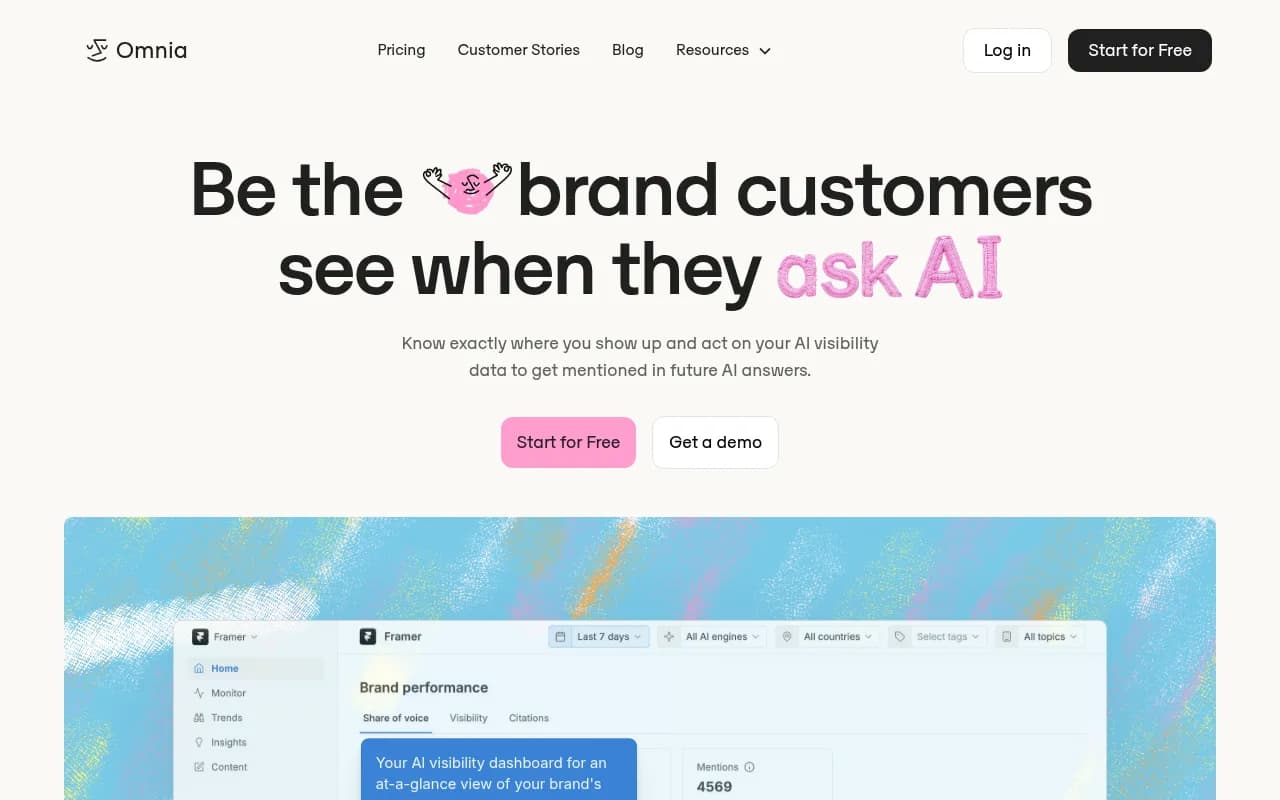
Omnia positions itself as "AI visibility software for marketing teams" with a focus on SEO and marketing experts. The platform monitors citations and mentions across ChatGPT, Perplexity, Gemini, and Microsoft Copilot. Omnia's approach centers on three pillars: discovering real questions people ask AI, seeing your brand through AI's eyes via competitive benchmarking, and translating tracking data into an actionable roadmap.
Their client base includes travel companies (Exoticca), education providers (Ironhack, The Power Business School), and B2B SaaS companies (Pleo, Embat). This suggests a focus on mid-market companies and marketing teams rather than enterprise-only. Omnia offers a free trial and emphasizes accessibility for marketing practitioners.
Side-by-side comparison
| Feature | Whitebox | Omnia |
|---|---|---|
| Pricing model | Custom enterprise pricing | Free trial + Pro plan (pricing on request) |
| Free tier | No | Yes (trial) |
| Target audience | Enterprise brands, agencies | Marketing teams, SEO experts |
| AI engines tracked | Major platforms (specifics not disclosed) | ChatGPT, Perplexity, Gemini, Copilot |
| Automation level | Agentic (generates and ships fixes) | Insight-driven (provides roadmap) |
| Prompt discovery | Not emphasized | Yes (surfaces real customer questions) |
| Competitive benchmarking | Yes (implied) | Yes (share of voice analytics) |
| Citation tracking | Yes | Yes |
| Content recommendations | Automated fixes | Step-by-step roadmap |
| Technical SEO guidance | Not specified | Yes (part of roadmap) |
| Onboarding complexity | Enterprise (demo required) | Self-service trial available |
| Public documentation | Minimal | Minimal |
Platform approach: Automation vs insights
The biggest difference between these platforms is philosophical. Whitebox promises to generate and ship fixes for you -- an "agentic" approach where the platform takes action on your behalf. This sounds powerful but raises questions about control and customization. What if the automated fix doesn't align with your brand voice or content strategy? The enterprise focus suggests they handle this through white-glove service and custom implementations.
Omnia takes the opposite approach: comprehensive monitoring and insights that translate into a roadmap you execute yourself. The platform shows you where you're mentioned, how you benchmark against competitors, and what content gaps exist. Then it maps out steps for content creation, technical SEO, and content placement. You maintain full control but do the work yourself.
For teams that want to own the optimization process and have the resources to execute, Omnia's approach makes sense. For enterprises that want to offload the execution entirely, Whitebox's agentic model is appealing -- assuming the automation actually works as advertised.
Prompt discovery and research capabilities
Omnia explicitly highlights prompt discovery as a core feature. The platform surfaces real questions customers are asking AI about your industry or product. This is valuable for content strategy -- you can see exactly what people want to know and create content that answers those questions.
Whitebox doesn't emphasize prompt discovery in their public messaging. Instead, they focus on "scientific clarity" about how AI systems interpret your brand. This suggests a more analytical approach focused on understanding AI behavior rather than surfacing user queries.
If your goal is to build a content strategy around actual customer questions, Omnia's prompt discovery tools give you a clear advantage. If you're more concerned with how AI models perceive your brand at a systemic level, Whitebox's scientific analysis might be more relevant.
Citation tracking and competitive analysis
Both platforms track where your brand is cited in AI responses, but they present this data differently. Omnia emphasizes share of voice analytics -- showing how often you're mentioned compared to competitors across different prompts. This competitive benchmarking helps you understand your relative position in AI search results.
Whitebox talks about measuring "real-time shifts in AI perception and ranking with precision," which implies similar tracking capabilities but with a focus on temporal changes rather than competitive positioning. The platform promises to show you why AI systems interpret your brand the way they do, suggesting deeper causal analysis.
For competitive intelligence and market positioning, Omnia's share of voice approach is more straightforward. For understanding the underlying factors driving AI perception, Whitebox's analytical depth might be stronger -- though without hands-on testing, it's hard to verify these claims.
Optimization and action
This is where the platforms diverge most sharply. Whitebox's "agentic GEO" promise is that it generates and ships fixes automatically. The website doesn't specify what these fixes look like -- are they content updates, schema markup changes, backlink strategies? The lack of detail is frustrating but typical for enterprise platforms that customize heavily per client.
Omnia provides a "step-by-step AI visibility roadmap" covering content creation, technical SEO, and content placement. Each recommendation is mapped to fill specific gaps in your brand's AI visibility. This is more transparent but requires you to have the team and resources to execute the roadmap.
If you have a lean team and want the platform to do the heavy lifting, Whitebox's automation is attractive. If you have in-house SEO and content teams who want clear direction on what to build, Omnia's roadmap approach is more practical.
Worth noting that tools like Promptwatch take a middle path here -- they show you content gaps through Answer Gap Analysis, then help you create optimized content with their AI writing agent, but you still control the publishing process.

Pricing and accessibility
| Plan type | Whitebox | Omnia |
|---|---|---|
| Free trial | No | Yes |
| Entry-level pricing | Custom (enterprise only) | Pro plan (pricing on request) |
| Self-service signup | No (demo required) | Yes |
| Pricing transparency | None | Partial (must request quote) |
| Target customer size | Enterprise | Mid-market to enterprise |
Whitebox's enterprise-only positioning with custom pricing means you need to go through a sales process to even see the platform. This makes sense for their target market but creates a high barrier to entry. If you're a small marketing team or startup, you probably can't afford Whitebox.
Omnia offers a free trial and self-service signup, making it accessible to smaller teams who want to explore AI visibility tracking without a major commitment. The Pro plan pricing isn't public, but the fact that they offer a trial suggests more reasonable pricing for mid-market companies.
For budget-conscious teams, Omnia is the only realistic option here. For enterprises with significant budgets who want a fully managed solution, Whitebox's custom approach might be worth the investment.
AI engine coverage
Omnia explicitly lists the AI engines they monitor: ChatGPT, Perplexity, Gemini, and Microsoft Copilot. This is a solid core set covering the major consumer-facing AI search platforms.
Whitebox doesn't specify which AI engines they track on their website. Given their enterprise focus and premium positioning, they likely cover at least the same platforms as Omnia, possibly more. But the lack of transparency is annoying.
Both platforms appear to miss some emerging players. For comprehensive coverage including Google AI Overviews, Meta AI, Grok, DeepSeek, and Mistral, you'd need to look at platforms like Promptwatch that explicitly track 10+ AI models.
User interface and experience
Neither platform provides screenshots or detailed UI walkthroughs on their public websites, which is frustrating when trying to evaluate them. Whitebox's website is heavy on abstract visuals and light on concrete product screenshots. Omnia shows a few interface glimpses but not enough to judge usability.
Based on their positioning, Whitebox likely has a more complex, enterprise-grade interface with extensive customization options. Omnia's focus on marketing teams suggests a more streamlined, accessible UI designed for practitioners rather than analysts.
Without trial access or demos, it's impossible to say which platform is actually easier to use. The fact that Omnia offers a free trial gives you a chance to evaluate the UX yourself before committing.
Integration and workflow
Neither platform provides detailed information about integrations, API access, or how they fit into existing marketing workflows. This is a significant gap in their public documentation.
For enterprise platforms like Whitebox, you'd expect custom integrations as part of the implementation process. For Omnia, the lack of integration details is more concerning -- marketing teams need to connect AI visibility data to their existing SEO tools, content management systems, and analytics platforms.
If integrations are critical for your workflow, you'll need to ask about this specifically during demos or sales conversations.
Pros and cons
Whitebox pros
- Agentic approach automates fix generation and implementation
- Enterprise-grade platform with major client logos
- Scientific analysis of how AI systems interpret your brand
- Custom implementations for complex brand management needs
Whitebox cons
- No pricing transparency -- custom enterprise pricing only
- No free trial or self-service option
- Minimal public documentation about features and capabilities
- Unclear what "agentic" fixes actually look like in practice
- High barrier to entry for smaller companies
Omnia pros
- Free trial available for hands-on evaluation
- Prompt discovery surfaces real customer questions
- Share of voice analytics for competitive benchmarking
- Step-by-step roadmap translates data into action
- More accessible for mid-market companies and marketing teams
Omnia cons
- Requires you to execute the roadmap yourself (no automation)
- Limited AI engine coverage (4 platforms)
- Pricing still not fully transparent (must request quote)
- Less emphasis on deep causal analysis of AI behavior
- Fewer enterprise-grade features and customization options
Who should choose which platform
Choose Whitebox if:
- You're an enterprise with a significant budget for AI visibility
- You want the platform to generate and implement fixes automatically
- You need custom implementations and white-glove service
- You're managing complex brand presence across multiple markets
- You have the resources to go through an enterprise sales process
Choose Omnia if:
- You're a marketing team at a mid-market company
- You want to understand what questions customers are asking AI
- You need competitive share of voice analytics
- You prefer to maintain control over content and optimization execution
- You want to try the platform before committing (free trial)
- You have in-house SEO and content resources to execute the roadmap
Consider alternatives if:
- You need comprehensive coverage of 10+ AI models including emerging platforms
- You want transparent pricing with self-service plans starting under $100/month
- You need both monitoring and content generation in one platform
- You want to track AI crawler behavior and indexing issues
- You're looking for Reddit and YouTube citation tracking
Final verdict
Whitebox and Omnia represent two different philosophies in AI visibility management. Whitebox promises automation and enterprise-grade brand control at an enterprise price point. Omnia offers accessible monitoring and insights that marketing teams can act on themselves.
For most companies, Omnia is the more practical starting point. The free trial lets you evaluate whether AI visibility tracking is valuable for your business before making a financial commitment. The prompt discovery and share of voice features give you concrete data to inform content strategy. The roadmap approach works well if you have a team that can execute.
Whitebox makes sense for large enterprises that want to offload the entire optimization process and have the budget for custom implementations. But the lack of transparency about features, pricing, and what "agentic" fixes actually entail makes it hard to recommend without seeing the platform in action.
The AI visibility space is still young and evolving rapidly. Both platforms would benefit from more transparent documentation, clearer feature lists, and concrete examples of how they've improved AI search visibility for clients. Until then, start with Omnia's free trial if you're exploring this space, and only consider Whitebox if you're an enterprise with specific requirements that justify the custom pricing model.