Key takeaways
- "GEO tool" covers three different things for fashion and beauty: monitoring platforms, enterprise SEO suites with AI add-ons, and catalog or commerce-level tools that change what AI can read about your products.
- Product pages and landing pages are the most cited content types in ChatGPT (22.4% and 16.8%, Sep 28 to Oct 4, 2026), so product data quality matters more than blog volume.
- Instagram and TikTok barely register in ChatGPT citations. Google AI Overviews cites social more often, led by YouTube.
- Most DTC brands need one monitoring and optimization platform, plus clean product schema and open crawler access. Few need an agency from day one.
- Many "best GEO tools" lists are written by vendors. Treat their numbers as marketing until you can verify them.
Why beauty and fashion behave differently in AI search
A shopper asking ChatGPT "best vitamin C serum for sensitive skin" or "linen dress for a summer wedding" is not looking for a blog post. They want a shortlist with reasons. That changes what gets cited.
Promptwatch Data tracked which content types ChatGPT cited from Sep 28 to Oct 4, 2026 (content type citation share report). Product pages led at 22.4%, landing pages followed at 16.8%, and listicles got 13.6%. For commercial prompts like "best X", product pages rose to 26.0% and landing pages to 20.6%. Comparisons got 7.9%.
For beauty and fashion, that is useful news. You control product pages. Ingredient lists, sizing, fit notes, skin-type suitability, prices, and availability are exactly the facts an AI answer needs, and they sit on your own domain.
Branded prompts ("is Brand X worth it?") look different. Reviews rise to 5.6% of citations, more than three times their overall share. So review collection on trusted third-party sites is worth real effort.
Social is a weaker lever than it feels
Beauty and fashion teams live on Instagram and TikTok. AI engines mostly do not cite them. In Promptwatch's social media citations report for Sep 28 to Oct 4, 2026, all seven tracked social platforms combined made up 0.46% of ChatGPT citations. Reddit fell to 0.09% there. Google AI Overviews was different: social platforms earned 12.2% of its citations, with YouTube at 4.28%, Facebook at 2.38%, and Instagram at 1.61%. TikTok sat at 0.22%.
So a YouTube tutorial library helps in AI Overviews. A viral TikTok does very little for ChatGPT visibility. Plan accordingly.
The three kinds of GEO tool
Vendor guides group the market in roughly the same way, and the grouping holds up.
1. AI visibility monitoring and optimization platforms
These run a set of prompts against ChatGPT, Perplexity, Gemini, and Google AI, then report which brands get mentioned and cited. The basic ones are closer to a rank tracker. The better ones also tell you why you are missing and help you fix it.
2. Enterprise SEO suites with AI tracking
BrightEdge, Conductor, Semrush, and seoClarity have added AI visibility modules. They make sense if you already run enterprise SEO through them. The AI features tend to focus on content pages, not on product catalogs.
3. Catalog and commerce-level GEO
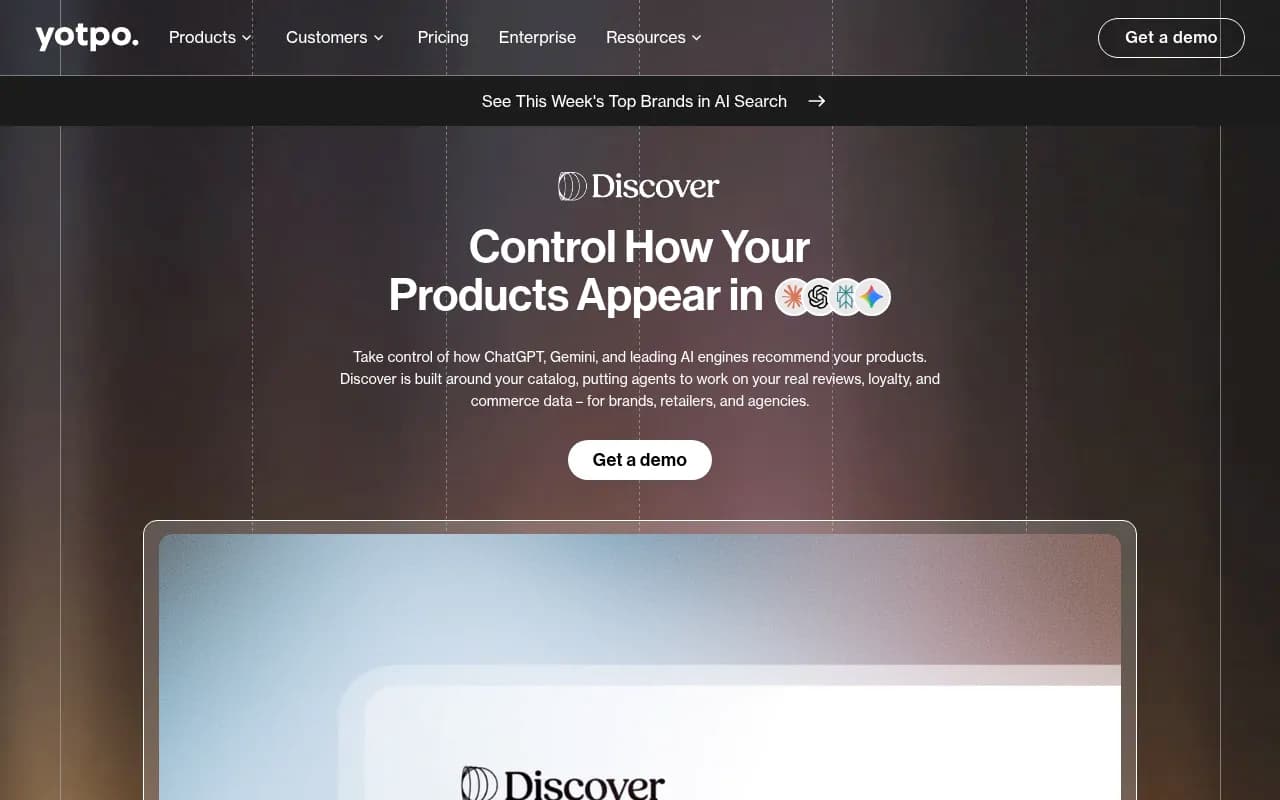
This is the newer group. Instead of only measuring, these tools work on product data, structured markup, shopping surfaces, and review content. Veristyle, for example, enriches products with computer-vision attributes and publishes them as structured data. Yotpo Discover builds on reviews and purchase data. Both are vendors writing about their own category, so read their claims with that in mind.
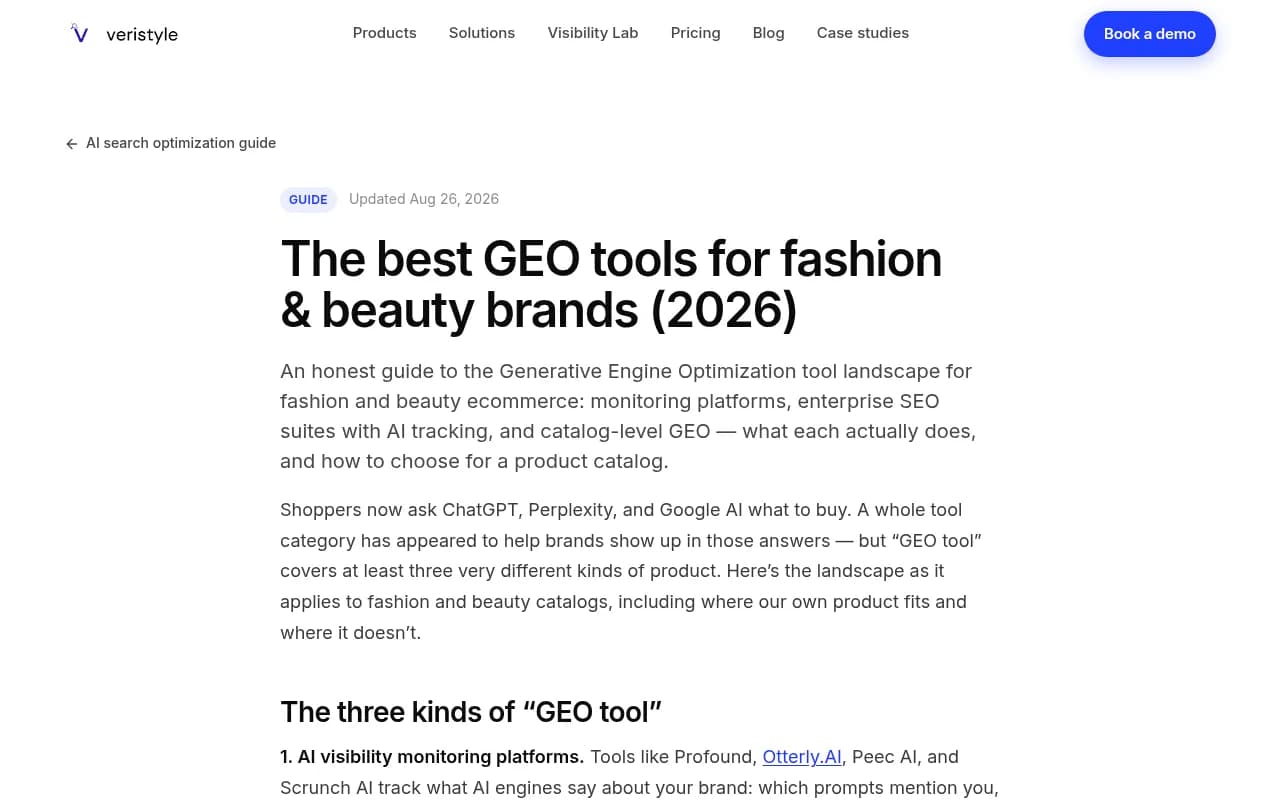
The honest caveat from that guide is one I agree with: monitoring and optimization complement each other. Plenty of brands run both.
Comparison: which type fits which brand
| You need | Look at | Example tools |
|---|---|---|
| To see what AI says about your brand and competitors | Monitoring platform | Promptwatch, Profound, Peec AI, Otterly.AI |
| AI tracking inside an existing enterprise SEO program | SEO suite with AI module | BrightEdge, Conductor, Semrush One, seoClarity |
| Products recommended in shopping-style answers | Commerce or catalog GEO | Azoma, Yotpo Discover, Goodie AI, Nudge |
| Review and UGC signals feeding AI answers | Reviews platform with AI visibility | Yotpo Discover |
| Content published against visibility gaps | Optimization platform with content tools | Promptwatch, AirOps, Frase |
The best GEO tools for beauty, fashion and DTC in 2026
Promptwatch
Promptwatch is where I would start for most DTC brands, because it covers the full loop instead of just reporting. It tracks real user interfaces in ChatGPT, Google AI Overviews, AI Mode, Gemini, Perplexity, and Copilot by country and language, which matters when answers differ from API outputs.
For fashion and beauty specifically, three things stand out. First, it tracks ChatGPT shopping carousels and Amazon Alexa product results, and you can upload your catalog to track your own products. Second, IP-verified AI crawler logs show whether GPTBot, OAI-SearchBot, and others can actually read your product pages or hit errors. Third, the Content Agent plans and publishes content against visibility gaps to Shopify-adjacent CMSs like WordPress, Webflow, and Framer, then tracks whether each page gets crawled, cited, and clicked.
It also covers Reddit, YouTube, and LinkedIn citation reports, which helps with the AI Overviews side of the social picture. Plans start with a free Explore tier, with Essential at $95 per month and Professional at $245. Agencies have separate tiers from $199. Confirm current pricing at promptwatch.com/pricing.

Profound
Profound is a strong enterprise monitoring product. It suits large brands with budget and a dedicated team. It sits at a higher price point, and it focuses on monitoring more than execution.

Peec AI and Otterly.AI
Both are lighter, cheaper prompt trackers. If you only need to know whether your serum or sneaker shows up for a handful of prompts, they are fine. Expect to do the fixing yourself and to look elsewhere for crawler data and traffic attribution.


Yotpo Discover
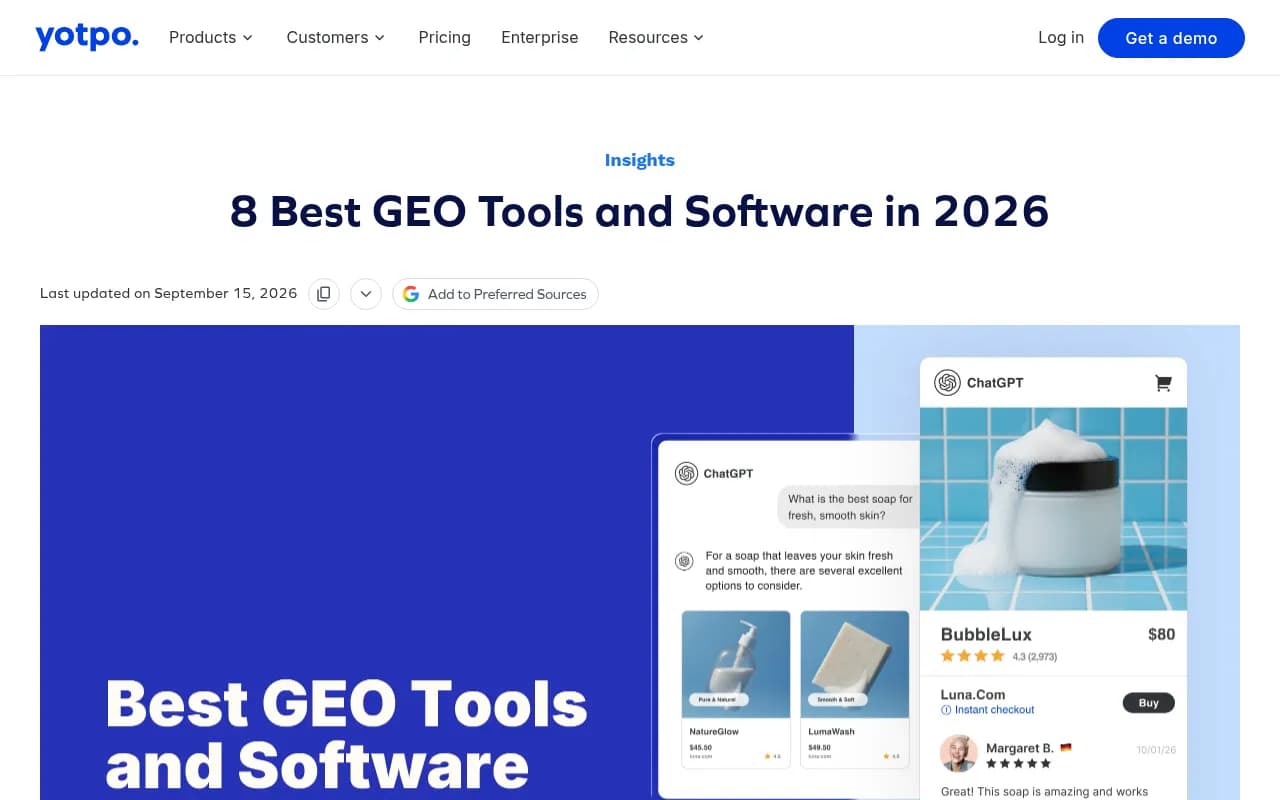
Yotpo's pitch is that its reviews, verified purchase, and loyalty data feed AI visibility for ecommerce. If you already run Yotpo reviews, that is a natural fit, since reviews are a meaningful share of branded citations. Yotpo's own guide to GEO tools is worth reading for context, though it is written by a vendor that ranks its own product first.
Azoma and Goodie AI
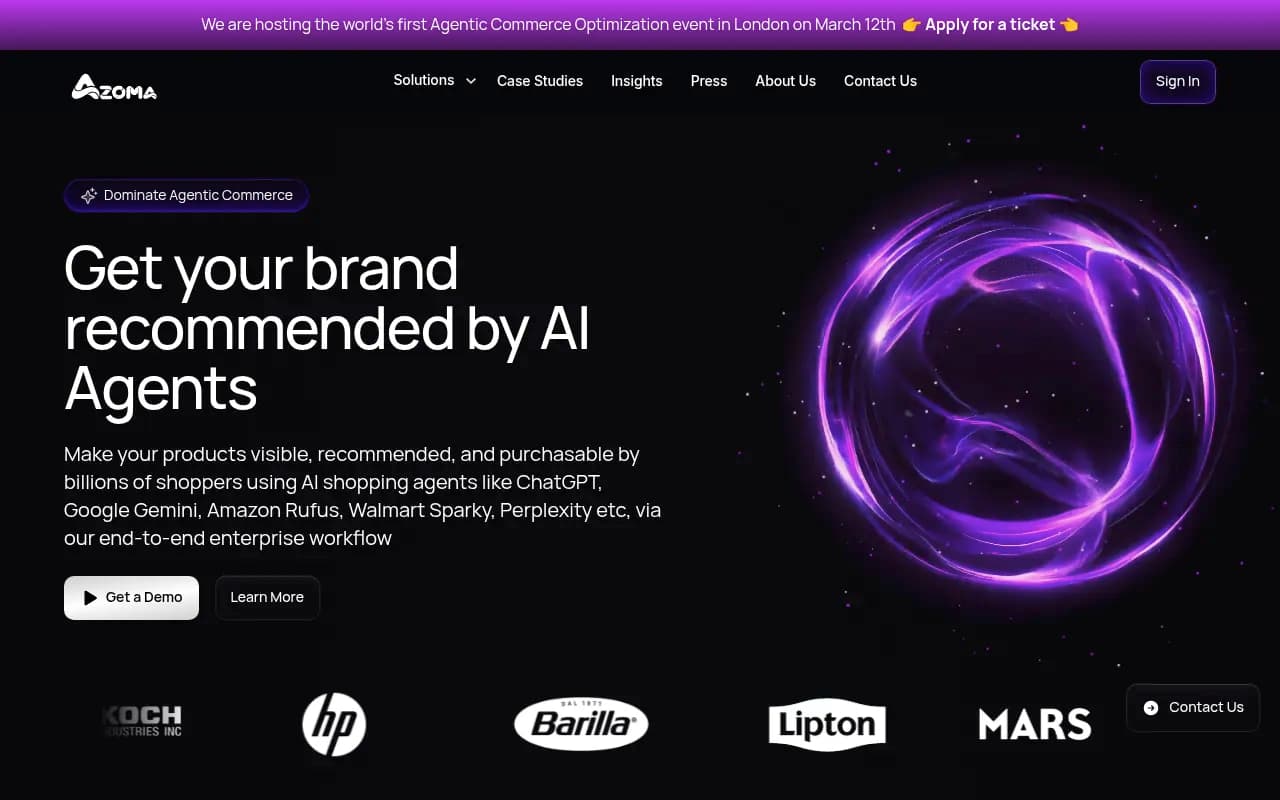
Azoma targets enterprise AI shopping optimization across ChatGPT, Amazon Rufus, and similar surfaces. Goodie AI focuses on agentic commerce. Both are better suited to brands with large catalogs and marketplace exposure than to a 40-SKU skincare label.
Semrush One, Conductor and BrightEdge
If your SEO team already lives in one of these, adding the AI module is the lowest-friction path. The tradeoff is shallower AI-specific data and little on crawler logs or AI traffic attribution.
AthenaHQ, Scrunch and Brandlight
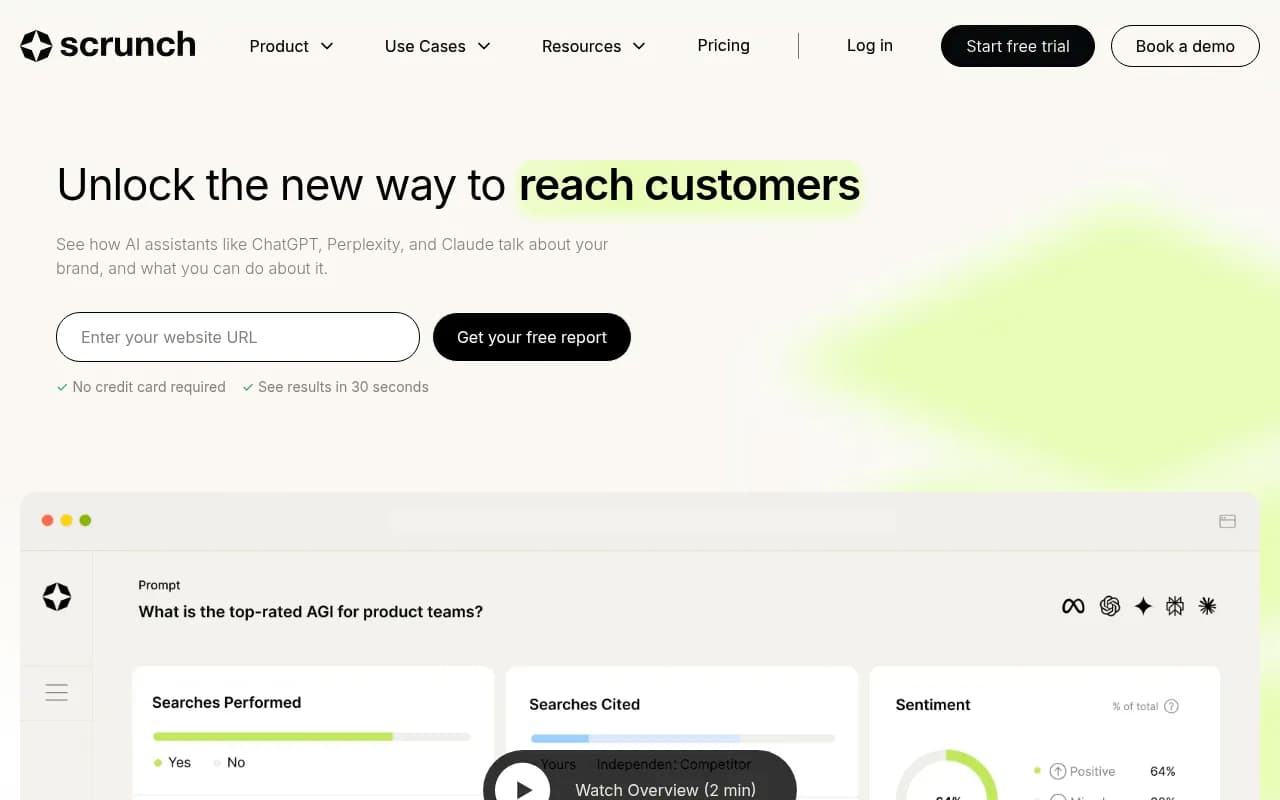
These are monitoring-focused options that come up often in shortlists. They are worth a demo if you are comparing several platforms, but check whether they cover shopping surfaces and publishing.

For a broader view of the market, the GEO software directory at bestgeosoftware.com lists far more options than fit here.
What to fix before you buy anything
No tool compensates for a site AI cannot read. Do these first.
- Check AI crawler access. Make sure robots.txt and your CDN are not blocking GPTBot, OAI-SearchBot, ChatGPT-User, ClaudeBot, or PerplexityBot. Shopify themes and bot protection settings are common culprits.
- Complete your Product schema. Price, availability, brand, GTIN, ratings, and variants. Promptwatch's own guidance from its shopping data is to keep Product schema complete and prices accurate.
- Keep your merchant feed clean. Shopping features appear in only a low single-digit percentage of ChatGPT web-search responses, per Promptwatch's ChatGPT shopping data, and the rate has shifted in steps. Do not build a strategy on it, but do not leave feed errors either.
- Render product pages without heavy JavaScript. If the facts only appear after scripts run, many crawlers will not see them.
- Write product copy for questions. Who is it for, which skin type, which fit, what is it made of, how does it compare.
A short robots.txt check looks like this:
User-agent: GPTBot
Allow: /

User-agent: OAI-SearchBot
Allow: /

User-agent: PerplexityBot
Allow: /
Content that earns citations
The citation data points to a fairly simple content mix.
- Product and landing pages with prices, specs, and clear audience statements.
- Your own comparison pages ("retinol vs bakuchiol", "wide-leg vs straight-leg for petite frames"). Comparisons are 5.9% of citations overall and 7.9% on commercial prompts.
- Placement in the roundup articles ChatGPT cites. Listicles are 13.6% of citations, so earning a spot in third-party "best of" lists is worth outreach.
- An FAQ page. FAQ pages get 3.3% overall and 4.8% on branded prompts.
- Reviews on trusted sites, given their 5.6% share on branded prompts.
One warning on freshness. Promptwatch's content half-life report found landing pages and docs stayed cited longest, while news lost half its pages within 36 days. Evergreen product and category pages are a better bet than trend-chasing posts.
Also keep in mind that almost half of ChatGPT responses cite 10 or more unique domains, per Promptwatch's unique domains report (Sep 28 to Oct 4, 2026). You are not fighting for a single slot. Being one of many sources is a realistic goal.
Do you need a GEO agency?
A pile of agency listicles targets this niche. Passionfruit, Web Tonic, First Page Sage, Stella Rising, and others all publish rankings that put themselves near the top. That is the nature of the genre. Passionfruit's claimed 1,400% AI traffic growth for Solawave, for instance, is a vendor-published figure I could not verify independently.
An agency makes sense when you lack in-house SEO capacity, when you need technical work across a large catalog, or when digital PR and link building are the bottleneck. If you go that route, ask for named case studies with baseline numbers, ask which tools they use for tracking, and avoid long lock-in. Full-service shops like 1001 SEO Media combine technical SEO, content, and digital PR with GEO work, and they use Promptwatch for AI visibility tracking. The same questions apply to them as to anyone else.
If you want a tool-led approach instead, a platform plus one good content person often goes further than a retainer at the $5M to $20M revenue stage.
How to choose: a simple decision path
| Situation | Suggested path |
|---|---|
| Early-stage DTC, under 50 SKUs | Free Promptwatch Explore tier or a free AI visibility report, fix schema and crawler access |
| Growing brand, small team | One optimization platform (Promptwatch Essential or Professional), plus cheap tracker comparison |
| Already on Yotpo reviews | Add Yotpo Discover and still run an independent tracker |
| Enterprise SEO team on BrightEdge or Conductor | Use their AI module, add a dedicated platform for crawler logs and publishing |
| Large marketplace-heavy catalog | Evaluate Azoma or Goodie AI alongside a core platform |
| Multi-brand portfolio or agency | Agency plans with white-label reporting |
Questions to ask any vendor
- Does it track real UI answers or only API outputs? They can differ.
- Can I track by country and language? Beauty and fashion often vary by market.
- Does it show shopping carousels and product cards?
- Can it show AI crawler visits and errors on my product pages?
- Does it connect AI visits to traffic and conversions?
- What happens after the report: does it help me fix gaps, or do I get a dashboard and a to-do list from my own head?
Measuring whether it works
Track three layers. Visibility: are you mentioned and cited for the prompts your buyers use? Access: are AI crawlers reading the right pages without errors? Outcomes: sessions and conversions from AI platforms. Mentions alone do not pay anyone's salary.
A reasonable first 30 days: pick 30 to 50 prompts across ingredient, routine, fit, occasion, and "best for" queries; log a baseline; fix crawler access and schema; publish or refresh your ten highest-margin product and category pages; then re-check. Expect movement to be uneven. ChatGPT's behavior changes in steps, as Promptwatch's data on shopping features and citation shifts has shown.
Bottom line
For most beauty, fashion, and DTC brands, the practical stack is a platform that monitors and helps you act, clean product data, open crawler access, and reviews on trusted sites. Start with a free scan, shortlist two or three tools from the table above, and pick the one that tells you what to do next, not just where you stand.