Key takeaways
- Product pages are the most cited content type in ChatGPT (22.4% of citations, Sep 28 to Oct 4, 2026), and product plus landing pages together make up about 39%. For a retailer, your catalog is your GEO surface.
- A good e-commerce GEO tool covers three things: citations in written answers, shopping carousels and product cards, and AI crawler access to your product URLs.
- Monitoring-only tools tell you that you're missing. Pick one that also tells you why and helps you fix it.
- Match the tool to your size: Shopify merchants, mid-market brands and enterprise catalogs need different things.
- Product schema, accurate prices and a clean merchant feed matter more than any prompt-tracking dashboard.
Why e-commerce needs its own GEO approach
Most GEO advice is written for publishers and SaaS companies. Retailers have a different goal. You don't want to be mentioned in an explainer. You want a specific product in a specific card, with the right price, above a competitor's.
That changes what you measure. Three surfaces matter, and they behave differently:
- Written answers, where AI recommends brands and cites pages as sources.
- Shopping carousels and product cards, where merchant, price and position decide who gets the click.
- Crawlers, because if GPTBot or OAI-SearchBot can't read your product pages, none of the above happens.
The traffic that comes out of this is small but valuable. Hello Retail's guide cites Adobe data showing AI-referred traffic to US retail sites grew 393% year over year in Q1 2026 and converted 42% better than non-AI sources by March. Treat those as the vendor's cited figures, not something I verified, but the direction matches what retailers report: low volume, high intent.
What the data says about product pages and citations
Promptwatch Data's report on ChatGPT content types (Sep 28 to Oct 4, 2026) is the clearest evidence that retailers have an advantage here:
- Product pages: 22.4% of classified citations
- Landing pages: 16.8%
- Listicles: 13.6%
- How-to guides: 8.7%
- Documentation: 7.5%
- Comparisons: 5.9%
- Reviews: 1.7%
On commercial prompts, the ones closest to a purchase, product pages climb to 26.0% and landing pages to 20.6%. Those two plus listicles and comparisons are almost 70% of commercial citations. Product pages are the top type for informational and branded prompts too.
Two practical conclusions. First, your own pages can win, so spec completeness, price accuracy and easy comparison are worth real effort. Second, listicles still take 13.6%, which means getting into the "best of" roundups ChatGPT cites is a legitimate parallel strategy.
There is also a durability point. In Promptwatch's content half-life data, landing pages and docs stayed cited longest while news lost half its pages within 36 days. Evergreen product and category pages are a better bet than a seasonal blog post.
Shopping carousels: the part most tools skip
ChatGPT's shopping features, meaning product cards, recommendations and price comparisons, attach to only a low single-digit percentage of web-search responses overall, according to Promptwatch's ChatGPT shopping usage data. The rate moves in steps. It roughly doubled overnight in late May and fell back weeks later, which Promptwatch reads as OpenAI actively tuning when cards show up. The page doesn't give an exact percentage or a clean window, so don't build a forecast on it.
What is clear: cards concentrate on commercial and transactional prompts, and only appear when ChatGPT runs a web search. If your tool only tracks text mentions, it misses this whole surface.
Ads are the other half. Promptwatch's ChatGPT ads data shows ads in an average of 20.1% of ChatGPT web-search responses between May 20 and Aug 17, 2026, with no ads at all until May 27 and a daily peak of 43.9%. Most ad-bearing responses (73.3%) were organic prompts, which is mostly a reflection of prompt volume. For a retailer, that means the shelf is getting crowded, and you want to know which advertisers are bidding on your category prompts.
What to look for in an e-commerce GEO tool
Use this checklist when you demo anything:
- Does it track real product cards, with merchant, price and position, not just brand mentions?
- Does it track the actual ChatGPT, AI Overviews and AI Mode interfaces rather than only API outputs? Answers and shopping results can differ.
- Does it show AI crawler activity on product URLs, with errors?
- Can it connect AI visibility to sessions and revenue (GA4, Shopify, or its own visitor analytics)?
- Does it support multiple countries? Merchants, prices and availability change by market.
- Does it tell you what to do next, or does it just hand you a score?
- Can your catalog be uploaded so it tracks your own products?
That last question separates a store-ready tool from a generic brand tracker.
The best GEO tools for e-commerce retailers in 2026
Promptwatch
Promptwatch is the one I'd shortlist first for retailers who want to act on the data rather than only watch it. It tracks written-answer visibility and citations, product cards in ChatGPT shopping carousels and Amazon Alexa results (you can upload your catalog to track your own products), and sponsored placements through its Ads Radar. Its own e-commerce guide describes tracking all three surfaces on the same prompts, market by market.
The less obvious value is the diagnostic layer. IP-verified AI crawler logs show whether GPTBot, OAI-SearchBot or ChatGPT-User are hitting your product URLs and hitting errors. Weekly site audits flag technical problems. Visitor analytics tie AI visits to conversions. Then the Action Board and Content Agent turn gaps into prioritized work and published content for WordPress, Webflow or Framer.
TreeHouse, the company behind Pararius, grew AI search to roughly 25% of organic conversions largely by fixing crawler access and publishing proprietary data. Crisp reported 2x higher conversion from AI traffic than from traditional channels. Those are not retailers, but the mechanics (crawlability, then structured, citable content) transfer directly.
Pricing starts free for 10 prompts on ChatGPT only. Essential is $95/mo, Professional $245/mo and Business $579/mo, which adds state/city tracking, Shopping Insights and Ads Radar. Confirm current numbers at promptwatch.com/pricing.

Azoma
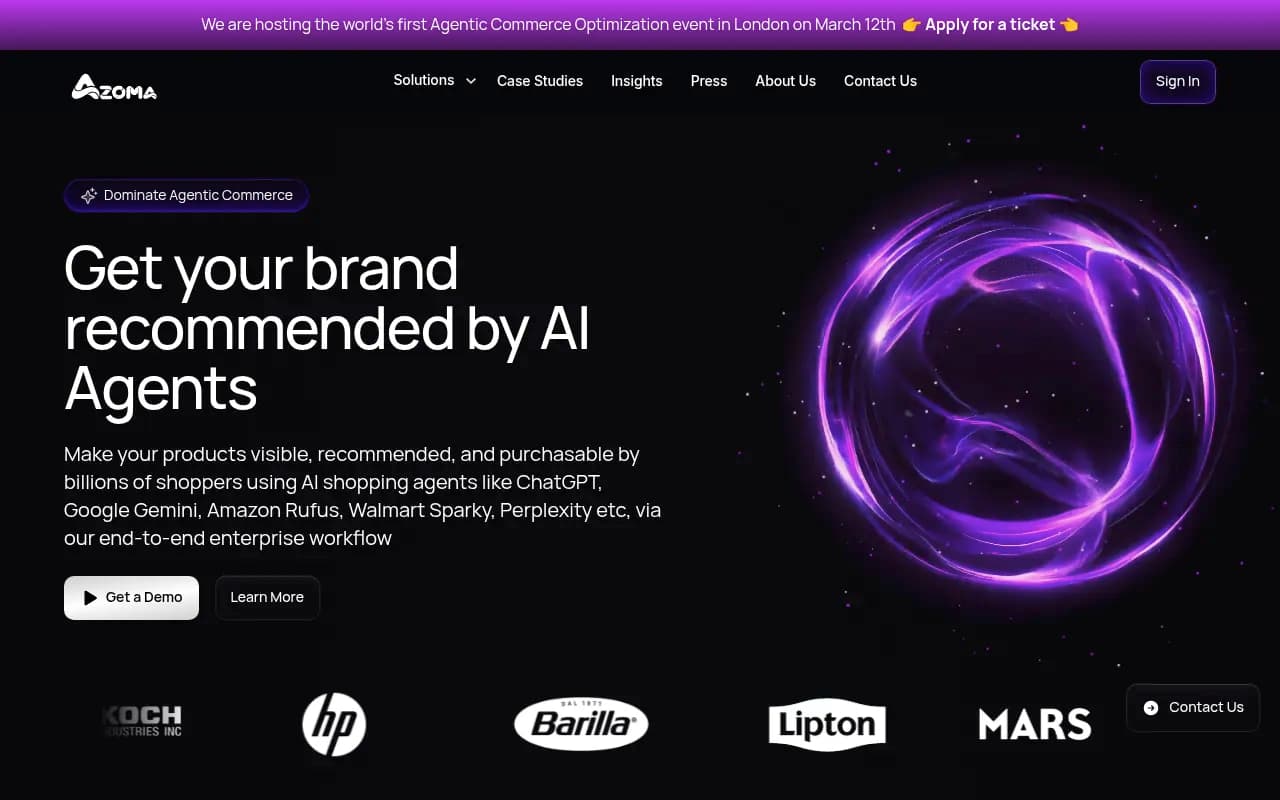
Azoma is built specifically for AI shopping optimization across ChatGPT, Rufus and other shopping surfaces. If your revenue is concentrated on marketplaces and you care about Amazon-style assistants, it's worth a call. Expect an enterprise sales process rather than self-serve.
Yotpo Discover
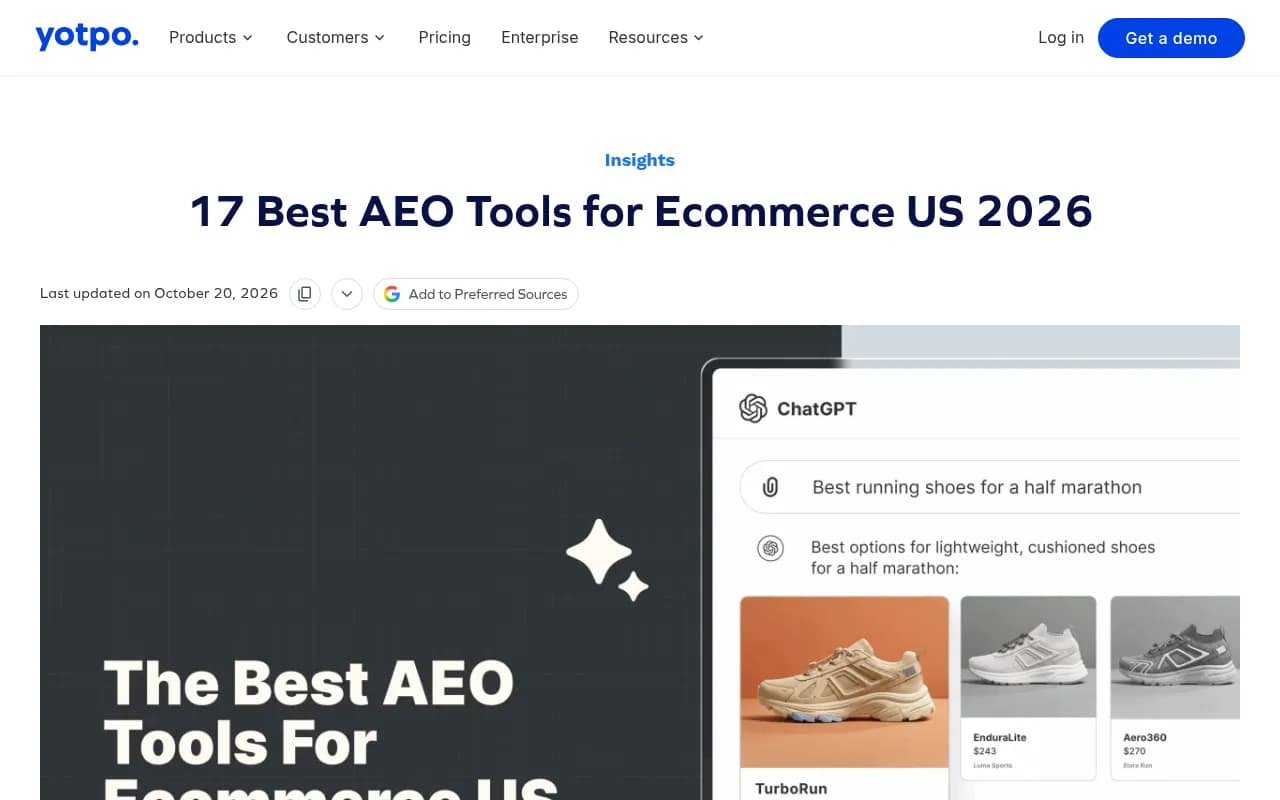
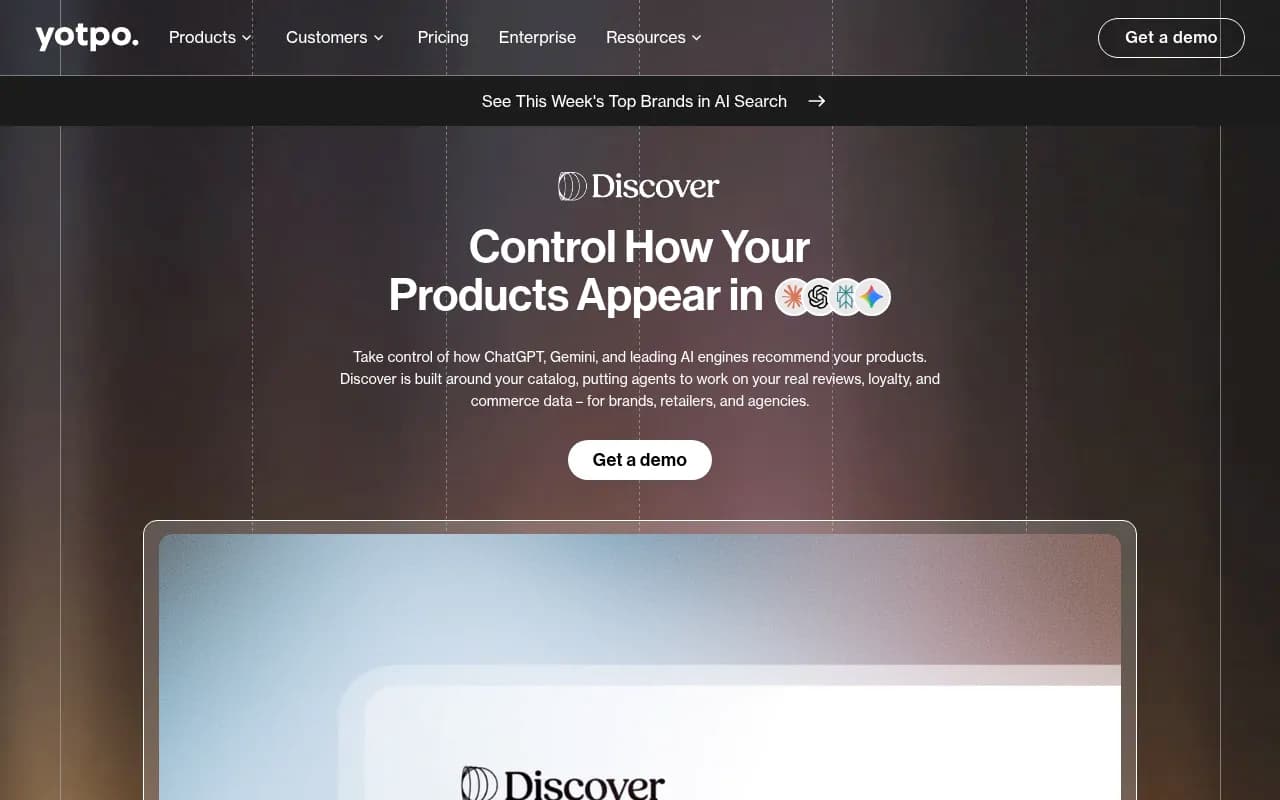
Yotpo positions Discover around ecommerce product discovery, and it sits next to Yotpo's reviews and loyalty data. That matters because reviews are an input AI systems use to validate claims. If you already run Yotpo, this is the shortest path. Note that Yotpo's own roundup of AEO tools is a vendor listing, so read its claims (such as the 31% conversion uplift) as unverified.
Profound and Scrunch
Both are strong monitoring platforms with enterprise pricing. Scrunch adds an agent-facing experience layer that makes content easier for AI assistants to read and cite, which suits large catalogs with messy templates. Compared with Promptwatch, you generally give up shopping-card tracking and agentic content execution.

Omnia
Omnia publishes a store-owner-oriented GEO guide covering how ChatGPT and AI Mode choose products, and sells visibility and share-of-voice analytics. A reasonable fit for smaller teams that want something less enterprise.
Passionfruit Labs
Passionfruit offers AI citation tracking that integrates with GA4 and Shopify, so you can correlate visibility with sales. In the catalog it's described as a full-service agency, so judge it as a services partner as well as software.
Otterly.AI and Peec AI
Affordable prompt trackers. They answer "was my brand mentioned?" and do it cheaply. They won't show you crawler logs, AI-driven visits, or content gap work, so they suit a store that just wants a baseline.


Content and schema helpers
Clearscope shows which pages AI systems reference and helps shape content. InLinks handles entity-based internal linking and schema. Neither tracks shopping cards.


Comparison table
| Tool | Shopping card tracking | Crawler logs | Content execution | Best for |
|---|---|---|---|---|
| Promptwatch | Yes (ChatGPT, Alexa, catalog upload) | Yes, IP-verified | Content Agent, Action Board | Retailers who want to fix, not just watch |
| Azoma | Yes (marketplace focus) | Not confirmed | Enterprise services | Marketplace-heavy brands |
| Yotpo Discover | Ecommerce discovery focus | Not confirmed | Tied to Yotpo stack | Existing Yotpo customers |
| Profound | Limited | Limited | No | Enterprise monitoring |
| Scrunch | No | No | Agent-facing pages | Large messy catalogs |
| Omnia | Not confirmed | No | Guidance | Small stores |
| Otterly.AI / Peec AI | No | No | No | Cheap baselines |
I did not verify competitor pricing for this guide, so check each vendor directly.
Which tool for which retailer
- Small Shopify store: start with the free Promptwatch tier or a low-cost tracker, then fix schema and feeds by hand.
- Mid-market DTC brand: you need shopping-card tracking plus crawler visibility, so Promptwatch Professional or Business.
- Marketplace seller: add Azoma-style marketplace coverage if Amazon assistants drive sales.
- Enterprise catalog: crawler logs, multi-region tracking and an audit trail matter most. Compare Promptwatch Business or Enterprise against Profound and BrightEdge.
- Agency serving retailers: look for white-label reports and unlimited projects.
For more options, the GEO software directory at bestgeosoftware.com lists dozens of tools by category.
A practical workflow for retailers
1. Fix the foundation
Complete Product and Organization schema, accurate prices and availability, and a clean merchant feed. Write answer-first product copy: what it does and who it's for, then measurable claims. "Reduces returns by 15% based on 500 fitted orders" is citable. "Dramatically improves your results" is not.
2. Check crawler access
Confirm that AI crawlers can fetch product pages without errors or bot-blocking rules. Promptwatch's AI crawler traffic data shows weekly verified requests from OpenAI, Anthropic, Google, Perplexity and Mistral, which gives you a benchmark.
3. Build a buyer-prompt set
Write 30 to 50 commercial and transactional prompts the way shoppers ask them. Run them and record which brands fill the cards and the citations.
4. Close the gaps
Compare cited pages against yours. Are competitors winning through listicles? Pitch for inclusion. Through reviews? Collect them on trusted sites. Through comparison pages? Build your own.
5. Measure revenue, not mentions
Track AI-referred sessions and conversions per page. A mention that never produces a visit is a vanity metric.
Mistakes to avoid
- Optimizing blog content while product pages are thin.
- Treating a one-day shopping-card snapshot as a trend. The rate moves in steps.
- Ignoring market differences in price and merchant.
- Relying on API-only tracking, which can differ from what shoppers see.
- Buying a tool whose output is a score with no action list.
Final take
Start by auditing your top 20 product pages for schema, price accuracy and crawler access, then pick the tool that matches the surfaces you actually sell through. If shopping carousels and crawler visibility matter to you, Promptwatch's free tier is the quickest way to see where you stand before committing budget.
If you'd rather have specialists run the programme, 1001 SEO Media publishes this site and uses Promptwatch for client GEO work.