Azoma Review 2026
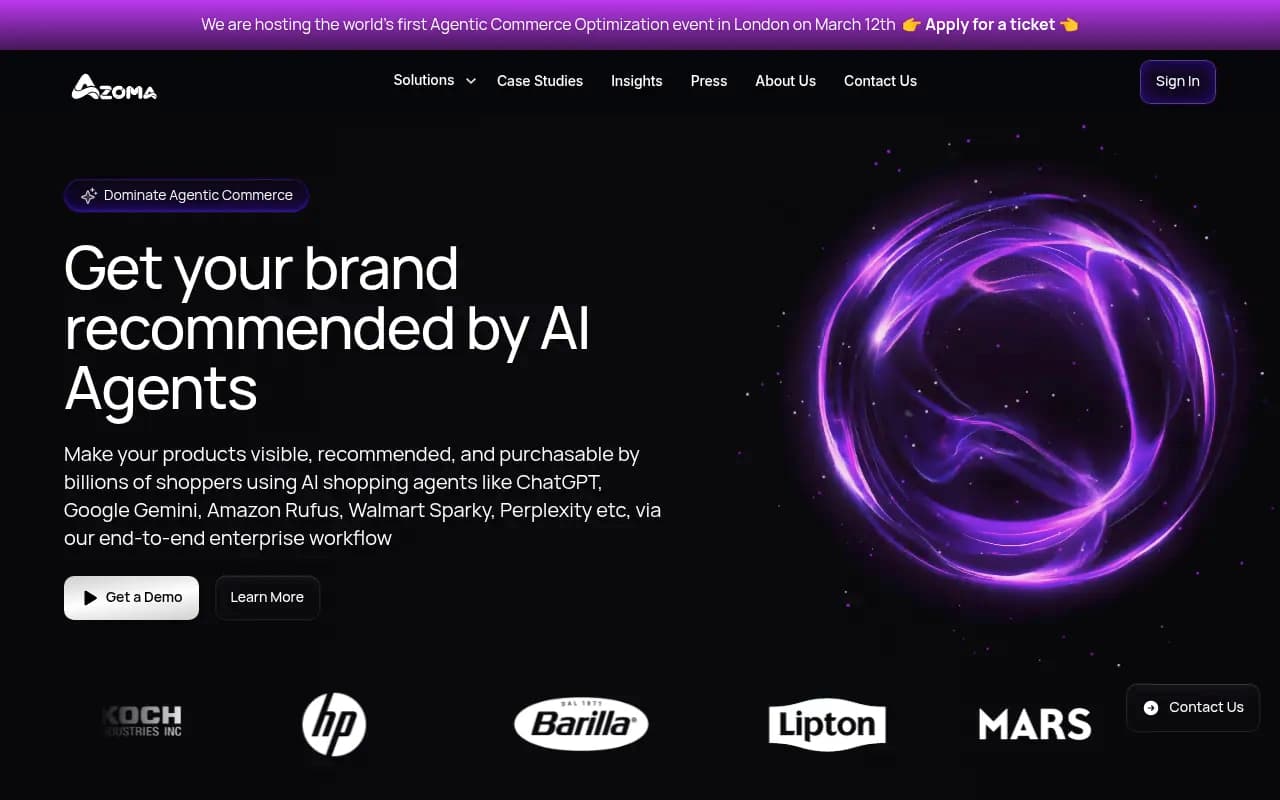
Azoma is an end-to-end Agentic Commerce Optimization platform that helps consumer brands and retailers get discovered by AI shopping agents. Monitor product visibility across ChatGPT, Amazon Rufus, Walmart Sparky, Google Gemini, and Perplexity, generate optimized product listings at scale, and track
Key Takeaways
- Azoma is a specialized Agentic Commerce Optimization (ACO) platform focused exclusively on helping consumer brands rank in AI shopping agents like ChatGPT, Amazon Rufus, Walmart Sparky, and Perplexity -- not general AI search visibility
- Monitoring-only approach with limited optimization capabilities -- lacks the content gap analysis, AI crawler logs, traffic attribution, and Reddit/YouTube tracking that Promptwatch offers for broader AI visibility
- Strong enterprise client roster (HP, Mars, Colgate, Unilever) and deep ecommerce integrations (Shopify, Amazon, Walmart, Salsify), but narrow focus on product listings limits use cases
- Pricing is enterprise-only with no transparent tiers -- expect custom quotes based on SKU count and markets tracked
- Best for large consumer brands and retailers optimizing product catalogs for AI shopping agents, not for content publishers, SaaS companies, or agencies needing comprehensive AI search visibility

Azoma launched as one of the first platforms to tackle what it calls "Agentic Commerce Optimization" -- the practice of making products visible and purchasable through AI shopping assistants. The company is venture-backed and holds two patents related to optimizing content for large language models. Its client list includes major consumer brands like HP, Mars, Colgate, L'Oréal, Unilever, P&G, and Reckitt, along with retailers like Zappos, eBay, and Canadian Tire. Azoma positions itself as the only enterprise-grade platform built specifically for ecommerce, as opposed to general-purpose AI visibility tools.
The platform's core thesis is that AI shopping agents -- ChatGPT's shopping mode, Amazon Rufus, Walmart Sparky, Google Gemini, Perplexity -- are becoming the primary way consumers discover and purchase products. According to Azoma's site, Rufus adoption hit 38% by Black Friday 2025, and AI chatbots drove $14.2 billion in sales globally during that period. Amazon's CEO confirmed that Rufus users are 60% more likely to complete purchases. Azoma's goal is to help brands capture this shift by monitoring where they appear in AI recommendations and optimizing product data to rank higher.
Shopping Agent Visibility (Monitoring & Analytics)
Azoma's monitoring dashboard tracks how AI shopping agents discover, evaluate, and recommend your products. You can see your Share of Voice (SOV) across platforms -- the percentage of relevant prompts where your brand appears in AI responses. The platform monitors ChatGPT, Amazon Rufus, Walmart Sparky, Google Gemini, Google AI Mode, and Perplexity.
Product Ranking Tracking: Azoma shows which specific products AI agents recommend and for which prompts. You can see mention counts per product, SOV percentages, and how your catalog performs across different AI platforms. This is useful for identifying which SKUs are invisible to AI and which are getting traction.
Citation Tracking: The platform surfaces the sources AI agents cite when recommending products -- Reddit threads, Quora posts, Wikipedia pages, YouTube videos, TikTok content. You can see citation counts per source and drill into specific pages. This helps you understand where AI models are pulling product information from, though Azoma doesn't offer the depth of Reddit and YouTube analysis that Promptwatch provides (Promptwatch surfaces specific discussions, sentiment, and trending topics that influence AI recommendations).
Competitor Benchmarking: Azoma lets you compare your SOV against competitors. You can see which brands are winning for specific prompts and track changes over time. However, the platform lacks the detailed competitor heatmaps and query-level breakdowns available in more comprehensive AI visibility tools.
Attribution & Traffic Tracking: Azoma claims to offer attribution for AI-driven traffic, though details on implementation are sparse. It's unclear whether this uses a tracking snippet, Google Search Console integration, or server log analysis. Promptwatch offers all three methods with page-level tracking that connects visibility to actual revenue.
Agentic Commerce Optimization (Content & Data Generation)
Azoma's optimization workflow is built around improving product listings at scale. The platform audits your product pages and data, identifies gaps, and generates optimized content designed to rank in AI shopping agents.
Agentic Commerce Readiness Audit: Azoma evaluates product detail pages (PDPs) and product data at the SKU level. It flags issues like missing schema markup, crawlability problems, JavaScript-only content, incomplete titles, missing images, and insufficient product attributes. This is a technical audit focused on making sure AI agents can parse your product data correctly.
Product Data Enrichment: Azoma fills critical product data gaps by expanding attribute coverage. For example, if your Shopify catalog is missing size charts, material details, or use case descriptions, Azoma generates these attributes to improve how AI models understand your products. The platform claims to have enriched 153 attributes for Walmart's Universal Commerce Protocol (UCP) in one example.
PDP Content Generation: Azoma generates optimized product listing copy and images at scale. You can connect your ecommerce site (Shopify, Amazon, Walmart) and bulk-optimize listings with a single click. The generated content is designed to rank in AI shopping agents, though it's unclear how this differs from standard SEO copywriting. The platform also offers image generation, presumably for product visuals or lifestyle shots.
Content Syndication: Azoma produces and syndicates content to third-party sources commonly cited by AI shopping agents -- likely blogs, review sites, and comparison pages. This is where the platform tries to influence the citation sources AI models rely on. However, Azoma doesn't offer the content gap analysis or AI writing agent capabilities that Promptwatch provides (Promptwatch's Answer Gap Analysis shows exactly which prompts competitors rank for but you don't, then generates articles grounded in 880M+ citations to close those gaps).
RegGuard Compliance: Azoma includes a compliance engine that scans generated content against FDA/DSHEA rules and brand guidelines. This is relevant for consumer brands in regulated categories like supplements, food, and cosmetics. The system enforces compliance outcomes with audit trails for legal teams.
Integrations & Ecosystem
Azoma integrates directly with ecommerce platforms and enterprise systems. Key integrations include:
- Ecommerce Platforms: Shopify, Amazon, Walmart. Azoma syncs product data via API, enabling automated optimization workflows.
- PIM Systems: Salsify integration for product information management. This is critical for enterprise brands managing thousands of SKUs across multiple channels.
- Agentic Protocols: Azoma supports Universal Commerce Protocol (UCP) and Agentic Commerce Protocol (ACP), which allow AI agents to transact directly with brands. These are emerging standards for AI-to-commerce communication.
- Workspace Tools: Slack and Microsoft Teams integrations for performance alerts and competitive intelligence.
- SSO: SAML and OIDC support for enterprise authentication.
Azoma lacks the broader ecosystem integrations that general AI visibility platforms offer -- no Google Search Console, no Zapier, no API for custom workflows. The platform is tightly focused on ecommerce use cases.
Who Is Azoma For?
Azoma is built for enterprise consumer brands and retailers with large product catalogs. The ideal customer is a brand like HP, Mars, or Colgate managing thousands of SKUs across multiple markets and channels. These companies need to monitor how AI shopping agents recommend their products and optimize product data at scale.
Primary User Personas:
- Ecommerce Directors at CPG Brands: Managing product visibility across Amazon, Walmart, and DTC channels. Need to track SOV vs competitors and optimize listings for AI discovery.
- Digital Commerce Teams at Retailers: Running large online catalogs (10,000+ SKUs) and looking to capture AI-driven traffic. Need bulk content generation and PIM integration.
- Marketing Teams at D2C Brands: Focused on top-of-funnel visibility in AI shopping agents. Want to understand which prompts drive product discovery and how to rank higher.
Azoma is not a fit for:
- Content Publishers & Media Companies: Azoma is product-focused, not content-focused. If you're optimizing articles, guides, or editorial content for AI search, you need a platform like Promptwatch that tracks content visibility across all AI models and helps you create articles that rank.
- SaaS Companies & B2B Brands: Azoma is built for consumer products, not software or services. B2B companies need broader AI visibility tracking across ChatGPT, Claude, Perplexity, and Google AI Overviews -- not just shopping agents.
- Agencies Managing Multiple Clients: Azoma's enterprise pricing and narrow focus make it impractical for agencies. Promptwatch offers agency plans with multi-client management and broader AI visibility tracking.
- Small Brands & Startups: Azoma's pricing is enterprise-only with no transparent tiers. If you're a small brand with a limited budget, you need a platform with accessible pricing and a free trial.
Pricing & Value
Azoma does not publish pricing on its website. Based on the enterprise focus and client roster, expect custom quotes starting in the thousands per month. Pricing is likely based on:
- Number of SKUs tracked
- Number of AI platforms monitored
- Number of markets/regions covered
- Content generation volume (number of listings optimized per month)
There is no free trial or freemium tier. Azoma requires a demo and sales conversation to access the platform.
For comparison, Promptwatch offers transparent pricing starting at $99/mo (Essential plan: 1 site, 50 prompts, 5 articles), $249/mo (Professional: 2 sites, 150 prompts, 15 articles, crawler logs), and $579/mo (Business: 5 sites, 350 prompts, 30 articles). Promptwatch also offers a free trial and agency/enterprise plans with custom pricing.
Azoma's value proposition is strongest for large consumer brands with complex product catalogs and enterprise budgets. If you're managing 10,000+ SKUs across Amazon, Walmart, and DTC channels, Azoma's deep ecommerce integrations and bulk optimization tools justify the cost. For smaller brands or companies outside ecommerce, the platform is overkill.
Strengths & Limitations
Strengths:
- Vertical Focus on Ecommerce: Azoma is the only AI visibility platform built exclusively for consumer brands and retailers. Its features -- SKU-level tracking, PDP content generation, Salsify integration, UCP/ACP support -- are tailored to ecommerce use cases.
- Enterprise Client Roster: Azoma works with some of the world's largest consumer brands (HP, Mars, Colgate, Unilever, P&G). This signals credibility and enterprise-grade infrastructure.
- Amazon Rufus & Walmart Sparky Analytics: Azoma is one of the few platforms tracking product visibility in retail-specific AI shopping agents. This is a unique capability for brands selling on Amazon and Walmart.
- Compliance Engine (RegGuard): Built-in compliance scanning for FDA/DSHEA rules is valuable for regulated consumer categories like supplements and food.
- Bulk Content Generation: Azoma's ability to generate and optimize product listings at scale is useful for brands managing large catalogs.
Limitations:
- Monitoring-Only Approach: Azoma shows you where you're visible but lacks the content gap analysis and optimization tools that Promptwatch offers. Promptwatch's Answer Gap Analysis shows exactly which prompts competitors rank for but you don't, then helps you create content to close those gaps.
- No AI Crawler Logs: Azoma doesn't track AI crawler activity (ChatGPT, Claude, Perplexity bots) hitting your website. Promptwatch offers real-time crawler logs showing which pages AI models read, errors they encounter, and how often they return.
- No Traffic Attribution Details: Azoma claims to offer attribution but doesn't explain how it works. Promptwatch provides three methods (tracking snippet, GSC integration, server logs) with page-level tracking that connects visibility to revenue.
- Limited Reddit & YouTube Insights: Azoma surfaces citation sources but doesn't offer the depth of Reddit and YouTube analysis that Promptwatch provides (specific discussions, sentiment, trending topics).
- No ChatGPT Shopping Tracking: Azoma doesn't monitor ChatGPT's product recommendations and shopping carousels, a feature Promptwatch includes.
- No Prompt Intelligence: Azoma lacks prompt volume estimates, difficulty scores, and query fan-outs that help prioritize high-value prompts. Promptwatch offers all of these.
- Enterprise-Only Pricing: No transparent pricing, no free trial, no accessible entry point for small brands or agencies.
- Narrow AI Model Coverage: Azoma monitors ChatGPT, Rufus, Sparky, Gemini, and Perplexity but lacks coverage of Claude, DeepSeek, Grok, Mistral, Meta AI, and Copilot. Promptwatch monitors 10+ AI models.
Bottom Line
Azoma is a specialized Agentic Commerce Optimization platform for enterprise consumer brands and retailers. If you're managing a large product catalog (10,000+ SKUs) across Amazon, Walmart, and DTC channels, Azoma's deep ecommerce integrations, bulk content generation, and retail-specific AI tracking (Rufus, Sparky) make it a strong fit. The platform's enterprise client roster (HP, Mars, Colgate) signals credibility and infrastructure.
However, Azoma is a monitoring-focused tool that lacks the optimization capabilities of comprehensive AI visibility platforms. It doesn't offer content gap analysis, AI crawler logs, traffic attribution details, or the depth of Reddit/YouTube insights that Promptwatch provides. For brands that want to go beyond tracking and actually improve their AI visibility -- by identifying content gaps, generating articles that rank, and tracking the results -- Promptwatch is the stronger choice.
Azoma is best for large consumer brands optimizing product catalogs for AI shopping agents. For content publishers, SaaS companies, agencies, or brands needing broader AI search visibility, Promptwatch offers a more complete solution with transparent pricing, a free trial, and the action loop that turns visibility data into revenue.
Tags:
Frequently asked questions
What is Azoma and what does it do?
How much does Azoma cost?
Is Azoma free to use?
Who is Azoma best suited for?
What AI shopping platforms does Azoma monitor?
What are the main features of Azoma?
How is Azoma different from general AI SEO tools?
Does Azoma integrate with ecommerce platforms?
Similar and alternative tools to Azoma