Key Takeaways
- Otterly.AI is a brand monitoring tool for content marketers tracking mentions across AI search engines -- Azoma is an enterprise product optimization platform for retailers and consumer brands selling through AI shopping agents
- Pricing gap is massive: Otterly.AI starts at $29/mo with transparent tiers, Azoma requires custom enterprise quotes with no public pricing or free trial
- Otterly.AI covers 6 AI engines (ChatGPT, Perplexity, Google AI Overviews, AI Mode, Gemini, Copilot) -- Azoma covers 5 shopping-specific agents (ChatGPT, Amazon Rufus, Walmart Sparky, Google Gemini, Perplexity)
- Otterly.AI focuses on brand mentions and website citations -- Azoma focuses on product recommendations, shopping cart placements, and SKU-level visibility
- Otterly.AI includes GEO audit tools and keyword research -- Azoma includes product listing generation and agentic commerce workflow automation
- If you're a content team tracking brand visibility, pick Otterly.AI. If you're an enterprise retail team optimizing thousands of SKUs for AI shopping, pick Azoma.
Overview
Otterly.AI: Affordable AI search monitoring

Otterly.AI positions itself as the affordable entry point for AI visibility monitoring. It tracks brand mentions and website citations across ChatGPT, Perplexity, Google AI Overviews, Google AI Mode, Gemini, and Microsoft Copilot. The platform targets content marketers, SEO teams, and small-to-midsize brands who want to understand where they show up in AI search results without breaking the bank. Core features include keyword research for conversational prompts, brand monitoring dashboards, a GEO audit tool that analyzes 25+ on-page factors, and basic citation tracking. Pricing starts at $29/mo for 15 prompts, scaling up to $189/mo for 100 prompts, with a 14-day free trial.
Azoma: Enterprise agentic commerce optimization
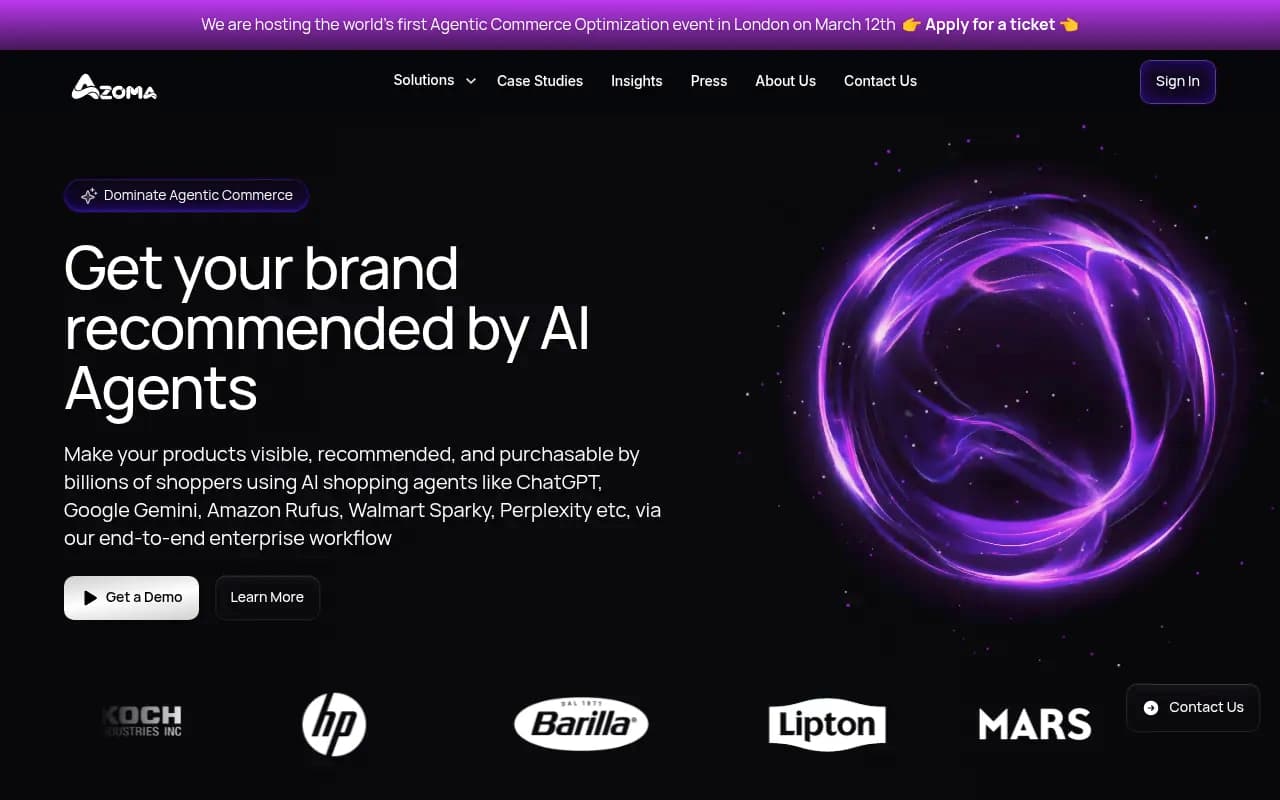
Azoma takes a completely different angle. It's an end-to-end agentic commerce optimization platform built for consumer brands and retailers with large product catalogs. Instead of tracking brand mentions in editorial AI responses, Azoma monitors product recommendations in AI shopping agents -- ChatGPT, Amazon Rufus, Walmart Sparky, Google Gemini, and Perplexity. The platform generates optimized product listings at scale, tracks SKU-level visibility, and provides workflow automation for enterprise teams managing thousands of products. Client roster includes HP, Mars, Zappos, eBay, and Canadian Tire. Pricing is custom enterprise only -- no transparent tiers, no self-service signup, no free trial.
Side-by-side comparison
| Feature | Otterly.AI | Azoma |
|---|---|---|
| Starting price | $29/mo | Custom enterprise (likely $5k+/mo) |
| Free trial | 14 days | No |
| Target audience | Content marketers, SEO teams, SMBs | Enterprise retailers, consumer brands |
| Primary use case | Brand mention tracking | Product recommendation optimization |
| AI engines covered | 6 (ChatGPT, Perplexity, AI Overviews, AI Mode, Gemini, Copilot) | 5 (ChatGPT, Rufus, Sparky, Gemini, Perplexity) |
| Tracking focus | Brand mentions, website citations | Product recommendations, shopping cart placements |
| Content generation | No | Yes (product listing optimization at scale) |
| GEO audit | Yes (25+ on-page factors) | No (focused on product data, not web pages) |
| Keyword research | Yes (conversational prompts) | No |
| SKU-level tracking | No | Yes |
| Self-service signup | Yes | No (sales-led only) |
| API access | Not mentioned | Likely yes (enterprise platform) |
| Multi-market support | Not specified | Yes (global markets) |
Head-to-head feature breakdown
Use case and target audience
Otterly.AI is built for content teams and marketers who want to know: "Does our brand get mentioned when people ask ChatGPT or Perplexity about our industry?" You're tracking editorial visibility -- whether AI models cite your blog posts, mention your brand in listicles, or recommend your company when users ask for advice. This matters for thought leadership, brand awareness, and driving organic traffic from AI search experiences.
Azoma is built for product teams and ecommerce managers who want to know: "Does our shampoo show up when someone asks ChatGPT to recommend the best sulfate-free shampoo under $15?" You're tracking transactional visibility -- whether AI shopping agents recommend your products, add them to carts, and drive actual purchases. This matters for revenue, market share, and competing with Amazon's private labels in AI-driven shopping experiences.
The audiences barely overlap. If you sell products and care about AI shopping agents discovering your SKUs, Otterly.AI won't help you. If you're a SaaS company or media brand tracking thought leadership mentions, Azoma is overkill and won't even talk to you unless you have thousands of products.
AI engine coverage
Otterly.AI monitors 6 AI search engines: ChatGPT, Perplexity, Google AI Overviews, Google AI Mode, Google Gemini, and Microsoft Copilot. This covers the main conversational search experiences where people ask open-ended questions and get editorial-style answers with citations.
Azoma monitors 5 AI shopping agents: ChatGPT (shopping features), Amazon Rufus, Walmart Sparky, Google Gemini (shopping mode), and Perplexity (shopping queries). These are the same underlying models but used in shopping contexts -- product recommendations, price comparisons, cart additions.
The overlap is ChatGPT, Gemini, and Perplexity, but even there the tracking differs. Otterly.AI tracks whether your website gets cited in a ChatGPT response. Azoma tracks whether your product gets recommended when someone asks ChatGPT to help them shop.
Neither platform covers Claude, Grok, DeepSeek, or Meta AI. If you need broader coverage across all major LLMs, you'd need to look at something like Promptwatch, which monitors 10+ AI models and bridges the gap between brand visibility and content optimization.

Monitoring and tracking capabilities
| Capability | Otterly.AI | Azoma |
|---|---|---|
| Brand mention tracking | Yes | No |
| Website citation tracking | Yes | No |
| Product recommendation tracking | No | Yes |
| Shopping cart placement tracking | No | Yes |
| SKU-level visibility | No | Yes |
| Share of voice metrics | Yes | Likely yes |
| Competitor benchmarking | Yes | Yes |
| Historical trend data | Yes | Yes |
| Alert notifications | Not specified | Likely yes |
Otterly.AI gives you dashboards showing how often your brand gets mentioned, which pages get cited, and how you compare to competitors. You can track specific prompts over time and see whether your visibility is improving or declining. The GEO audit tool analyzes your website's on-page factors (structured data, content quality, authority signals) and tells you what's holding you back from getting more citations.
Azoma gives you dashboards showing which products get recommended, in what contexts, at what price points, and how often they make it into AI-generated shopping carts. You can track SKU-level performance across markets and see which product attributes (price, reviews, features) correlate with higher recommendation rates. The platform generates optimized product listings based on what AI agents are looking for.
Otterly.AI is read-only monitoring. Azoma is monitoring plus optimization.
Content and optimization features
Otterly.AI includes:
- Keyword research tool to discover conversational prompts people are asking
- GEO audit analyzing 25+ on-page factors (schema markup, content depth, E-E-A-T signals)
- Recommendations for improving citation rates
- No content generation or automated optimization
Azoma includes:
- Product listing generation at scale (optimized titles, descriptions, attributes)
- Workflow automation for enterprise teams managing thousands of SKUs
- Agentic commerce optimization recommendations
- No website content generation (focused on product data, not editorial content)
If you're trying to improve your website's content to get more AI citations, Otterly.AI gives you the audit but you still have to write the content yourself. If you're trying to optimize product listings to get more AI recommendations, Azoma generates the optimized listings for you.
Neither platform helps you create the kind of editorial content that ranks in AI search. For that, you'd need a platform that combines visibility tracking with AI content generation -- something that shows you the content gaps and then helps you fill them.
Pricing and accessibility
| Plan | Otterly.AI | Azoma |
|---|---|---|
| Entry tier | $29/mo (Lite: 15 prompts) | No entry tier |
| Mid tier | $189/mo (Standard: 100 prompts) | Custom quote |
| Enterprise | Custom (Premium: unlimited prompts) | Custom quote |
| Free trial | 14 days | None |
| Self-service signup | Yes | No |
Otterly.AI wins on accessibility. You can sign up today, start a 14-day trial, and be tracking your brand mentions within an hour. The $29/mo Lite plan is genuinely affordable for small teams testing AI visibility for the first time. The $189/mo Standard plan gives you 100 prompts, which is enough for most mid-market brands. Premium pricing isn't public but follows a similar transparent structure.
Azoma requires a sales conversation. No public pricing, no free trial, no self-service. Based on the enterprise client roster (HP, Mars, eBay) and the platform's scope (multi-market SKU tracking, listing generation at scale), expect pricing in the $5k-$20k+/mo range depending on SKU count and markets covered. This makes sense for a retailer with 10,000 products generating millions in AI-driven revenue. It makes zero sense for a small brand testing the waters.
If you're a startup or SMB, Otterly.AI is your only realistic option here. If you're an enterprise with budget and a massive product catalog, Azoma's lack of transparent pricing won't scare you off.
Integration and workflow
Otterly.AI appears to be a standalone dashboard. No mention of API access, integrations with content management systems, or workflow automation. You log in, check your dashboards, export reports, and take action manually in your CMS or wherever you manage content.
Azoma is built as an enterprise workflow platform. It integrates with product information management (PIM) systems, ecommerce platforms, and likely has API access for custom integrations. The platform is designed for teams managing thousands of SKUs across multiple markets, so workflow automation and bulk operations are core features.
If you're a solo marketer or small team, Otterly.AI's simplicity is a feature. If you're a 50-person ecommerce team at a Fortune 500 retailer, Azoma's enterprise workflow capabilities are table stakes.
Reporting and analytics
Otterly.AI provides:
- Brand mention frequency over time
- Website citation tracking (which pages get cited)
- Share of voice vs competitors
- Prompt-level performance data
- GEO audit scores and recommendations
Azoma provides:
- Product recommendation rates across AI agents
- SKU-level visibility and performance
- Shopping cart placement tracking
- Multi-market comparison
- Competitor product benchmarking
- Attribution to actual sales (likely)
Otterly.AI's reporting is straightforward -- you see charts showing your brand mentions going up or down, which prompts you're visible for, and how you compare to competitors. Good for monthly reporting to stakeholders and tracking progress on AI visibility initiatives.
Azoma's reporting is SKU-centric and tied to revenue. You see which products are winning in AI shopping agents, which are invisible, and what changes you need to make to improve recommendation rates. This feeds directly into merchandising decisions, pricing strategy, and product development.
Pros and cons
Otterly.AI pros
- Affordable entry point ($29/mo) with transparent pricing
- 14-day free trial lets you test before committing
- Covers 6 major AI search engines in one dashboard
- GEO audit tool provides actionable optimization recommendations
- Keyword research helps you discover new conversational prompts
- Self-service signup -- start tracking today
- Good fit for content marketers and SEO teams
Otterly.AI cons
- Monitoring only -- no content generation or automated optimization
- Limited to brand mentions and citations, doesn't track product recommendations
- No API access or integrations mentioned
- Prompt limits on lower tiers (15 prompts on Lite, 100 on Standard)
- Doesn't cover Claude, Grok, DeepSeek, or Meta AI
- No crawler log analysis or visitor attribution
Azoma pros
- End-to-end platform with monitoring plus optimization
- Generates optimized product listings at scale
- SKU-level tracking across multiple markets
- Built for enterprise workflows and bulk operations
- Covers AI shopping agents (Rufus, Sparky) that Otterly.AI doesn't
- Proven with major brands (HP, Mars, Zappos, eBay)
- Likely includes API and PIM integrations
Azoma cons
- No transparent pricing -- custom enterprise quotes only
- No free trial or self-service signup
- Sales-led process adds friction and time
- Overkill for brands without large product catalogs
- Doesn't track editorial brand mentions or website citations
- Focused on shopping agents, not general AI search visibility
- Likely expensive ($5k+/mo minimum)
Who should pick which tool
Pick Otterly.AI if you:
- Run content marketing, SEO, or brand awareness campaigns
- Want to track whether your brand gets mentioned in AI search results
- Need to monitor website citations and share of voice
- Have a limited budget ($29-$189/mo range)
- Want to start tracking AI visibility today with a free trial
- Care about editorial visibility in ChatGPT, Perplexity, AI Overviews
- Are a small-to-midsize brand or agency
- Don't sell physical products through AI shopping agents
Pick Azoma if you:
- Sell consumer products through ecommerce channels
- Manage hundreds or thousands of SKUs across multiple markets
- Need to optimize product listings for AI shopping agents
- Want to track product recommendations in ChatGPT, Rufus, Sparky
- Have enterprise budget and can handle custom pricing
- Need workflow automation and PIM integrations
- Care about AI-driven shopping cart placements and sales attribution
- Are a major retailer or consumer brand with dedicated ecommerce team
Consider alternatives if you:
- Need both brand visibility tracking AND content optimization with generation capabilities -- Promptwatch combines monitoring across 10+ AI models with content gap analysis and an AI writing agent that generates articles engineered to get cited
- Want broader AI engine coverage including Claude, Grok, DeepSeek, Meta AI
- Need crawler log analysis to see how AI bots are indexing your site
- Want visitor attribution to connect AI visibility to actual traffic and revenue
- Are looking for a platform that bridges the gap between monitoring and taking action
Final verdict
Otterly.AI and Azoma aren't really competitors -- they solve completely different problems for completely different audiences.
Otterly.AI is the right choice for content marketers and SEO teams who want affordable, accessible AI visibility monitoring. You get transparent pricing, a free trial, and dashboards showing your brand mentions across 6 AI search engines. The GEO audit tool gives you actionable recommendations. But you're on your own for content creation and optimization.
Azoma is the right choice for enterprise retailers and consumer brands with large product catalogs who need to dominate AI shopping agents. You get end-to-end optimization, SKU-level tracking, and automated listing generation at scale. But you need enterprise budget, patience for a sales process, and a product catalog that justifies the investment.
The real question isn't "Otterly.AI or Azoma?" -- it's "Am I tracking brand mentions or product recommendations?" Answer that and the choice is obvious.