Key takeaways
- Reviews are a small slice of what ChatGPT cites overall (1.7% of classified citations, Sep 28 to Oct 4, 2026), but they jump to 5.6% when a prompt names a brand.
- Product pages and landing pages make up about 39% of ChatGPT citations. Your own crawlable pages matter more than review widgets locked inside third-party platforms.
- Review count, recency and platform diversity look like the signals AI models can actually use. Star ratings alone are a weaker lever, with banking and Trustpilot as a noted exception in Uberall's research.
- Trustpilot, Birdeye and Reputation.com do different jobs. Trustpilot is a public review source, Birdeye and Reputation.com are tools for collecting, managing and responding to reviews.
- Social review content matters far more for Google's AI surfaces (12.2% of AI Overviews citations) than for ChatGPT (0.46%).
The short answer
Yes, reviews still matter for local AI search. But not in the way most review-software marketing implies.
I went looking for clean evidence that a Trustpilot score or a Birdeye rating directly moves a business up in ChatGPT or Gemini answers. It doesn't exist in public form. What exists is a mix of first-party citation data, a few agency studies, and a lot of vendor posts and forum threads that say reviews are "training data" or "visibility." Some of that is directionally right. Little of it is proven.
So this guide separates what we can measure from what vendors claim, then gets practical about what to do.
What the citation data says about reviews
The most useful number I have comes from Promptwatch Data's report on ChatGPT citations by content type, covering Sep 28 to Oct 4, 2026. Across all classified ChatGPT citations:
- Product pages: 22.4%
- Landing pages: 16.8%
- Listicles: 13.6%
- How-tos: 8.7%
- Documentation: 7.5%
- General articles: 6.1%
- Comparisons: 5.9%
- News: 5.7%
- FAQ pages: 3.3%
- Reviews: 1.7%
Reviews at 1.7% is lower than I expected. If you have been told that review sites are the main fuel for AI answers, this is the number to sit with.
There is a catch, and it is the interesting part. When the prompt names a company (something like "is X good for startups"), reviews rise to 5.6%, more than three times their overall share. Social posts rise to 3.0%, almost four times. So reviews do their work at the moment someone is evaluating a specific brand, which is exactly when a local customer checks a dentist, dealership or restaurant by name.
One caveat. This report covers ChatGPT citations overall, not local-intent queries specifically, and it doesn't break out Trustpilot, Birdeye or Reputation.com. Treat it as a guide to how ChatGPT weighs content types, not a verdict on local packs.
Where social review content shows up
User-generated content behaves very differently by engine. In Promptwatch's social media citations data for Sep 28 to Oct 4, 2026:
| Engine | Share of citations from social platforms | Notable platforms |
|---|---|---|
| ChatGPT | 0.46% | LinkedIn 0.3% (top), Reddit 0.09% |
| Google AI Overviews | 12.2% | YouTube 4.28%, Facebook 2.38%, Reddit 2.15%, Instagram 1.61%, LinkedIn 1.55% |
| Perplexity | 2.7% | LinkedIn and Reddit 0.86% each, YouTube 0.79% |
Reddit's collapse in ChatGPT is documented in Promptwatch's report on Reddit citations dropping in ChatGPT: reddit.com's share fell from roughly 4% to 0.5% on August 14, 2026. If your review strategy leaned on community threads for ChatGPT visibility, that bet got worse. For Google's AI surfaces, social and community content still counts.
What the other sources claim
Here is where I would be careful.
Reputation.com published an article titled "Why Ratings and Reviews Matter More with AI-Powered Search." It walks through a "Subaru dealers near me" search, comparing a traditional results page to Google's SGE summary that shows customer ratings next to each dealer, then a follow-up asking which dealers get the best reviews. The screenshots are from 2023, and the article refers to SGE, Bard and Bing Chat, products that have since changed or been renamed. It is a useful illustration of the idea, not current data.
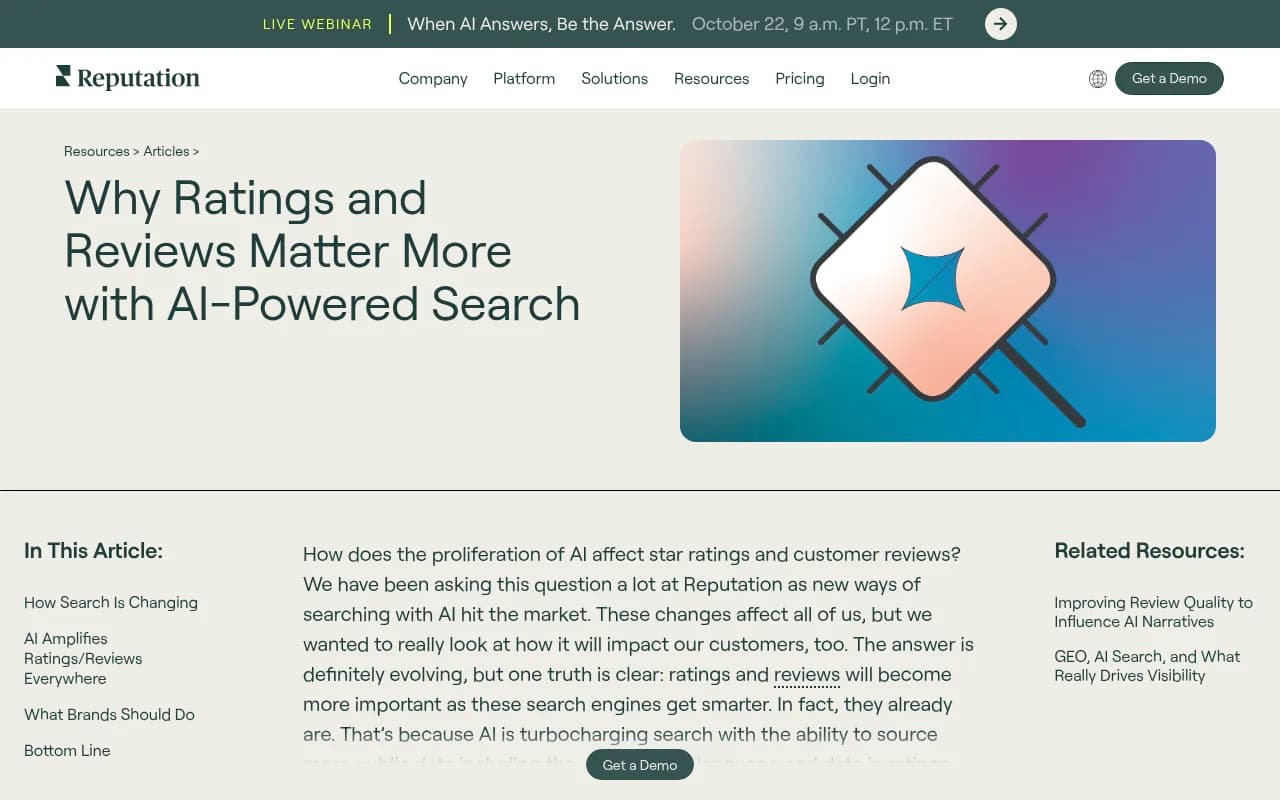
The article's claim that AI pulls specific language from ratings and reviews and aggregates it is plausible. Its claim that surveys won't be part of those data points is also sensible, since surveys are private and AI can't read them.
Birdeye has been posting along similar lines. A Birdeye Facebook post says reviews "are no longer just about building trust" and are used as training data that helps AI decide how and when to show your business. A Birdeye LinkedIn post cites its State of Online Reviews 2026, including a figure that 40% of review responses are now AI-generated and that Google holds 79.4% of all reviews. These are vendor social posts, not independent research, so I would not build a strategy on them. The Google concentration figure is at least consistent with what local SEOs already see.
The most grounded outside source is Uberall's write-up of review sites that influence AI mentions. Its main argument is counterintuitive: you don't need good star ratings to be recommended by AI. The reasoning is that models often lack access to the actual text of your reviews, so review count and recency become the signals that are really available. Its recommendation is to make your Google rating, review count and a few dated review examples visible on a crawlable local page, backed by local business schema. Its restaurant data also found that brands on zero review platforms beyond Google had a 51.2% AI mention rate, which Uberall uses as the case for platform diversity.
I would call this a hypothesis supported by one agency dataset. It is a sensible one, and it matches the citation data above: pages you control get cited far more than reviews hidden elsewhere.
How Trustpilot fits in
Trustpilot is a public review platform, not a management tool in the Birdeye sense. Uberall notes it hosts more than 300 million reviews and that its profiles frequently rank on page one for branded searches. That matters because AI systems that retrieve from search results will see those profiles even if no user ever visits Trustpilot.
Uberall also reports that Trustpilot average ratings showed the highest correlation with AI mention probability of any review platform in the banking category. That is one of the few cases where a rating, not just volume, looked meaningful. Notice it is one category in one study. Don't generalize it to restaurants or plumbers.
Trustpilot is also a reminder that review platforms are public and messy. Reputation.com's own Trustpilot page mixes glowing reviews of the platform with sharp complaints about support responsiveness, scoring algorithms and a survey setup that dragged on for months. It is a useful example for a different reason: whatever tool you use, your public review profile is the thing AI and customers both read, and vendors are not exempt from it. Trustpilot's guidelines also bar incentivized or selective review requests, which can bias the TrustScore. That affects how you ask.
How Birdeye and Reputation.com fit in
These two sit one layer below the public platforms. They help you collect reviews, monitor them across sites, and respond from one place. They don't make AI cite you by themselves. They make the inputs (volume, recency, response quality, listing consistency) easier to maintain across many locations.

Birdeye positions itself around customer experience and reputation management, and its 2026 messaging leans hard on the idea that reviews drive AI visibility.
Reputation.com targets multi-location brands. Its site highlights results such as Kia UK's dealer network moving from an average 4.2 to 4.6 stars and a health system going from 3.3 to 4.8 stars. Those are customer-reported case study outcomes about star ratings, not proof of AI citation gains. Reputation is also hosting a webinar with IDC on Thursday, October 22, called "When AI Answers, Be the Answer," focused on AI-mediated local discovery for multi-location businesses. I have not verified pricing or feature comparisons for either vendor, so check their sites directly before shortlisting.
Other options in this space include SOCi for local search, social and reviews, and Yext for listings and answer-engine presence.
| Platform | Role in the review chain | What to check before buying |
|---|---|---|
| Trustpilot | Public review source AI can retrieve | Guidelines on soliciting reviews, how your profile ranks for branded search |
| Birdeye | Review collection, monitoring, response | Multi-location support, listings sync, pricing |
| Reputation.com | Reputation management for multi-location brands | Platform scoring, support responsiveness, pricing |
| SOCi | Local search, social and reviews | Fit for franchise or multi-location teams |
| Yext | Listings and answer-engine presence | Data accuracy across directories |
What to actually do
1. Put review proof on pages you control
If ChatGPT cites product and landing pages at about 39% combined, your location pages are the real battleground. Show your rating, review count and a few dated review excerpts in crawlable HTML, with local business schema. Uberall's advice here is the most actionable thing in this whole research set.
2. Prioritize count and recency over chasing 5.0
A steady stream of recent reviews beats a one-time burst. A perfect score with 12 reviews from 2022 gives a model very little to work with. Set up a request flow that runs every week, within each platform's rules.
3. Spread reviews across platforms your category trusts
Google Business Profile stays the foundation, since reviews feed the local pack, Maps and AI Overviews. Beyond it, add the platforms that matter for your industry, plus Bing Places if you care about Copilot. Promptwatch's own advice from its content type report is to collect reviews on the sites people trust in your category, because ChatGPT cites reviews far more often when a prompt names a brand.
4. Don't ignore social and video for Google's AI surfaces
If Google AI Overviews gets 12.2% of its citations from social platforms, with YouTube and Facebook leading, then customer videos, Facebook reviews and recommendations deserve attention. For ChatGPT, that effort pays back far less.
5. Reply to reviews, but write the replies yourself
Birdeye's cited figure says 40% of review responses are now AI-generated. Even if the number is soft, the pattern is obvious from reading review pages: canned replies are everywhere. Specific, human replies are one of the few things competitors can't easily copy.
6. Measure what AI actually says about you
Review tools report ratings. They don't tell you whether ChatGPT or Gemini recommends you. For that you need AI visibility tracking. Tools like Promptwatch can show which of your pages and which third-party review or listing pages get cited for the prompts that matter, including crawler activity from AI bots.

Other trackers in our catalog include Profound, Peec AI and Otterly.AI. For a wider list, the GEO software directory at bestgeosoftware.com is a good place to compare.



A simple test you can run this week
- Write 10 prompts a local customer would use, including a few that name your business ("is [your business] good for...").
- Run them in ChatGPT, Gemini and Perplexity from the right location.
- Note which domains get cited. Count how many are your own pages, Google, Trustpilot or other review sites.
- Fill the gaps. If a review platform keeps showing up and you have 6 reviews there, that is your first job.
- Repeat in a month.
This tells you more about your market than any vendor dashboard.
What I would not do
- Don't buy a review platform because a vendor post says reviews are "training data." Nobody outside the model labs can verify that.
- Don't gate or cherry-pick who you ask for reviews. It breaks Trustpilot's rules and Google's policies, and it skews your own data.
- Don't treat star rating improvements as proof of AI visibility. A Kia UK jump from 4.2 to 4.6 is a good outcome, but it is a ratings result.
- Don't rely on Reddit threads for ChatGPT visibility after August 14, 2026.
Bottom line
Reviews matter for local AI search, but as one input among several, and mostly when a user already has your name in mind. The measurable pattern is that pages you control get cited most, reviews get a boost on branded prompts, and Google's AI surfaces lean on social content far more than ChatGPT. Build review volume and recency across a few trusted platforms, put the proof on your own crawlable pages, and check the actual AI answers monthly. That last step is the one almost nobody does.