Birdeye Review 2026
All-in-one customer experience platform for local businesses, covering reviews, listings, messaging, surveys, and AI-powered insights to manage reputation and attract customers.
Key takeaways
- Birdeye is a comprehensive, enterprise-grade platform built specifically for multi-location brands managing reputation, listings, social media, and customer messaging at scale
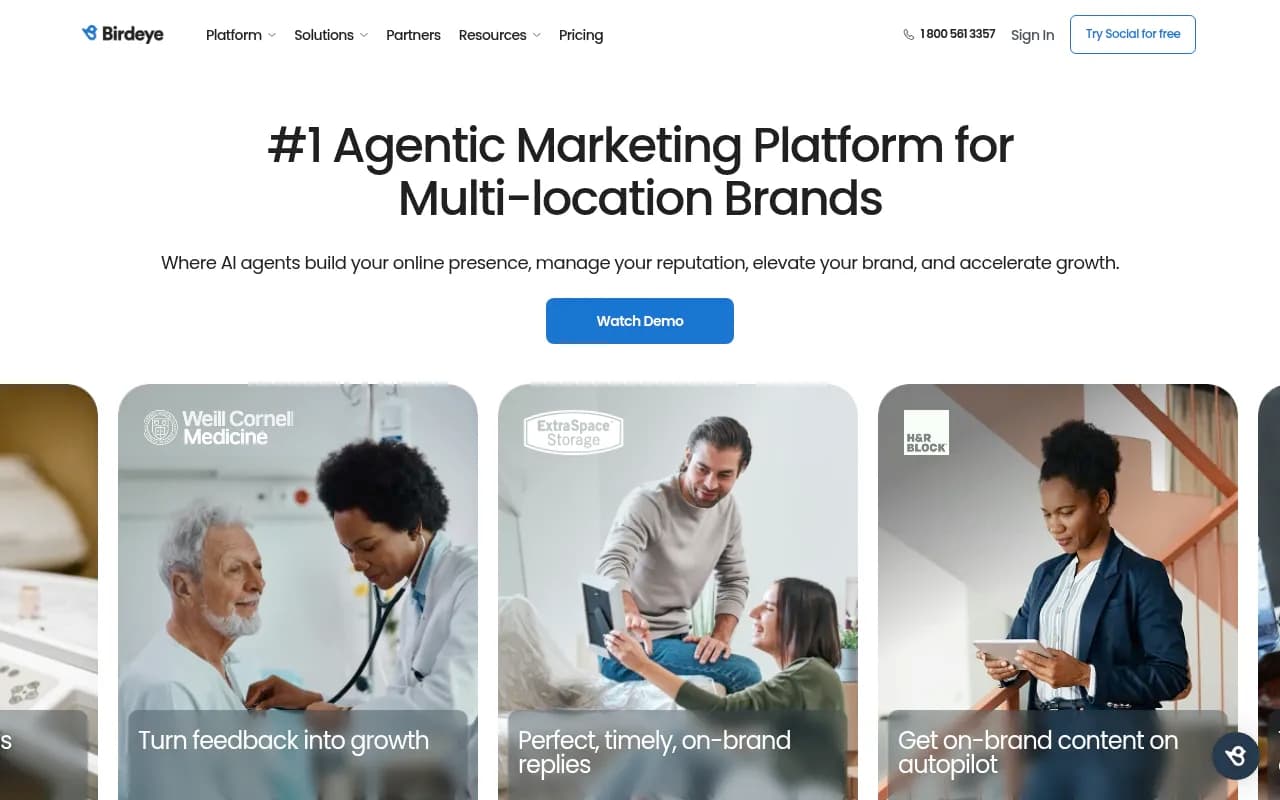
- The platform has evolved from a reputation management tool into a full "agentic marketing" suite, with AI agents that autonomously handle review requests, responses, social publishing, and listings optimization
- Pricing starts around $299/month (billed annually) for the Standard plan, making it one of the pricier options in the reputation management space -- though the breadth of features justifies the cost for larger organizations
- Birdeye's "Search AI" feature touches on AI search visibility, but it focuses on local search and Google presence rather than deep LLM citation tracking, prompt analytics, or content gap analysis that dedicated GEO platforms like Promptwatch provide
- Best fit for franchise brands, healthcare networks, real estate groups, and multi-location retailers with 10+ locations; overkill for single-location small businesses
Birdeye has been around since 2012, founded by Naveen Gupta and Neeraj Gupta in Palo Alto. It started as a straightforward review management tool -- the kind of thing a dental chain or car dealership would use to collect Google reviews and respond to them from one dashboard. Over the past decade it has grown into something considerably more ambitious. The company now positions itself as an "agentic marketing platform," which is a mouthful, but the underlying idea is real: instead of just giving you a dashboard to manage things manually, Birdeye deploys AI agents that take autonomous action on your behalf.
The platform serves over 150,000 businesses, with a heavy concentration in healthcare, real estate, finance, dental, restaurants, legal, and auto. Those aren't random verticals -- they're industries where local reputation is directly tied to revenue, and where managing dozens or hundreds of locations from a single marketing team is genuinely painful. Birdeye has raised significant funding over the years (over $60 million as of its last disclosed round) and counts H&R Block, Smile Brands, and American Pacific Mortgage among its enterprise customers.
Key features
Review Generation Agent This is where Birdeye built its reputation, and it's still the strongest part of the platform. The Review Generation Agent automates the entire review request workflow -- sending personalized SMS and email requests after customer interactions, timing them based on when customers are most likely to respond, and routing unhappy customers to private feedback channels before they post publicly. The system integrates with CRMs and practice management software to trigger requests automatically. For a 50-location dental group, this means reviews flow in without anyone on the marketing team manually sending requests.
Review Response Agent Responding to reviews at scale is genuinely tedious, and Birdeye's AI handles it. The Review Response Agent generates on-brand replies to incoming reviews across Google, Facebook, Yelp, and 200+ other sources. You can configure brand voice, set response templates by sentiment or category, and let the agent run autonomously or require human approval before posting. The quality of AI responses has improved noticeably -- they don't read like generic templates, which matters when customers can tell the difference.
Listings Optimization Agent Birdeye manages business listings across Google Business Profile, Apple Maps, Bing, Facebook, and dozens of directories. The Listings Agent monitors for incorrect information (wrong hours, outdated phone numbers, duplicate listings), pushes corrections automatically, and tracks how listing accuracy affects local search rankings. For multi-location brands, this is a significant time saver -- manually auditing 100 locations across 20 directories is a full-time job.
Search AI This is Birdeye's newest and most interesting product direction. Search AI is designed to help brands appear in AI-powered search results -- Google AI Overviews, ChatGPT, and similar engines. It analyzes how your brand appears in AI search responses and provides recommendations for improving visibility. That said, Search AI is primarily focused on local search optimization and Google's ecosystem. It doesn't offer the depth of prompt-level tracking, citation analysis, or content gap identification that dedicated AI visibility platforms provide. If your primary concern is understanding exactly which prompts your brand appears in across ChatGPT, Perplexity, Claude, and Gemini -- and why competitors are getting cited instead of you -- you'll need a more specialized tool.
Social Publishing and Engagement Agents Birdeye's social suite covers publishing, scheduling, and engagement across Facebook, Instagram, Google Business Profile, LinkedIn, and Twitter/X. The Social Publishing Agent generates on-brand content for each location, schedules posts at optimal times, and can localize content for individual locations while maintaining brand consistency. The Social Engagement Agent monitors comments and messages and responds automatically or flags items for human review. Valley Veterinary Care reported a 400% increase in social publishing output after adopting this feature -- a real number that reflects how much manual work it replaces.
Marketing Automation Birdeye includes email and SMS campaign tools with location-level personalization. You can build automated nurture sequences, send appointment reminders, run re-engagement campaigns, and segment audiences by location or customer behavior. It's not as deep as a dedicated marketing automation platform like HubSpot or Klaviyo, but for multi-location brands that want everything in one place, it covers the core use cases.
Insights AI The Insights module aggregates customer feedback from reviews, surveys, and messaging into sentiment analysis and trend reports. It surfaces themes in customer complaints, tracks Net Promoter Score over time, flags locations with declining sentiment, and benchmarks performance across your portfolio. The Birdeye Score is a composite metric that rolls up reputation, engagement, and presence data into a single number per location -- useful for executive reporting.
BirdAI (the underlying AI layer) BirdAI is Birdeye's proprietary AI system, trained on industry-specific data and configurable to your brand voice. It powers all the agents described above. You can set tone guidelines, industry context, and brand-specific terminology so that AI-generated content sounds like it came from your team rather than a generic language model. This customization layer is genuinely useful -- a law firm and a fast-casual restaurant chain have very different communication styles, and BirdAI can be tuned accordingly.
Who is it for
Birdeye's sweet spot is multi-location brands with 10 to 1,000+ locations that have a dedicated marketing team but not enough headcount to manage reputation and social media manually at scale. Think a regional healthcare network with 40 clinics, a franchise restaurant group with 80 locations, or a real estate company with offices across multiple states. These organizations have real operational complexity -- different managers at each location, inconsistent review response rates, listings that drift out of date -- and Birdeye solves those problems systematically.
The platform also works well for marketing agencies managing reputation for multiple business clients, though Birdeye's agency tooling is less developed than some competitors. Agencies get multi-client dashboards and white-label reporting, but the platform is primarily designed around the brand-side use case.
Single-location small businesses should probably look elsewhere. The pricing starts at roughly $299-$349/month, which is hard to justify for a single restaurant or dental practice. Tools like Podium or even Google's native review management features cover the basics at a fraction of the cost. Birdeye's value scales with location count -- the more locations you manage, the more the automation pays off.
Industries where Birdeye particularly excels: healthcare (deep integrations with EHR systems like Epic and Athenahealth), dental (integrations with Dentrix and Eaglesoft), real estate (integrations with property management platforms), and auto dealerships (integrations with DMS systems). These vertical integrations mean review requests can be triggered automatically from existing workflows rather than requiring manual data exports.
Integrations and ecosystem
Birdeye's integration library is one of its genuine strengths. The platform connects with over 3,000 apps and systems, including:
- CRM and practice management: Salesforce, HubSpot, Zoho, Epic, Athenahealth, Dentrix, Eaglesoft, DealerSocket
- Review platforms: Google Business Profile, Facebook, Yelp, Healthgrades, Zillow, TripAdvisor, and 200+ others
- Social networks: Facebook, Instagram, LinkedIn, Twitter/X, Google Business Profile
- Communication tools: Twilio (SMS), various email providers
- Analytics: Google Analytics, basic reporting exports
- Zapier: Available for connecting to tools outside the native integration library
Birdeye has a REST API for custom integrations, which enterprise customers use to connect proprietary systems. The API is reasonably well-documented, though it's not the most developer-friendly experience compared to tools built API-first.
There's no native mobile app for end customers, but location managers can access a mobile-optimized interface for responding to reviews and messages on the go. Browser extensions aren't a core part of the product.
Pricing and value
Birdeye doesn't publish full pricing on its website, which is a minor frustration. Based on third-party sources and user reports, the structure looks like this:
- Standard: approximately $299/month (billed annually) or $349/month billed monthly. Covers core review management, listings, and basic messaging for a single location.
- Professional: approximately $399-$449/month (billed annually). Adds social media management, surveys, and more advanced automation.
- Premium/Enterprise: custom pricing. Adds advanced AI features, multi-location management, dedicated support, and custom integrations.
Pricing scales with the number of locations, so a 50-location enterprise account will be negotiated separately. Most serious multi-location deployments are on custom contracts.
Compared to competitors: Podium starts lower (around $249/month) but has less depth for multi-location management. Reputation.com targets similar enterprise customers at similar or higher price points. Yext focuses more on listings and is often more expensive for comparable coverage. For what Birdeye delivers -- the breadth of features, the AI automation layer, the vertical integrations -- the pricing is reasonable for organizations with 10+ locations. For smaller businesses, it's genuinely expensive.
A free trial is available via demo request, though Birdeye doesn't offer a self-serve free tier.
Strengths and limitations
What Birdeye does well
- Breadth of automation: The AI agents genuinely reduce manual work. A marketing team managing 50 locations can realistically run review generation, response, and social publishing on near-autopilot. The case study numbers (400% increase in social publishing, 86% increase in direction requests) reflect real operational leverage.
- Vertical depth: The healthcare, dental, and auto integrations are genuinely deep. Triggering review requests from an EHR appointment completion is a workflow most competitors can't match without custom development.
- Unified platform: Having reviews, listings, social, messaging, and insights in one place reduces the tool sprawl that plagues multi-location marketing teams. The alternative -- stitching together Yext for listings, Podium for reviews, Hootsuite for social -- creates data silos and reporting headaches.
- BirdAI customization: The ability to train the AI on your brand voice and industry context produces noticeably better output than generic AI tools. Review responses and social posts don't read like they came from a template.
Limitations worth knowing
- Search AI is surface-level for LLM visibility: Birdeye's Search AI feature is primarily about local search and Google. If you need to understand how your brand appears in ChatGPT, Perplexity, Claude, or Gemini responses -- with prompt-level tracking, citation analysis, content gap identification, and AI traffic attribution -- Birdeye doesn't go there. That's a different category of tool entirely.
- Pricing opacity and cost at scale: Not publishing pricing is a minor annoyance, but the bigger issue is that costs can escalate significantly with location count. Some enterprise customers report sticker shock when contracts renew with location-based pricing adjustments.
- Reporting depth: The Insights module is useful but not analyst-grade. Power users who want to slice data by custom dimensions, build complex attribution models, or export raw data for BI tools will find the reporting limiting. Looker Studio or Tableau integrations aren't native.
- Agency tooling: Agencies managing multiple brand clients find the multi-tenant experience less polished than the brand-side experience. White-label options exist but require some setup.
Bottom line
Birdeye is the right choice for multi-location brands -- healthcare networks, franchise groups, real estate companies, auto dealer groups -- that need to manage reputation, listings, and social media at scale without proportionally scaling their marketing headcount. The AI agents are genuinely useful, the vertical integrations are deep, and the unified platform eliminates a lot of tool sprawl.
For teams specifically focused on understanding and improving their brand's visibility in AI search engines like ChatGPT, Perplexity, and Claude -- tracking which prompts trigger citations, identifying content gaps, and measuring AI-driven traffic -- Birdeye's Search AI feature is too limited. That use case is better served by a dedicated GEO platform like Promptwatch, which is built specifically around the AI visibility optimization loop.
Best use case in one sentence: Birdeye is the go-to platform for multi-location brands that want to automate review management, listings, and social media at scale with AI agents trained on their brand voice.
Tags:
Frequently asked questions
What is Birdeye?
How much does Birdeye cost?
Is Birdeye good for small businesses?
What industries does Birdeye specialize in?
Does Birdeye track AI search visibility in ChatGPT or Perplexity?
How does Birdeye compare to Podium or Reputation.com?
Similar and alternative tools to Birdeye