Key takeaways
- Rankability, Frase, and NeuronWriter all started life as Google-era content optimizers, and all three have since bolted on some form of AI visibility tracking. The quality of those add-ons varies a lot.
- Frase has repositioned itself most aggressively as an "AI search" platform, but its multi-model AI visibility tracking only unlocks at the top pricing tier.
- NeuronWriter is the cheapest entry point ($23/month) and its AI Visibility module is surprisingly capable for the price, though it's a $9/month add-on and the interface shows its age.
- Rankability's entity-based scoring is the most analytically interesting of the three, and its AI search tracking is built in rather than bolted on, but it starts at $99/month.
- None of these tools can tell you why AI engines cite or ignore your pages. That requires crawler logs and citation analytics, which is where a dedicated GEO platform like Promptwatch comes in.
Why "legacy" is the right word
All three of these tools earned their reputations in the era of blue-link Google. You feed them a keyword, they scrape the top-ranking pages, they tell you which terms and headings your draft is missing, and you nudge a content score upward until it's ready to publish. That workflow still works. It still moves Google rankings.
The problem is that search now has a second surface. Google AI Overviews, ChatGPT Search, Perplexity, and Gemini answer questions directly and cite a handful of sources inside those answers. Getting cited is a different game from ranking. AI engines pull from product pages, comparison pages, how-tos, and off-site sources like Reddit and YouTube, and they compress your "visibility" into a few citation slots per response. ChatGPT cites roughly 5 sources per web-search response, while Google AI Overviews and Perplexity both sit near 10, per Promptwatch's average sources per response data. Ten slots sounds generous until you remember a traditional SERP gave you thirty.
So the fair question for these three tools isn't "do they still optimize content well?" They do. The question is whether their AI-era additions are real capabilities or checkbox features. I dug into current pricing, feature sets, and third-party reviews for each, and the honest answer is: it depends on which tool and which pricing tier.
What AI search actually rewards (and what that means for optimizers)
Before grading the tools, it helps to know what AI engines cite, because it's not what most content optimizers were built to produce.
Per Promptwatch's ChatGPT citation types data for July 2026, product pages dominated ChatGPT Search citations at roughly a third of all citations, nearly double their share from four months earlier. Listicles, how-tos, comparison pages, and social posts all grew within the month but from much smaller bases. Google AI Overviews tells a similar story: per the AI Overviews citation types report for July 2026, product pages overtook listicles as the most-cited format in late July for the first time, and video citations have climbed steadily since January.
Two takeaways for this comparison. First, AI search is warming to brand-owned commercial pages, which is good news if you optimize product and comparison content. Second, the blog-post-and-listicle format that tools like Frase and NeuronWriter were built around still gets cited, but its share is shrinking, not growing.
One more myth worth killing while we're here: publishing markdown files does nothing for AI search visibility. Promptwatch analyzed over 1.6 million citations across ChatGPT, Claude, Perplexity, and AI Overviews and found HTML pages made up 99.94% of them, while .md files accounted for 0.05%, per their markdown in AI search report. Markdown matters for coding agents reading your docs. It does nothing for consumer AI search.
Rankability: entity scoring with AI search built in
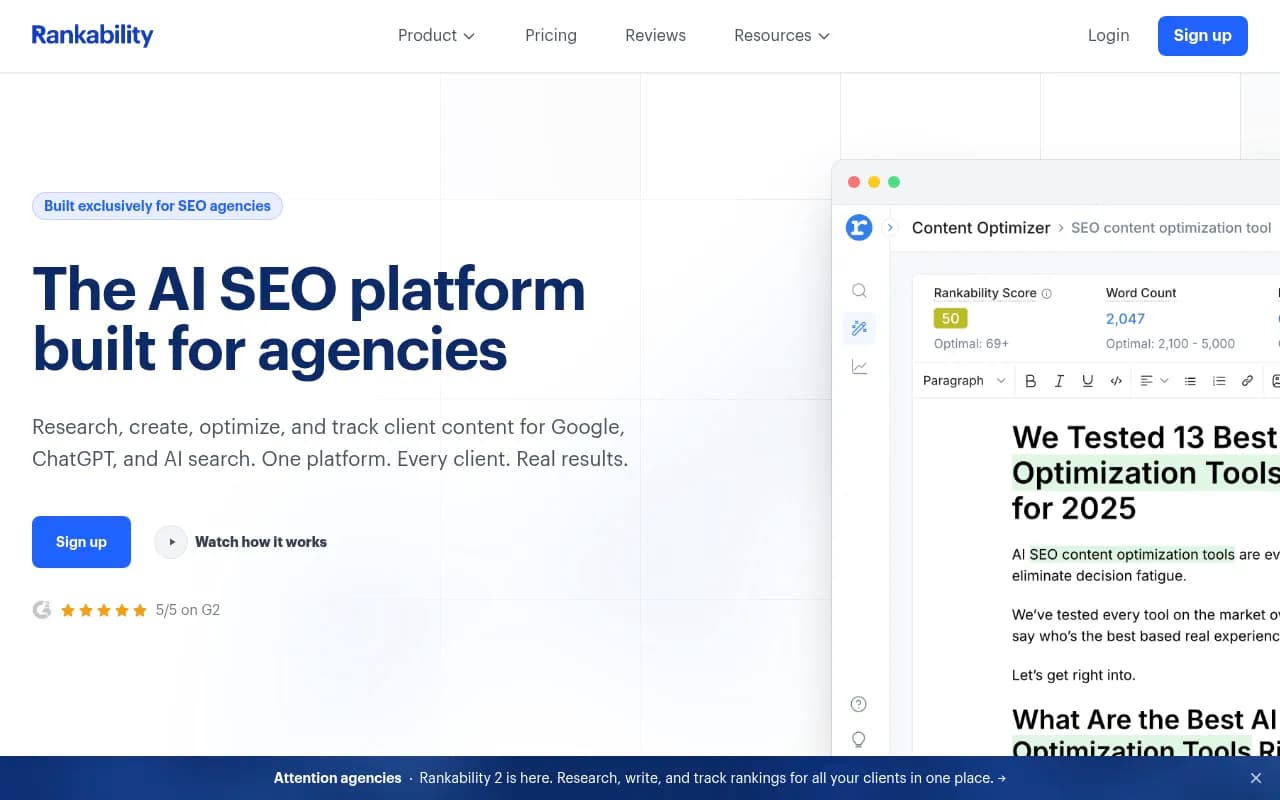
Rankability, founded in 2024 by Nathan Gotch of Gotch SEO, takes a genuinely different analytical approach from the other two. Instead of scoring keyword and NLP term frequency against the SERP, it scores entity coverage: the named concepts, entities, and semantic relationships that appear in top-ranking content. For a page about digital marketing analytics, that means checking whether you actually cover attribution modeling, conversion tracking, UTM parameters, ROAS, and customer lifetime value, rather than whether you repeated a keyword enough times.
A head-to-head analysis by Digital Applied rated Rankability's entity analysis as the deepest available among content tools and scored its AI-search fit as "good," specifically because entity coverage aligns well with the signals AI engines use when deciding what a page is about and whether to cite it. That's a fair assessment. If your content is semantically thin, no amount of keyword stuffing will make ChatGPT cite it.
The AI search side is where Rankability separates itself from typical content optimizers. Its AI Search Analyzer tracks brand presence across ChatGPT, Google AI Mode, and Claude on the Starter plan, adding AI Overviews and Perplexity at Core, and Gemini, Grok, and Copilot at Team. Every tier also includes classic rank tracking (Google, Bing, DuckDuckGo, Brave), local pack tracking, and video tracking across YouTube and TikTok. Unlimited seats on every plan is a quiet but meaningful perk for agencies.
Pricing: Starter at $99/month ($83 annual), Core at $199/month, Team at $399/month, Enterprise custom.
The honest criticism, raised in independent reviews: Rankability is more diagnostic than executional. It will show you exactly what's wrong and what's missing, and its Serena AI teammate drafts content, but it doesn't do deep original research the way Frase does, and it doesn't build backlinks. If you want a tool that monitors and scores across both Google and AI search and hands your team prioritized work, it's strong. If you want a tool that does the whole job, it isn't that.
Frase: the fastest researcher, now claiming AI search
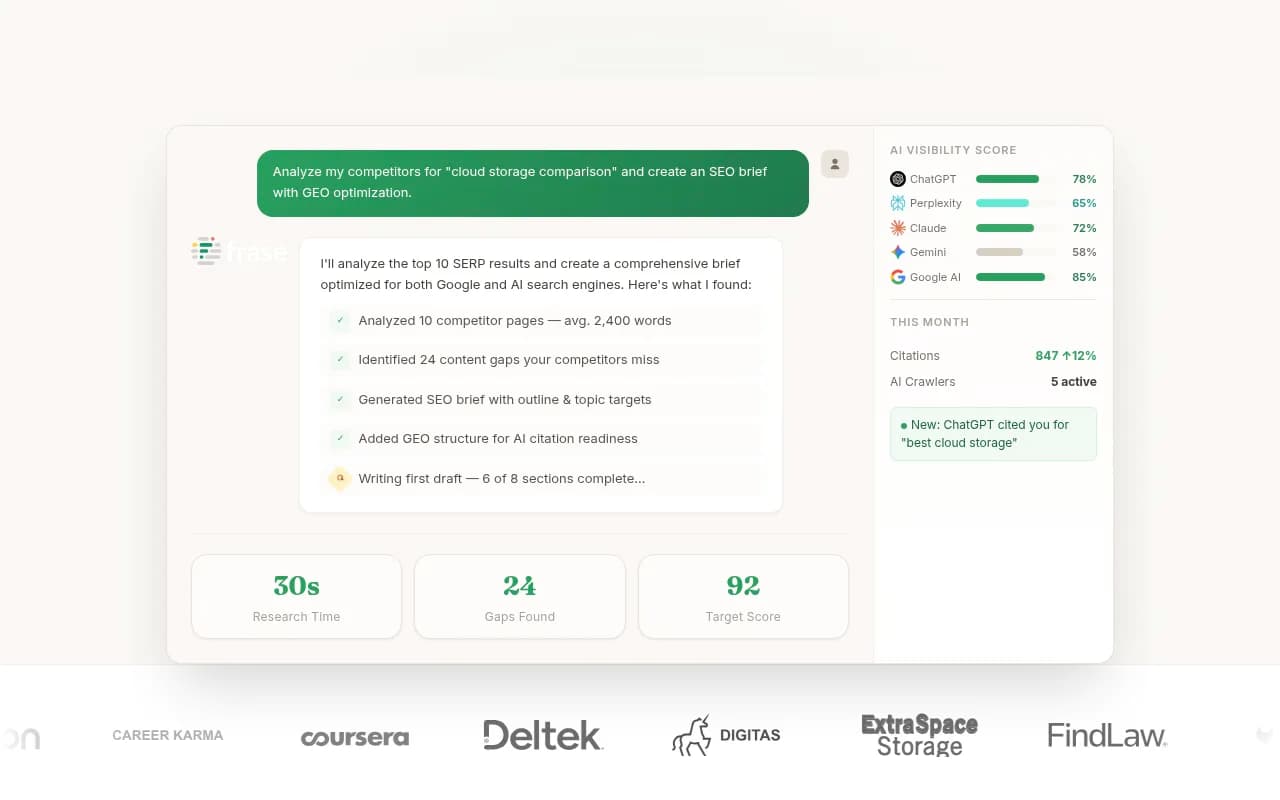
Frase has always been the speed tool. Its core strength is collapsing SERP research into minutes: it analyzes up to 20 top-ranking pages per query and extracts the questions, headings, statistics, and topics into a structured brief. Work that used to take an analyst two or three hours becomes a ten-minute task. Digital Applied's comparison rated Frase's brief generation as the fastest and most thorough in the category, and I've seen nothing that contradicts that.
What's changed recently is the positioning. Frase now markets itself as "the content operating system for AI search" with the tagline "Rank on Google. Get cited by AI." The product has genuinely grown to match some of that talk: every page gets both a search score and an AI-readiness score, there's a Content Guard feature that watches published pages for ranking decay and drafts fixes for your approval, it publishes to WordPress, Webflow, Sanity, and Wix, and it ships an MCP server and CLI on every plan so you can run it from Claude, ChatGPT, or Cursor. Its customer list (Oracle, Coursera, Under Armour, GitLab) and 4.8/5 G2 rating across 500+ reviews suggest the repositioning is landing.
Here's the catch, and it's a big one for this comparison: AI visibility tracking is tiered. On Starter you get ChatGPT and Google AI only. Professional adds Perplexity. Claude and Gemini only arrive at Scale, which runs $239/month on annual billing or $299 month-to-month. So the full multi-model AI citation coverage that the homepage promises requires the top tier. Starter at $39/month yearly ($49 monthly) is good value for research and drafting, but "AI search readiness" on that plan means a partial view.
One more note for the AI-readiness question specifically: Digital Applied rated Frase's AI-search fit as "limited," noting that its question extraction helps answer-readiness but that's about it. The new GEO scoring features may close that gap, but the tiered visibility tracking means many paying users won't see the full picture.
NeuronWriter: budget scoring, surprisingly real AI visibility
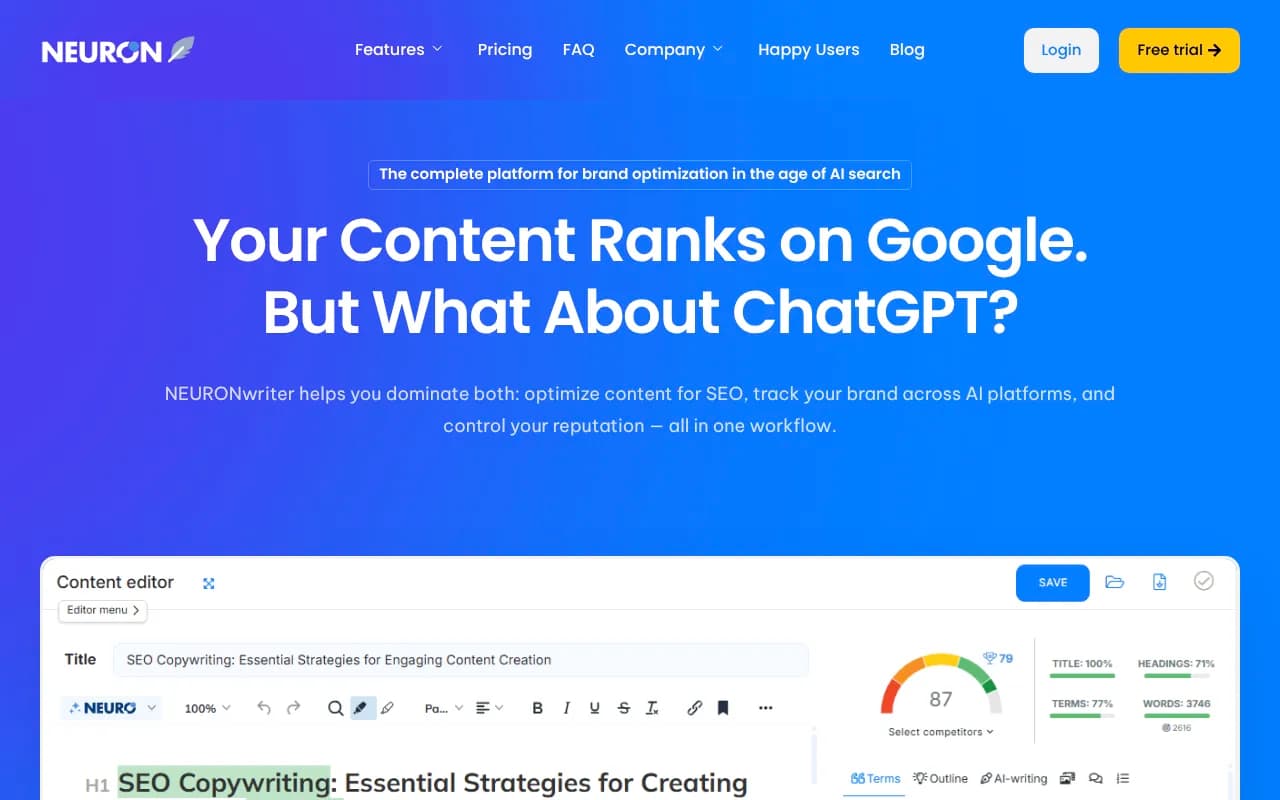
NeuronWriter is the price play. Bronze starts at $23/month (five tiers run up to Diamond at $117/month), and you get Surfer-style content scoring based on NLP analysis of the top 30+ SERP results, with terms categorized by importance. A Reddit thread on Surfer alternatives summed up the experience bluntly: "NeuronWriter is okay but the UX feels like 1998." That's unkind but not entirely wrong. The interface is dense and functional rather than pleasant.
What surprised me is the AI visibility layer. The dedicated AI Visibility module gives a 0-100 visibility score per query, tracks brand mentions across ChatGPT, Perplexity, and Google AI Overviews, surfaces ranked action suggestions, and even checks whether AI crawlers are blocked from your site, which is a genuine silent killer that most SEOs never verify. There's also a separate AI Score that rates content on topic coverage, structure, and clarity, with concrete suggestions like adding comparison tables or numbered lists. In one third-party hands-on test, a 1,200-word draft scored 61/100 and got flagged for thin mid-article coverage and low structural variety, which is the kind of specific, actionable feedback you want.
The pricing structure has a wrinkle: AI-monitored questions are limited by tier (5 on Bronze, up to 20 on Diamond), and scaling beyond that requires the AI Monitoring add-on at $9/month. So the AI visibility is real but metered. Also worth knowing: NeuronWriter has no rank tracking and no site audits. It's a content scoring and writing tool with an AI visibility bolt-on, nothing more. For some teams that's exactly enough.
The classic NeuronWriter pitfall, flagged repeatedly by reviewers, is score-chasing. Writers fixate on hitting 100/100 and produce bloated, term-stuffed content that reads badly and, increasingly, doesn't match what AI engines actually reward. The score is directional feedback, not a publication gate.
Head-to-head comparison
| Rankability | Frase | NeuronWriter | |
|---|---|---|---|
| Starting price | $99/mo ($83 annual) | $39/mo annual, $49 monthly | $23/mo ($19 annual) |
| Core scoring method | Entity and semantic coverage | SERP-based briefs, NLP scoring, AI-readiness score | NLP term scoring vs. top 30+ SERP |
| AI visibility tracking | Built in; ChatGPT, AI Mode, Claude from Starter; 7 engines at Team | Tiered; ChatGPT + Google AI at Starter, all models only at Scale ($239-299/mo) | Add-on module; ChatGPT, Perplexity, AI Overviews; $9/mo to scale questions |
| Content drafting | AI writer with templates (local, ecommerce, SaaS) | Strongest drafting workflow; brand voice, CMS publishing, MCP/CLI | AI drafts with credits; Content Designer on Gold+ |
| Best fit | Agencies wanting one workflow across Google + AI search | Teams whose bottleneck is research-to-draft speed | Budget-conscious solo optimizers |
And a narrower look at just the AI-readiness features:
| AI-readiness capability | Rankability | Frase | NeuronWriter |
|---|---|---|---|
| Tracks brand mentions in AI answers | Yes, multiple engines | Yes, tiered by plan | Yes, via add-on |
| Scores content for AI citation fit | Entity-based | SEO + GEO scores per page | AI Score (coverage, structure, clarity) |
| Checks AI crawler access to your site | Not advertised | AI crawler monitoring on Professional+ | Yes, explicitly |
| Shows which pages AI engines cite | Prompt-level tracking | Share of voice tracking | Query-level visibility score |
| Explains why AI cites or ignores a page | No | No | No |
That last row is the one nobody passes, and it matters more than any of the others.
Where all three fall short
Here's the structural limitation shared by every tool in this comparison: they're all scoring and monitoring layers. They can tell you that your visibility score is 58, or that ChatGPT mentioned your competitor but not you. None of them can show you the mechanics behind that result, which pages of yours AI crawlers actually visited, what they read, whether they hit errors, and which of your pages have a crawl-to-citation path at all.
That matters because visibility scores without diagnosis are just anxiety with a dashboard. If ChatGPT isn't citing your product page, is it because the content is weak? Because GPTBot got a 403 on your CDN? Because a competitor's comparison page is eating the slot? A content score can't distinguish between those. Crawler logs and citation analytics can.
This is exactly the gap dedicated GEO platforms exist to fill. Promptwatch, for instance, pairs prompt tracking with real-time AI crawler logs (400+ bots, including ChatGPTBot, ClaudeBot, and PerplexityBot), citation trends classified by content and source type, visitor analytics showing actual traffic and conversions from AI platforms, and automated content agents that close the loop by writing and publishing the fixes. It's the difference between knowing you're invisible and knowing why, then doing something about it.

The stacking pattern that Digital Applied recommends, and that I'd echo: pair a research and optimization tool with a dedicated GEO layer. Frase or NeuronWriter for content production, Rankability if entity gaps are your problem, and a visibility platform for the diagnosis and measurement side. If you want to survey the full field, the GEO software directory at bestgeosoftware.com covers the dedicated platforms in depth.
How to test your own stack for AI search readiness
If you're currently using one of these three tools, run this quick audit before buying anything new:
-
Check AI crawler access first. It costs nothing and it's the most common silent failure. NeuronWriter's visibility module includes this check, and Promptwatch's free AI Crawler URL Inspector does the same job. If GPTBot and ClaudeBot are blocked, every other optimization is wasted effort.
-
Ask your tool what it's scoring against. If your optimizer is scoring blog posts and listicles against Google SERPs, remember that product pages now lead citations on both ChatGPT and AI Overviews. Make sure some of your optimization effort goes to product, comparison, and how-to pages, not just editorial content.
-
Verify visibility claims manually. Ask ChatGPT, Perplexity, and Gemini the ten questions your buyers actually ask. See who gets cited. If your tool's visibility score disagrees with reality, you've learned something about the tool.
-
Watch citation counts, not just mentions. With ChatGPT citing only about 5 sources per response, per Promptwatch's sources per response data, a "mentioned" flag tells you little about how contested your category's prompts are. Prompt-level difficulty and volume data is what turns tracking into strategy.
-
Don't chase scores. Whether it's NeuronWriter's content score, Frase's readiness score, or Rankability's entity coverage, treat every score as directional. The failure mode of the legacy tool era, writers padding content to hit 100, produces exactly the bloated pages that AI engines skip.
Recommendations by team type
Solo blogger or affiliate site on a budget: NeuronWriter Bronze or Silver, plus the $9 AI Monitoring add-on if AI visibility matters to you. Accept the dated UX as the price of the price.
Content team whose bottleneck is production speed: Frase. Nothing in this comparison turns a SERP into a brief and a draft faster, and the research quality is real. Just know that meaningful AI visibility tracking means Professional at minimum, and full model coverage means Scale.
Agency running multi-client SEO with AI search in scope: Rankability. The entity scoring, unlimited seats, and built-in multi-engine AI tracking add up to the most complete agency workflow of the three, and the white-label reporting closes the loop for client deliverables.
Anyone serious about AI search specifically: whichever optimizer you pick, pair it with a dedicated GEO platform. The legacy tools will make your content better. They won't tell you why ChatGPT still isn't citing it.
The verdict
Calling these tools "legacy" is half fair. Their optimization cores are mature and still effective, and all three have made genuine, if uneven, moves toward AI search: Rankability built visibility tracking in from the start, Frase repositioned its whole product around it (with a paywall on the good parts), and NeuronWriter shipped a surprisingly honest visibility module at a budget price.
But all three remain content tools first. They optimize what you write and monitor whether it worked. AI search readiness, in 2026, increasingly depends on things none of them touch: whether AI crawlers can reach your pages, which content formats the engines are citing this month, and what actually happens between a crawl and a citation. That's a different category of tool, and the teams winning AI citations right now are the ones running both.