Key takeaways
- Most GEO tools are built for SaaS and ecommerce. Home service businesses need tools that cover local listings, reviews and service-area pages, not just prompt tracking.
- A realistic stack has three layers: something that measures AI visibility, something that fixes your content and listings, and something that handles reviews.
- ChatGPT has nearly stopped citing social platforms (0.46% of citations, Sep 28 to Oct 4, 2026), so your own site, review sites and directories matter more than Reddit threads.
- Product and landing pages are the most cited content types in ChatGPT, which maps to service pages and city pages for contractors.
- Be skeptical of vendor-written "best tool for HVAC" claims, including the ones in this research. Test with a free scan before paying.
Why home services need a different GEO approach
A homeowner with a burst pipe at 11pm doesn't read a 3,000-word comparison. They ask ChatGPT, Gemini or Google "emergency plumber near me" and call one of the first names they see. That's the entire funnel.
The numbers floating around the industry are mostly vendor-written, so take them with salt. One HVAC-focused vendor cites a Watson Co 2026 figure that 84% of homeowners use Google before choosing a contractor. Another guide claims HVAC contractors lose about $45,600 a year to missed calls and plumbers up to $125,000. Treat those as directional. The point stands even if the exact figures wobble: local intent is high, urgency is high, and the shortlist is short.
GEO (generative engine optimization) for a contractor means making sure AI systems can find, trust and recommend your business. That involves your Google Business Profile, reviews, service pages, schema markup and consistent listings. It is less about blog volume than most SEO tools assume.
What AI actually cites for service businesses
Promptwatch Data has no home services report, so I'm inferring here. But its ChatGPT citation share by content type report (Sep 28 to Oct 4, 2026) is a useful proxy:
- Product pages made up 22.4% of classified citations and landing pages 16.8%. About 39% of citations go to pages describing what a company sells.
- For commercial "best X for Y" prompts, product pages hit 26.0%, landing pages 20.6% and listicles 15.0%.
- For branded prompts, reviews rise to 5.6%, about three times their overall share, and FAQ pages reach 4.8%.
For a plumber, that translates to clear service pages (drain cleaning, water heater replacement), city pages, FAQ sections and reviews on trusted sites. Not a daily blog.
Reddit and social are less useful than you think
Promptwatch's social citation data for Sep 28 to Oct 4, 2026 shows all seven major social platforms together are 0.46% of ChatGPT citations. Reddit fell from 5.19% to 0.09% in that comparison, after a drop on August 14, 2026. Google AI Overviews is different: social platforms are 12.2% of its citations, with YouTube at 4.28% and Facebook at 2.38%.
So if your customers use Google, a complete and active Facebook page and a few YouTube videos (a tech showing how to find a shutoff valve) are worth the effort. Don't build a Reddit strategy to get into ChatGPT.
The three-layer stack
No single tool does everything for a contractor. Here is how I'd think about it.
| Layer | Job | Tool types |
|---|---|---|
| Measure | See whether AI recommends you for "best HVAC company in [city]" | AI visibility trackers |
| Fix | Improve service pages, listings, schema and content | GEO platforms, content tools, listings platforms |
| Reputation | Collect and respond to reviews | Review management tools |
Layer 1: tracking AI visibility
This is the layer most crowded with tools, and the one where you should spend the least on a small contractor budget. You need to know: for the 20 or so prompts a homeowner would type, does your company show up, and who does instead?
Promptwatch
Promptwatch is the most complete option if you can justify the spend, mainly because it goes past tracking. It monitors the real interfaces of ChatGPT, Google AI Overviews, AI Mode, Gemini, Perplexity and Copilot, with country tracking on every paid plan and state and city tracking from the Business plan. For a multi-location HVAC company, city-level tracking is the feature that matters, since "best plumber in Tampa" and "best plumber in Orlando" return different answers.
It also has IP-verified AI crawler logs (to check whether bots can actually read your site), weekly site audits, an Action Board that prioritizes fixes, and a Content Agent that can publish to WordPress, Webflow or Framer. Pricing runs from a free Explore tier to Essential at $95/mo, Professional at $245/mo and Business at $579/mo. Check promptwatch.com/pricing before buying. Agencies serving many contractors should look at the agency plans, which start at $199/mo.
Honest take: a one-truck plumber doesn't need this. A regional HVAC company with several locations, or an agency running ten contractor accounts, probably does.

Budget trackers
If you only want a scoreboard, cheaper trackers are fine. Otterly.AI and Peec AI are basic prompt trackers. They tell you whether you were mentioned. They won't tell you why, and they won't fix anything.


Small-team options in the catalog include BrandAxis, Atyla and Airefs, all positioned as lower-cost. I haven't verified their local coverage, so run a trial and check whether they can track city-specific prompts before committing.
Enterprise-leaning platforms
Profound and Scrunch are strong monitoring products, but they're priced and built for larger brands. For a national franchise or a multi-state contractor group they make sense. For a local shop, skip them.

Layer 2: fixing what AI reads
Tracking without fixing is a hobby. This layer is where contractors win or lose.
Listings and local data
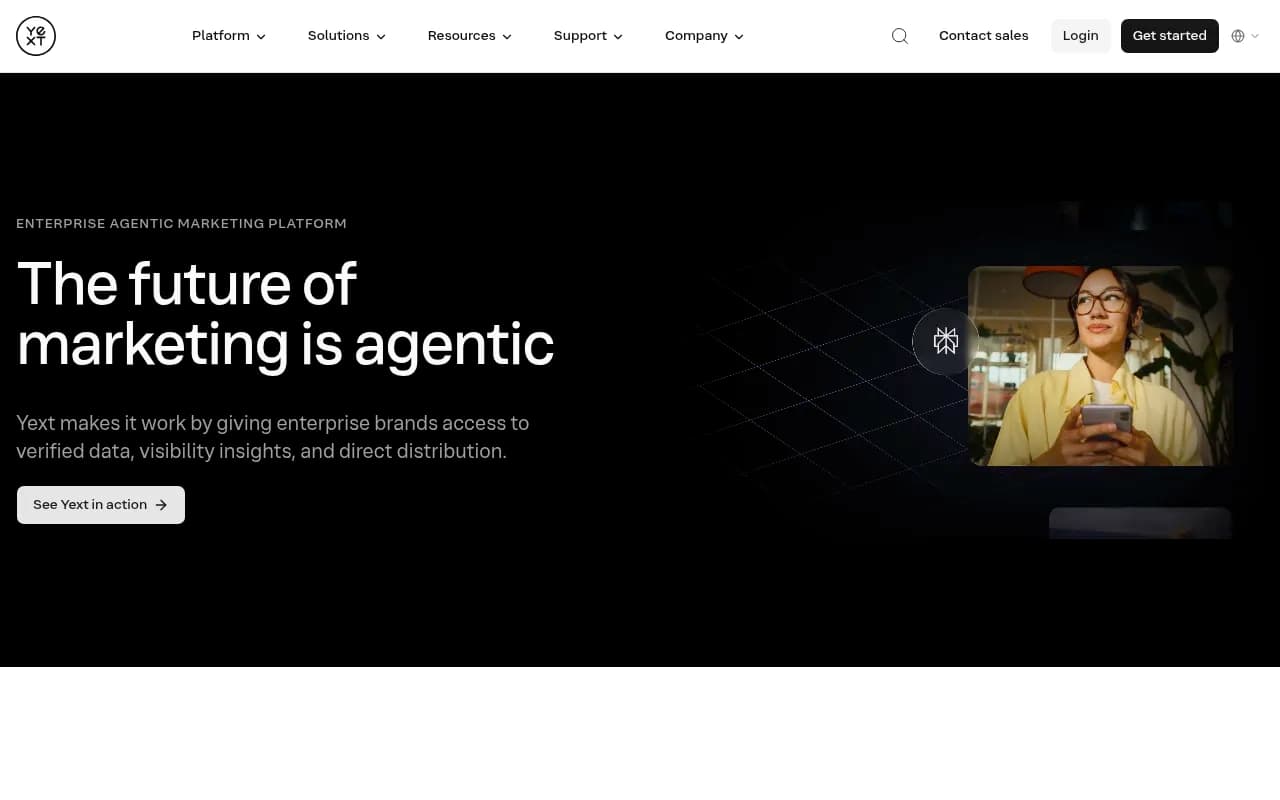
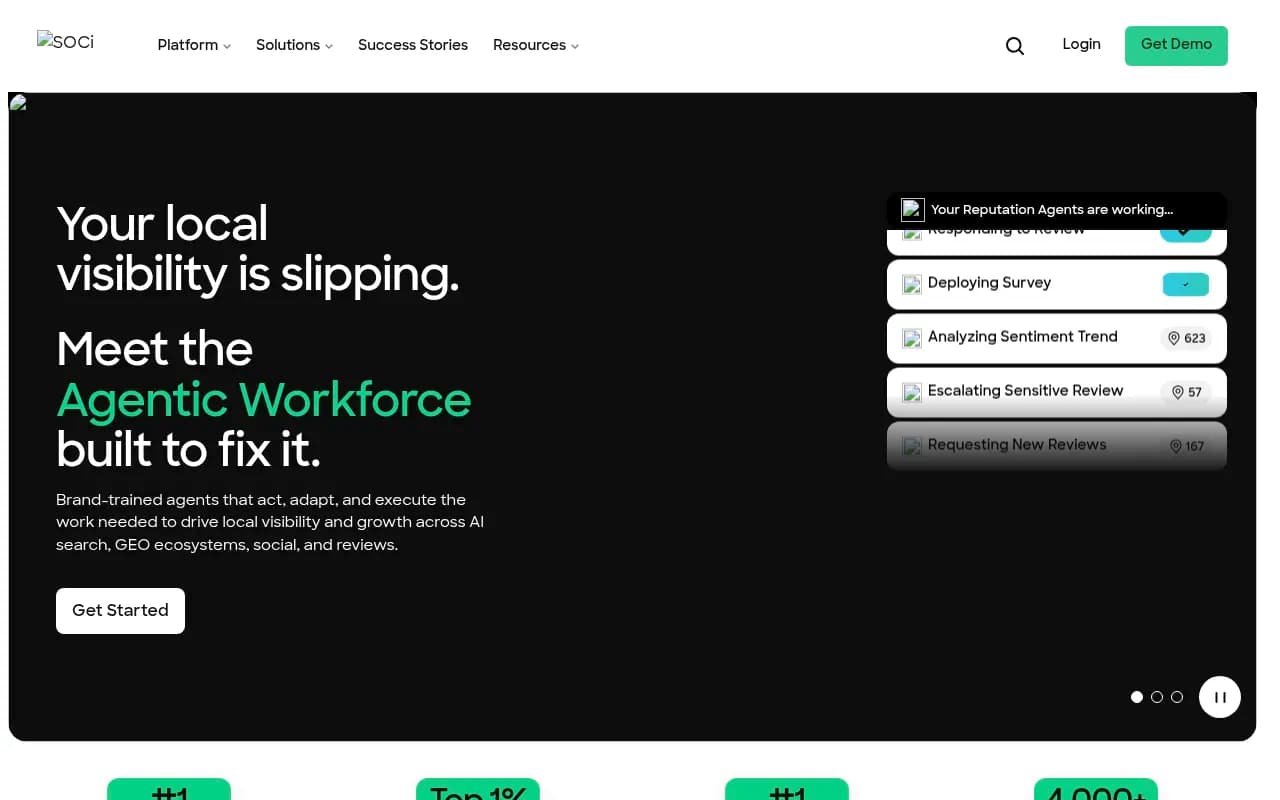
AI assistants pull heavily from business directories, Google Business Profile and review sites. Inconsistent names, phone numbers and service areas make you harder to recommend. Yext is a digital presence platform for search and AI answers, and SOCi runs local search, social and reviews for multi-location brands. Both lean toward multi-location operators rather than a single shop.
Auto-publishing content tools
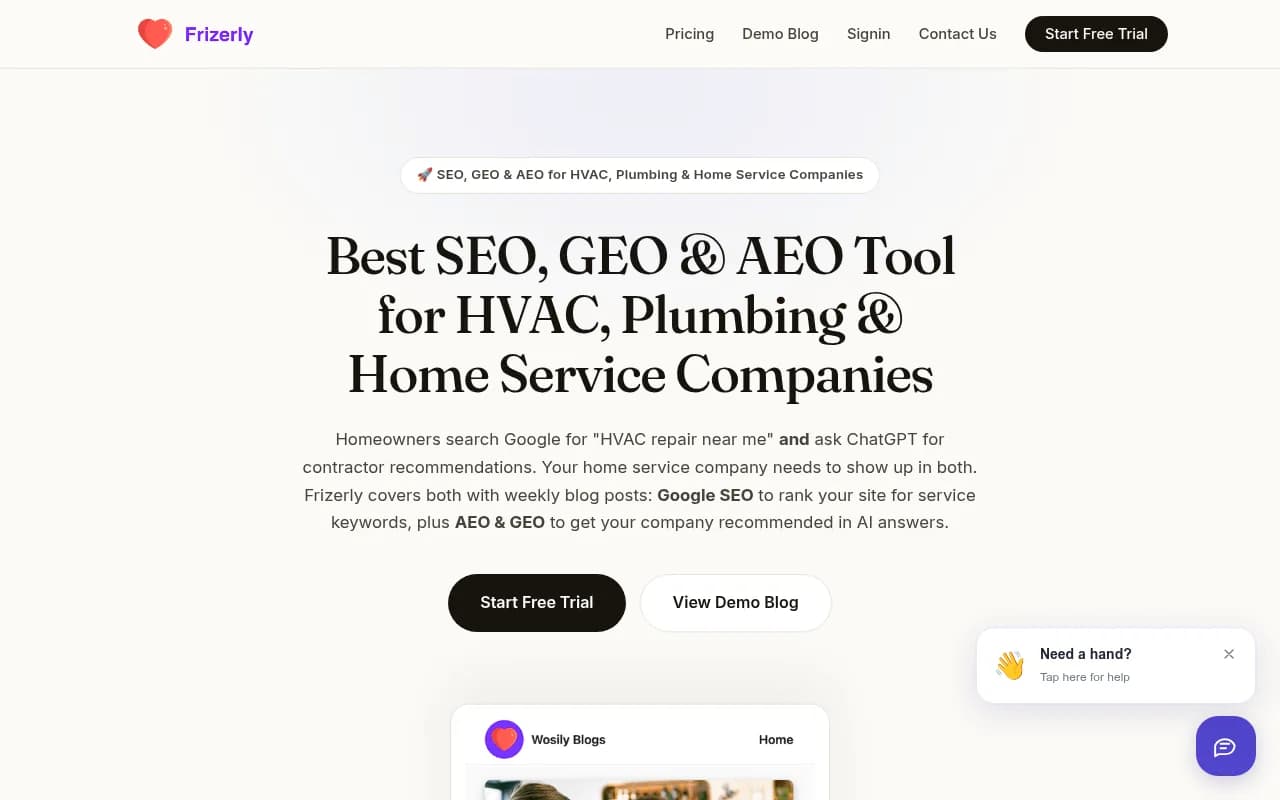
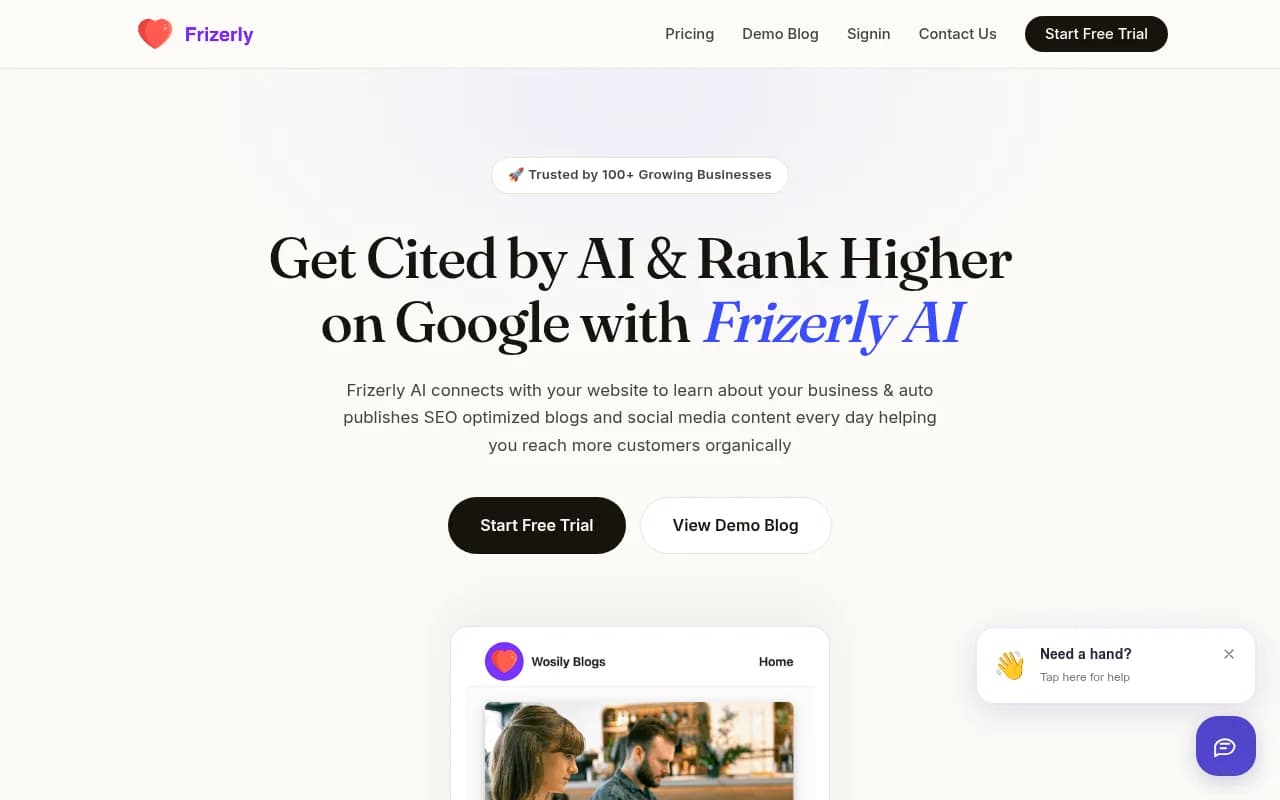
Frizerly is aimed squarely at HVAC, plumbing and home service companies. It auto-publishes weekly blog posts, and bundles review management, social and Reddit agents. The pitch is attractive for a busy owner. Two cautions. First, its page on this topic claims it is "the best SEO, AEO, and GEO tool" for the trade, which is self-promotion, so verify with your own trial. Second, weekly blogs are the lowest-leverage content for a contractor based on the citation data above. Use it, if you do, to keep service and FAQ content fresh, not to flood the site.
Gushwork builds and publishes 100+ pages for inbound lead capture, which can suit service-area page buildouts. Diib is an automated SEO growth tool aimed at small businesses.
Gushwork
Content optimization
If you or your marketer write the service pages, Surfer SEO and Clearscope help structure pages against what ranks. They are not home-service specific, but they work on a "water heater replacement in Denver" page as well as any other.

Technical checks
A surprising number of contractor sites are slow, have broken pages or block crawlers by accident. Screaming Frog handles a one-off crawl cheaply. Sitebulb is friendlier if you want visual reports.
Layer 3: reviews and reputation
Reviews are a main input for branded prompts, where they hit about three times their usual share of ChatGPT citations. Birdeye covers review requests, responses and reputation for local businesses.
The free work matters as much as the software. Ask every satisfied customer for a Google review the day the job ends, while they're still happy. Respond to every review, good or bad, with the service and city mentioned naturally.
Comparison table
| Tool | Best for | Local or city-level focus | Fixes things or just tracks |
|---|---|---|---|
| Promptwatch | Multi-location contractors and agencies | City and state tracking on Business and agency plans | Tracks and acts (Action Board, Content Agent) |
| Frizerly | Owner-operators wanting hands-off blogging | Built for home service trades | Publishes content, bundles reviews |
| Otterly.AI / Peec AI | Cheap visibility scoreboard | Limited, verify first | Tracks only |
| Yext / SOCi | Multi-location listings and local presence | Strong | Fixes listings |
| Birdeye | Review collection and replies | Strong | Reputation |
| Surfer SEO / Clearscope | Writing service pages | None specific | Content guidance |
| Screaming Frog / Sitebulb | Technical audits | None specific | Diagnoses |
What the 5WPR index tells you (and doesn't)
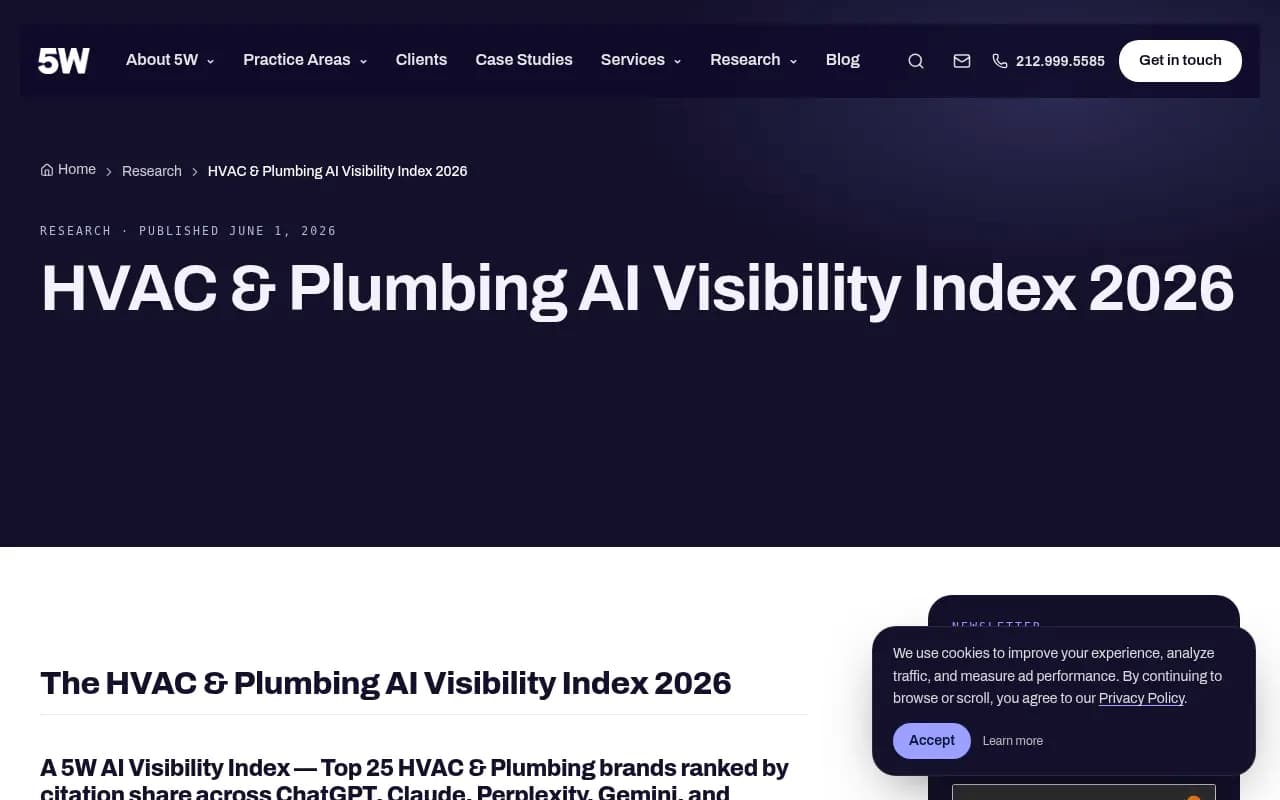
The 5WPR HVAC and Plumbing AI Visibility Index 2026 ranks the top brands by AI citation share. ServiceTitan leads at 14.0%, then Roto-Rooter at 11.5%, ARS/Rescue Rooter at 5.5%, Mr. Rooter at 4.8% and Housecall Pro at 4.2%.
Two takeaways. First, the list is dominated by software vendors and national franchises, not independent contractors, so it tells you little about how a local company gets recommended. Second, it is a PR firm's study, so I'd treat the exact percentages loosely. The one claim in it I find plausible: franchise and aggregator sites (Angi, Thumbtack) take big citation share on generic prompts, which means you need to be present on them or beat them with a better local page.
A 30-day plan for a local contractor
- Week 1: Write down 20 prompts a homeowner would use, such as "emergency plumber in [city]" and "how much does a new AC unit cost in [city]". Run them in ChatGPT, Gemini and Google by hand. Note who appears.
- Week 1: Audit your Google Business Profile, then fix name, address and phone mismatches across directories.
- Week 2: Build or tighten one page per core service and one per city you serve. Put prices or price ranges, service areas, license info and an FAQ on each.
- Week 2: Add LocalBusiness and FAQ schema.
- Week 3: Start a review request routine and reply to old reviews.
- Week 3: Check that AI crawlers aren't blocked in robots.txt, and that your site loads fast on mobile.
- Week 4: Pick a tracker, rerun your prompts, and compare. Then iterate on the pages that didn't move.
For more options by category, the GEO software directory at bestgeosoftware.com lists a much wider field of trackers.
Do you need an agency instead?
Possibly. If you have five trucks and no marketing person, a specialist is often cheaper than learning five tools. An agency like 1001 SEO Media handles technical SEO, local SEO and AI search work, and they use Promptwatch for the AI visibility side. Whoever you hire, ask to see the prompts they track for you and the pages they changed. Vague monthly reports are a red flag.
Which one should you start with?
- Solo or small shop, under $200 a month: fix your listings and reviews first, use free manual prompt checks, and add a budget tracker only if you'll look at it.
- Growing regional contractor: add a platform that tracks by city and tells you what to fix, such as Promptwatch's Essential or Professional plan.
- Multi-location or franchise: pair a listings tool like Yext or SOCi with a full GEO platform.
- Agency: look at the agency tiers with unlimited projects and white-label reporting.
The tool matters less than the habit. Check your prompts monthly, fix the page or listing that's missing, and see if the answer changes.