Diib Review 2026
AI-driven SEO tool that monitors site health, benchmarks against competitors, and delivers prioritized daily action plans to improve search rankings.
Key takeaways
- Diib is built specifically for small business owners with little to no SEO experience -- the entire UX is designed around plain-English recommendations, not raw data dumps
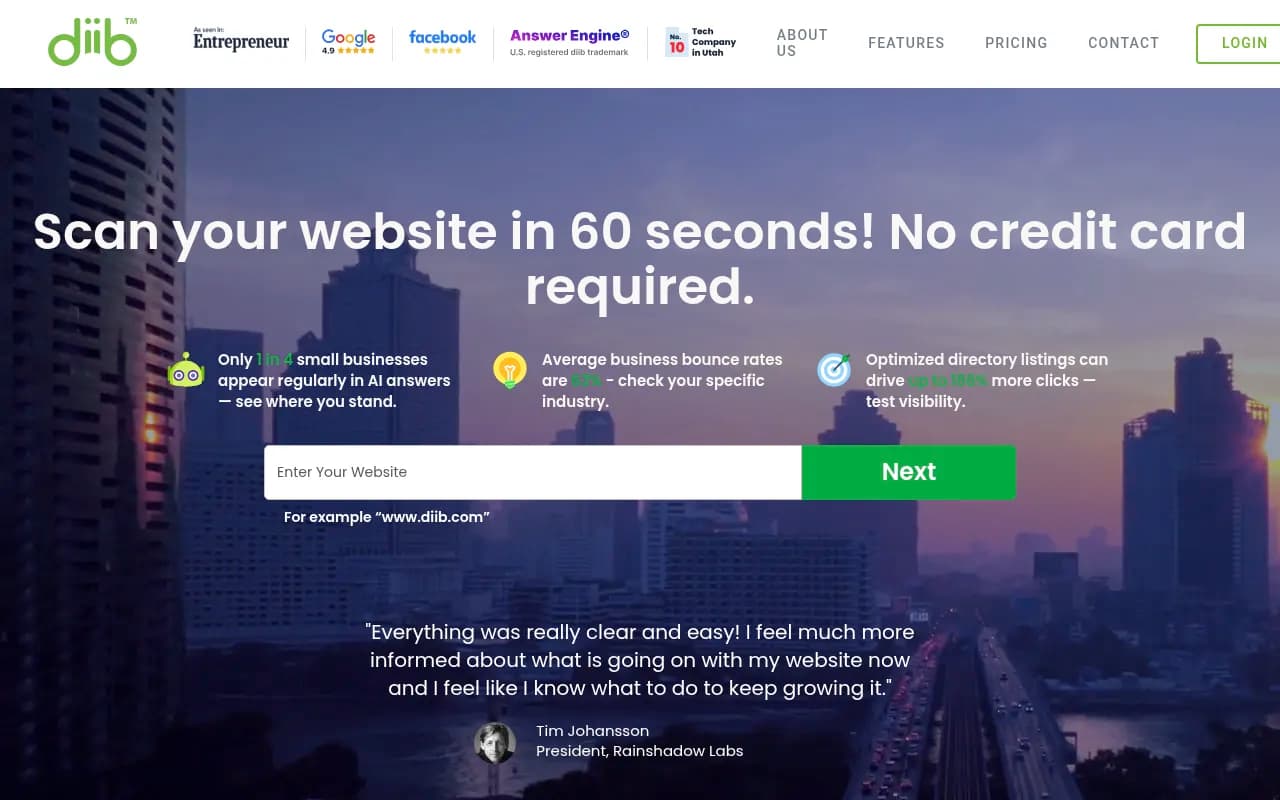
- Syncs directly with Google Analytics and delivers a prioritized growth plan within 60 seconds of signing up
- Covers SEO, backlinks, social media, mobile performance, local maps, and website security in one dashboard
- Free tier is genuinely usable but limited; the Pro plan at roughly $7.99/month (billed annually) is one of the more affordable full-featured SEO tools on the market
- Not the right tool for enterprise SEO teams, technical SEOs, or agencies managing dozens of client sites -- the depth simply isn't there
- Lacks AI search visibility tracking, citation monitoring in LLMs, or any GEO/AEO capabilities -- if you want to know how your brand appears in ChatGPT or Perplexity, you'll need a separate tool
Diib has been quietly serving small business owners since around 2013, operating out of Salt Lake City, Utah. The pitch is simple: most small business owners know they need SEO but have no idea where to start, no budget for an agency, and no time to learn a complex tool. Diib tries to solve all three problems at once by automating the analysis, translating the results into plain English, and handing you a prioritized to-do list every day.
The platform has grown to over 500,000 members across 160 countries, which is a real number for a tool in this price range. It's not competing with Semrush or Ahrefs for the enterprise market -- it's going after the David M. in Sacramento who runs a toy store and just realized he needs to show up on Google. That focus shapes everything about how the product is built.
Founder Daniel Urmann has a background in digital marketing and analytics going back nearly 20 years, and that experience shows in how the product communicates. The emphasis throughout is on making SEO feel approachable rather than overwhelming. Whether that's enough for your needs depends entirely on where you are in your growth journey.
Key features
Answer Engine and Growth Plan
The core of Diib is what they call the "Answer Engine" -- an automated system that pulls in your Google Analytics data, analyzes your site alongside competitor sites and industry benchmarks, and produces a prioritized list of growth objectives. In practice, this means you log in and see a clear list of things to fix or improve, ranked by impact. Each item comes with step-by-step instructions written for non-technical users.
This is genuinely useful for someone who doesn't know the difference between a 301 redirect and a canonical tag. The recommendations cover SEO, social, mobile, and user experience, and they update continuously as your data changes.
Daily Health Score
Diib combines 12 metrics into a single score that gives you a quick read on your website's overall health. The score accounts for growth trends, user experience signals, social performance, mobile performance, and more. It also adjusts for seasonality and day-of-week variations, which prevents false alarms when traffic dips on a Sunday.
This is a nice feature for business owners who don't want to dig into dashboards every day. One number tells you whether things are generally okay or whether something needs attention.
Rank Guard and keyword tracking
All Pro accounts include Rank Guard, which monitors your keyword rankings and alerts you when positions change. More usefully, it tells you which specific page was affected and what changed -- not just that your rankings dropped. You can track up to six competitors' keyword rankings and backlinks, which gives you a practical way to find content gaps and link-building opportunities without needing a separate tool.
The keyword explorer helps you find new keyword ideas for articles and blog posts, though it's not as deep as Semrush's keyword database or Ahrefs' content explorer.
Benchmarking
Diib compares your site's performance against similar websites in your industry. Bounce rate, return visitor percentage, page speed -- you can see whether your numbers are normal for your vertical or whether you're significantly underperforming. This context is something a lot of cheaper SEO tools skip entirely, and it helps prioritize where to focus.
Website monitoring
Pro accounts get monitoring for up to 30 websites, covering speed, security, email deliverability, rankings changes, and competitor activity. The email deliverability check (making sure your domain isn't flagged as spam) is a nice touch that most SEO tools don't include. Alerts come via email when issues are detected.
Social media integration
Diib syncs with Facebook and Instagram data to give you insights on engagement, posting timing, and audience behavior. It's not a social media management tool -- you can't schedule posts or run campaigns from within Diib -- but it surfaces useful data about when your followers are active and whether your content is resonating. For a small business owner trying to manage everything themselves, having this in the same dashboard as their SEO data is convenient.
Local SEO and Google Maps tracking
Diib tracks local map rankings, which matters a lot for brick-and-mortar businesses. The case study of David's toy store in Sacramento shows this in action: he improved his Google My Business rankings and started getting 70-80 new in-person shopping appointment requests per month. Local SEO is often an afterthought in broader SEO tools, so the explicit focus here is a genuine differentiator for the target audience.
Growth Experts (Pro)
Pro plans include access to human SEO experts with an average of 10+ years of experience. You can ask questions about keyword strategy, site speed, competitor rankings, or anything else. This is a meaningful addition for small business owners who hit a wall with the automated recommendations and need a real person to talk to. It's not unlimited consulting, but it's more than most tools at this price point offer.
Weekly Snapshot email
A weekly digest covering traffic and rankings changes, social performance, local map stats, new growth opportunities, and a security/speed/SEO overview. For busy owners who can't check the dashboard daily, this keeps them informed without requiring active engagement.
Who is it for
Diib is built for small business owners who are doing their own digital marketing -- the solo founder running a Shopify store, the local service business trying to rank in Google Maps, the professional services firm that knows it needs more web presence but doesn't have a marketing team. The tool's entire design philosophy is about removing friction for people who find SEO intimidating. If you've ever opened Semrush and immediately felt overwhelmed, Diib is the antidote.
It also works reasonably well for freelance web designers and consultants who manage a handful of client sites. The Pro plan's 30-site monitoring capability and the ability to track multiple competitors make it practical for light agency use. The Growth Experts feature means you can escalate questions you can't answer yourself without having to bring in a separate consultant.
E-commerce businesses on Shopify, WooCommerce, BigCommerce, and similar platforms are a natural fit. The platform explicitly supports these integrations, and the case studies on the site (amplifier store going from 0 to 3,100+ keyword rankings, toy store improving mobile speed from 43 to 79/100) are drawn from exactly this audience.
Who should not use Diib: technical SEOs who need deep crawl data, log file analysis, or advanced schema markup tools. Enterprise marketing teams running complex multi-site operations. Agencies managing 20+ client sites who need white-label reporting and client portals. Anyone who needs detailed AI search visibility tracking -- Diib has no capability to monitor how your brand appears in ChatGPT, Perplexity, Claude, or other AI models. For that use case, you'd need a dedicated GEO platform.
Integrations and ecosystem
Diib's primary integration is Google Analytics, which it syncs with immediately on signup. This is the foundation of its "real data" approach -- rather than estimating your traffic like many SEO tools do, it reads your actual GA data.
Platform support is broad: WordPress, Shopify, Wix, Squarespace, BigCommerce, Magento, Weebly, Tumblr, Blogger, Drupal, Joomla, and a dozen more. This covers the vast majority of small business websites.
Social integrations include Facebook and Instagram. There's no TikTok, LinkedIn, or Pinterest integration mentioned, which is a gap for businesses whose audiences live on those platforms.
Google My Business data feeds into the local map tracking features, though the depth of this integration isn't fully documented on the public site.
There's no public API mentioned, no Zapier integration listed, and no browser extension. For a tool aimed at small business owners rather than developers, the absence of an API is understandable, but it does limit automation possibilities for more technical users.
Export capabilities exist but aren't prominently featured -- the tool is designed to be used within the dashboard rather than as a data source for other systems.
Pricing and value
Diib offers a free tier that provides a basic site analysis and limited ongoing monitoring. It's genuinely useful for getting an initial read on your site's health, but the free plan restricts how many keywords you can track, how many competitors you can monitor, and how frequently data updates.
The Pro plan is where the real value is. Based on available pricing information, it comes in around $7.99/month billed annually (roughly $14.99/month billed monthly), which puts it at the very affordable end of the SEO tool market. At that price, you get Rank Guard, access to Growth Experts, monitoring for up to 30 websites, competitor tracking for up to six competitors, and the full Answer Engine growth plan.
For comparison, Semrush's entry-level Pro plan runs $139.95/month. Ahrefs starts at $129/month. Even Moz Pro starts at $99/month. Diib is not trying to compete with those tools on features -- it's competing on accessibility and price for an audience that would never pay $100+/month for SEO software.
The honest value assessment: if you're a small business owner spending $8/month and actually following the recommendations, Diib can deliver real results. The case studies on the site show meaningful improvements in keyword rankings, mobile speed, and traffic. The ROI math works at this price point even if you only act on a fraction of the recommendations.
Strengths and limitations
Where Diib does well:
- The plain-English recommendations are genuinely accessible. This is harder to build than it sounds -- translating technical SEO issues into actionable steps for non-experts requires real product thinking, and Diib has done it well.
- The price-to-feature ratio at the Pro tier is hard to beat for the target audience. $8/month for keyword tracking, competitor monitoring, backlink analysis, social insights, local SEO, and access to human experts is a strong package.
- The Google Analytics integration means the data is real, not estimated. Many tools in this price range rely on third-party traffic estimates that can be wildly inaccurate for smaller sites.
- The Daily Health Score and Weekly Snapshot email are well-designed for busy owners who need to stay informed without spending hours in a dashboard.
- Local SEO and Google Maps tracking is a genuine differentiator for brick-and-mortar businesses.
Where Diib falls short:
- Keyword database depth is limited compared to Semrush or Ahrefs. If you're doing serious keyword research for a competitive niche, you'll hit the ceiling quickly.
- No AI search visibility features at all. As AI-powered search engines like ChatGPT, Perplexity, and Google AI Overviews become more important traffic sources, Diib has no capability to track whether your brand is being cited or recommended in those environments. This is an increasingly significant gap.
- The tool is designed for self-service use by non-experts, which means it deliberately simplifies things that technical SEOs would want to control directly. There's no access to raw crawl data, no log file analysis, no advanced structured data tools.
- Social media coverage is limited to Facebook and Instagram. No TikTok, LinkedIn, Pinterest, or YouTube integration.
- No white-label reporting or client portal features, which limits its usefulness for agencies beyond very light use.
Bottom line
Diib is the right tool for small business owners who want to stop ignoring their SEO without having to become SEO experts or spend hundreds of dollars a month on software. The combination of automated recommendations, real Analytics data, competitor tracking, local SEO, and access to human experts at under $10/month is a genuinely strong value proposition for its target audience.
Best use case in one sentence: a small business owner or solo founder who wants a clear, prioritized action plan to improve their Google rankings without needing to understand the technical details behind each recommendation.
Tags:
Frequently asked questions
What is Diib and what does it do?
How much does Diib cost?
Is Diib suitable for beginners with no SEO experience?
How does Diib compare to Semrush or Ahrefs?
Does Diib track AI search visibility or LLM citations?
How many websites and competitors can I track with Diib?
Similar and alternative tools to Diib