Key takeaways
- Searchable offered a clean, accessible entry point into AI search visibility monitoring in 2025, but remained largely a tracking-only tool
- Its core gap: no content generation, no crawler logs, and limited prompt intelligence left teams with data but no clear path to acting on it
- Teams that outgrew Searchable typically moved to platforms that close the loop between finding visibility gaps and fixing them
- Several strong alternatives exist depending on budget and team size, from lightweight trackers to full GEO optimization platforms
What Searchable actually was in 2025
Before getting into what went wrong, it's worth being fair about what Searchable was trying to do. The platform positioned itself as a straightforward AI search visibility tracker: pick your brand, set up some prompts, and watch how often AI models like ChatGPT, Perplexity, and Gemini mention you in their responses.
For teams just waking up to the fact that AI search was eating into their organic traffic, that was a reasonable starting point. The interface was clean. Onboarding was fast. You could get a basic read on your AI visibility in an afternoon without needing an SEO specialist to configure everything.
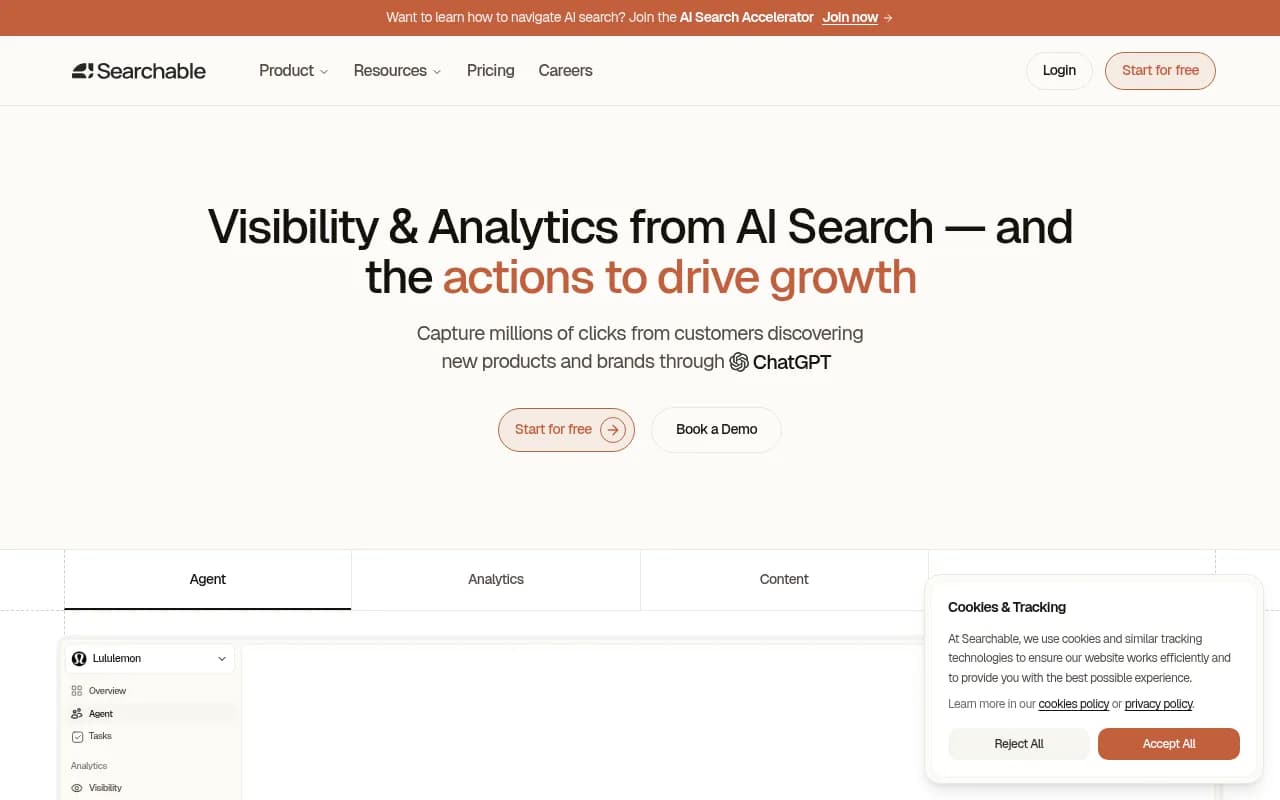
That accessibility mattered more than it sounds. In 2025, most marketing teams were still figuring out that AI search was a real channel, not a novelty. Having a tool that didn't require a three-week implementation to produce a dashboard was genuinely useful.
So Searchable got some things right. It just didn't get enough things right for teams that needed to actually move the needle.
What Searchable got right
Simple setup and readable dashboards
Searchable's biggest genuine strength was its low friction. You didn't need to understand the mechanics of LLM citation to get value out of the first session. The dashboards were readable by non-technical stakeholders, which matters when you're trying to get buy-in from a CMO who wants to see whether the brand shows up when someone asks ChatGPT for a product recommendation.
Monitoring across multiple AI models
Searchable tracked responses across several major AI platforms, which was more than some early competitors managed. Seeing your visibility across ChatGPT, Perplexity, and Gemini in one view gave teams a reasonable baseline to work from.
Competitive benchmarking basics
The platform let you compare your brand's mention rate against a handful of competitors. For teams doing initial audits or quarterly reviews, this was enough to tell a story in a slide deck.
Where Searchable fell short
Here's where it gets honest.
Monitoring without action
The fundamental problem with Searchable was that it showed you a problem without helping you fix it. You'd see that a competitor was being cited for a category of prompts you weren't appearing in. You'd see your visibility score drop. And then... you'd be on your own to figure out what to do about it.
That's not a small gap. It's the whole job. Knowing you're invisible in AI search is only useful if you know what content to create, what topics to cover, and how to structure it so AI models actually cite you. Searchable didn't offer any of that.
No content generation or gap analysis
Most teams that left Searchable pointed to the same thing: there was no answer gap analysis. No way to see which specific prompts competitors were winning that you weren't, and no tooling to help you create content that could close those gaps. You were left exporting data and then figuring out your own content strategy from scratch.
No AI crawler logs
One of the more underrated features in mature GEO platforms is the ability to see when AI crawlers (ChatGPT's GPTBot, Perplexity's PerplexityBot, etc.) are actually visiting your pages. Searchable had no visibility into this. That meant teams couldn't tell whether their content was even being indexed by AI models, let alone cited.
Limited prompt intelligence
Searchable tracked prompts but didn't tell you much about them. There were no volume estimates, no difficulty scores, and no fan-out analysis showing how one prompt branches into related sub-queries. Without that, prioritizing which prompts to target was basically guesswork.
No Reddit or YouTube tracking
By mid-2025, it was clear that AI models were pulling heavily from Reddit discussions and YouTube content when forming their responses. Searchable didn't surface any of this. Teams optimizing for AI citations without knowing what Reddit threads or YouTube videos were influencing those citations were working with an incomplete picture.
The feature gap at a glance
| Feature | Searchable | Full GEO platforms |
|---|---|---|
| AI model monitoring | Yes | Yes |
| Competitor benchmarking | Basic | Advanced |
| Answer gap analysis | No | Yes |
| AI content generation | No | Yes |
| AI crawler logs | No | Yes |
| Prompt volume & difficulty | No | Yes |
| Reddit/YouTube tracking | No | Yes |
| Traffic attribution | No | Yes |
| ChatGPT Shopping tracking | No | Yes (some) |
Why teams switched
The teams that moved away from Searchable in 2025 generally fell into two groups.
The first group had grown past the "awareness" phase. They knew their AI visibility was low. They'd shown the dashboards to leadership. Now they needed to actually improve, and Searchable gave them no tools to do that. They needed a platform that could identify content gaps and help produce content engineered to get cited.
The second group were agencies managing multiple clients. Searchable's reporting wasn't built for multi-client workflows, and the lack of white-labeling or API access made it hard to integrate into existing reporting stacks.
Both groups ended up looking for platforms that treated AI visibility as an optimization problem, not just a measurement problem.
What teams moved to instead
For teams that want the full action loop
Promptwatch is the most complete option in this category right now. It's built around a specific cycle: find the prompts where competitors are visible and you're not, generate content designed to get cited, and track whether your visibility improves as a result. The answer gap analysis is genuinely useful -- it shows you the specific topics and questions AI models want answers to that your site doesn't currently address. The built-in writing agent generates content grounded in citation data from over 880 million citations analyzed, not generic SEO filler.
It also covers the things Searchable skipped entirely: AI crawler logs, prompt volume and difficulty scoring, Reddit and YouTube tracking, ChatGPT Shopping monitoring, and traffic attribution through GSC integration or server log analysis.

For teams that want solid monitoring at a lower price
Otterly.AI is a reasonable step up from Searchable if your main need is better monitoring rather than content generation. It's more affordable than the enterprise-tier platforms and covers the major AI models.

Peec AI is worth considering if you're operating across multiple languages or regions. Its multi-language tracking is one of the better implementations in the mid-market.

For enterprise teams
AthenaHQ covers 8+ AI engines with solid competitive analysis. It's more monitoring-focused than optimization-focused, but the depth of data is strong for larger teams doing regular reporting.

Profound has a strong feature set and is popular with enterprise marketing teams. The price point is higher, but the data quality is good.

For agencies
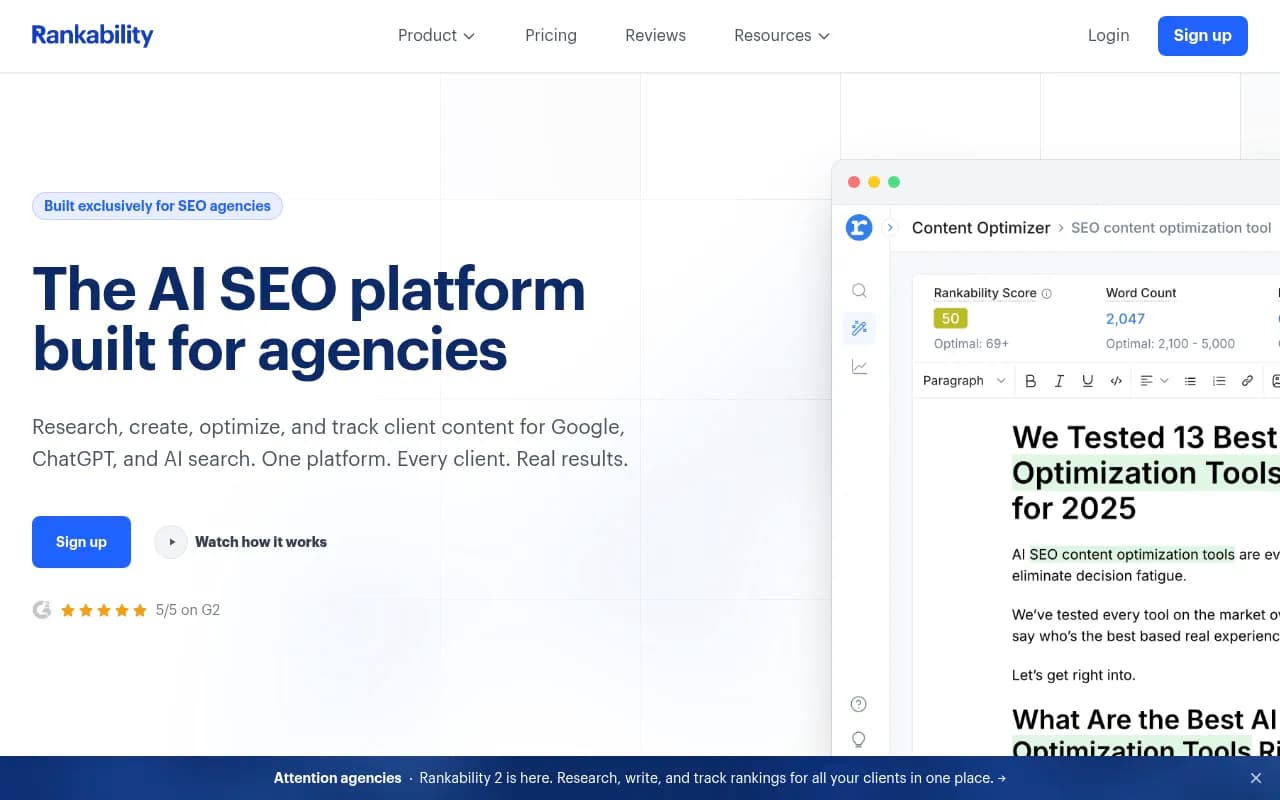
Rankability is built with agency workflows in mind, with multi-client management and reporting features that Searchable never had.
A quick comparison of the main alternatives
| Tool | Best for | Content generation | Crawler logs | Price range |
|---|---|---|---|---|
| Promptwatch | Full GEO optimization | Yes | Yes | $99-$579/mo |
| Otterly.AI | Budget monitoring | No | No | Low |
| Peec AI | Multi-language tracking | No | No | Mid |
| AthenaHQ | Enterprise monitoring | No | No | Enterprise |
| Profound | Enterprise optimization | Limited | No | Enterprise |
| Rankability | Agency reporting | No | No | Mid-enterprise |
| Searchable | Basic monitoring | No | No | Low-mid |
The broader context: what changed in AI search in 2025
Searchable's limitations weren't just about the product. They also reflected how fast the category moved.
At the start of 2025, most brands were still asking "should we care about AI search?" By the end of the year, the question had shifted to "how do we actually rank in it?" That's a fundamentally different problem. Monitoring tools built for the first question weren't equipped for the second.
AI models got more sophisticated about citation. They started pulling from a wider range of sources, including Reddit threads, YouTube transcripts, and niche publications. They developed stronger preferences for structured, authoritative content over thin pages. And they started powering more of the search experience directly, with Google's AI Overviews taking up more real estate in standard search results.
Teams that treated AI visibility as a passive monitoring exercise fell behind. The ones that treated it as an active content optimization channel, with the same rigor they'd apply to traditional SEO, pulled ahead.
Searchable was built for the monitoring phase. The market moved to the optimization phase.
Should you still use Searchable?
If you're a small team or solo marketer who just needs a basic read on whether your brand shows up in AI responses, Searchable might still be enough. The low friction and readable dashboards are real advantages if you're not ready to invest in a full GEO platform.
But if you're past the "let's see what's happening" stage and into "let's actually improve our AI visibility," you'll hit Searchable's ceiling quickly. The absence of content tooling, crawler logs, and prompt intelligence means you'll end up doing a lot of manual work that better platforms handle automatically.
The honest version: Searchable was a reasonable tool for 2024. By 2025, the category had moved on, and the gap between what it offered and what teams actually needed had grown too wide for most to ignore.
For teams serious about AI search visibility as a growth channel, the move is to a platform that doesn't just tell you where you stand but helps you change it.