Key takeaways
- Monitoring-only platforms (Searchable, Otterly.AI, Peec.ai) show you where you're invisible in AI search but give you no tools to fix it
- Teams that buy a tracker without a content system to act on the data typically see flat dashboards for months before churning
- The gap between "knowing you're invisible" and "becoming visible" requires content gap analysis, AI-optimized content creation, and citation tracking -- capabilities most trackers skip entirely
- AI search is no longer optional: 60% of B2B buyers now use ChatGPT, Perplexity, or Gemini to build vendor shortlists before any direct engagement
- Platforms that close the full loop -- find gaps, create content, track results -- produce measurably different outcomes than monitoring-only tools
There's a pattern playing out across marketing teams right now. Someone reads about AI search visibility, signs up for a monitoring tool, watches their "share of voice" score sit at 12% for three months, and then... nothing changes. The dashboard keeps refreshing. The score doesn't move. The team doesn't know what to do next.
This is the monitoring-only trap, and it's where a lot of teams are stuck in 2026.
The tools aren't broken. Searchable, Otterly.AI, and Peec.ai all do what they say they do: they query AI engines, log whether your brand appears, and show you a score. The problem is that knowing your score and improving your score are two completely different problems. Most of these platforms solve the first one and leave you entirely alone with the second.
Why AI search visibility actually matters now
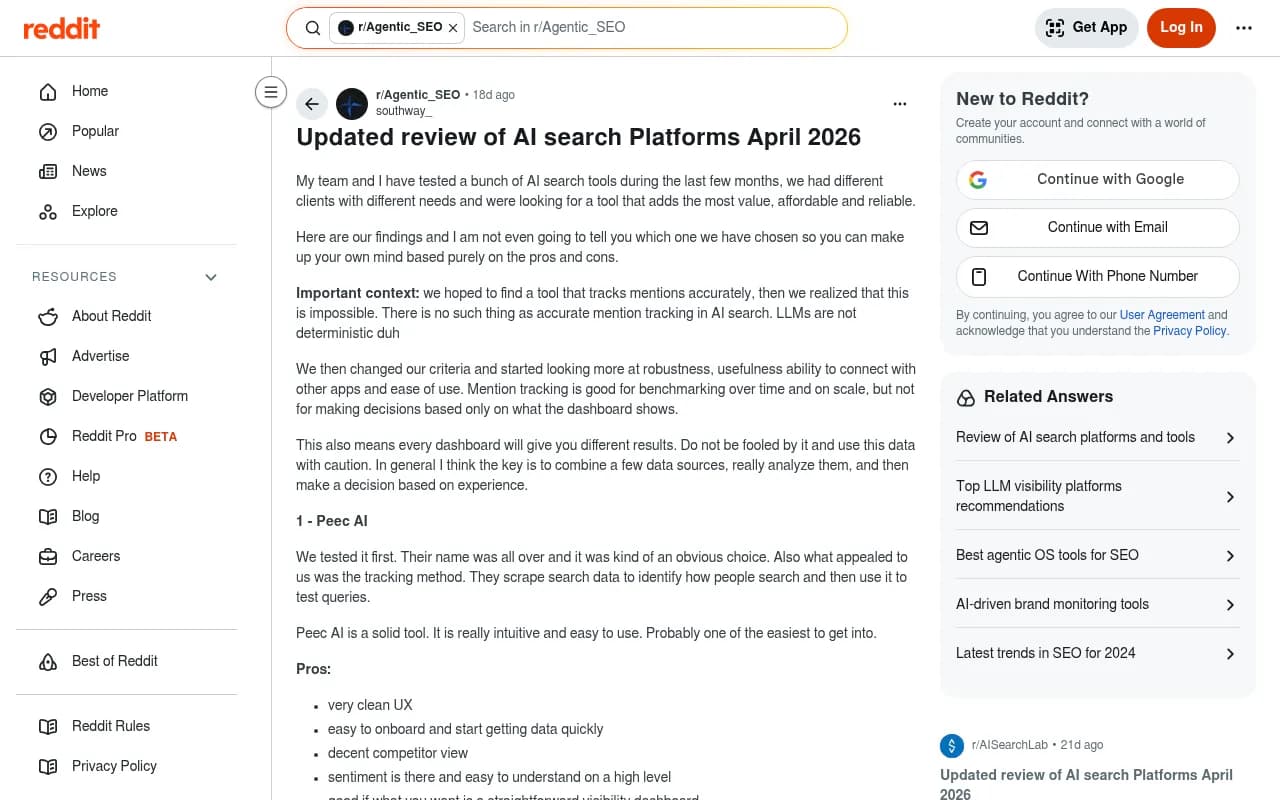
Before getting into the tools, it's worth being concrete about why this category exists at all.
Organic click-through rates have dropped 61% on queries where Google AI Overviews appear, according to Seer Interactive's analysis of 25.1 million impressions. Zero-click searches hit an estimated 93% in Google's AI Mode. Meanwhile, AI-referred visitors convert at significantly higher rates than traditional organic visitors -- making the fast-growing volume of AI referrals disproportionately valuable even at lower volumes.
The research from Averi AI's 2026 tracker review puts it plainly: 60% of B2B buyers now use ChatGPT, Perplexity, or Gemini to augment vendor lists before any vendor engagement. If you're not in those answers, you're not on the shortlist.
So the stakes are real. The question is whether the tools teams are buying are actually helping them compete -- or just helping them watch themselves lose.
What monitoring-only tools actually give you
Let's be fair about what Searchable, Otterly.AI, and Peec.ai do well before explaining where they fall short.
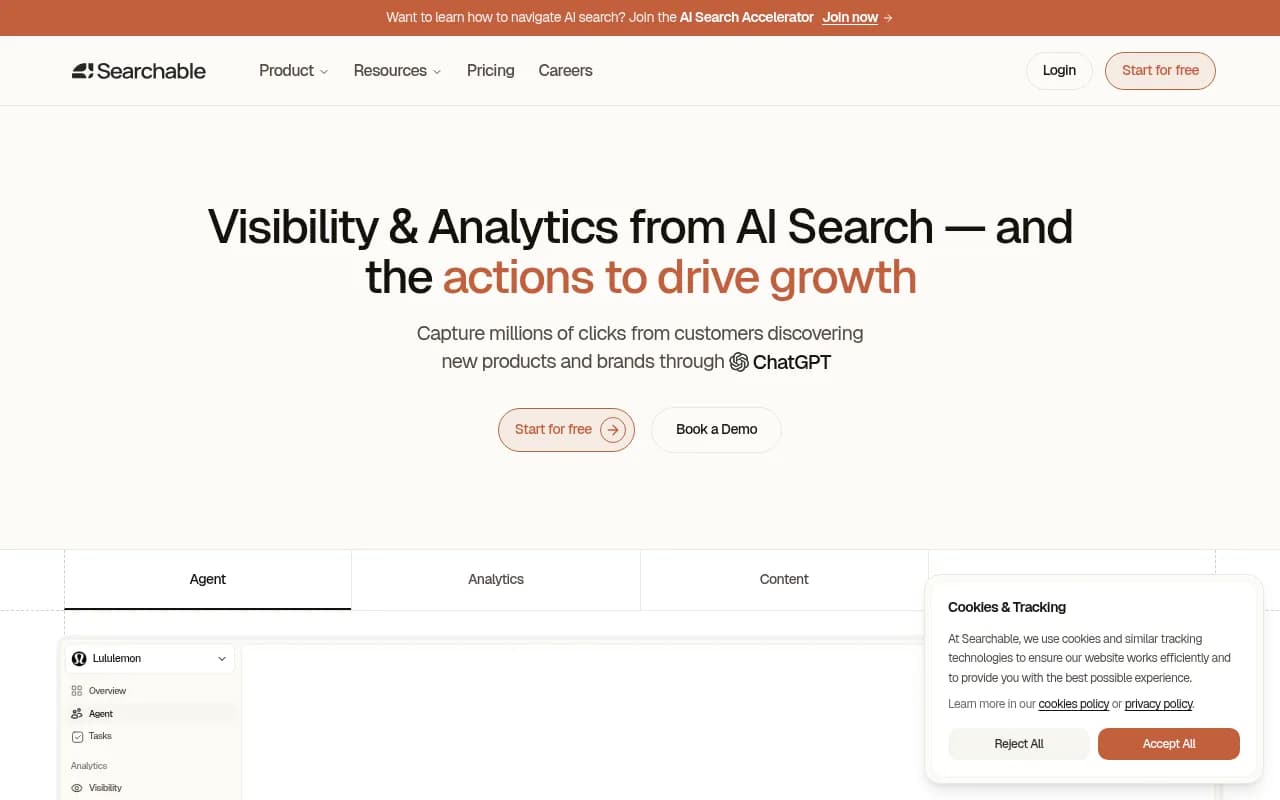


All three tools share a similar core loop:
- You enter a set of prompts relevant to your category
- The platform queries AI engines (ChatGPT, Perplexity, Gemini, etc.) on a recurring schedule
- It logs whether your brand appears in the response
- You get a share-of-voice score, trend lines, and competitor comparisons
Otterly.AI has a reputation for being operationally clean -- the interface is straightforward, the data is easy to read, and it covers a reasonable range of AI models. One practitioner on r/Agentic_SEO described it as "a bit more operational than Peec -- not in the sense that it does the work for you, but in the sense that it gives you clearer signals." That's a fair characterization.
Peec.ai covers multiple languages and markets, which matters for international teams. It's clean, it's fast to set up, and it gives you a reasonable snapshot of where you stand.
Searchable sits in a similar lane -- AI search visibility monitoring with a focus on making the data accessible without a steep learning curve.
The problem isn't that these tools are bad. It's that they stop at the point where the real work begins.
Where the monitoring-only model breaks down
Here's the honest version of what happens after you've been using a monitoring-only tool for a few weeks:
You know your share of voice is 18%. You know your main competitor is at 34%. You can see which prompts you're missing. And then you open a blank Google Doc and have absolutely no idea what to write.
The ZipTie.dev analysis of multi-model AI visibility tools in 2026 describes Peec specifically as "a monitoring-only platform with no content optimization capabilities -- it shows you where you stand but provides no guidance on what to do about it." That's not a knock on Peec's execution. It's a description of what the product is designed to do.
The same pattern applies to Otterly.AI and Searchable. They're dashboards. Good dashboards, in some cases. But dashboards don't write content, don't tell you which specific topics are missing from your site, and don't help you understand why a competitor is getting cited while you aren't.
The Averi AI review makes the point bluntly: "Brands that buy a tracker without a content engine to act on the data typically watch flat dashboards for 6 months and churn."
That's not a prediction. That's a pattern they observed across teams.
The gap between data and action
What actually moves AI visibility scores? The research is fairly consistent:
- Long-form, schema-rich, FAQ-dense content that directly answers the questions AI models are fielding
- Pages updated within the last year (which make up roughly 70% of AI-cited pages, per AirOps' AI Search Playbook)
- Reddit and community presence (accounting for about 21% of Google AI Overview citations, according to Profound's citation pattern research)
- Specific topical coverage that matches the exact angles competitors are being cited for
None of this is mysterious. The problem is that knowing these principles and knowing which specific content to create for your specific brand in your specific category are different things. That's where monitoring-only tools leave you stranded.
You can see that a competitor appears for "best project management software for remote teams" and you don't. But you can't see what's on their site that earned that citation. You can't see the full universe of prompts you're missing. You can't generate a content brief that's grounded in actual citation data. You just... know you're losing.
The comparison: monitoring vs. optimization platforms
Here's how the monitoring-only tools stack up against platforms built around the full optimization loop:
| Platform | Model coverage | Content gap analysis | AI content generation | Crawler logs | Citation analysis | Reddit/YouTube tracking | Traffic attribution |
|---|---|---|---|---|---|---|---|
| Otterly.AI | 5-6 models | No | No | No | Basic | No | No |
| Peec.ai | Multi-language | No | No | No | Basic | No | No |
| Searchable | Limited | No | No | No | Basic | No | No |
| Profound | 6+ models | Partial | No | No | Yes | No | No |
| AthenaHQ | 8+ models | Partial | No | No | Yes | No | No |
| Promptwatch | 10+ models | Yes | Yes | Yes | Yes (880M+ citations) | Yes | Yes |

The table tells the story. Monitoring-only tools cover the first column well. The columns that actually connect to revenue -- content gap analysis, content generation, traffic attribution -- are blank.
What the full optimization loop looks like
The teams that are actually improving their AI visibility aren't just tracking. They're running a cycle:
- Find the specific prompts where competitors appear and they don't
- Understand what content is missing from their site that would earn those citations
- Create content engineered to be cited -- not generic SEO filler, but articles and comparisons grounded in real citation data
- Track whether that content starts getting cited, and by which models
- Connect those citations to actual traffic and revenue
This is the difference between a monitoring tool and an optimization platform. Monitoring tools handle step 4 (partially). The full loop requires all five steps.
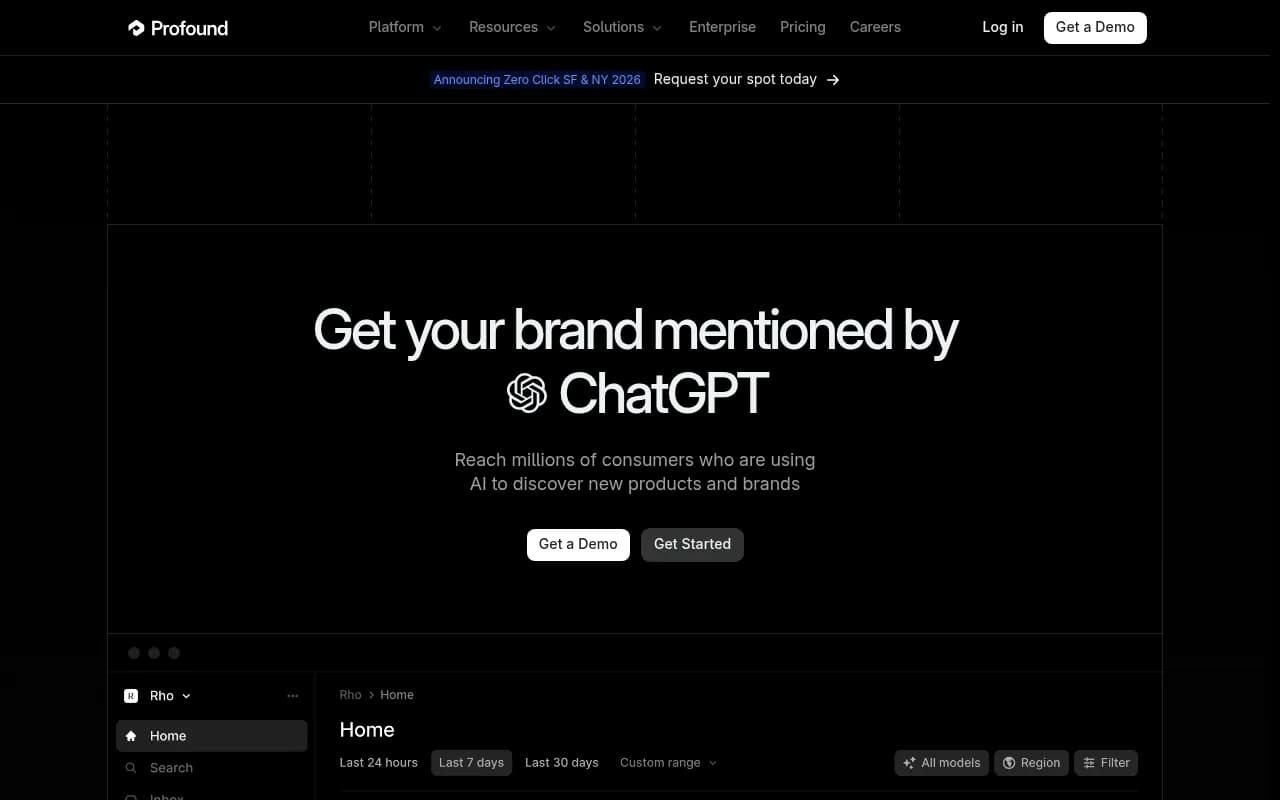
Platforms like Profound and AthenaHQ go further than the pure monitoring tools -- they have stronger citation analysis and some competitive intelligence features. But even they tend to stop short of step 3: actually generating the content.

The gap is meaningful. Knowing you need content about "enterprise project management for distributed teams" is not the same as having a 2,000-word article grounded in the specific angles AI models want to cite, structured the way AI models prefer to pull from, and published in a format that gets indexed by AI crawlers quickly.
Why teams keep buying monitoring-only tools anyway
It's worth being honest about why this keeps happening. Monitoring tools are easier to sell.
The value proposition is immediate and tangible: "See how often ChatGPT mentions your brand." You can demo that in five minutes. The score goes up or down. It feels like measurement.
The harder sell is: "We'll show you what's missing, help you create content to fill those gaps, and then track whether it worked." That's a longer sales cycle, a bigger commitment, and a more complex product.
But the teams that are actually winning in AI search in 2026 are the ones who made the harder investment. The monitoring-only approach produces data. The optimization approach produces results.
One practitioner on r/DigitalMarketing described what actually useful AI visibility tracking looks like: "Not 'your score is 23%' but 'you showed up in 8 out of 50 prompts this month, up from 3 last month, and here's which competitors are showing up instead.' That's an actual signal. The other thing that's actually actionable is just seeing what your competitors are doing differently when they DO get cited. That gap tells you something real about content structure."
That's the right frame. The score is a lagging indicator. The gap analysis is where the work starts.
What to look for in a platform that actually moves the needle
If you're evaluating AI visibility tools right now, here are the questions worth asking:
Does it show you the specific prompts you're missing? Not just your overall share of voice, but the exact questions where competitors appear and you don't. This is answer gap analysis, and it's the foundation of any actionable strategy.
Does it tell you why competitors are getting cited? Understanding which pages, which content structures, and which topics are driving citations is more valuable than knowing the citation count.
Does it help you create content, or just identify gaps? There's a big difference between a tool that says "you're missing coverage of X" and one that helps you produce content about X that's engineered to earn citations.
Does it track AI crawlers on your site? Knowing when ChatGPT or Perplexity's crawlers visit your pages, which pages they read, and whether they encounter errors is genuinely useful for understanding how AI models discover and index your content. Most monitoring-only tools don't touch this.
Can it connect visibility to revenue? Share of voice is nice. Knowing that your AI visibility improvements drove a 15% increase in organic traffic from AI sources is better.
Platforms like Promptwatch are built around this full loop -- from identifying gaps to generating content to tracking results and attributing traffic. It's a different product category than Otterly.AI or Peec.ai, even if they all get described as "AI visibility tools."
The right way to use monitoring-only tools
To be clear: if you're using Otterly.AI, Peec.ai, or Searchable, you're not doing something wrong. Monitoring is a legitimate first step. Knowing where you stand is genuinely useful.
The mistake is treating the monitor as the strategy. These tools are good at telling you the score. They're not built to help you change it.
If you're going to use a monitoring-only tool, pair it with a content system. Use the visibility data to identify which topics need coverage, then build a process for creating and publishing content that addresses those gaps. The monitoring tool becomes an input to a content strategy, not the strategy itself.
The teams that are stuck are the ones who bought the monitor and waited for the score to improve. It doesn't work that way. The score improves when you create content that AI models want to cite -- and that requires more than a dashboard.
The bottom line
The monitoring-only trap is real, and it's costing teams time and budget in 2026. Searchable, Otterly.AI, and Peec.ai are competent tools for what they do. What they do just isn't enough.
AI search visibility is a content problem. You're invisible because AI models can't find authoritative, well-structured answers to relevant questions on your site. No amount of monitoring fixes that. Only content does.
The tools worth investing in are the ones that help you find the gaps, fill them with content that actually earns citations, and track whether it worked. That's the full loop. Everything else is just watching the scoreboard.