Key takeaways
- Searchable is useful for quick AI answer exploration, but it monitors a limited set of AI models and doesn't help you act on what you find.
- The best alternatives in 2026 cover 8-10+ AI models (ChatGPT, Claude, Perplexity, Gemini, Grok, DeepSeek, and more) and pair monitoring with content optimization.
- If you want to close the loop from visibility gap to published content to traffic attribution, you need a platform built around execution, not just dashboards.
- Budget options exist from around $10-49/month; serious teams typically land in the $99-579/month range depending on scale.
- The right tool depends on whether you need monitoring only, content generation, agency workflows, or enterprise-grade analytics.
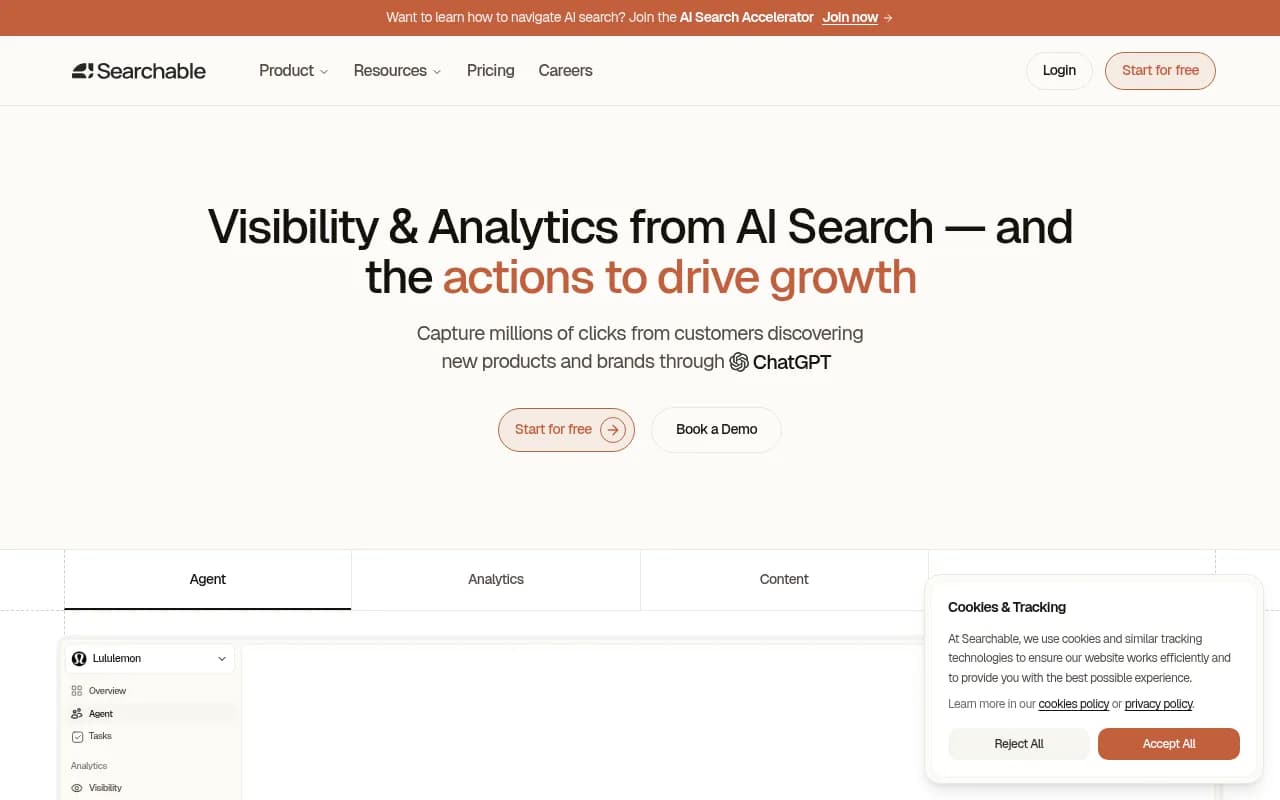
Searchable has a clear use case: you can explore how AI engines answer questions in your category and get a rough sense of where your brand shows up. For early-stage experimentation, that's fine.
But teams that have moved past the "let's see what ChatGPT says about us" phase tend to hit the same walls. Coverage is thin across newer models. There's no clear path from "we're invisible here" to "here's the content that fixes it." And the entry-level pricing restricts how many prompts you can actually track.
So if you're looking for something that covers more ground, here are nine alternatives worth considering in 2026.
What to look for in a Searchable alternative
Before jumping into the list, it's worth being clear about what "covers more AI models" actually means in practice.
Most tools in this space launched tracking ChatGPT and Perplexity, then added Google AI Overviews. The better platforms now cover Claude, Gemini, Grok, DeepSeek, Meta AI, Copilot, and Mistral too. That matters because your brand's visibility isn't uniform across models -- you might rank well in Perplexity responses but be completely absent from Claude's answers on the same topic.
Beyond model coverage, the other things worth evaluating:
- Can it show you which specific prompts your competitors are visible for but you're not?
- Does it help you create content to close those gaps, or just show you the data?
- Can you track which pages are getting cited, and connect that to actual traffic?
- Does it surface where AI models are pulling citations from (Reddit threads, YouTube, specific domains)?
With that in mind, here's the breakdown.
The 9 best Searchable alternatives in 2026
1. Promptwatch -- best for teams that want to monitor and fix visibility gaps
Promptwatch is the most complete option on this list if your goal is to actually improve your AI visibility, not just measure it. It monitors 10 AI models (ChatGPT, Perplexity, Claude, Gemini, Grok, DeepSeek, Google AI Overviews, Google AI Mode, Copilot, and Mistral) and pairs that monitoring with tools to act on what you find.
The part that separates it from most alternatives is the content generation layer. Once you've identified which prompts competitors are visible for and you're not, the built-in AI writing agent generates articles and comparisons grounded in real citation data. It's not generic content -- it's built around what AI models actually cite. Then you can track whether those new pages start getting cited, and connect that back to traffic through a code snippet, GSC integration, or server log analysis.
It also has AI crawler logs, which show you in real time which pages ChatGPT, Claude, and Perplexity are crawling on your site, how often, and what errors they're hitting. Most competitors don't have this at all.
Pricing starts at $99/month for one site and 50 prompts. Professional is $249/month (150 prompts, crawler logs, city-level tracking). Business is $579/month for five sites and 350 prompts. Free trial available.

2. Otterly.AI -- best for brand monitoring and sentiment tracking
Otterly focuses on brand monitoring across AI engines with a clean interface that's easy to get started with. It covers ChatGPT, Perplexity, Claude, and Google AI Overviews, and does a decent job of tracking sentiment and how your brand is described in AI responses over time.
It's a solid choice for brand and PR teams that care more about how they're being talked about than where they rank for specific queries. The GEO optimization layer is there but fairly lightweight -- you get monitoring and alerts more than a full content workflow.

3. Peec AI -- best for multilingual and multi-region coverage
If your brand operates across multiple languages or regions, Peec AI is one of the few tools that handles this well. It tracks AI visibility in different languages and lets you compare how your brand appears in AI responses across markets.
The prompt-level analytics are solid -- you can see which specific questions are driving visibility for competitors in different regions. It's more of a data and analytics tool than an execution platform, but for global teams that need to understand the full picture, it fills a real gap.

4. Profound -- best for enterprise teams with complex tracking needs
Profound is the enterprise end of this market. It covers multiple AI models and regions, has strong AI crawler analysis, and goes deep on conversation-level data. The pricing reflects that -- starting around $499/month and going up significantly for larger deployments.
For teams at large brands or agencies managing multiple clients with serious budgets, Profound has the depth to match. For everyone else, it's probably more platform than you need.

5. AthenaHQ -- best for GEO-focused enterprise teams
AthenaHQ positions itself as a full GEO platform with AI visibility tracking, automation, and some revenue attribution capabilities. It covers a good range of AI models and has solid competitive analysis features.
The focus is more on monitoring and strategy than on content generation. If your team has writers and just needs the data to direct them, AthenaHQ works well. If you want the platform to help generate the content too, it falls short of what Promptwatch offers.

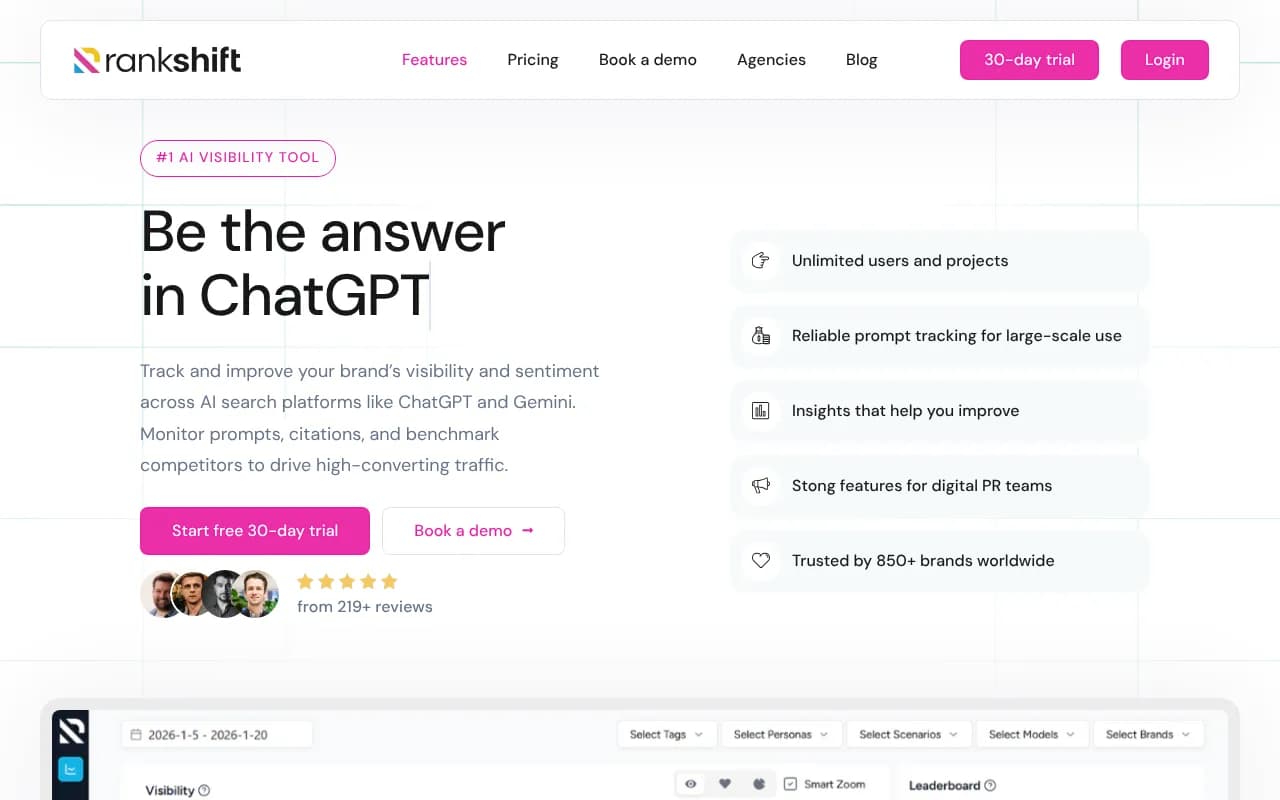
6. Rankshift -- best affordable option for clean, focused tracking
Rankshift is a leaner tool that does one thing well: tracking your AI visibility across a handful of models with a clean, easy-to-read interface. It's more affordable than most platforms on this list and doesn't try to be everything.
If you're an individual SEO or a small team that just wants to know where you stand across ChatGPT and Perplexity without a complex setup, Rankshift is worth a look. Don't expect deep content gap analysis or crawler logs -- it's monitoring, cleanly done.
7. Airefs -- best budget option for opportunity discovery
Airefs comes in at around $24/month, which undercuts most of the market significantly. For that price, you get AI search visibility tracking and some opportunity discovery features that help you identify which prompts are worth targeting.
The depth isn't there compared to mid-tier tools, but for solo operators or early-stage teams that want to start tracking AI visibility without a major budget commitment, it's a reasonable starting point.
8. SE Ranking -- best for teams already using a full SEO suite
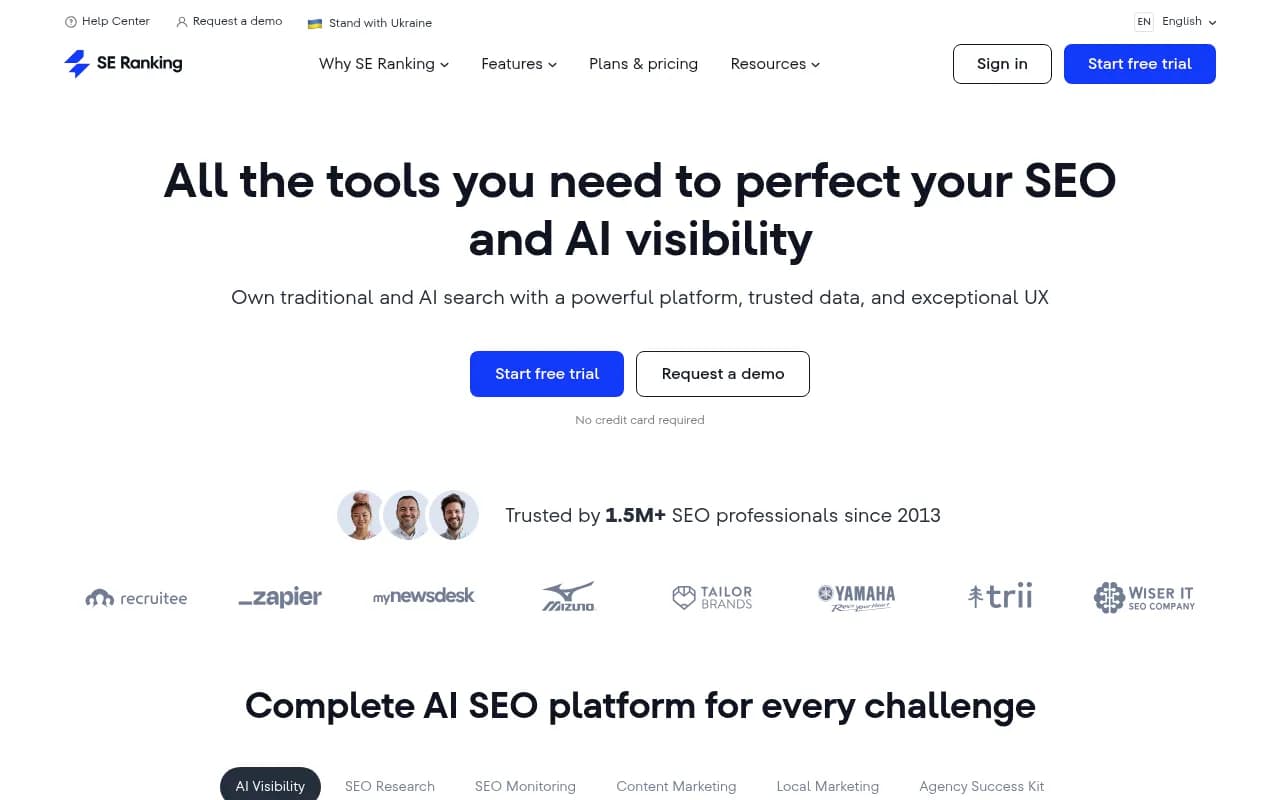
SE Ranking has been building out its AI visibility features alongside its traditional SEO toolkit. If your team already uses SE Ranking for rank tracking, site audits, and keyword research, the AI visibility add-ons let you extend your existing workflow without adopting a new platform.
The AI coverage isn't as broad as dedicated GEO tools, but the integration with traditional SEO data is genuinely useful. Seeing your traditional rankings and AI visibility side by side in one place has real value for teams managing both.
9. Semrush -- best for teams that want AI visibility layered into existing SEO work
Semrush has added AI visibility features to its platform, though the approach is different from dedicated GEO tools. The prompts are more fixed and the AI-specific tracking is less granular than what you'd get from a purpose-built platform.
That said, Semrush's strength is the breadth of its SEO data. If you're already paying for Semrush and want a basic read on AI visibility without adding another tool, the built-in features are worth exploring. Just don't expect the same depth as a dedicated platform.
How these tools compare
Here's a side-by-side view of the key dimensions that matter when choosing between these alternatives:
| Tool | AI models covered | Content generation | Crawler logs | Starting price | Best for |
|---|---|---|---|---|---|
| Promptwatch | 10 (ChatGPT, Claude, Perplexity, Gemini, Grok, DeepSeek, Copilot, Mistral, Google AI Overviews, Google AI Mode) | Yes (built-in AI writer) | Yes | $99/mo | Full optimization loop: monitor, create, track |
| Otterly.AI | 4 (ChatGPT, Perplexity, Claude, AI Overviews) | No | No | ~$49/mo | Brand monitoring and sentiment |
| Peec AI | Multi-model, multi-language | No | No | Custom | Global brands, multilingual tracking |
| Profound | Multi-model, enterprise | Limited | Yes | $499+/mo | Enterprise AI visibility intelligence |
| AthenaHQ | 8+ models | No | No | Custom | Enterprise GEO strategy |
| Rankshift | 3-4 models | No | No | ~$29/mo | Affordable, clean monitoring |
| Airefs | 2-3 models | No | No | $24/mo | Budget entry-level tracking |
| SE Ranking | Google AI Overviews + select LLMs | No | No | $65/mo | Teams already using SE Ranking |
| Semrush | Limited AI features | No | No | $199/mo | Teams already using Semrush |
The pattern is clear: most tools stop at monitoring. They show you where you're invisible but leave you to figure out what to do next. Promptwatch is the outlier here -- it's built around the full loop from gap identification through content creation to traffic attribution.
How to choose the right one
The honest answer is that it depends on what stage you're at and what you actually need.
If you're just starting to understand AI visibility and want to explore without spending much, Airefs or Rankshift give you a low-cost entry point. You'll get a basic read on where you stand.
If you're at a global brand tracking visibility across languages and regions, Peec AI's multilingual capabilities are hard to match at the mid-market level.
If you're at an enterprise with a serious budget and need deep crawler analysis and multi-region tracking, Profound or AthenaHQ are worth evaluating.
If you're a marketing or SEO team that wants to actually move the needle -- find the gaps, create content that gets cited, and track whether it's working -- Promptwatch is the most complete option. The combination of 10-model coverage, answer gap analysis, built-in content generation, and AI crawler logs is genuinely difficult to replicate by stitching together other tools.
The one thing worth being clear about: no tool can guarantee that AI models will cite your content. What these platforms do is help you understand what AI models are citing and why, so you can create content that fits those patterns. That's a meaningful advantage over guessing.
A note on model coverage specifically
The original question in this guide is about covering more AI models. It's worth being direct about what that means in practice.
Searchable's model coverage has been limited relative to what the market now offers. Tools like Promptwatch and Profound track 8-10 models. That matters because the AI search landscape isn't monolithic -- a user asking Claude for software recommendations gets different results than the same query in Perplexity or ChatGPT. If you're only tracking one or two models, you're missing a significant portion of the AI-driven discovery happening in your category.
The models worth tracking in 2026, at minimum: ChatGPT, Perplexity, Claude, Gemini, and Google AI Overviews. Grok, DeepSeek, and Copilot are worth adding if your audience skews toward power users or specific platforms. The tools that cover all of these give you a much more accurate picture of your actual AI visibility.
Final thoughts
Searchable isn't a bad tool -- it's just narrow. For teams that have moved beyond basic exploration and want to understand their AI visibility across the full range of models that matter, and then actually do something about the gaps they find, the alternatives above cover more ground.
The tools that will matter most in 2026 are the ones that connect monitoring to action. Data without a path to improvement is just a dashboard you check and feel vaguely anxious about.