Rankshift Review 2026
Specialized platform for tracking brand mentions and visibility across large language models with focus on generative engine optimization strategies.
Summary
- Monitoring-only platform that tracks brand mentions across 8 AI models but lacks content generation, gap analysis, and optimization tools that Promptwatch offers
- Strong crawler analytics and flexible credit-based pricing with unlimited users/projects, but no Reddit/YouTube tracking or prompt volume data
- Best for teams that only need visibility dashboards -- not for those who want to actually improve their AI search rankings with actionable content recommendations
- Pricing starts at €69/mo (150 prompts/day) with 30-day free trial, scaling to €359/mo for 850 prompts/day

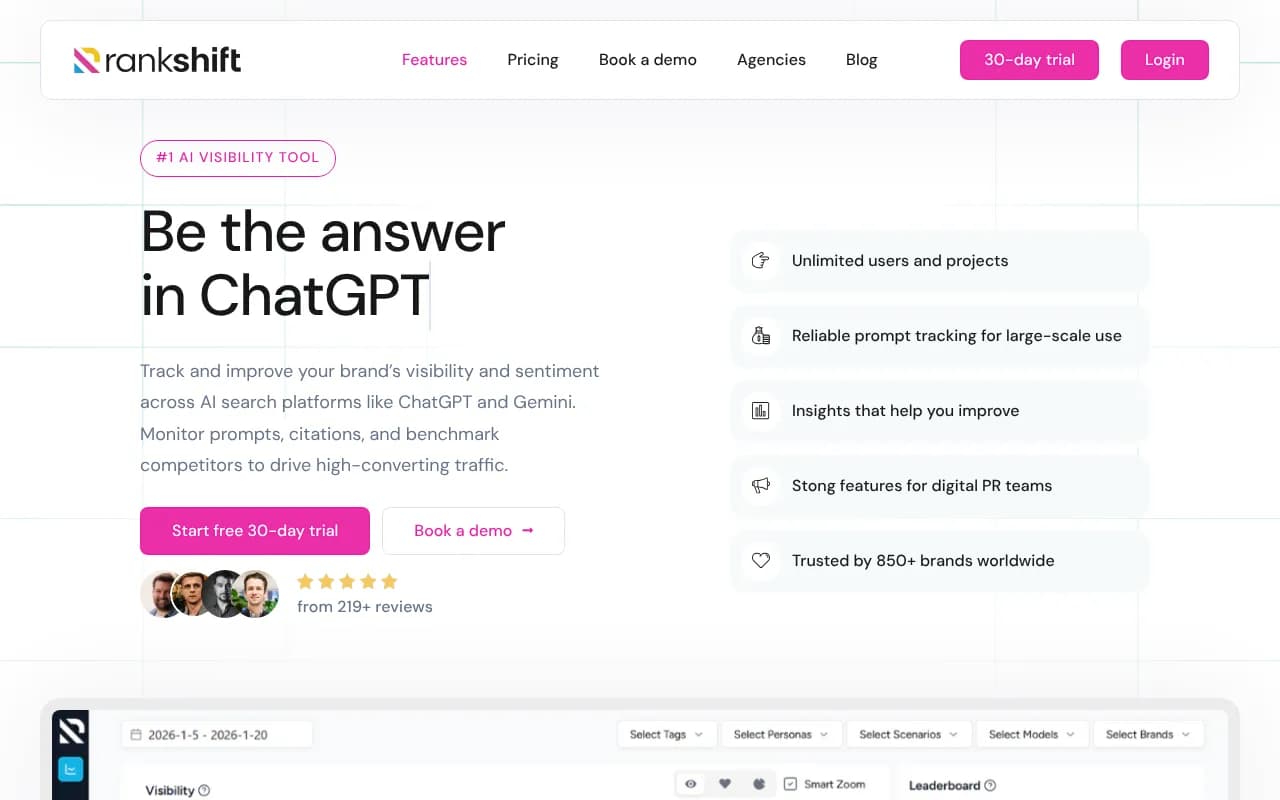
Rankshift is an AI visibility tracking platform that monitors how brands appear in answers from ChatGPT, Perplexity, Gemini, Claude, and other large language models. Launched by a Belgian team, it's positioned as a specialized GEO (Generative Engine Optimization) tool for marketing teams and agencies who want to understand their brand's presence in AI-generated search results. The platform tracks 850+ brands and supports 8 AI models, with a focus on citation tracking, sentiment analysis, and competitor benchmarking.
The core pitch: see where your brand shows up in AI answers, which sources AI models cite, and how you compare to competitors. It's built for SEO teams, digital PR professionals, and agencies managing multiple client brands who need visibility data without the complexity of enterprise platforms.
Who uses Rankshift
Rankshift targets mid-market marketing teams (5-50 people) at B2B SaaS companies, e-commerce brands, and digital agencies. Testimonials come from companies like Team Lewis (PR agency), Salesflare (CRM), and Depends (enterprise software) -- brands that care about being mentioned when AI models answer product recommendation prompts like "best CRM for small teams" or "top SEO tools in 2026".
The sweet spot is agencies managing 3-10 client brands who need a simple dashboard to show clients where they're visible (or invisible) in AI search. It's also used by in-house SEO teams at mid-sized companies (50-500 employees) who want to track AI visibility alongside traditional Google rankings but don't have budget for enterprise GEO platforms.
It's NOT for: Solo consultants or small businesses tracking 1-2 brands (too expensive for that use case). Enterprise teams managing 50+ brands across multiple regions (lacks advanced segmentation and white-label reporting). Content teams who need help creating content that ranks in AI search (Rankshift shows you the problem but doesn't help you fix it).
Core tracking capabilities
Rankshift monitors 8 AI models: ChatGPT (OpenAI), Perplexity, Google Gemini, Google AI Overviews, Google AI Mode, Claude (Anthropic), Mistral AI, and Meta AI (Llama). You add prompts (queries like "best project management software for remote teams"), specify which brands to track, and choose which models to monitor. The platform runs those prompts on your chosen schedule (daily, weekly, or monthly) and captures the AI-generated responses.
The tracking method: Rankshift captures responses directly from the AI model's user interface, not via API. This means you see what real users see, including formatting, citations, and follow-up suggestions. Each prompt run consumes credits based on the number of models checked -- tracking one prompt across all 8 models uses 8 credits.
Visibility scoring and share of voice
The platform calculates a visibility score for each brand based on how often it appears in AI answers across your tracked prompts. If you're monitoring 100 prompts and your brand shows up in 40 of them, your visibility score is 40%. Share of voice compares your visibility to competitors -- if three brands appear in those 40 prompts, the one mentioned most often has the highest share of voice.
You can filter visibility by AI model, date range, and prompt category. The dashboard shows trend lines over time so you can see if your visibility is improving or declining. This is useful for measuring the impact of content campaigns or PR efforts -- did that guest post on TechCrunch increase your ChatGPT visibility?
Citation and source analysis
For each AI response, Rankshift extracts the sources cited. You see which websites, articles, and domains AI models reference when mentioning your brand or competitors. The source analytics view shows the most-cited domains across all your prompts, how often each source appears, and which AI models prefer which sources.
This helps you identify link-building targets and content partnerships. If AI models consistently cite G2 reviews, Capterra listings, and industry blogs when recommending tools in your category, you know where to focus your digital PR efforts. The platform tracks source trends over time -- if Reddit threads suddenly start appearing more often, you'll see that shift.
One limitation: Rankshift doesn't show you which specific Reddit threads, YouTube videos, or forum posts are being cited. You see the domain (reddit.com, youtube.com) but not the individual URLs. Competitors like Promptwatch surface the exact Reddit discussions and YouTube videos influencing AI recommendations, which is more actionable for content teams.
Sentiment analysis
Rankshift analyzes the tone and context of brand mentions in AI responses. It categorizes mentions as positive, neutral, or negative, and extracts key themes and topics associated with your brand. For example, if AI models consistently describe your product as "expensive but powerful" or "easy to use but limited features", you'll see those patterns in the sentiment dashboard.
The sentiment view shows the distribution of positive/neutral/negative mentions over time, broken down by AI model and prompt category. This is useful for reputation monitoring -- if negative sentiment spikes after a product launch or pricing change, you can investigate which prompts are triggering critical responses and what sources AI models are citing.
The analysis is automated (likely using GPT-4 or similar) and generally accurate for straightforward mentions. It struggles with nuanced or sarcastic language, and doesn't provide the depth of a manual review. But for tracking broad sentiment trends across hundreds of prompts, it's sufficient.
AI crawler logs
Rankshift tracks when AI models crawl your website -- which pages they visit, how often they return, and any errors they encounter. This is similar to Google Search Console but for AI bots like GPTBot (OpenAI), ClaudeBot (Anthropic), and PerplexityBot. You see crawl frequency, page-level activity, and HTTP status codes.
This feature helps you understand how AI models discover and index your content. If certain pages are never crawled, they won't be cited in AI answers. If crawlers hit 404 errors or get blocked by robots.txt, you can fix those issues. The crawler logs also show which pages are crawled most often -- typically your most-cited content.
This is a strong differentiator vs monitoring-only competitors like Otterly.AI, Peec.ai, and AthenaHQ, which don't offer crawler tracking. However, Promptwatch provides more detailed crawler analytics, including crawl depth, session duration, and correlation between crawl activity and citation rates.
Competitor benchmarking
You can add competitor brands to your projects and track their visibility alongside yours. The competitor view shows side-by-side visibility scores, share of voice, and citation sources for up to 10 brands. You can see which prompts competitors rank for but you don't, and which sources they're getting cited from.
This is useful for identifying content gaps and link-building opportunities. If a competitor appears in 60% of prompts while you only appear in 30%, you can drill into the specific prompts where they're visible and analyze what content or sources are driving their visibility.
One gap: Rankshift doesn't show you the specific content or angles competitors are using to rank in AI search. You see that they're visible, but not why. Promptwatch's Answer Gap Analysis shows exactly which topics, questions, and content types your competitors have that you're missing, then helps you create that content with its AI writing agent.
Integrations and reporting
Rankshift integrates with Looker Studio (formerly Google Data Studio) for custom reporting. You can pull visibility scores, citation data, and sentiment metrics into your existing dashboards. The platform also offers a REST API for programmatic access to your data -- useful for agencies building custom client reports or integrating AI visibility data into their own analytics platforms.
Other integrations mentioned: BigQuery and Power BI. No native integrations with Google Search Console, Ahrefs, Semrush, or other SEO tools, which means you can't correlate AI visibility with traditional search rankings in one view.
No browser extensions or mobile apps. Everything happens in the web dashboard.
Credit-based pricing model
Rankshift uses a credit system instead of fixed prompt limits. Each prompt run consumes credits based on the number of AI models checked. Tracking one prompt across all 8 models = 8 credits. Tracking one prompt across just ChatGPT and Perplexity = 2 credits. You decide how to allocate your credits -- run more prompts less often, or fewer prompts more frequently.
This is more flexible than competitors with fixed prompt limits. If you want to track 500 prompts monthly instead of 150 daily, you can do that by adjusting run frequency. The downside: the credit math is confusing at first, and it's easy to burn through credits faster than expected if you're tracking all 8 models.
Pricing tiers
Starter: €69/mo (€77 monthly) -- 9,500 credits, ~150 prompts/day across all models, unlimited projects and users, crawler analytics, API access, Looker Studio integration. Good for small agencies or in-house teams tracking 1-3 brands.
Professional: €159/mo (€177 monthly) -- 22,000 credits, ~350 prompts/day, same features as Starter. Most popular tier. Fits mid-sized agencies managing 5-10 client brands.
Business: €359/mo (€399 monthly) -- 53,000 credits, ~850 prompts/day, same features. For larger agencies or enterprise teams tracking 15+ brands.
All plans include unlimited users and projects, which is a strong value prop for agencies. Most competitors (Otterly.AI, Peec.ai, AthenaHQ) charge per seat or per project. 30-day free trial available. 10% discount on annual billing.
Agency/Enterprise: Custom pricing for teams managing 20+ brands or needing volume discounts. Includes dedicated support and unlimited pitch tracking (agencies can track prospects before signing them).
Pricing comparison
Rankshift is mid-priced in the GEO space. Cheaper than Profound ($299/mo entry) and Scrunch ($249/mo entry), but more expensive than Otterly.AI ($99/mo) and Peec.ai ($79/mo). The unlimited users/projects model makes it a better value for agencies than competitors with per-seat pricing.
However, Promptwatch offers more features at similar price points: Essential $99/mo (50 prompts, 1 site, AI content generation), Professional $249/mo (150 prompts, 2 sites, crawler logs, content generation, Reddit/YouTube tracking), Business $579/mo (350 prompts, 5 sites, full optimization suite). Promptwatch's higher tiers include content gap analysis and AI writing tools that Rankshift lacks entirely.
What Rankshift does well
Flexible credit system: The credit-based model lets you optimize for your specific use case -- track more prompts less often, or fewer prompts more frequently. Competitors with fixed daily limits don't offer this flexibility.
Unlimited users and projects: Agencies can manage unlimited client brands and give clients direct dashboard access without paying per seat. This is rare in the GEO space and a major cost advantage for agencies.
Crawler analytics: Real-time logs of AI bot activity on your website. Most competitors (Otterly.AI, Peec.ai, AthenaHQ, Search Party) don't offer this at all.
UI-based tracking: Captures responses from the actual AI interface, not API outputs. This means you see what real users see, including formatting and follow-up suggestions.
Fast setup: You can be tracking prompts in under 5 minutes. The onboarding flow is simple and the dashboard is intuitive.
What Rankshift is missing
No content optimization or generation: Rankshift shows you where you're invisible but doesn't help you fix it. There's no content gap analysis, no AI writing agent, no recommendations for what content to create. You're left to figure out optimization on your own. Promptwatch solves this with Answer Gap Analysis (shows exactly what content you're missing) and an AI writing agent that generates articles grounded in citation data.
No Reddit or YouTube tracking: You see that reddit.com or youtube.com is cited, but not which specific threads or videos. This makes it hard to identify influencer partnerships or community engagement opportunities. Promptwatch surfaces the exact Reddit discussions and YouTube videos influencing AI recommendations.
No prompt intelligence: Rankshift doesn't show you prompt volume estimates, difficulty scores, or query fan-outs (how one prompt branches into sub-queries). You're guessing which prompts are worth tracking. Promptwatch provides volume and difficulty data so you can prioritize high-value, winnable prompts.
No traffic attribution: You can't connect AI visibility to actual website traffic or revenue. Rankshift doesn't offer a tracking snippet, Google Search Console integration, or server log analysis to show which AI referrals are driving conversions. Promptwatch closes this loop with visitor analytics and traffic attribution.
No ChatGPT Shopping tracking: Rankshift doesn't monitor when your brand appears in ChatGPT's product recommendations or shopping carousels. This is a growing channel for e-commerce brands. Promptwatch tracks ChatGPT Shopping visibility.
Limited multi-language support: You can track prompts in any language, but there's no built-in persona targeting or region-specific tracking. Promptwatch lets you customize personas (e.g. "small business owner in Texas") and track responses by country and city.
Who should use Rankshift
Rankshift is best for agencies managing 5-15 client brands who need a simple, affordable dashboard to show clients where they're visible in AI search. The unlimited users/projects model makes it a good value for agencies, and the credit system offers flexibility for clients with different tracking needs.
It's also a fit for in-house marketing teams at mid-sized B2B companies (50-500 employees) who want to monitor AI visibility alongside traditional SEO but don't need advanced optimization features. If your goal is "understand where we stand" rather than "improve our rankings", Rankshift delivers.
Who should NOT use Rankshift
Don't use Rankshift if you want to actually improve your AI search rankings, not just monitor them. The platform shows you the problem (low visibility, missing citations) but doesn't help you solve it. There's no content gap analysis, no AI writing tools, no recommendations for what to optimize. You're on your own for the hard part.
Also skip it if you need Reddit/YouTube insights, prompt volume data, traffic attribution, or ChatGPT Shopping tracking. These are table-stakes features in 2026 and Rankshift doesn't offer them.
For teams that want optimization, not just monitoring, Promptwatch is the stronger choice. It shows you what content you're missing (Answer Gap Analysis), helps you create it (AI writing agent grounded in 880M+ citations), and tracks the results (page-level citation tracking, traffic attribution). Rankshift stops at step one.
Bottom line
Rankshift is a solid monitoring tool for agencies and mid-market teams who need visibility dashboards without the complexity of enterprise platforms. The unlimited users/projects model and flexible credit system are strong value props. But it's a monitoring-only platform -- you see where you're invisible, but you're left to figure out optimization on your own. For teams that want to actually improve their AI search rankings with content gap analysis, AI writing tools, and traffic attribution, Promptwatch is the better choice.
Tags:
Frequently asked questions
What is Rankshift and what does it do?
How much does Rankshift cost?
Does Rankshift offer a free plan or trial?
What AI models does Rankshift track?
Who should use Rankshift?
What is GEO and how does Rankshift help with it?
What features does Rankshift include?
How many brands does Rankshift track?
Similar and alternative tools to Rankshift