Triple Whale Review 2026
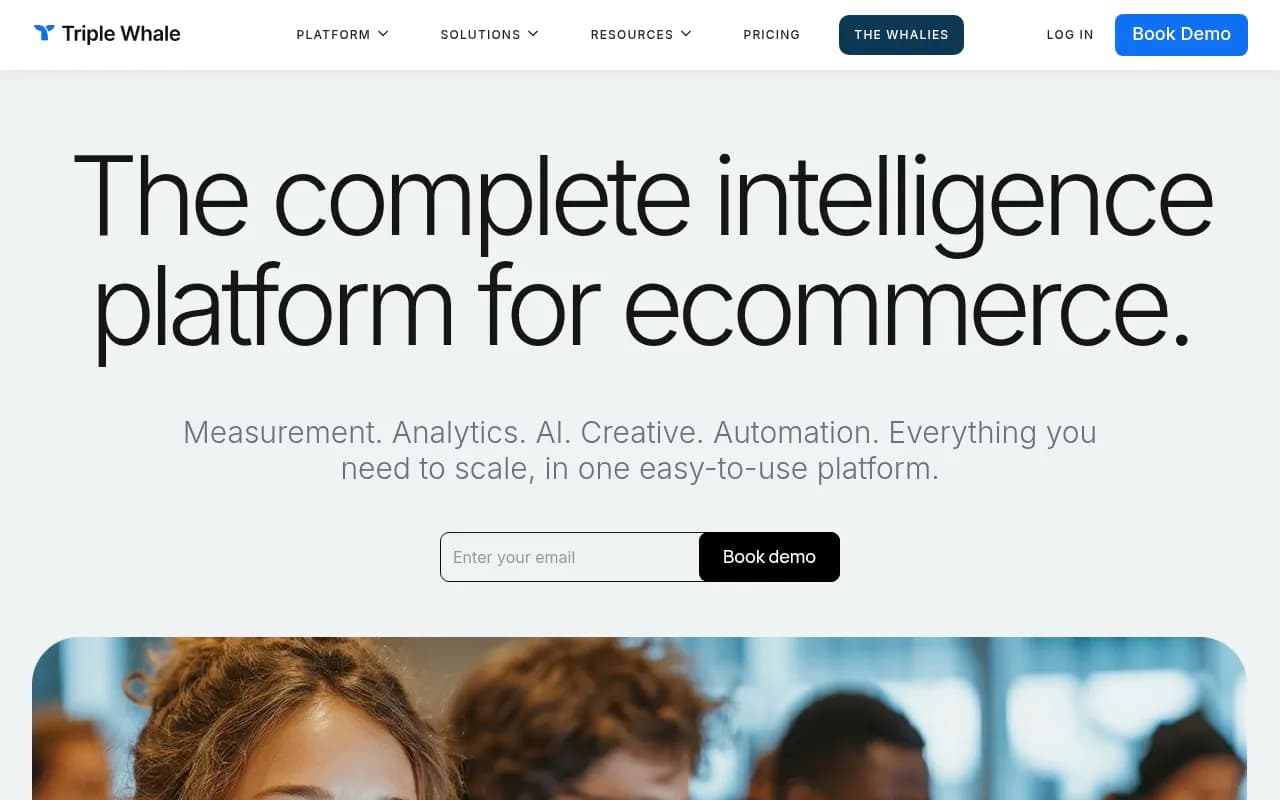
Triple Whale is an end-to-end ecommerce intelligence platform used by 50,000+ brands to unify marketing, sales, and operations data. It combines real-time analytics, unified measurement (MTA, MMM, incrementality), AI-powered insights via Moby agents, and instant activation tools to help DTC brands s
Summary
- Best for: DTC brands on Shopify doing $1M-$50M+ GMV who need unified ecommerce analytics, AI-driven insights, and activation tools in one platform
- Standout strength: Moby AI agents trained on $82B+ GMV that deliver actionable recommendations and can autonomously execute tasks like budget reallocation, creative briefs, and audience syncing
- Key limitation: Pricing scales with revenue (starts ~$549/mo for $1M-$2.5M GMV brands), making it expensive for early-stage stores; primarily Shopify-focused
- Unique differentiator: The only platform that combines measurement (MTA, MMM, incrementality), AI agents, and activation (audience syncing, ad platform controls) in one place -- most competitors stop at dashboards
Triple Whale is an all-in-one ecommerce intelligence platform built for direct-to-consumer brands and agencies who are tired of stitching together Google Analytics, Shopify reports, ad dashboards, and spreadsheets. Founded in 2021, it's now used by 50,000+ brands including Marine Layer, True Classic, Peloton Apparel, and LSKD. The company processes 9.2 billion events daily and has analyzed over $82 billion in gross merchandise value. It's backed by notable investors and has become one of the most popular analytics platforms in the Shopify ecosystem.
The core promise: give ecommerce teams a single source of truth for all their data, then use AI to turn that data into decisions and actions. Triple Whale isn't just a dashboard -- it's a platform that connects data ingestion, measurement, analysis, AI-powered recommendations, and execution in one workflow. This matters because most ecommerce teams waste hours every week pulling reports, reconciling numbers, and trying to figure out what to do next. Triple Whale collapses that cycle from days to minutes.
Who is Triple Whale for?
Triple Whale is built for three main personas:
DTC brand founders and operators running Shopify stores doing $1M-$50M+ in annual revenue. These are people who need to understand their entire business at a glance -- revenue, ad spend, profit margins, customer acquisition costs, lifetime value -- without logging into six different tools. They're making budget decisions daily and need confidence that their data is accurate and up-to-date. Triple Whale's Summary Dashboard gives them a real-time snapshot of everything that matters: sales, ROAS, CAC, LTV, profit, and more.
Performance marketers and media buyers managing Facebook Ads, Google Ads, TikTok, Snapchat, and other paid channels. These users need attribution that actually works post-iOS 14. They need to know which campaigns are profitable, which creatives are driving conversions, and how to reallocate budget without guessing. Triple Whale's Compass measurement suite (multi-touch attribution, marketing mix modeling, incrementality testing) gives them three different lenses on performance, so they're not flying blind when Facebook's pixel says one thing and Google Analytics says another.
Agencies managing multiple ecommerce clients. Triple Whale has 2,000+ agencies using the platform to monitor client performance, generate reports, and make data-driven recommendations. The platform supports multi-brand dashboards, white-label reporting, and agency-specific pricing. Moby Agents for Agencies can analyze performance across an entire client portfolio and surface insights that would take an analyst hours to find manually.
Triple Whale is not for early-stage stores doing under $500K/year in revenue -- the pricing doesn't make sense at that scale, and you're better off with free tools like Google Analytics and native Shopify reports. It's also not ideal for non-Shopify stores (though it does support WooCommerce, BigCommerce, and custom platforms via API). And if you're running a content site or SaaS product, this isn't the right tool -- it's purpose-built for ecommerce.
Key Features
Triple Whale Data Platform: The foundation of everything. Triple Whale connects to 60+ data sources -- Shopify, Facebook Ads, Google Ads, TikTok, Klaviyo, Gorgias, Amazon, Google Analytics, and more -- and unifies all that data in real-time. No data warehouse required. No waiting until tomorrow to see today's numbers. The platform processes 9.2 billion events per day and updates dashboards in real-time. This is a huge advantage over traditional BI tools like Looker or Tableau, which require data engineers to build pipelines and often show stale data. Triple Whale's integrations are plug-and-play: connect your Shopify store, authorize your ad accounts, and you're seeing unified data within minutes.
Triple Pixel (Advanced Tracking): Triple Whale's proprietary tracking pixel solves the post-iOS 14 attribution problem. It uses advanced identity resolution to track users across devices and sessions, even when cookies are blocked or users switch from mobile to desktop. This gives you more accurate conversion data than relying on Facebook's pixel or Google's tags alone. Triple Pixel also feeds data back to ad platforms via Conversions API integrations, improving their optimization algorithms. Brands report 15-30% more tracked conversions compared to native platform pixels.
Compass (Unified Measurement): This is Triple Whale's answer to the attribution mess. Compass combines three measurement methodologies in one platform: Multi-Touch Attribution (MTA) shows you the customer journey across touchpoints and assigns credit to each channel. Marketing Mix Modeling (MMM) uses statistical modeling to understand the incremental impact of each channel, accounting for external factors like seasonality and brand awareness. Incrementality Testing lets you run geo-holdout tests or channel pause experiments to measure true lift. Most platforms force you to pick one methodology. Triple Whale gives you all three, so you can triangulate the truth. This is especially valuable for brands spending $50K+/month on ads, where a 5% improvement in budget allocation can mean tens of thousands in profit.
Moby AI (Commerce-Specific AI): Moby is Triple Whale's AI assistant, and it's not just ChatGPT with your data bolted on. Moby is trained on $82 billion in GMV from 50,000+ brands, so it understands ecommerce metrics, seasonality, customer behavior, and channel dynamics out of the box. You can ask Moby questions like "Why did my ROAS drop last week?" or "Which products should I promote for Black Friday?" and get answers grounded in your actual data. Moby can also generate creative briefs, suggest audience segments, recommend budget reallocations, and even create ad images and videos. The Context Engine gives Moby a complete understanding of your business -- it knows your product catalog, customer segments, historical performance, and current goals. This means Moby can connect the dots across acquisition, retention, and operations in ways that generic AI tools can't.
Moby Agents (Autonomous AI Workflows): This is where Triple Whale goes beyond insights and into execution. Moby Agents are AI workflows that can autonomously perform tasks on your behalf. Examples: the Creative Analysis Agent reviews your ad creatives, identifies top performers, and suggests new angles to test. The Customer Retention Agent analyzes your email and SMS flows, identifies drop-off points, and recommends new campaigns. The Budget Optimization Agent monitors channel performance and reallocates spend to maximize ROAS. Moby Agents can even take action: syncing audiences to Facebook, pausing underperforming ads, or triggering email campaigns. This is a major differentiator -- most analytics platforms stop at recommendations. Triple Whale can execute them.
Sonar (Customer Data Enrichment): Sonar is Triple Whale's customer data platform. It enriches every customer record with behavioral data, purchase history, predicted LTV, churn risk, and more. This data powers segmentation, personalization, and predictive analytics. Sonar also includes Sonar Send, which syncs enriched audiences to ad platforms (Facebook, Google, TikTok) and email tools (Klaviyo, Attentive) in real-time. Brands use this to build high-value lookalike audiences, retarget at-risk customers, or exclude recent buyers from acquisition campaigns. One case study (Origin) reported $420K in incremental revenue within a year of using Sonar Send -- a 10x ROI on the entire Triple Whale subscription.
Self-Serve Analytics & Custom BI: Triple Whale offers pre-built dashboards for common use cases (Summary, Ads, Products, Customers, Cohorts, Profit) plus a drag-and-drop dashboard builder for custom views. You can slice data by date range, channel, product, customer segment, or any other dimension. For advanced users, Triple Whale integrates with Looker Studio and offers a full API for custom reporting. This flexibility means you're not locked into Triple Whale's opinionated views -- you can build exactly the reports your team needs.
Integrations & Ecosystem
Triple Whale integrates with 60+ platforms across ecommerce, advertising, email, SMS, customer support, and logistics. Key integrations include:
- Ecommerce platforms: Shopify (primary), WooCommerce, BigCommerce, custom APIs
- Ad platforms: Facebook/Instagram, Google Ads, TikTok, Snapchat, Pinterest, Amazon Ads
- Email & SMS: Klaviyo, Attentive, Postscript, Sendlane
- Customer support: Gorgias, Zendesk
- Analytics: Google Analytics, Google Search Console
- Logistics: ShipStation, AfterShip
- Payments: Stripe, PayPal
- Other: Recharge (subscriptions), Yotpo (reviews), Grin (influencer marketing)
Triple Whale also offers a Conversions API integration that sends server-side events to Facebook, Google, TikTok, and Snapchat, improving ad platform optimization and attribution accuracy. The platform has a public API and Zapier integration for custom workflows.
Pricing & Value
Triple Whale's pricing is based on your brand's annual Gross Merchandise Value (GMV). This is unusual but makes sense for ecommerce -- a $50M brand gets more value from the platform than a $1M brand, so they pay more.
Pricing tiers (as of 2026):
- $549/month for brands doing $1M-$2.5M GMV
- $1,129/month for $5M-$7M GMV
- $1,849/month for $10M-$15M GMV
- Custom pricing for brands over $15M GMV or agencies managing multiple clients
All plans include the core platform (data integrations, dashboards, Compass measurement, Moby AI, Sonar enrichment). Higher tiers unlock more advanced features like Moby Agents, AI crawler logs, and state/city-level tracking. There's a free trial available, and annual billing offers a discount.
Compared to competitors: Triple Whale is more expensive than basic analytics tools like Littledata ($40-$150/mo) or Polar Analytics ($200-$600/mo), but those platforms don't offer AI agents, unified measurement, or activation tools. It's cheaper than enterprise BI platforms like Looker or Tableau (which require data engineering resources) and more affordable than hiring a full-time analyst. For a $5M brand spending $100K/month on ads, a 2% improvement in ROAS (easily achievable with better attribution and budget allocation) pays for Triple Whale 10x over.
Strengths
- All-in-one platform: Data ingestion, measurement, analytics, AI insights, and activation in one place. No need to stitch together five different tools.
- Moby AI is legitimately useful: Unlike generic AI tools, Moby understands ecommerce and can deliver actionable recommendations grounded in real data. The ability to autonomously execute tasks (audience syncing, budget reallocation) is a game-changer.
- Real-time data: 9.2 billion events processed daily, dashboards update in real-time. No waiting until tomorrow to see today's performance.
- Unified measurement: Compass gives you MTA, MMM, and incrementality testing in one platform. This is huge for brands struggling with post-iOS 14 attribution.
- Sonar enrichment & activation: The ability to enrich customer data and sync audiences to ad platforms in real-time is a major competitive advantage. Brands report 10x ROI on Sonar Send alone.
Limitations
- Pricing scales with revenue: If you're a $1M brand, $549/month is a significant expense. Early-stage stores may not see enough value to justify the cost.
- Shopify-centric: While Triple Whale supports other platforms, it's clearly built for Shopify. WooCommerce and BigCommerce users may find some features less polished.
- Learning curve for advanced features: The core dashboards are intuitive, but Moby Agents, Compass measurement, and custom BI require some ramp-up time. Smaller teams may not fully utilize the platform's capabilities.
Bottom Line
Triple Whale is the best all-in-one ecommerce intelligence platform for DTC brands and agencies who want to move beyond dashboards and into action. If you're a Shopify brand doing $1M+ in revenue, spending $50K+/month on ads, and tired of stitching together Google Analytics, Facebook Ads Manager, and spreadsheets, Triple Whale will save you hours every week and help you make better decisions. The combination of unified measurement, AI-powered insights, and instant activation is unmatched in the market.
Best use case in one sentence: A $5M-$20M DTC brand with a lean team that needs to understand performance across acquisition, retention, and operations without hiring a data analyst.
Tags:
Frequently asked questions
What is Triple Whale and what does it do?
How much does Triple Whale cost?
Who should use Triple Whale?
Is Triple Whale free to use?
What makes Triple Whale different from other ecommerce analytics tools?
What are the main features of Triple Whale?
Does Triple Whale work with Shopify?
What is the main limitation of Triple Whale?
Similar and alternative tools to Triple Whale