Atomic AGI Review 2026
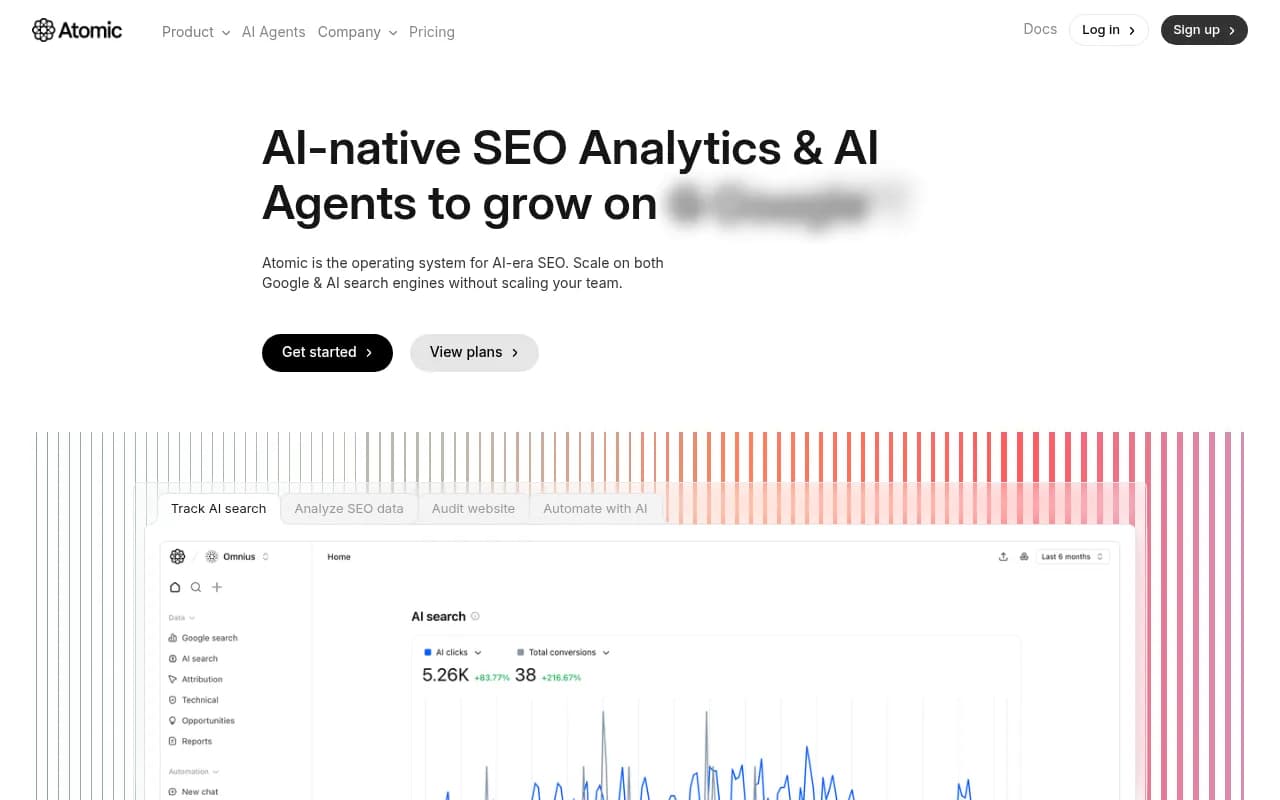
Atomic AGI is an all-in-one SEO analytics and automation platform that tracks both traditional Google search and AI search engines (ChatGPT, Perplexity, Gemini, Claude). It combines multi-engine data tracking, technical audits, AI agents, and workflow automation to help marketing teams scale organic
Summary
- Atomic AGI is a comprehensive SEO platform that tracks both Google and AI search engines (ChatGPT, Perplexity, Gemini, Claude, Copilot, DeepSeek, Grok, Meta Llama, Qwen, Mistral) in one dashboard
- Combines analytics, technical audits, AI agents, and workflow automation to scale SEO operations without adding headcount
- Lacks the content gap analysis, AI content generation, and crawler log visibility that Promptwatch offers -- Atomic focuses on tracking and automation, while Promptwatch helps you fix what's broken and create content that ranks
- Pricing starts at $10/mo (Starter) with a free tier available; paid plans scale up for teams and enterprises
- Best for marketing teams and SEO professionals who want unified visibility across Google and AI search engines with automation capabilities
Atomic AGI positions itself as the "operating system for AI-era SEO" -- a platform that unifies search analytics, technical optimization, and AI-powered automation into a single workflow. The company's pitch is simple: you can't manage modern SEO with fragmented tools anymore. Google is still the primary traffic driver, but AI search engines like ChatGPT and Perplexity are exploding in usage. Atomic tracks both sides of the equation and automates the grunt work in between.
The platform is used by recognizable brands including Booking.com, Accenture, Payoneer, Samsung, MIT, Loom, and Bunq. It launched with a focus on making AI search traffic visible and actionable -- something traditional analytics tools like Google Analytics and Search Console don't handle. The company is based in Europe (servers hosted in Germany) and emphasizes GDPR compliance and data security.
AI Search Tracking (The Core Differentiator)
Atomic's standout feature is holistic AI search tracking across 10+ generative engines. Most SEO tools still treat AI search as an afterthought or ignore it entirely. Atomic makes it a first-class citizen.
Generative Engines: Shows which AI platforms (ChatGPT, Perplexity, Gemini, Claude, Copilot, DeepSeek, Grok, Meta Llama, Qwen, Mistral) are sending traffic to your website. You see visitor volume, conversions, and average session time per platform. This answers the question: which AI engines actually drive business results?
Prompt Tracking: Monitors which prompts and queries users enter into AI search engines that trigger mentions of your brand. You see your visibility percentage, average position in AI responses, mention frequency, and which AI engines return your brand for each prompt. Prompts are categorized by intent stage (Awareness, Consideration, Decision). This is where you identify optimization opportunities -- if you're invisible for high-value prompts, you know where to focus.
Visibility Dashboard: Aggregates visibility data across all AI platforms, tracking total AI clicks, click-through rate, and visibility percentage. You get breakdowns by platform, position distribution in AI responses, citation share, and recent chat examples showing how your brand appears in real conversations. This is your AI search report card.
Pages: Shows which pages on your website receive traffic from AI-generated responses. You see landing pages with AI clicks, zero-click pages where users don't proceed to your site, and AI indexability percentage (how much of your content is generating visitors from LLMs). This reveals which content successfully drives engagement from AI search.
Competitors: Tracks how your brand's AI search visibility compares to competitors. You see each company's visibility percentage, average position in AI responses, and citation frequency across all tracked prompts and platforms, with trend analysis showing competitive shifts over time.
Citations: Shows which specific pages and domains AI engines cite as sources when responding to your tracked prompts. You see citation share by source, ranking position, citation type (You, Competitor, UGC, Corporate, Reference), and trends across different platforms over time. This reveals which sources AI engines consider authoritative for specific queries.
Sentiment Analysis: Analyzes how your brand is described and evaluated inside AI search engines, based on the tone and context of AI-generated answers. You see positive and negative sentiment percentages with recurring themes and source attribution. Each signal is linked to the source the AI model relies on, allowing you to track how AI perception changes over time.
The AI search tracking is available on paid plans (prompt tracking, visibility, competitors, citations, sentiment) with basic generative engine traffic tracking available on all plans including free.
Google Search Analytics (Traditional SEO Foundation)
Atomic integrates with Google Search Console and Google Analytics 4 to provide comprehensive traditional SEO analytics. The platform emphasizes that Google remains the primary data source for LLM retrieval -- optimizing traditional search directly improves AI citations.
Keywords: Tracks all keywords that generate impressions and clicks from Google Search. You see total keyword count, position distribution (top 3, 4-10, 11-50), clicks, impressions, average position, and CTR for individual keywords, branded terms, and questions over time. The system categorizes keywords by position tier and visualizes trends to identify opportunities and ranking changes.
Landing Pages: Shows which pages receive organic traffic from Google Search, tracking total clicks, impressions, average position, and CTR for each landing page, with performance trends showing how individual pages gain or lose visibility over time. You can identify pages with high impressions but low clicks -- optimization opportunities.
Attribution: Tracks which traffic sources and channels drive conversions on your website. You see total sessions and conversions by source (direct, Google, ChatGPT, LinkedIn, etc.), with performance metrics including conversion counts, conversion rates, and average time spent per source. This connects SEO to actual business results.
Referring Domains: Shows which external domains and sources refer traffic to your website from Google Search, tracking total referring domains and session volume from each source, with trend analysis showing how referral traffic evolves over time.
Geography: Shows which countries and regions drive organic traffic from Google Search to your website, with visual map representation and performance metrics including clicks, impressions, average position, and conversions by geographic location. Heat mapping identifies high-value markets and expansion opportunities.
Devices: Shows which device types (desktop, mobile, tablet) drive organic traffic from Google Search to your website, tracking clicks, impressions, and conversions by device with performance trends showing how user behavior varies across platforms.
Google analytics features are available on all plans including free, with attribution and geography tracking available on paid plans.
Technical SEO Audits (Website Health)
Atomic provides comprehensive technical SEO audits for both traditional Google crawlers and LLM crawlers.
SEO Audit: Automated crawls that scan pages for technical SEO issues across indexability, content optimization, social tags, images, sitemaps, and more. The system categorizes issues by severity (errors, warnings, notices), calculates overall site health percentage, tracks audit history to show improvements or regressions, and provides specific page-level details with recommendations for each issue. Available on all plans.
LLM Audit: Evaluates how well your website is optimized for AI search engines and LLM crawlers, tracking performance, accessibility, best practices, SEO, and content scores across categories like crawlability, trust signals, content structure, HTML preview, organic backlinks, and diagnostics specific to AI engine requirements. This is where Atomic differentiates from traditional SEO tools -- it audits from an LLM perspective, not just Google's. Available on paid plans.
Interlinking: Maps your website's internal linking structure, tracking which pages link to each other with performance scores, incoming link counts, and outgoing link counts for every page. This reveals how link equity flows through your site architecture and identifies pages with weak internal linking. Available on paid plans.
URL Indexing: Tracks the indexing status of all URLs on your website, categorizing URLs by status (indexed, discovered, unknown, indexing requested, errored). You can bulk load URLs from your sitemap, check current indexing status, and request indexing for specific pages directly through the interface, with historical tracking of when each URL was last checked. Available on paid plans.
Additional technical automations include schema markup validation, LLM bot permission checking, URL indexing monitoring, JavaScript & CSS optimization, internal link structure analysis, meta tag & content auditing, Core Web Vitals tracking, robots.txt compliance scanning, and sitemap error detection.
AI Agents and Workflow Automation (The Productivity Multiplier)
Atomic's AI agents and workflow automation are where the platform moves beyond analytics into execution. The company's pitch: deploy specialized agents that analyze data and execute optimization tasks continuously, scaling operations without scaling headcount.
Opportunities: Real-time SEO opportunities identified website-wide and page-specific that you can implement right away to grow faster organically. The system surfaces opportunities by page and by issue category, with the ability to fix issues using AI.
Agents: Ask Atomic Agents to analyze data, deploy them to automate tasks, or schedule them to create AI employees. The interface allows you to build and fine-tune agents, run them, and execute tasks. Agents can perform search data analysis & alerting, AI search visibility optimization, content refreshment, content writing, backlink opportunity discovery, page value analysis, keyword decay monitoring, and site crawlability diagnostics.
Workflows: Automate operations with multi-step workflows and agent orchestration. Pull data, execute tasks, publish updates to your website, and send notifications via email or Slack. This is the full automation layer -- you can build custom workflows that run on a schedule or trigger based on conditions.
The AI agents and workflow features are positioned as "coming soon" for full release, with some capabilities already available in the platform. This is the area where Atomic is investing heavily to differentiate from competitors.
Content Optimization (NLP-Driven Insights)
Atomic includes content analysis, content editor, and content clustering features to help you optimize and organize content.
Content Analysis: Identifies the reason behind decreasing content performance using NLP-driven insights.
Content Editor: Provides optimization recommendations for articles.
Content Clustering: Organizes content into effective clusters.
These features are less developed than the analytics and automation capabilities -- the platform is stronger on tracking and workflow automation than on content creation and optimization. This is where Promptwatch has a clear advantage with its AI writing agent that generates articles, listicles, and comparisons grounded in real citation data (880M+ citations analyzed), prompt volumes, persona targeting, and competitor analysis.
Reports (Custom Dashboards)
Atomic allows you to build custom reports using available data from the platform. You can add explanations, share insights with your team, publish reports, or invite collaborators for seamless decision-making. The reporting goes beyond clicks and impressions to include conversion data, AI search metrics, and technical audit results.
Integrations and Ecosystem
Atomic integrates with Google Search Console, Google Analytics 4, and tracks data from 10 AI search engines (ChatGPT, Perplexity, Gemini, Claude, Copilot, DeepSeek, Grok, Meta Llama, Qwen, Mistral). The platform also monitors Google AI Overviews and AI Mode.
The system is designed for no-code setup -- you can integrate data sources in as little as 4 minutes with no development required. Data is hosted in Germany on European-owned cloud infrastructure, with GDPR compliance and encryption.
There's no mention of API access, browser extensions, mobile apps, or integrations with other marketing tools (Slack, Zapier, CMS platforms, etc.) beyond the core Google and AI search engine connections. The platform is focused on being a standalone SEO operating system rather than a tool that plugs into a broader martech stack.
Pricing and Value
Atomic offers a free tier to start, with paid plans scaling from $10/mo (Starter) up through team and enterprise tiers. Specific pricing details:
- Free Tier: Available with basic features including generative engine traffic tracking, keyword analytics, landing page analytics, referring domains, devices, SEO audit, and reports.
- Starter Plan: $10/mo -- includes all free features plus additional capabilities.
- Paid Plans: Scale up for teams and enterprises with features like prompt tracking, visibility dashboard, competitors, citations, sentiment analysis, LLM audit, interlinking, URL indexing, attribution, geography, and AI agents/workflows.
The pricing is positioned as significantly more affordable than competitors like Semrush, Ahrefs, and specialized GEO platforms. The company emphasizes "same AI visibility and optimization features at a fraction of the cost" and "accessible for teams who need speed, clarity and value."
Compared to Promptwatch (Essential $99/mo, Professional $249/mo, Business $579/mo), Atomic's entry point is much lower. However, Promptwatch includes content gap analysis (Answer Gap Analysis), AI content generation (built-in AI writing agent), and AI crawler logs that Atomic lacks. Atomic is cheaper but less comprehensive for content optimization and creation.
Who Is It For
Atomic AGI is best for:
- Marketing teams at mid-size to enterprise companies who need unified visibility across Google and AI search engines without juggling multiple tools. If you're tracking SEO in Search Console, AI search in a separate tool, and running audits in yet another platform, Atomic consolidates everything.
- SEO professionals and agencies who want to scale operations with automation. The AI agents and workflow features are designed to reclaim time previously spent on manual data analysis and reporting -- the company claims typical teams save about 30 hours per month.
- Brands investing in AI search visibility who want to understand how ChatGPT, Perplexity, and other LLMs are presenting their brand. If you're already getting traffic from AI search engines but have no visibility into which prompts trigger mentions or which pages drive clicks, Atomic makes that data actionable.
- Teams with limited SEO headcount who need to do more with less. The automation layer is explicitly positioned as a way to lower growth-to-headcount dependency -- you can scale organic growth without scaling your team.
Atomic is NOT ideal for:
- Teams who need deep content optimization and creation capabilities. Atomic tracks performance and automates workflows, but it doesn't help you create content that ranks in AI search. Promptwatch is the better choice if you need Answer Gap Analysis to find missing content opportunities and an AI writing agent to generate articles grounded in citation data.
- Solo freelancers or very small businesses who don't need enterprise-level automation. The free tier is generous, but the platform's complexity and feature set are overkill if you're just tracking a single small website.
- Teams who want AI crawler logs and visitor analytics. Atomic tracks which AI engines send traffic and which prompts trigger mentions, but it doesn't show real-time logs of AI crawlers hitting your website (which pages they read, errors they encounter, how often they return). Promptwatch includes this.
Strengths
- Unified dashboard for Google + AI search: Most competitors force you to use separate tools for traditional SEO and AI search. Atomic tracks both in one place, which is a massive workflow improvement.
- Comprehensive AI search tracking across 10+ engines: ChatGPT, Perplexity, Gemini, Claude, Copilot, DeepSeek, Grok, Meta Llama, Qwen, Mistral -- Atomic monitors more AI engines than most competitors.
- Workflow automation and AI agents: The ability to build multi-step workflows that pull data, execute tasks, publish updates, and send notifications is a genuine productivity multiplier. Most GEO platforms are monitoring-only dashboards.
- Affordable entry point: $10/mo starter plan with a free tier makes Atomic accessible to smaller teams. Compare to Promptwatch ($99/mo minimum) or enterprise-focused competitors.
- Technical audits for both Google and LLM crawlers: The LLM audit is a unique feature that evaluates your site from an AI engine perspective, not just Google's.
- No-code setup: 4-minute integration with no development required is a real advantage for non-technical users.
Limitations
- No content gap analysis or AI content generation: Atomic tracks what's happening but doesn't help you fix what's broken. Promptwatch shows you which prompts competitors are visible for but you're not (Answer Gap Analysis), then helps you create content that ranks with its AI writing agent. Atomic lacks both.
- No AI crawler logs: You can see which AI engines send traffic, but you can't see real-time logs of AI crawlers hitting your website. Promptwatch includes this, which is critical for understanding how AI engines discover your content and fixing indexing issues.
- Limited integrations beyond Google and AI search: No mention of API access, Slack, Zapier, CMS integrations, browser extensions, or mobile apps. Atomic is a standalone platform, not a tool that plugs into a broader martech stack.
- AI agents and workflows still maturing: Some automation features are marked "coming soon" -- the platform is investing heavily here but not fully built out yet.
- Less focus on content optimization: The content analysis, content editor, and content clustering features are less developed than the analytics and automation capabilities. If content optimization is your priority, other tools are stronger.
Bottom Line
Atomic AGI is a solid choice for marketing teams and SEO professionals who want unified visibility across Google and AI search engines with workflow automation to scale operations without adding headcount. The platform's strengths are its comprehensive AI search tracking (10+ engines), technical audits for both Google and LLM crawlers, and automation capabilities that save time on manual tasks. The affordable pricing ($10/mo starter, free tier available) makes it accessible to smaller teams.
However, Atomic is a monitoring and automation platform, not an optimization and content creation platform. If you need to find content gaps, generate AI-optimized articles, or see real-time AI crawler logs, Promptwatch is the better choice. Promptwatch's Answer Gap Analysis shows exactly which prompts competitors are visible for but you're not, its AI writing agent generates content grounded in 880M+ citations analyzed, and its crawler logs reveal how AI engines discover your content. Atomic tracks performance and automates workflows; Promptwatch helps you fix what's broken and create content that ranks.
Best use case in one sentence: Atomic AGI is best for mid-size to enterprise marketing teams who want a unified SEO analytics and automation platform that tracks both Google and AI search engines without juggling multiple tools, but who don't need deep content optimization or creation capabilities.
Tags:
Frequently asked questions
What is Atomic AGI?
How much does Atomic AGI cost?
Does Atomic AGI have a free plan?
What AI search engines does Atomic AGI track?
Who uses Atomic AGI?
What makes Atomic AGI different from traditional SEO tools?
Is Atomic AGI GDPR compliant?
What features does Atomic AGI include?
Similar and alternative tools to Atomic AGI