Key takeaways
- All four platforms now sell some form of AI search visibility. The real differences are where each starts (content, technical crawl, on-site automation, or Adobe's stack) and how much work each executes for you.
- Many comparisons you will find are vendor-authored. Conductor's "best enterprise SEO platforms" list ranks Conductor first, and its claims about BrightEdge and Botify are out of date.
- Pricing is quote-based for all four. The only figure we found is a third-party claim for Adobe: a 1,000-prompt minimum, roughly EUR 60 per prompt per year. Treat it as a rough signal.
- Pick by team shape: Conductor for content teams, BrightEdge for technical and automation-heavy programs, Botify for huge sites where crawl budget binds, Adobe if you already run AEM and a CDN.
- None of these tells you everything. Pair them with independent AI citation data before you sign a six-figure contract.
Why this comparison needs a skeptical read
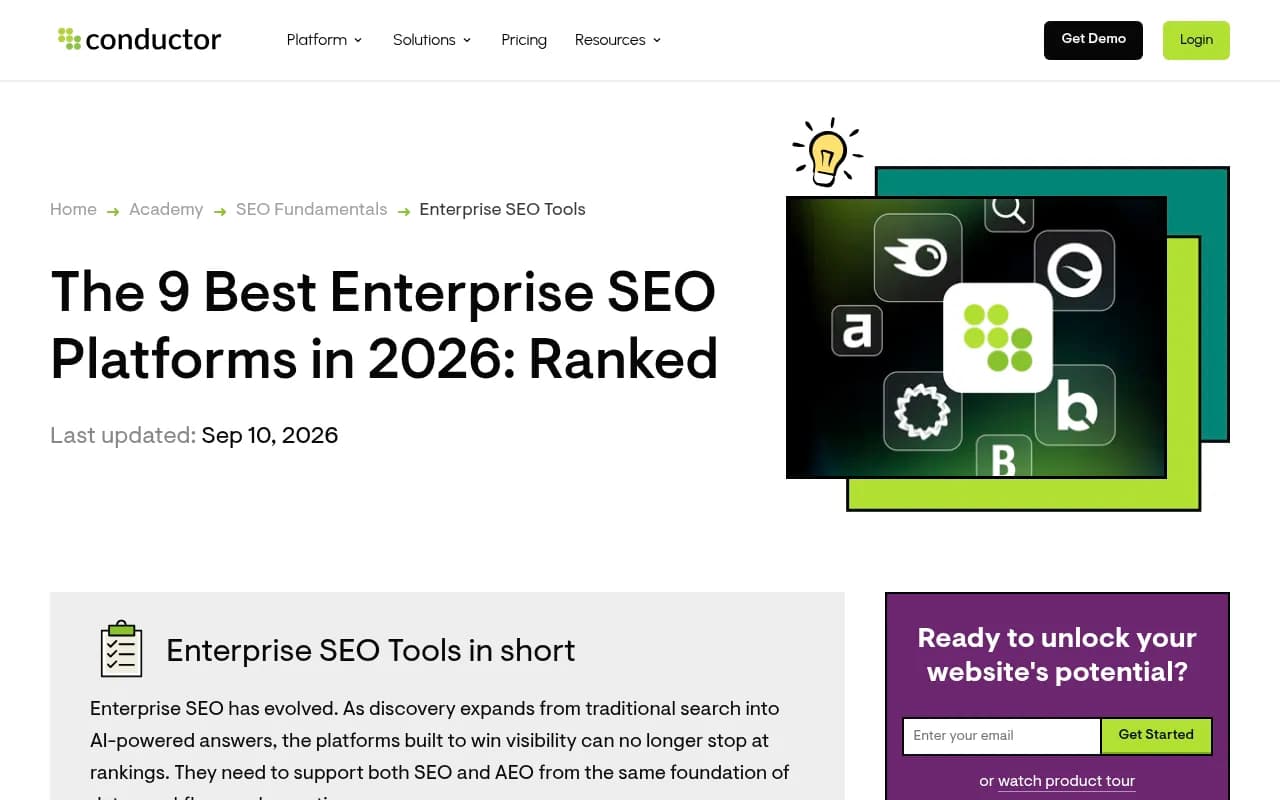
Search for any of these four tools and the top results are written by the vendors or their rivals. Conductor's ranking of the nine best enterprise SEO platforms puts Conductor at #1. Indexable's 14-platform comparison puts Indexable in its own recommended slot. Authoritytech's BrightEdge vs Conductor piece pushes a separate "Machine Relations" service. That is not a scandal, it is just how this category works. But it means you should read the claims with a pencil in your hand.
I will flag the specific places where those sources are stale. Two examples are below, and both matter if you are shortlisting.
Two claims that no longer hold
Conductor's article says Botify "doesn't track AI citations or brand mentions." Botify has since launched AI Visibility inside Botify Analytics, in beta first and now, per its blog, generally available to customers. Its April 2026 release added Gemini and Google AI Overview coverage and CSV export. An August 2026 release added competitor comparison and topic grouping.
The same article says BrightEdge has Google AI Overview monitoring but limited coverage of ChatGPT and Perplexity. BrightEdge's own AI Catalyst page now lists ChatGPT, Perplexity, AI Overviews, AI Mode and Gemini. Whether every engine is tracked at the depth you need is a demo question, but "limited to AI Overviews" is out of date.
The four platforms at a glance
| Platform | Starts from | AI visibility | Execution angle | Pricing |
|---|---|---|---|---|
| Adobe Brand Visibility (formerly LLM Optimizer) | Adobe stack, AEM, CDN | Brand representation in LLM answers, agentic traffic from CDN logs | Auto-Optimize pushes approved changes to edge/CDN | Annual license, quote only |
| BrightEdge | Enterprise SEO suite, Data Cube | AI Catalyst, AI Hyper Cube, AI Agent Insights | Autopilot, Agent Edge, Site Agents Suite | Quote only, reported $36K-$120K+/yr |
| Conductor | Content and organic marketing workflow | Mentions, citations, share of voice, sentiment across many engines | AgentStack: LLM apps, MCP server, turnkey agents | Quote only, reported $24K-$60K/yr |
| Botify | Technical crawl and log analysis | AI Visibility, AI bot log analysis | SpeedWorkers, PageWorkers, SmartIndex | Quote only; AI Visibility is an add-on |
The contract ranges for BrightEdge and Conductor come from a third-party comparison and neither vendor publishes list pricing. Use them for budgeting conversations, not as quotes.
Adobe LLM Optimizer, now Adobe Brand Visibility
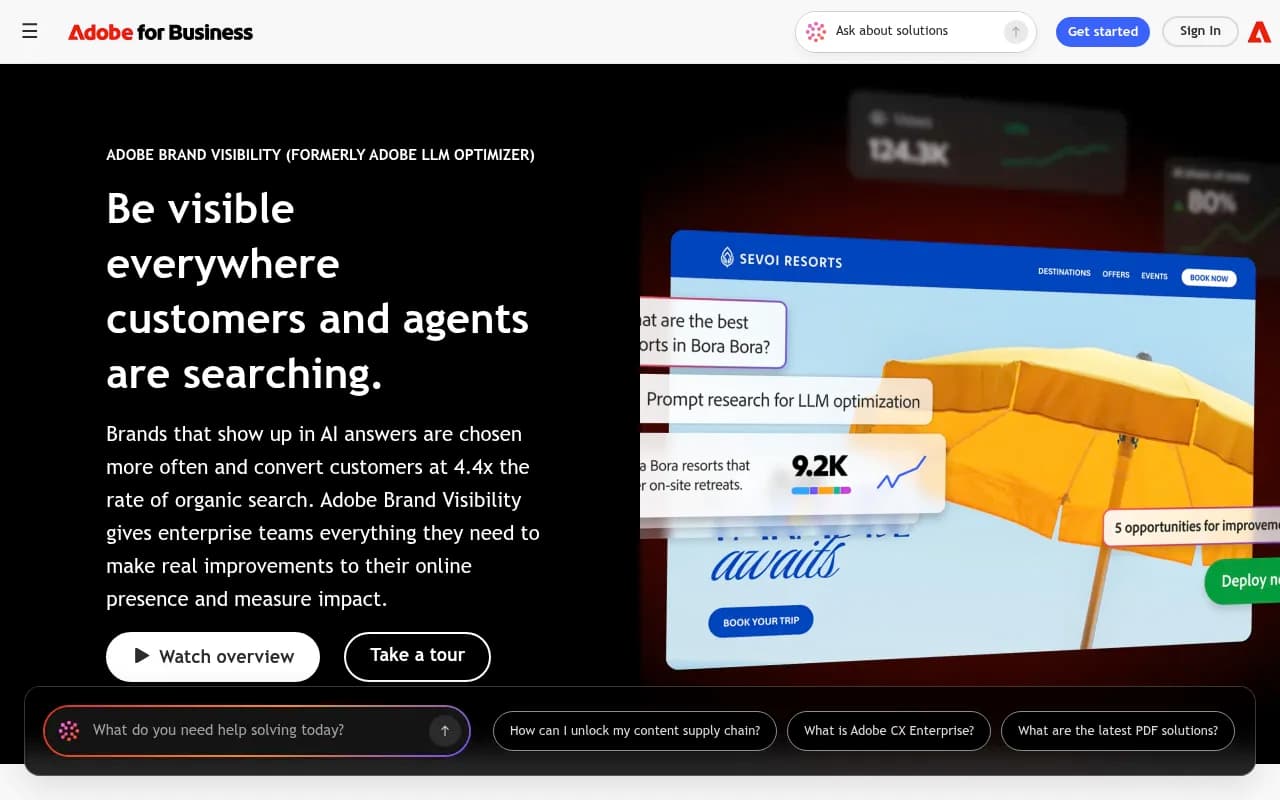
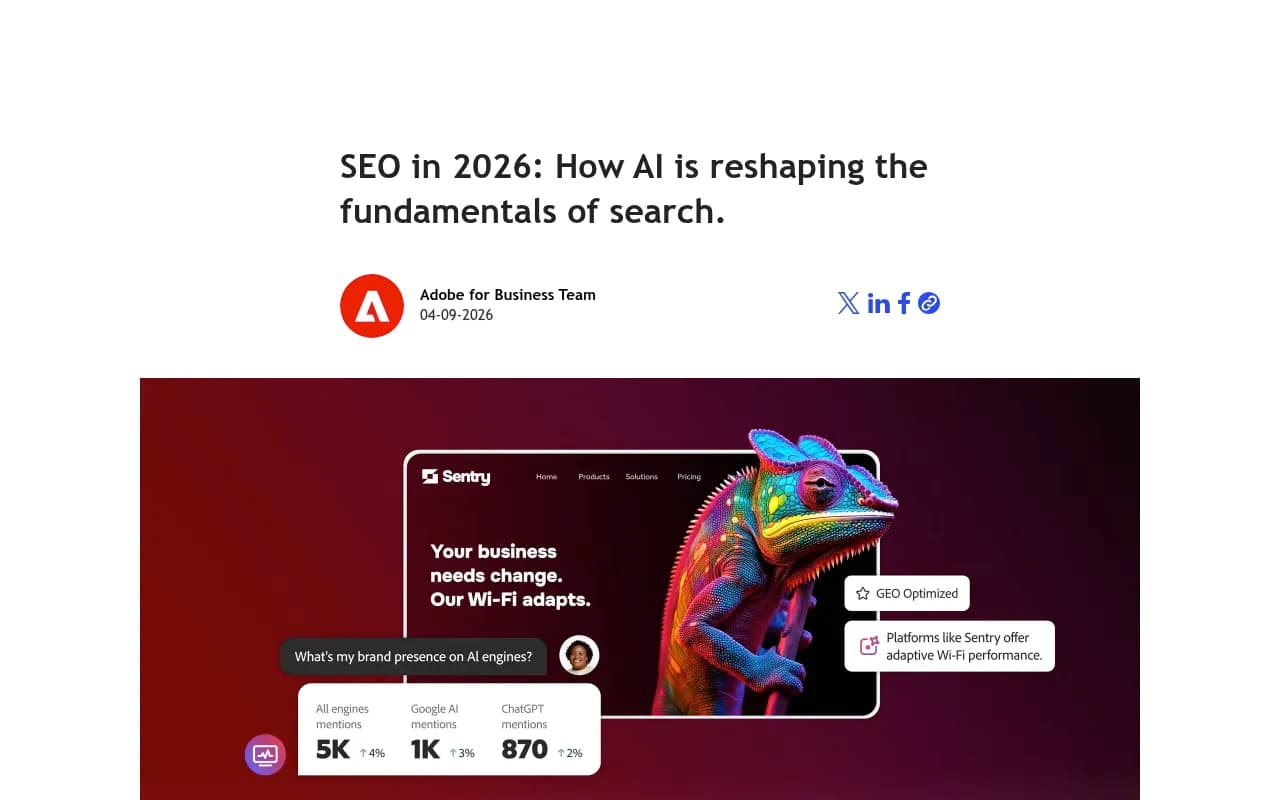
Adobe's product page now reads "Adobe Brand Visibility (formerly Adobe LLM Optimizer)." LLM Optimizer has been on sale since October 2025. On June 17, 2026, Adobe announced Brand Visibility as the expanded platform layering Semrush's AI Optimization data on top of it. Semrush has been an Adobe company since April 28, 2026, which explains the pairing.
What it does
The part I find most interesting is agentic traffic analysis. Adobe reads CDN log data to show how AI agents move through your site. Its own best-practices documentation notes that agentic traffic often lands on pages deeper in the hierarchy, not the home page. That matches what you would expect: agents fetch specific answers, not brand front doors.
On the action side, the insights dashboard runs an Analyze, Plan, Act, Adapt cycle. A URL Inspector flags pages blocked from AI crawlers. Auto-Optimize pushes approved content changes to the edge or CDN so LLMs see updated narratives without a full republish cycle. That deployment path needs AEM plus CDN or edge, which is the catch.
Who it fits
Adobe says the product runs standalone and integrates with the wider Adobe stack. In practice, the deployment story is strongest if you are already an AEM shop. If you are on another CMS, you get monitoring and recommendations but not the one-click deployment that makes it distinctive. One analysis calls this the "six-figure paradox": the product is most valuable to the organizations that already spent the most on Adobe.
The only pricing signal is secondhand. A competitor's blog (LLM Pulse) says it is an annual license with a minimum of 1,000 tracked prompts in 200-prompt increments, at about EUR 60 per prompt per year. That would put the floor around EUR 60,000. Since the source sells a rival product, verify it with Adobe.
BrightEdge
BrightEdge is the incumbent suite, built around Data Cube (a keyword database it puts at over 10 billion terms) and deep technical auditing. Its AI additions in 2026 are substantial.
AI products
- AI Catalyst tracks mentions, citations and sentiment (positive, neutral or negative, with reasoning), maps prompts to buyer-journey stages, and flags when a competitor takes over an answer you held. BrightEdge says it is included in all SEO Platform subscriptions.
- AI Hyper Cube, launched March 2026, is its demand-intelligence layer for how brands appear across AI engines.
- AI Agent Insights shows visits from ChatGPT, Claude, Perplexity and Gemini to your site and where they fail. BrightEdge claims nearly 1 in 4 ChatGPT attempts to reach enterprise sites fail. That is a vendor claim, so ask to see it on your own domain.
- Agent Edge, launched August 2026, serves agent-ready content to AI agents. There is also an MCP connection to AI workflows.
- Autopilot is the on-site automation pitch: it says it "handles fully automated optimizations on your website."
The tradeoff is complexity. Reviewers describe a 2 to 3 month learning curve and a dense interface, and G2 lists recurring criticism about the learning curve and slow loading (4.4 out of 5 from 877 reviews, checked September 28, 2026). If you want automation and technical depth, that may be fine. If your editors need to act on data themselves, it is a real cost.
Conductor
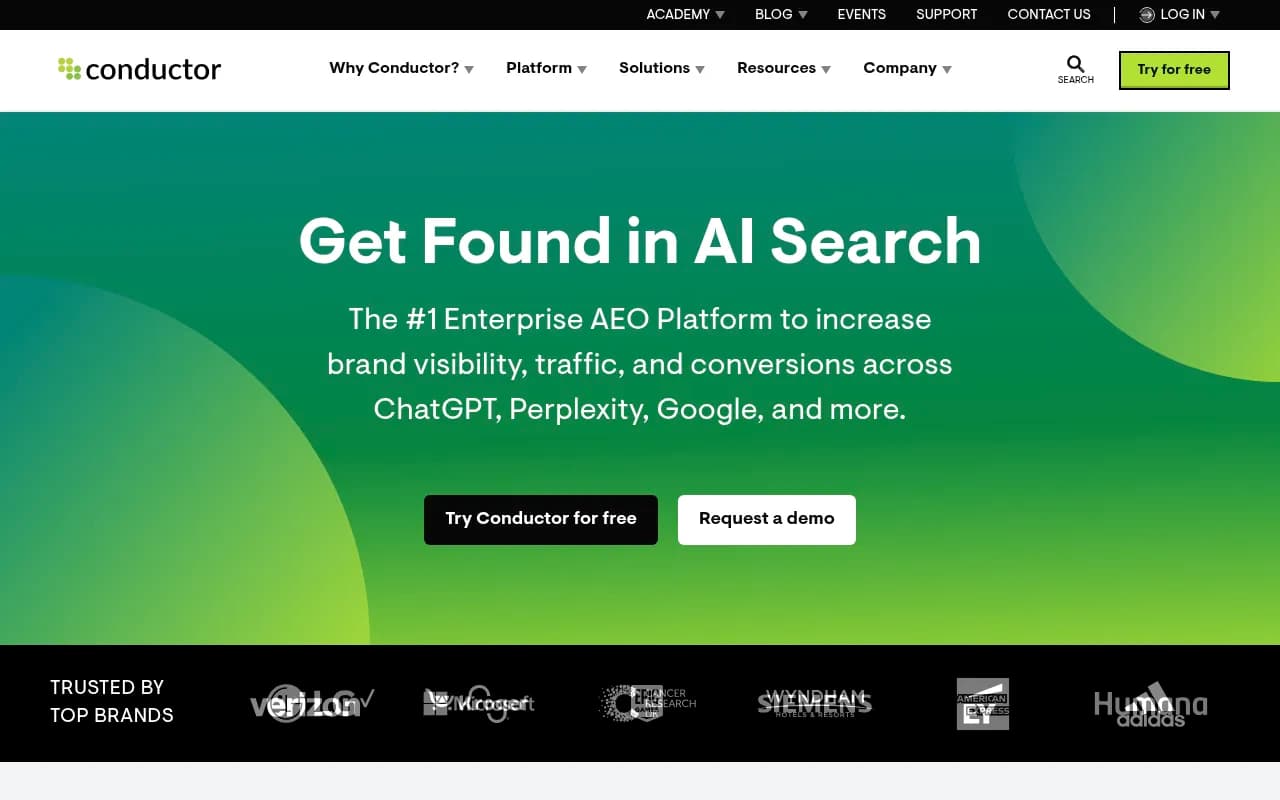
Conductor is the content-team favorite. Its pitch is clarity over data density, and onboarding reportedly takes 2 to 3 weeks rather than months.
AI products
Per its own materials, Conductor measures mentions, citations, share of voice and sentiment across ChatGPT, Perplexity, Google AI Overviews, AI Mode, Copilot, Grok and Claude. Other sources list the engine set differently, and marketing pages name fewer than its docs do, so confirm the current list.
AgentStack, launched April 2026, bundles native apps inside ChatGPT, Claude and Copilot, an MCP server and turnkey AEO agents. The headline claim is going from insight to published, optimized content in under three minutes. Its own 2026 benchmarks report says AI-referred sessions are about 1% of traffic but growing at 527% year over year, across 3.3 billion sessions on 13,000+ enterprise domains.
One caution. Conductor's statement that it is "the only platform on this list that closes the loop between AI visibility and action" is marketing. BrightEdge, Botify and Adobe all publish execution claims of their own. Indexable's analysis found eleven of fourteen platforms make one.
Botify
Botify is the pick when the site is enormous and crawl budget is the constraint. It calls itself an "AI search optimization platform."
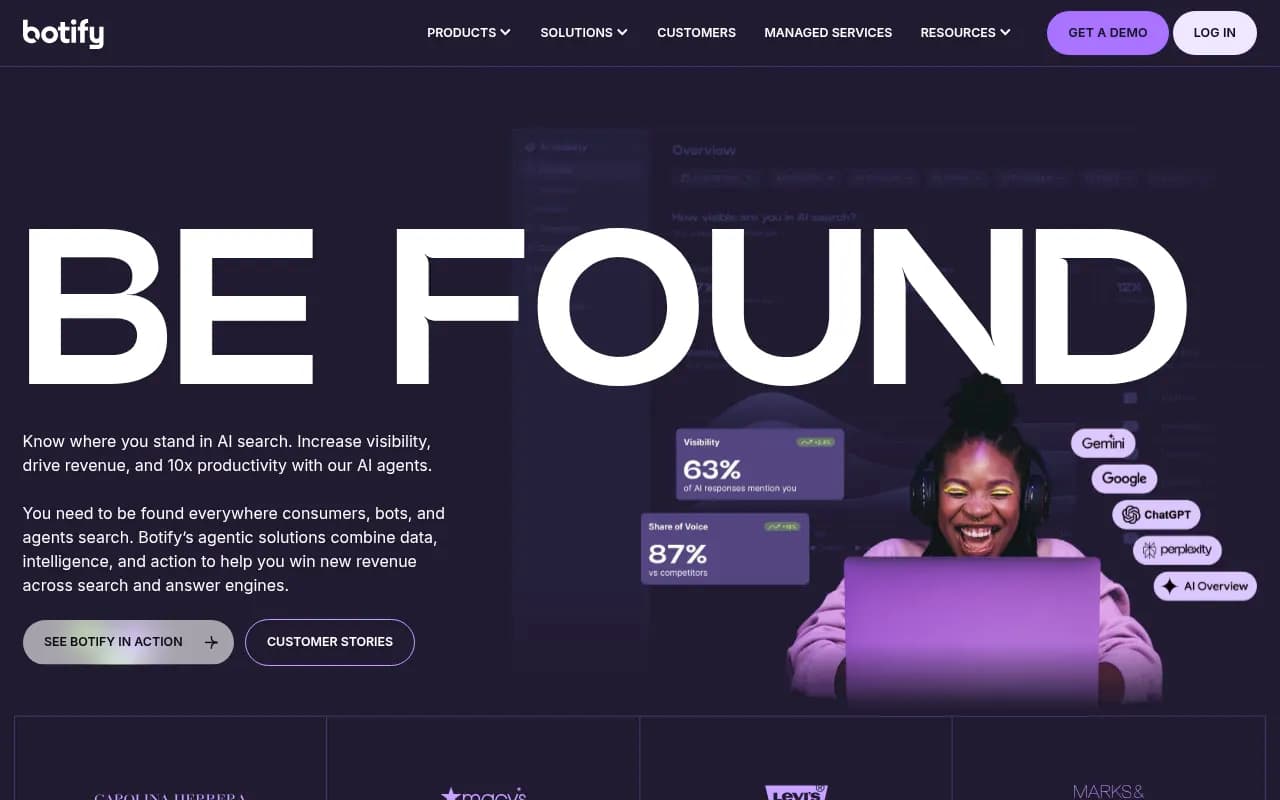
AI Visibility prompts are generated automatically from your top Search Console keywords and People Also Ask questions. It lists share of voice, citations, rankings, mention counts and LLM-based sentiment. SpeedWorkers serves rendered content to bots so AI crawlers can see everything on JavaScript-heavy pages. PageWorkers applies changes for AI bots, and SmartIndex can notify search and AI engines of page changes via IndexNow. Botify's own AI Visibility FAQ says API access for that product is not currently planned, and its MCP server was in early access when last checked.
Botify says AI Visibility is an option on all plans, with no published price. G2 shows 4.4 out of 5 from 80 reviews, with praise for ease of use and integrations and complaints about the learning curve and cost.
Side-by-side: what to ask in the demo
| Question | Adobe | BrightEdge | Conductor | Botify |
|---|---|---|---|---|
| Tracks AI citations and mentions | Yes | Yes | Yes | Yes, newer |
| Agent/bot traffic analysis | CDN-log agentic traffic | AI Agent Insights | AI crawler monitoring | Bot log analysis, strongest at scale |
| Deploys fixes for you | Edge/CDN, needs AEM + CDN | Autopilot, Agent Edge | Agents inside LLM apps | SpeedWorkers, PageWorkers |
| Learning curve | Moderate | Steep | Gentle | Moderate to steep |
| Pricing lever | Prompt count | Suite subscription | Credits and seats | Add-on to plan |
| Best fit | AEM shops | Technical SEO-led orgs | Content-led orgs | Millions of URLs |
What the AI crawler data says about log features
Agent analytics is a headline feature in Adobe, BrightEdge and Botify, so a benchmark helps. In Promptwatch Data's AI crawler traffic report (IP-verified requests, June 8 to September 6, 2026), OpenAI made up 79.8% of verified AI crawler requests in the week of August 31 to September 6, down from 94.8% in the week of June 8. The mix is shifting. If a major provider is large in that mix but near zero in your logs, check robots.txt and CDN or WAF rules for blocks. A good platform should surface that for you. Ask each vendor to show it on your own data.
Where to point the work
Promptwatch Data's ChatGPT citation share by content type (September 28 to October 4, 2026) found product pages are the most cited type at 22.4%, then landing pages at 16.8% and listicles at 13.6%. For commercial prompts, product pages reach 26.0%. So platforms that fix and structure product and landing pages, whether that is Adobe's edge deployment or Botify's structured data, are aimed at the biggest citation surface.
Also, ChatGPT's query fanouts got shorter, with query length falling from about 117 characters to about 53 in the tracked period. Headings that read like short search queries are a cheap fix any of these tools can help you find.
How to choose
Pick Conductor if
Your bottleneck is turning search data into content and your editors need to use the tool without an analyst translating. You want shorter adoption and executive-readable reporting.
Pick BrightEdge if
You have a technical SEO team, want keyword scale and automation, and can absorb the learning curve. Existing BrightEdge customers get AI Catalyst inside their subscription, which makes the incremental decision easy.
Pick Botify if
You run millions of URLs, crawl and indexation are the real constraint, and your site relies on JavaScript rendering. Check that AI Visibility depth meets your needs, since it is newer than the crawl product.
Pick Adobe Brand Visibility if
You are on AEM with CDN or edge access and want fixes deployed without a developer queue. Without that stack, much of the advantage disappears. Ask for a firm quote, not a per-prompt estimate from a rival's blog.
The gap all four leave
These four are suites or technical platforms that added AI visibility. Dedicated GEO platforms go deeper on prompt-level data. Promptwatch tracks the real interfaces of ChatGPT, AI Overviews, AI Mode, Gemini, Perplexity and Copilot, adds prompt volumes and difficulty, and runs a Content Agent that publishes to Webflow, Framer and WordPress, then tracks whether pages get crawled and cited. Many enterprise teams run a suite for classic SEO and a dedicated GEO tool alongside it.

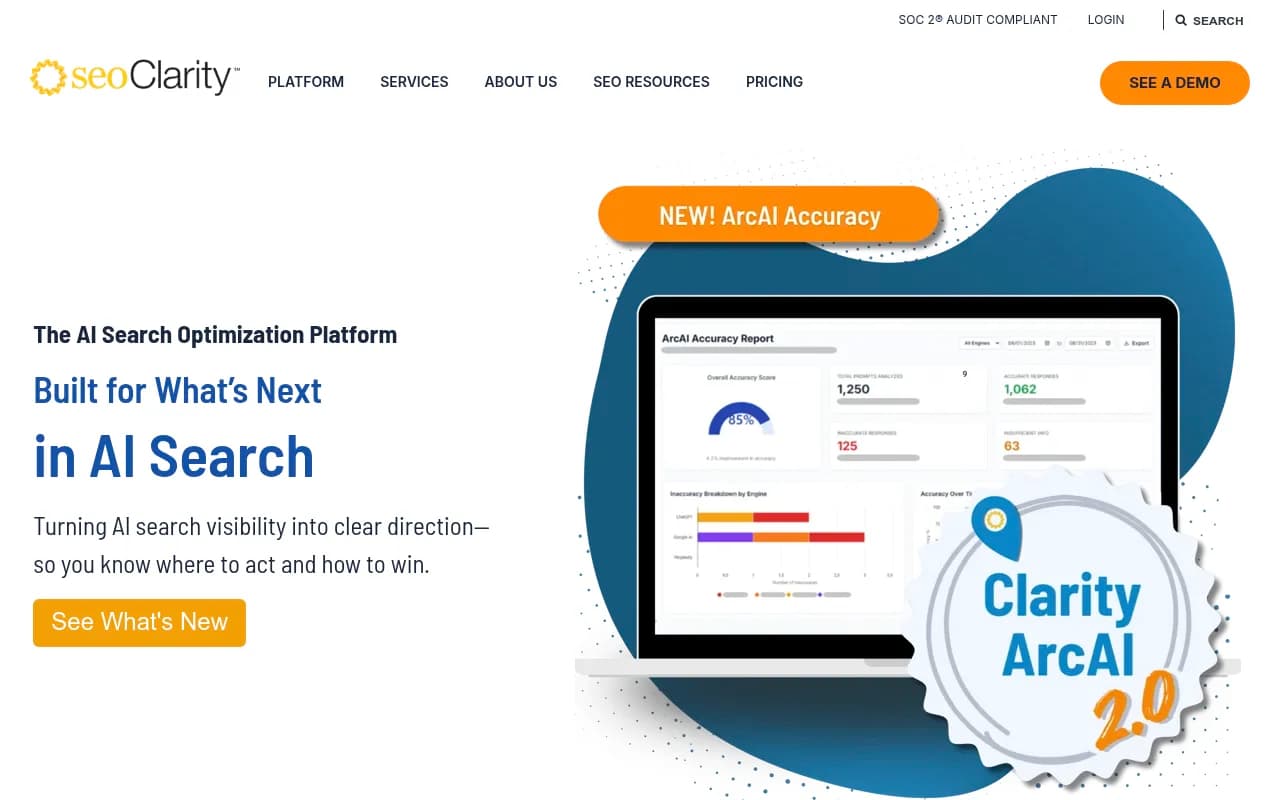
If the suite route feels heavy, other options in the same space include Profound, seoClarity and Semrush Enterprise. The GEO software directory at bestgeosoftware.com lists more, and for crawl-focused alternatives to Botify, Lumar and Oncrawl are worth a look.

Procurement checklist
- Ask each vendor which AI engines are tracked today, and whether they use the real interfaces or APIs. Answers can differ.
- Request a trial on your own domain to see agent traffic and failures in your logs.
- Get written approval controls, publishing methods and rollback processes for any automated deployment.
- Confirm what the price includes: prompt volume, seats, markets, AI modules.
- Ask how AI referrals connect to conversions, and whether you can export or hit an API.
- Check security scope: SAML SSO, and certification coverage, not just the badge.
- Treat every "best of" list, including this one, as input rather than a verdict. Verify against vendor pages and a demo.
There is no clean winner. The right answer is whichever one your team will actually operate every week, and whichever one can show real AI citation and crawler data on your site before you commit.