BrightEdge Review 2026
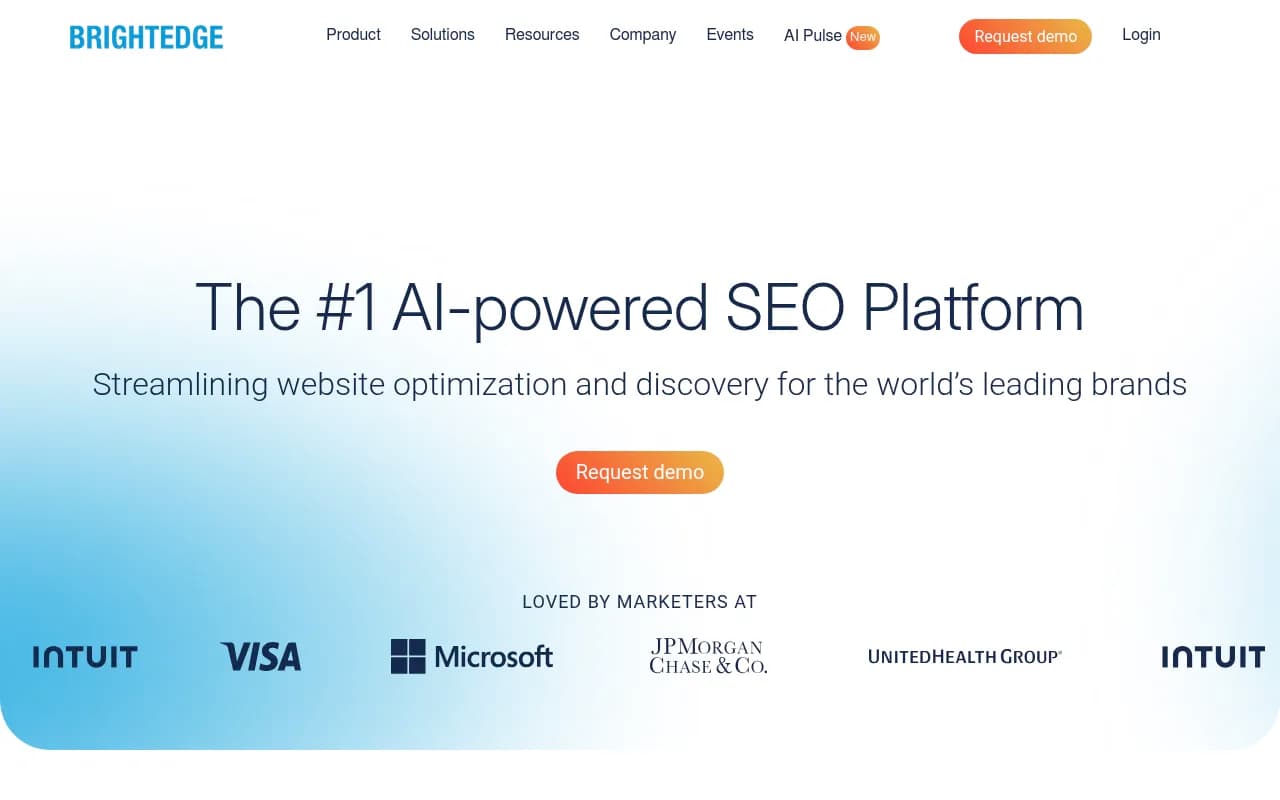
BrightEdge is an enterprise-grade SEO platform that combines proprietary keyword research (4B+ data points), AI-powered content optimization (Copilot/Autopilot), and visibility tracking across traditional search and AI engines. Built for large marketing teams managing complex, multi-market websites
Key Takeaways
- BrightEdge is an enterprise SEO platform built for large organizations managing complex, multi-market websites -- think IBM, Fortune 500 brands, and global e-commerce operations
- The platform combines proprietary keyword research (Data Cube X with 4B+ data points and 10 years of historical data), AI-powered optimization (Copilot for insights, Autopilot for automated changes), and visibility tracking across traditional search and AI engines
- Lacks content generation, AI crawler logs, and traffic attribution that Promptwatch offers -- BrightEdge monitors AI visibility but doesn't help you create content that ranks in AI search or track how AI models crawl your site
- Pricing is custom/enterprise only (no public pricing) -- expect significant investment, typically starting at $10K-$30K+ annually based on industry reports
- Best for enterprise marketing teams with dedicated SEO resources and budget; overkill for small businesses or solo marketers
BrightEdge has been around since 2007, making it one of the older players in the enterprise SEO space. It's positioned as an all-in-one platform for large organizations that need to coordinate SEO strategy across multiple teams, markets, and websites. The company claims over 1,700 customers including major brands like Microsoft, Adobe, and 3M. In 2024, they raised additional funding and have been pushing hard into AI search visibility as traditional SEO gets disrupted by ChatGPT, Perplexity, and Google AI Overviews.
The core pitch: replace your stack of point solutions (keyword tools, content optimization, rank tracking, site audits, local SEO management) with one unified platform that gives everyone -- from SEO specialists to CMOs -- a single source of truth.
Data Cube X: The Keyword Research Engine
BrightEdge's proprietary keyword research database is the foundation of the platform. Data Cube X claims 4 billion data points with 10 years of historical ranking data. You can research keywords, see search volume, difficulty scores, SERP features, and track how rankings change over time. The historical depth is genuinely useful if you're trying to understand seasonal trends or long-term shifts in search behavior.
What makes it different from Ahrefs or Semrush: BrightEdge focuses on accuracy for enterprise use cases. They claim their data is more reliable for tracking large keyword sets (thousands or tens of thousands of terms) across multiple markets and languages. The interface lets you segment keywords by product line, geography, or custom business categories -- helpful when you're managing a global brand with regional teams.
The downside: it's not as fast or exploratory as Ahrefs. If you want to quickly brainstorm content ideas or discover long-tail variations, Ahrefs Keyword Explorer is more intuitive. Data Cube X is built for structured research and ongoing tracking, not ad-hoc discovery.
Copilot and Autopilot: AI-Powered Optimization
BrightEdge has two AI features with confusingly similar names:
-
Copilot is an AI assistant that surfaces insights and recommendations. It analyzes your site, identifies optimization opportunities (missing meta descriptions, thin content, keyword cannibalization), and suggests fixes. Think of it as a smart dashboard that tells you what to work on next.
-
Autopilot is automated optimization. You set rules (e.g. "auto-generate meta descriptions for product pages missing them") and Autopilot makes the changes directly on your site via API integrations or tag manager. This is powerful for large sites with thousands of pages where manual optimization isn't feasible.
Autopilot is the more interesting feature. If you're managing an e-commerce site with 50,000 product pages, having AI automatically optimize title tags, meta descriptions, and structured data can save hundreds of hours. The catch: you need technical setup (API access, CMS integration) and trust that the AI won't break things. BrightEdge positions this as a differentiator vs competitors, and it is -- most SEO platforms stop at recommendations, they don't make changes for you.
Copilot is less impressive. It's essentially a smart to-do list. Useful, but not groundbreaking. Ahrefs Site Audit and Semrush Site Audit provide similar prioritized recommendations.
AI Search Visibility Tracking
BrightEdge added AI search visibility tracking in 2024 as ChatGPT, Perplexity, and Google AI Overviews started eating into traditional search traffic. The platform now monitors whether your brand appears in AI-generated answers across multiple models.
What it tracks: brand mentions and citations in AI responses, visibility scores, and which competitors are appearing instead of you. You can see which queries trigger AI answers and whether your content is being cited.
What it doesn't do: BrightEdge is monitoring-only. It shows you the data but doesn't help you fix the problem. There's no content gap analysis showing what topics you're missing, no AI content generation to create articles optimized for AI citation, no AI crawler logs to see how ChatGPT or Claude are actually crawling your site, and no traffic attribution to connect AI visibility to actual revenue.
This is where Promptwatch is fundamentally different. Promptwatch doesn't just monitor AI visibility -- it shows you exactly what content you're missing (Answer Gap Analysis), generates optimized content for you (AI writing agent grounded in 880M+ citations), tracks AI crawler behavior (real-time logs of ChatGPT, Claude, Perplexity hitting your site), and connects visibility to traffic and revenue (visitor analytics and attribution). BrightEdge gives you the dashboard; Promptwatch gives you the action loop.

Content Optimization and Creation
BrightEdge has a content module that helps you optimize existing pages and plan new content. You can analyze a page, see which keywords it ranks for, get suggestions for related terms to add, and track content performance over time.
The content brief feature generates outlines based on top-ranking pages for a target keyword. It's similar to Clearscope or Surfer SEO but less detailed. You get a list of topics to cover and keywords to include, but not the depth of semantic analysis or real-time content scoring that dedicated content optimization tools provide.
BrightEdge does not have an AI content writer. Copilot can suggest content improvements, but it won't generate full articles for you. If you want AI-generated content optimized for search, you'll need a separate tool (Jasper, Copy.ai, or Promptwatch's AI writing agent for AI search optimization).
E-commerce and Amazon Tracking
BrightEdge is one of the few enterprise SEO platforms that tracks Amazon rankings. If you're a brand selling on Amazon, you can monitor keyword rankings, see which competitors are winning, and track how your product listings perform over time.
This is genuinely useful for e-commerce brands with a significant Amazon presence. Most SEO tools ignore Amazon entirely. The downside: Amazon SEO is a different game than Google SEO, and BrightEdge's Amazon features are more about monitoring than optimization. You still need Amazon-specific tools (Helium 10, Jungle Scout) for deep product research and listing optimization.
Local SEO Management
For brands with physical locations (retail chains, multi-location services), BrightEdge has a local SEO module that manages Google Business Profile listings, tracks local rankings, and monitors reviews.
You can bulk-update business information across hundreds of locations, respond to reviews from a central dashboard, and see which locations are ranking well vs poorly. It's similar to Yext or BrightLocal but integrated into the broader SEO platform.
The value here is consolidation. If you're already using BrightEdge for enterprise SEO, adding local management makes sense. But if local SEO is your primary focus, dedicated tools like BrightLocal or Whitespark offer more depth.
Site Audits and Technical SEO
BrightEdge crawls your site and identifies technical issues: broken links, missing meta tags, slow pages, duplicate content, crawl errors, structured data problems. Standard stuff. The audit reports are detailed and you can track fixes over time.
What's different: BrightEdge integrates audit data with keyword rankings and content performance. You can see which technical issues are affecting your most valuable pages and prioritize fixes based on business impact. Most site audit tools (Screaming Frog, Sitebulb) just give you a list of problems without connecting them to revenue.
The downside: the crawler is slower than Screaming Frog and less customizable. If you need deep technical analysis (JavaScript rendering, log file analysis, advanced crawl rules), you'll still want a dedicated tool.
Integrations and Workflow
BrightEdge integrates with major enterprise tools: Google Analytics, Google Search Console, Adobe Analytics, Salesforce, Marketo, HubSpot, WordPress, Drupal, and various tag managers. The integrations are solid -- you can pull in traffic data, push recommendations to your CMS, and sync SEO metrics with marketing dashboards.
The platform also has role-based access controls, approval workflows, and custom reporting for different stakeholders. This is important for large organizations where SEO touches multiple teams (content, web dev, product marketing, regional managers). You can give each team a customized view of the data they care about without overwhelming them with everything.
Who Is It For
BrightEdge is built for enterprise marketing teams managing large, complex websites. Specifically:
-
Fortune 500 brands and large enterprises with dedicated SEO teams (3+ people) managing sites with 10,000+ pages across multiple markets and languages. Think IBM, Microsoft, Adobe -- companies with global reach and complex organizational structures.
-
E-commerce operations with large product catalogs (thousands of SKUs) that need automated optimization at scale. If you're manually optimizing meta descriptions for 50,000 product pages, Autopilot can save you months of work.
-
Multi-location businesses (retail chains, franchise networks, healthcare systems) that need to manage local SEO across hundreds or thousands of locations while maintaining brand consistency.
-
Agencies serving enterprise clients who need a platform that can handle multiple client accounts, white-label reporting, and complex permission structures.
Who should NOT use BrightEdge:
-
Small businesses and startups -- the pricing is prohibitive and the feature set is overkill. You don't need enterprise workflow management when you're a team of 3.
-
Solo marketers or freelancers -- the platform is designed for team collaboration. If you're working alone, Ahrefs or Semrush gives you 90% of the value at 10% of the cost.
-
Companies prioritizing AI search optimization -- BrightEdge monitors AI visibility but doesn't help you create content that ranks in ChatGPT, Claude, or Perplexity. If AI search is a priority, Promptwatch's action-oriented approach (gap analysis, content generation, crawler logs, traffic attribution) is a better fit.
Pricing and Value
BrightEdge does not publish pricing. It's custom/enterprise only. Based on industry reports and user reviews, expect to pay $10,000-$30,000+ per year depending on the number of domains, keywords tracked, and features included. Some users report contracts in the $50,000-$100,000 range for large deployments.
There's no free trial. You have to request a demo and go through a sales process. This is standard for enterprise software but frustrating if you want to evaluate the platform quickly.
Is it good value? Depends on your scale. If you're managing a $10M+ SEO program with multiple teams and complex workflows, BrightEdge can pay for itself by improving efficiency and coordination. If you're a mid-market company with a $500K marketing budget, the ROI is harder to justify -- Ahrefs ($199/mo) or Semrush ($229/mo) will get you 80% of the way there for a fraction of the cost.
Strengths
- Proprietary keyword data with 10 years of historical context -- genuinely useful for understanding long-term trends and seasonal patterns
- Autopilot automated optimization -- unique in the enterprise SEO space, can save massive time for large sites
- Unified platform -- replaces multiple point solutions, simplifies workflows for large teams
- Amazon ranking tracking -- rare feature that matters for e-commerce brands
- Enterprise-grade integrations and permissions -- built for complex organizational structures
Limitations
- No AI content generation -- Copilot suggests improvements but won't write articles for you. If you want AI-generated content optimized for AI search, you need a separate tool like Promptwatch.
- No AI crawler logs -- BrightEdge tracks AI visibility but doesn't show you how ChatGPT, Claude, or Perplexity are actually crawling your site. Promptwatch provides real-time logs of AI crawler activity, errors, and indexing issues.
- No AI traffic attribution -- You can see AI visibility scores but can't connect them to actual traffic or revenue. Promptwatch offers visitor analytics and attribution to close the loop.
- Monitoring-only for AI search -- BrightEdge shows you where you're invisible in AI answers but doesn't help you fix it. No content gap analysis, no prompt volume data, no query fan-outs, no Reddit/YouTube tracking. Promptwatch's Answer Gap Analysis shows exactly what content you're missing and generates optimized articles to fill those gaps.
- Expensive and opaque pricing -- no public pricing, long sales cycles, high cost of entry
- Slower than dedicated tools -- keyword research is less exploratory than Ahrefs, site audits are slower than Screaming Frog
- Steep learning curve -- the platform is powerful but complex, requires training and onboarding
Bottom Line
BrightEdge is a solid enterprise SEO platform for large organizations that need unified workflows, automated optimization at scale, and executive-level reporting. If you're managing a Fortune 500 website with multiple teams and complex requirements, it's worth evaluating.
But it's monitoring-focused, not action-oriented -- especially for AI search. BrightEdge will show you that you're invisible in ChatGPT and Perplexity, but it won't help you fix it. For companies serious about AI search optimization, Promptwatch is the better choice: it shows you what content you're missing, generates optimized articles, tracks AI crawler behavior, and connects visibility to revenue. BrightEdge is a dashboard; Promptwatch is an optimization engine.
Best use case in one sentence: Enterprise marketing teams managing 10,000+ page websites across multiple markets who need automated optimization and unified reporting, but are willing to supplement with other tools for AI search optimization and content creation.
Tags:
Frequently asked questions
What is BrightEdge and what does it do?
How much does BrightEdge cost?
Who is BrightEdge best suited for?
What are the key features of BrightEdge?
Does BrightEdge offer a free version or trial?
What companies use BrightEdge?
Does BrightEdge track AI search visibility?
How long has BrightEdge been in business?
Similar and alternative tools to BrightEdge