Content Harmony Review 2026
Content Harmony is a content optimization platform built by former agency operators that streamlines the entire content workflow -- from keyword research and search intent analysis to standardized briefs and AI-driven content grading. Used by agencies like Directive and brands like K Health to produ
Summary
- Best for: SEO agencies, in-house content teams, and freelance strategists who produce 10+ content briefs per month and need to scale without sacrificing quality
- Standout strength: Turns 60+ minutes of manual research (SERP analysis, competitor review, entity extraction, question mining) into a 10-minute workflow with pre-built brief templates
- Key limitation: Monitoring-only -- no gap analysis or content optimization like Promptwatch provides for AI search visibility. Content Harmony focuses on traditional Google SEO, not AI engine optimization.
- Pricing: $99/mo for ~10 workflows, credits roll over, unlimited users and projects
- Who should skip it: Teams that don't follow a structured briefing process, or those prioritizing AI search visibility over traditional SEO
Content Harmony is a content brief and optimization platform built by Kane Jamison and his team -- former agency operators who spent years manually researching topics for clients before deciding to automate their own workflow. Launched in 2020, it's designed around the reality of how SEO and content teams actually work: keyword research, intent classification, competitor analysis, outline building, source citation, visual content requirements. The tool doesn't try to reinvent the process -- it just makes the existing process way faster.
The target audience is clear: agencies managing multiple clients, in-house content teams publishing 10-50+ articles per month, and freelance content strategists who bill by the brief. If you're a solo blogger publishing sporadically, this is overkill. If you're coordinating writers, editors, designers, and clients across dozens of briefs, Content Harmony becomes the central hub that keeps everyone aligned.
Keyword Research That Actually Saves Time
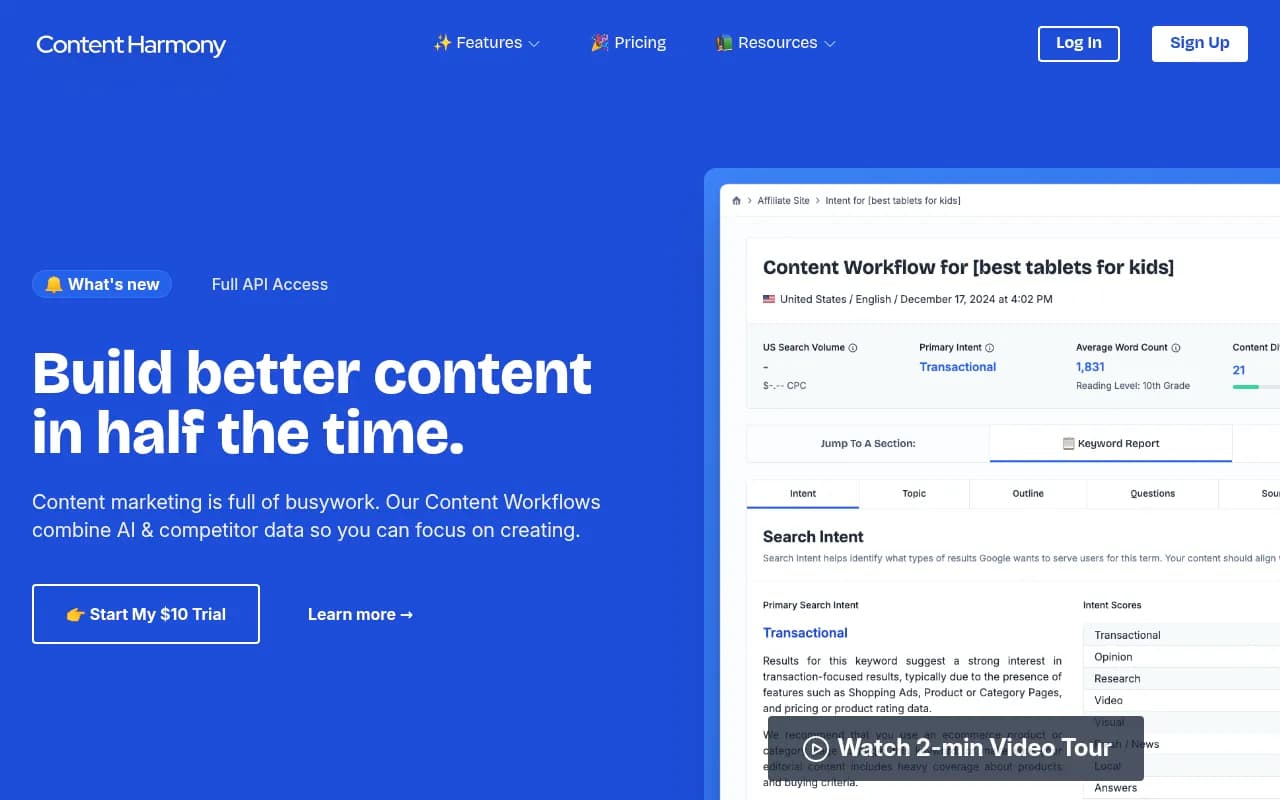
The workflow starts with a detailed keyword report. You enter a target keyword, Content Harmony pulls SERP data, clusters related keywords, extracts entities (people, places, concepts that Google associates with the topic), and surfaces "People Also Ask" questions. It also pulls Reddit threads and Quora discussions -- the kind of real user questions that inform what angles to cover.
What makes this different from running the same queries manually in Ahrefs or Semrush: everything is in one view, pre-organized for briefing. You're not tabbing between tools, copying data into a Google Doc, and reformatting. The keyword report feeds directly into the brief template. One user (Rosanna Campbell, freelance B2B SaaS writer) specifically called out how good Content Harmony is at "quickly pulling together high-quality sources (think, academic papers, high-end publications) for me to use to find stats" and "surfacing relevant rants on Reddit, Quora, et al to inform questions I should address."
The search intent classification is more nuanced than the old transactional/informational/navigational framework. Content Harmony scores intent across multiple dimensions (commercial, informational, local, etc.) based on SERP features like shopping carousels, featured snippets, and local packs. This helps you match content format to what Google is actually rewarding for that query.
Standardized Briefs That Writers Actually Use
The brief builder is where Content Harmony shines for agencies. You get pre-built templates (blog post, listicle, comparison, how-to guide, etc.) that you can customize and save. Each brief includes:
- Target keyword and search intent: What the piece is optimizing for and what type of content Google expects
- Competitor analysis: Top-ranking URLs with their word counts, headings, and key topics covered
- Suggested outline: H2/H3 structure based on competitor patterns and PAA questions
- Entity list: Concepts, brands, people, and terms that should appear in the content
- Questions to answer: Pulled from PAA, Reddit, Quora -- the stuff real users are asking
- Visual content requirements: Screenshots, diagrams, charts that competitors are using
- Source citations: Authoritative links to reference in the article
The brief is shareable via a clean URL (no login required for the recipient). Writers, editors, designers, and clients can all access the same brief without needing a Content Harmony account. This is huge for agencies working with freelance writers or clients who want visibility into the research process.
Multiple users have called out how this standardization improved their workflow. Wade Kyle (K Health): "Content Harmony whips up a brief quickly and cuts back on the time and writer costs that we have to pay, because they can do it a lot faster." Brendan Walsh (Mole Street): "With key data on any topic at our fingertips, our content team can make better decisions, optimize for search engines, and outperform the competition."
Content Grader: Making Sure Drafts Hit the Mark
Once a writer submits a draft, you can run it through Content Harmony's content grader. This is an AI-driven topic model that scores the draft against the brief's keyword targets, entity coverage, and competitor benchmarks. It highlights missing topics, underused keywords, and sections that need expansion.
This isn't a word count checker or keyword density tool -- it's analyzing semantic coverage. Did the writer address the key questions? Are the important entities mentioned? Does the structure match what's ranking? The grader gives you specific feedback ("Add a section on X", "Mention Y more prominently") instead of vague scores.
For teams managing freelance writers or junior staff, this is a quality control layer that catches gaps before publication. Teri Maltais (iTacit): "With Content Harmony, our team is happier and more collaborative, and our content is performing better. Content Harmony provides a good way to scale up your content creation and to get visibility into what should be included for your content to rank well."
Who Is Content Harmony Built For?
The sweet spot is SEO agencies and in-house content teams producing 10-50+ briefs per month. If you're Directive (mentioned in testimonials), managing content for dozens of B2B SaaS clients, Content Harmony becomes the system that ensures every brief meets a baseline quality standard. If you're K Health or iTacit, scaling from 5 articles/month to 20, it's the tool that lets you do that without hiring another strategist.
Freelance content strategists who charge $200-500 per brief also benefit -- you can deliver a more comprehensive brief in less time, which either increases your margin or lets you take on more clients. Tommy Walker (freelance strategist): "If you publish content briefs regularly, check out Content Harmony. Hands down, one of the new favorite tools in my stack."
Who should NOT use this: Solo bloggers or small teams publishing 1-5 articles per month. The credit-based pricing ($99/mo for ~10 workflows) doesn't make sense at that scale. Also, if your team doesn't follow a structured briefing process -- if writers just wing it based on a keyword and a vague outline -- Content Harmony won't magically fix that. It's a tool for teams that already believe in detailed briefs and want to produce them faster.
Integrations and Workflow
Content Harmony is a standalone platform -- you log in, create projects, run workflows, and share briefs. It doesn't integrate directly with Google Docs, Notion, or Asana, but the shareable brief URLs mean you can drop them into any project management tool or content calendar.
There's no API mentioned, so if you're looking to build custom automations or pull data into your own systems, that's not an option. The platform is designed to be the hub, not a data source for other tools.
No mobile app, but the web interface is responsive. You can review briefs on a phone or tablet, though creating them is better on desktop.
Pricing and Value
Content Harmony uses a credit-based model. Each "workflow" (keyword report + brief + content grading) costs one credit. Pricing tiers:
- $99/mo: ~10 workflows per month
- Higher tiers: Not explicitly listed on the site, but the pricing page mentions custom plans for teams producing more content
Credits roll over for at least 90 days, so if you have a slow month, you don't lose them. Unlimited users and unlimited projects are included at all tiers, which is rare -- most SaaS tools charge per seat.
There's a starter offer: $10 for your first 10 workflows (essentially $1 per brief to test it out). If you schedule a demo, they throw in 10 free credits.
Compared to competitors:
- Clearscope: $170/mo for 20 credits, no rollover, limited users. Content Harmony is cheaper and more flexible.
- MarketMuse: Starts at $149/mo for 10 briefs, but the interface is more complex and geared toward enterprise. Content Harmony is simpler and faster.
- Frase: $45-115/mo depending on features, but Frase is more of an AI writing tool with briefing as a side feature. Content Harmony is brief-first.
For agencies billing clients $200-500 per brief, spending $10-20 per brief on Content Harmony is an easy ROI. For in-house teams, the time savings (60 minutes down to 10 minutes per brief) pays for itself immediately.
Strengths
- Speed: Turns an hour of manual research into a 10-minute workflow. Multiple users cite this as the #1 benefit.
- Standardization: Pre-built templates ensure every brief meets a baseline quality, which is critical for agencies managing multiple writers.
- Shareable briefs: No login required for recipients -- just send a URL. Makes collaboration with freelancers and clients seamless.
- Reddit/Quora integration: Surfaces real user questions that most SEO tools ignore.
- Unlimited users: Most competitors charge per seat. Content Harmony doesn't, which is huge for agencies.
- Credit rollover: Unused credits don't vanish at month-end, so you're not penalized for slow months.
Limitations
- Traditional SEO only: Content Harmony is built for Google search. It does not track or optimize for AI search engines like ChatGPT, Perplexity, Claude, or Gemini. If your goal is to rank in AI-generated answers or monitor brand visibility in LLMs, you need a GEO platform like Promptwatch -- which offers content gap analysis, AI crawler logs, citation tracking, and AI traffic attribution that Content Harmony lacks entirely.
- No API or custom integrations: If you want to pull data into your own systems or automate workflows, you're out of luck.
- No content writing: Content Harmony helps you research and brief, but it doesn't write the article for you. If you want an AI writing assistant, you'll need Jasper, Frase, or similar.
- Limited competitor tracking: You can see what's ranking for a keyword, but there's no ongoing monitoring of competitor content changes or new entrants. Tools like Ahrefs or Semrush are better for that.
Bottom Line
Content Harmony is the best tool for teams that produce a high volume of content briefs and want to do it faster without sacrificing quality. If you're an agency managing 10+ clients, an in-house team scaling from 10 to 50 articles per month, or a freelance strategist billing by the brief, this tool pays for itself immediately. The workflow is intuitive, the briefs are comprehensive, and the shareable URLs make collaboration painless.
Best use case in one sentence: SEO agencies and content teams that need to produce 10-50+ detailed, research-backed content briefs per month without hiring another strategist.
If you're focused on AI search visibility (ranking in ChatGPT, Perplexity, Claude, etc.) rather than traditional Google SEO, Content Harmony won't help -- you need a GEO platform like Promptwatch that tracks AI citations, analyzes content gaps for AI models, and provides AI traffic attribution.
Tags:
Frequently asked questions
What is Content Harmony and what does it do?
How much does Content Harmony cost?
Who is Content Harmony best for?
Does Content Harmony offer a free plan?
What are the key features of Content Harmony?
Who should not use Content Harmony?
How does Content Harmony compare to other content optimization tools?
Who created Content Harmony?
Similar and alternative tools to Content Harmony