Superlines Review 2026
Generative Engine Optimization platform that helps brands track and improve visibility in AI search results, with tools for monitoring, content strategy, and competitive analysis.
Key takeaways
- Superlines monitors brand visibility across 10+ AI models by analyzing real front-end interfaces rather than API calls, which means the data reflects what users actually see
- Lacks content generation, AI crawler logs, Reddit/YouTube tracking, and traffic attribution that Promptwatch offers -- Superlines is primarily a monitoring and analytics platform with limited optimization tooling
- Pricing starts at €89/month with a 7-day free trial, making it one of the more accessible GEO tools for smaller teams
- Strong fit for enterprise brands and digital agencies that need competitive benchmarking and multi-region tracking
- The MCP server and API access are genuinely useful for teams building agentic workflows, which is a differentiator from many competitors
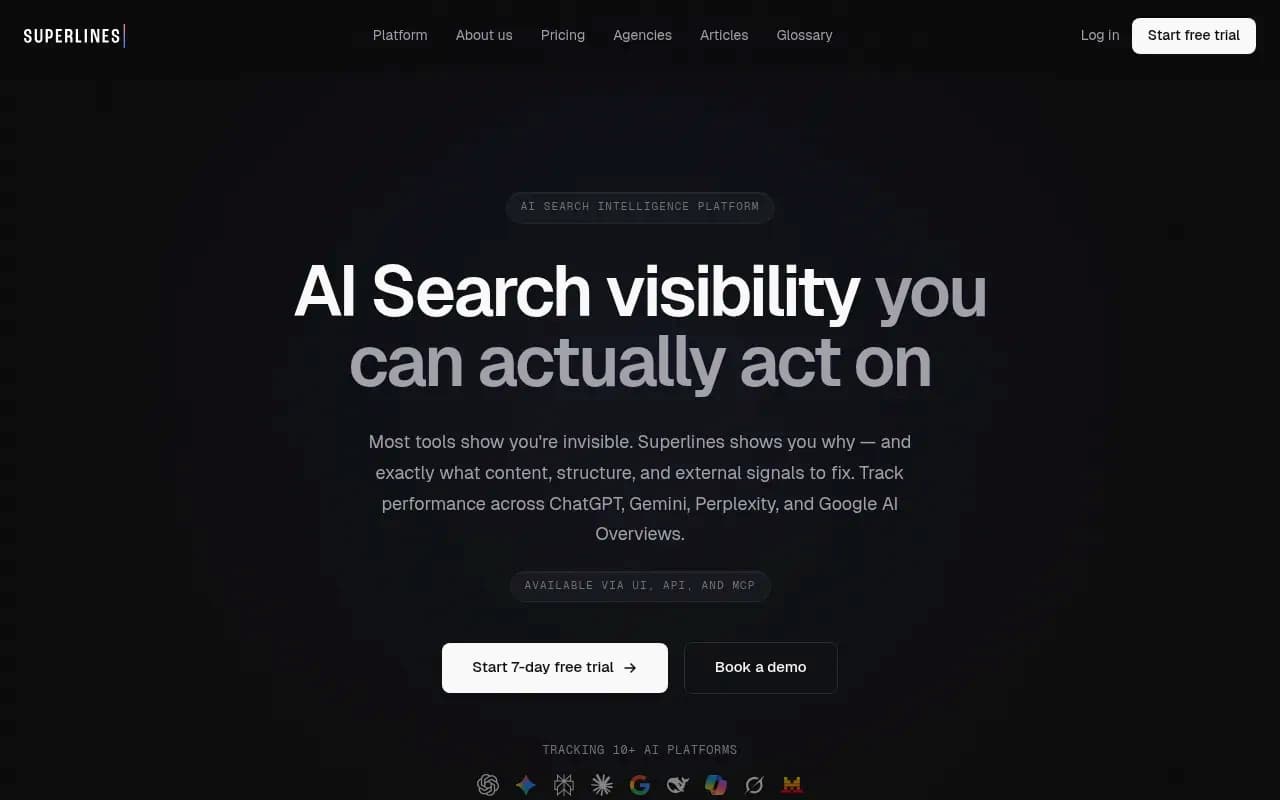
Superlines is a Finnish AI search intelligence platform aimed at brands and agencies that want to understand how they appear in AI-generated answers. The core pitch is straightforward: as more consumers use ChatGPT, Perplexity, and Google AI Overviews to research products and make decisions, traditional SEO tools leave a blind spot. Superlines fills that gap by continuously tracking where your brand shows up, how it's described, and which competitors are getting cited instead of you.
The company positions itself as "decision-grade" analytics, a phrase that comes up repeatedly in their marketing. What they mean is that the data is based on real AI interface outputs rather than API responses, which can differ from what users actually see. That's a meaningful technical distinction, and it's one of the more honest differentiators in a space where a lot of vendors are vague about methodology.
Superlines appears to be a relatively young company, with a customer base that includes Tallink Silja, Supabase, Tietoevry, and Finnlines. The platform is available via UI, API, and a Model Context Protocol (MCP) server, which suggests they're building for teams that want to integrate AI visibility data into broader workflows rather than just check a dashboard.
Key features
Real AI interface monitoring (not API-based) Most GEO tools query AI model APIs directly, which can produce different outputs than what users see in the actual ChatGPT or Perplexity interface. Superlines claims to capture the real front-end experience, including citations, formatting, and brand framing. In practice, this means the data should be more representative of actual user experience, though it also means the platform is dependent on scraping interfaces that can change without notice.
Multi-model coverage across 10+ platforms Superlines tracks ChatGPT, Gemini, Perplexity, Claude, Google AI Overviews, Google AI Mode, DeepSeek, Copilot, Grok, and Mistral. That's a solid breadth of coverage. The ability to compare performance across models matters because different AI systems have different citation behaviors -- a brand that ranks well in Perplexity might be invisible in Gemini.
Competitive benchmarking You can track how competitors perform across AI search, see which brands are cited most often, and monitor share of voice changes over time. The platform also flags new market entrants, which is useful for brands in fast-moving categories. Regional and language-specific tracking is available, which matters for global brands operating across multiple markets.
AI visibility signals Beyond just showing where you appear, Superlines tries to explain why competitors are being cited over you. This includes which URLs AI models prefer and how your brand is framed in responses. The "signals" framing suggests some diagnostic capability, though the depth of this analysis isn't fully clear from public documentation.
Prompt management and tracking You can build a governed set of tracked prompts for your category, use cases, and competitors, then run them continuously across AI models. This is the foundation of any GEO monitoring workflow. The ability to organize prompts by category and track them over time is table stakes for the category, but Superlines appears to handle it cleanly.
Enterprise MCP server and API This is one of Superlines' more interesting features. The Model Context Protocol (MCP) server lets you feed real-time visibility intelligence directly into AI agents and custom workflows. For teams building agentic marketing or SEO workflows, having structured AI visibility data available via MCP is genuinely useful. The API also supports custom reporting and integration with existing data stacks.
In-app agent Superlines includes an in-app agent that can help translate visibility data into prioritized actions. The specifics of what this agent does aren't fully detailed publicly, but the framing suggests it's meant to bridge the gap between data and action -- identifying what to publish, what to update, and what to fix technically.
Agency multi-client management For agencies, Superlines offers a dedicated workflow: manage multiple clients in one platform, create exportable reports, and access the data layer via API and MCP. There's also a partner program with revenue-sharing components, which is a standard agency incentive structure.
Sentiment and citation tracking The dashboard includes brand sentiment analysis alongside citation rate and share of voice metrics. Knowing that you're being cited is useful; knowing whether AI models are describing your brand positively or negatively is more useful. Sentiment tracking at the AI response level is a feature that not all competitors offer.
Who is it for
Superlines fits best for mid-market to enterprise marketing and SEO teams that are starting to take AI search seriously and need structured data to justify investment and guide strategy. Think a Head of SEO at a travel brand like Tallink Silja, managing visibility across multiple markets and languages, who needs to show leadership that AI search is a measurable channel. Or a digital agency like Tulos that wants to differentiate its offering by bringing AI visibility reporting into client engagements.
For agencies specifically, the multi-client management and exportable reporting make Superlines a reasonable operational choice. The partner program adds a commercial incentive. Agencies running 10-30 client accounts in competitive verticals like finance, travel, or B2B SaaS would find the competitive benchmarking features particularly relevant.
The MCP server and API access make Superlines interesting for technically sophisticated teams -- growth engineers or marketing ops folks who want to pipe AI visibility data into their own dashboards, Slack alerts, or agentic workflows. That's a narrower audience, but it's a real one.
Who should probably look elsewhere: small businesses or solo operators who need a simple, affordable way to track a handful of prompts. The platform's enterprise positioning and pricing structure (starting at €89/month) may be more than they need. Teams that want to not just monitor but actively generate content optimized for AI search will also find Superlines limited -- the platform is primarily an analytics and intelligence tool, not a content creation one.
Integrations and ecosystem
Superlines' most notable integration story is the MCP server, which connects AI visibility data to agentic workflows built on tools like Claude Desktop, Cursor, or custom AI agents. This is forward-looking infrastructure that most competitors haven't built yet.
The REST API allows teams to pull visibility data into external dashboards, BI tools like Looker or Tableau, or custom reporting setups. Export capabilities appear to include standard report formats for client delivery.
There's no publicly documented native integration with Google Search Console, Slack, or common marketing platforms like HubSpot or Salesforce. The GitHub presence (github.com/Superlines) suggests some developer tooling, though the public repositories aren't detailed in available information.
No mobile app is mentioned. The platform is web-based, accessible via the analytics subdomain (analytics.superlines.io).
Pricing and value
Superlines starts at €89/month, which positions it as one of the more affordable options in the GEO space. The company offers a 7-day free trial with access to core platform features, and agency pricing is available separately.
The full pricing tier breakdown isn't publicly detailed beyond the starting price, but the company explicitly compares itself to AthenaHQ (which starts at $295/month for its self-serve plan), positioning Superlines as significantly cheaper. Annual billing discounts are likely available but not confirmed in public documentation.
At €89/month, Superlines is cheaper than Promptwatch's Essential plan ($99/month) on paper, though the feature sets differ meaningfully. For pure monitoring and competitive benchmarking, Superlines is competitively priced. For teams that need content generation, AI crawler logs, and traffic attribution, the comparison gets more complicated because Superlines doesn't offer those capabilities.
The 7-day free trial is shorter than some competitors but enough to validate whether the platform's data quality and interface meet your needs.
Strengths and limitations
What Superlines does well:
- Real interface monitoring: Capturing actual AI interface outputs rather than API responses is a genuine methodological advantage. The data is more representative of user experience.
- MCP server and API: The infrastructure play is smart. Feeding AI visibility data into agentic workflows is a real use case that most competitors haven't addressed.
- Multi-model breadth: 10+ AI platforms is solid coverage, including less common ones like Mistral and Grok.
- Competitive benchmarking: The share of voice and competitor citation tracking is well-developed for a platform at this price point.
- Accessible pricing: Starting at €89/month makes it reachable for smaller teams and agencies without enterprise budgets.
Honest limitations:
- No content generation: Superlines identifies what to fix but doesn't help you create the content to fix it. There's no built-in AI writing agent or content gap analysis that generates actual articles or pages. Platforms like Promptwatch include a full AI writing agent that generates content grounded in citation data.
- No AI crawler logs: Superlines doesn't show you which AI crawlers are hitting your website, which pages they're reading, or what errors they encounter. This is a meaningful gap for teams trying to understand how AI models discover their content. Promptwatch's crawler log feature addresses this directly.
- No traffic attribution: There's no documented way to connect AI visibility to actual website traffic or revenue. Promptwatch offers traffic attribution via code snippet, Google Search Console integration, or server log analysis. Without this, it's hard to close the loop between visibility and business impact.
- No Reddit or YouTube tracking: AI models frequently cite Reddit threads and YouTube videos. Superlines doesn't appear to surface these sources, which means you're missing a channel that directly influences AI recommendations.
- No ChatGPT Shopping tracking: For e-commerce brands, monitoring when products appear in ChatGPT's shopping carousels is increasingly important. Superlines doesn't offer this.
- No prompt volume or difficulty scoring: There's no indication that Superlines provides volume estimates or difficulty scores for tracked prompts, which makes it harder to prioritize which prompts to target.
Bottom line
Superlines is a solid AI search monitoring platform with genuine strengths in data methodology, multi-model coverage, and developer-friendly infrastructure. For brands and agencies that primarily need competitive benchmarking and visibility tracking, it's a reasonable choice at an accessible price point.
The limitation is that it stops at monitoring. If you want to understand your AI visibility gaps and then actually do something about them -- generate content, track crawler behavior, attribute traffic -- you'll need to look at a more complete platform. Promptwatch covers the full optimization loop: find gaps, create content, track results, and connect visibility to revenue. Superlines shows you the problem; Promptwatch helps you fix it.
Best use case: A digital agency or enterprise SEO team that needs structured, multi-model AI visibility data and competitive benchmarking, and is comfortable handling content strategy and creation separately.
Frequently asked questions
What is Superlines?
How much does Superlines cost?
Does Superlines offer a free trial?
How does Superlines differ from other GEO tools?
Which AI platforms does Superlines monitor?
Is Superlines suitable for agencies?
Similar and alternative tools to Superlines