Serpstat Review 2026
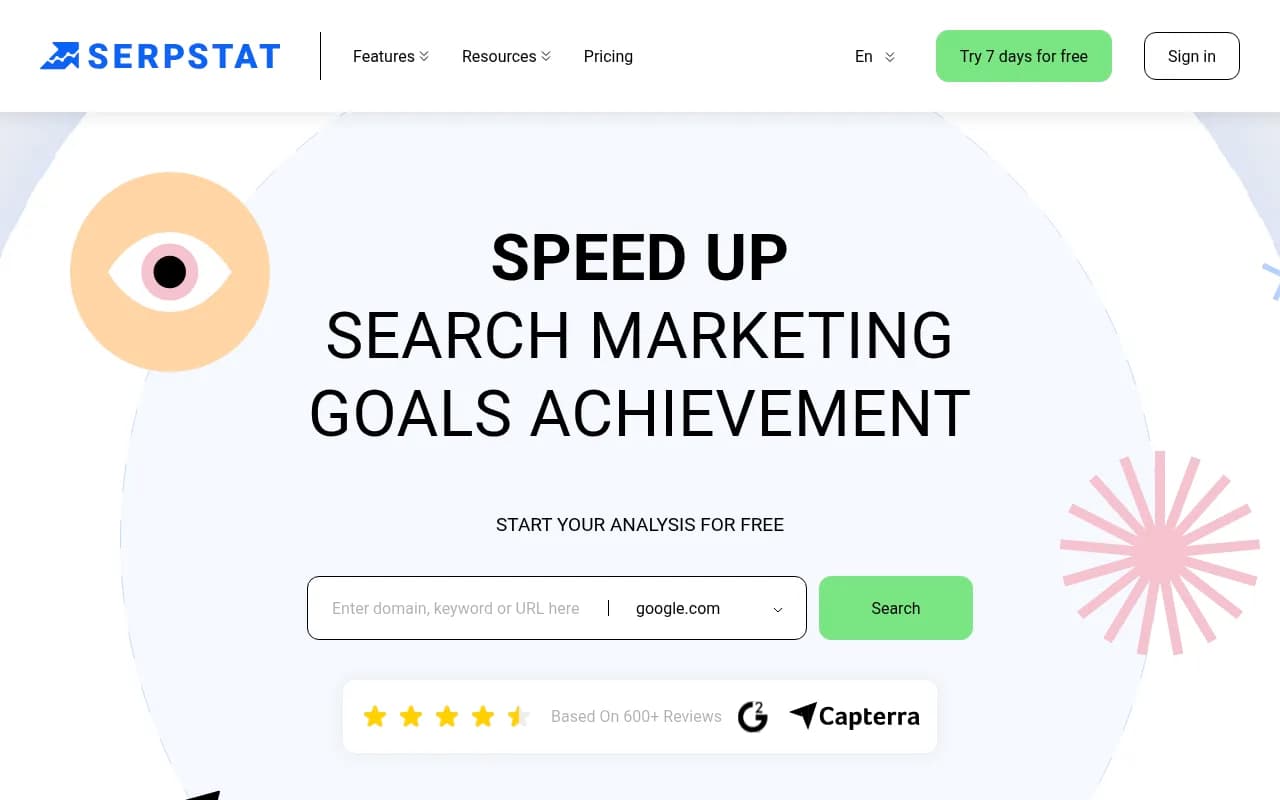
Serpstat is a comprehensive SEO and marketing platform used by 1.1M+ users including Deloitte, Visa, and Uber. It combines keyword research across 230 countries, competitor analysis, site auditing, rank tracking, and backlink analysis in one tool. Ideal for SEO teams, agencies, and marketers who nee
Summary
- Comprehensive SEO toolkit: Keyword research, competitor analysis, site audits, rank tracking, and backlink analysis in one platform
- Massive database: 8.62B keywords, 1.50B domains, 529B backlinks across 230 countries
- Affordable pricing: Individual plans start at $50/month (annual billing), significantly cheaper than Ahrefs or Semrush
- Strong for agencies: Multi-user accounts, white-label reports, API access for data reselling
- Limitations: Smaller index than Ahrefs/Semrush, less frequent data updates, fewer advanced features for enterprise users
Serpstat is an all-in-one SEO platform that's been quietly building a loyal following among agencies, freelancers, and in-house marketing teams since its launch. The company positions itself as the affordable alternative to Ahrefs and Semrush -- and for many use cases, it delivers on that promise. With 1.1M+ users and clients like Deloitte, Visa, Uber, and Shopify, it's proven it can handle serious workloads.
The core pitch is simple: you get keyword research, competitor analysis, site audits, rank tracking, and backlink analysis in one subscription, at a fraction of the cost of the big players. For small agencies managing 5-20 clients or in-house teams with limited budgets, that value proposition is hard to ignore.
Keyword Research
Serpstat's keyword database covers 8.62B keywords across 230 countries in Google and Bing. You can search by seed keyword, domain, or URL to generate keyword ideas, see search volume, keyword difficulty, CPC data, and SERP features. The tool breaks results into related keywords, questions, and search suggestions -- helpful for content planning.
Keyword difficulty scoring is straightforward but not as nuanced as Ahrefs' or Semrush's. It gives you a 0-100 score based on backlink profiles of ranking pages, but doesn't account for domain authority, content quality, or user intent signals. For most users, it's good enough to separate easy wins from uphill battles.
One standout feature: PPC keyword analysis. Serpstat shows you which keywords competitors are bidding on, their ad copy, and estimated ad spend. This is useful if you're running Google Ads campaigns and want to reverse-engineer competitor strategies without paying for a separate PPC tool.
The keyword clustering feature groups semantically related keywords together, which speeds up content planning. You can export clusters to CSV or push them directly into rank tracking projects.
Competitor Analysis
Serpstat's competitor analysis tools let you compare up to 200 domains side-by-side. You can see organic traffic estimates, keyword overlap, backlink profiles, top-performing pages, and paid search activity. The "Missing Keywords" report shows keywords your competitors rank for that you don't -- a quick way to find content gaps.
The Batch Analysis tool is particularly useful for agencies. You can upload a list of competitor domains and get a comparative report showing traffic, keywords, and backlinks for all of them at once. This saves hours compared to manually checking each domain.
One limitation: traffic estimates are less accurate than Ahrefs or Semrush, especially for smaller sites. Serpstat's index is smaller (1.50B domains vs Ahrefs' 16B+), so it misses some long-tail keywords and niche sites. For mainstream competitors in competitive niches, the data is solid. For obscure sites or very new domains, expect gaps.
Site Audit
The site audit tool crawls your website and flags technical SEO issues: broken links, duplicate content, missing meta tags, slow page speed, mobile usability problems, and more. Issues are prioritized by severity (critical, high, medium, low), and each comes with a brief explanation and fix recommendation.
You can schedule automatic audits (daily, weekly, monthly) and track how your site health score improves over time. The audit covers up to 20,000 pages on the Individual plan, 100,000 on higher tiers -- enough for most small-to-medium sites.
The recommendations are solid but generic. You won't get the depth of Screaming Frog or Sitebulb, but for most users, Serpstat's audit is good enough to catch the low-hanging fruit. The interface is clean and easy to navigate, which matters when you're trying to explain technical issues to non-technical clients.
One nice touch: the audit integrates with Google Search Console, so you can see indexing errors and manual actions alongside Serpstat's findings.
Rank Tracking
Serpstat's rank tracker monitors your keyword positions in Google (desktop and mobile) across 230 countries. You can track competitors alongside your own site, set up custom tracking schedules (daily, every 3 days, weekly), and get email alerts when rankings change significantly.
The tracker supports local search (city-level tracking), which is useful for local SEO campaigns. You can also track SERP features (featured snippets, People Also Ask, image packs) to see when your site appears in them.
One downside: the tracker doesn't support Bing, Yahoo, or other search engines. If you need multi-engine tracking, you'll need a different tool.
Project migration is free -- you can import projects from Ahrefs, Semrush, or other rank trackers without losing historical data. This is a big deal if you're switching tools mid-campaign.
Backlink Analysis
Serpstat's backlink database contains 529B backlinks across 1.50B domains. You can analyze your own backlink profile or spy on competitors to see where they're getting links. The tool shows referring domains, anchor text distribution, link types (dofollow/nofollow), and link quality scores.
The backlink index is smaller than Ahrefs (43T links) or Majestic (14T links), so you'll miss some links -- especially newer ones or links from low-authority sites. For most use cases, Serpstat's index is sufficient to identify major link-building opportunities and toxic links.
The Disavow Tool integration is handy: you can export toxic links directly to a disavow file and upload it to Google Search Console.
One missing feature: Serpstat doesn't have a link intersect tool (showing domains that link to multiple competitors but not to you). Ahrefs and Semrush both have this, and it's a powerful way to find link prospects.
API & Data Solutions
Serpstat offers API access on all paid plans, with rate limits that scale by tier. The API is well-documented and supports keyword data, backlinks, rank tracking, and domain metrics. Pricing is usage-based, starting at $0.001 per API call.
Unlike Ahrefs and Semrush, Serpstat explicitly allows data reselling. This makes it popular with agencies and SaaS companies that want to white-label SEO data for their own products. The API team offers dedicated support and custom integrations for high-volume users.
Who Is It For
Serpstat is best for:
- Small-to-medium agencies managing 5-30 clients who need a full SEO toolkit without the $400+/month price tag of Ahrefs or Semrush. The multi-user accounts and white-label reports make it easy to collaborate and present data to clients.
- Freelance SEO consultants who need keyword research, audits, and rank tracking for multiple projects but can't justify enterprise-level pricing.
- In-house marketing teams at startups or mid-sized companies with limited budgets. If you're doing SEO for one or two websites and don't need the deepest possible backlink index, Serpstat covers the essentials.
- PPC managers who want to combine SEO and paid search research in one tool. The PPC keyword analysis and ad copy insights are genuinely useful.
Who should NOT use Serpstat:
- Enterprise SEO teams managing 50+ sites or tracking hundreds of thousands of keywords. Serpstat's limits (keywords per project, pages per audit) will feel restrictive, and the smaller index will miss data you need.
- Link builders who need the most comprehensive backlink data. Ahrefs and Majestic have much larger indexes and faster crawl rates.
- Users who need advanced features like content gap analysis at scale, historical rank tracking beyond 12 months, or deep technical SEO audits. Serpstat covers the basics well but lacks the power-user features of its competitors.
Integrations & Ecosystem
Serpstat integrates with:
- Google Search Console: Import indexing data and search queries directly into Serpstat
- Google Analytics: Connect GA to see traffic data alongside keyword rankings
- Looker Studio (formerly Data Studio): Export Serpstat data to custom dashboards
- Zapier: Automate workflows (e.g., send rank tracking alerts to Slack)
The platform has a browser extension for Chrome and Firefox that shows SEO metrics (traffic, keywords, backlinks) directly in Google search results. It's lightweight and doesn't slow down your browser.
No mobile app, which is a miss. Most competitors (Ahrefs, Semrush) have mobile apps for checking rankings and metrics on the go.
Pricing & Value
Serpstat offers four subscription tiers:
- Individual: $50/month (annual billing) or $69/month (monthly). 1 user, 1 project, 500 keywords tracked, 20,000 pages audited, 10,000 backlinks checked per month.
- Team: $100/month (annual) or $139/month (monthly). 3 users, 5 projects, 2,000 keywords, 50,000 pages, 30,000 backlinks.
- Agency: $250/month (annual) or $349/month (monthly). 10 users, 20 projects, 5,000 keywords, 100,000 pages, 100,000 backlinks.
- Enterprise: Custom pricing. Unlimited users, projects, and API calls.
All plans include a 7-day free trial (no credit card required). Annual billing saves 30-40% compared to monthly.
Lifetime deals are occasionally available through AppSumo or Serpstat's own promotions. These typically offer unlimited access to a specific tier for a one-time payment ($500-$1,500). If you're committed to the platform, lifetime deals are excellent value.
Compared to competitors:
- Ahrefs: Starts at $129/month (Lite plan, 500 keywords, 5 projects). Serpstat's Individual plan is $50/month for similar limits.
- Semrush: Starts at $139.95/month (Pro plan, 500 keywords, 5 projects). Again, Serpstat is significantly cheaper.
- Moz Pro: Starts at $99/month (Standard plan, 300 keywords, 3 campaigns). Serpstat offers more keywords and projects for less money.
The trade-off: Serpstat's index is smaller, updates are less frequent, and advanced features are missing. But for most users, the cost savings outweigh the limitations.
Strengths & Limitations
Strengths:
- Affordable pricing: 50-70% cheaper than Ahrefs or Semrush for comparable features
- All-in-one platform: Keyword research, audits, rank tracking, backlinks, and PPC analysis in one subscription
- PPC keyword research: Better than most SEO tools for analyzing paid search competitors
- API access and data reselling: Explicitly allowed, making it popular with agencies and SaaS companies
- User-friendly interface: Clean, intuitive, and easy to navigate -- less overwhelming than Semrush
Limitations:
- Smaller index: 1.50B domains vs Ahrefs' 16B+. You'll miss some backlinks and long-tail keywords.
- Less frequent updates: Backlink and keyword data refreshes slower than Ahrefs or Semrush. Expect 2-4 week delays for new links or ranking changes.
- No link intersect tool: A major gap for link builders who want to find domains linking to multiple competitors.
- No mobile app: You're stuck using the web interface on mobile, which isn't optimized for small screens.
- Generic audit recommendations: The site audit is solid but doesn't match the depth of Screaming Frog or Sitebulb.
Bottom Line
Serpstat is the best budget-friendly all-in-one SEO platform in 2026. If you're a freelancer, small agency, or in-house team that needs keyword research, audits, rank tracking, and backlink analysis without spending $200+/month, Serpstat delivers. The PPC keyword research and API access are standout features that competitors charge extra for.
The smaller index and slower updates mean it's not ideal for enterprise teams or serious link builders. But for most users, Serpstat covers 80% of what Ahrefs or Semrush does at 30% of the price. That's a trade-off worth making.
Frequently asked questions
What is Serpstat and what does it do?
How much does Serpstat cost?
Is Serpstat free to use?
Who is Serpstat best for?
How does Serpstat compare to Ahrefs and Semrush?
What features does Serpstat include?
Does Serpstat offer white-label reporting?
How many countries does Serpstat cover for keyword research?
Similar and alternative tools to Serpstat