ShopOS Review 2026
Platform focused on generative engine optimization practices that help e-commerce brands appear in AI-generated answers.
Key takeaways
- ShopOS is an AI agent platform for ecommerce brands that bundles content creation, ad optimization, email marketing, and AI search visibility (GEO) into a single subscription, not a dedicated GEO tool.
- On the AI search visibility side, it lacks the depth of a dedicated platform like Promptwatch: no AI crawler logs, no prompt volume and difficulty scoring, no Reddit or YouTube citation tracking, and no AI traffic attribution.
- Pricing starts at $0 (Free) and $15/month (Pro), scaling to $159/month for the Business tier, which is genuinely cheap compared to hiring a creative or marketing team.
- Best suited to small DTC brands and solo Shopify founders who want a jack-of-all-trades assistant, not agencies or brands that need granular, audit-grade AI search data.
- The "squad of agents" framing is the product's real differentiator: instead of logging into five tools, you get one dashboard with named AI agents handling different jobs.
What it actually is
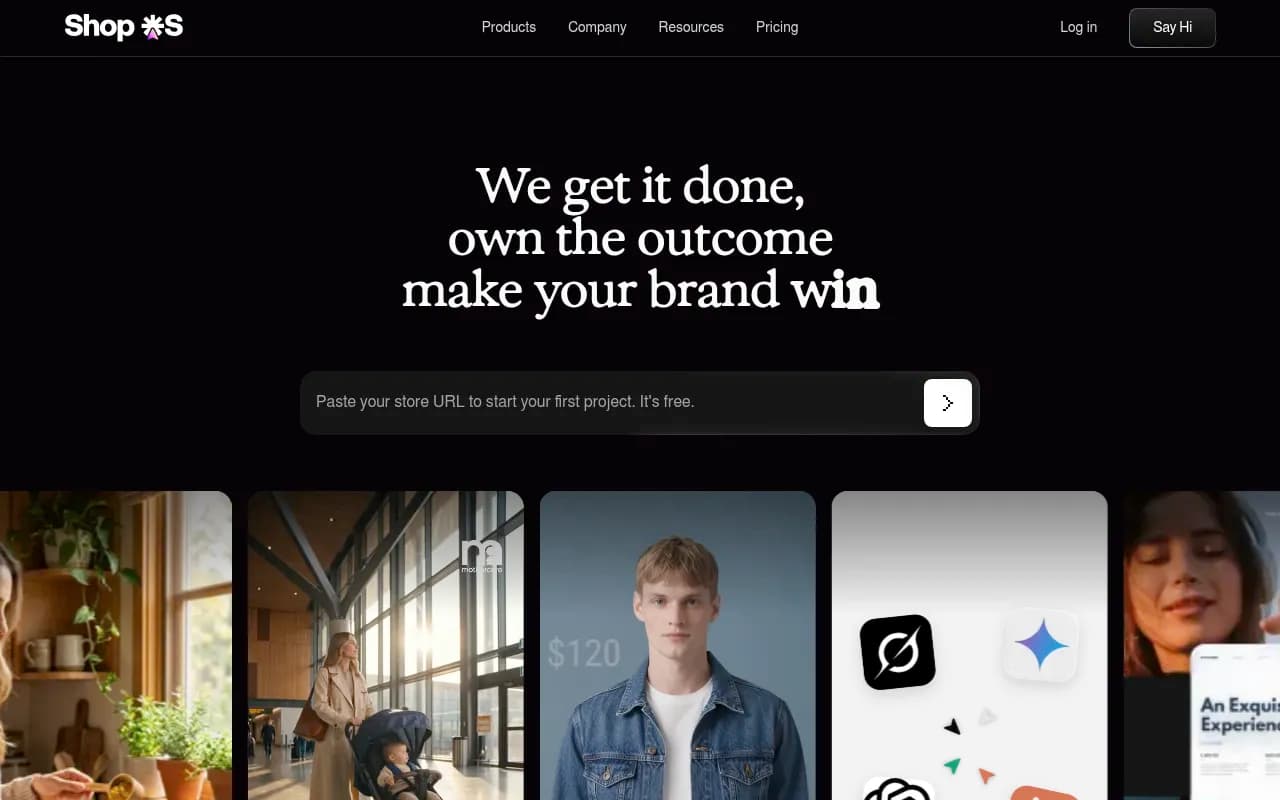
ShopOS bills itself as an AI operating system for ecommerce brands, and the pitch is pretty direct: for $159 a month you get something that approximates a $12,000-a-month in-house team of a photographer, video editor, designer, Shopify developer, and copywriter. That's an aggressive claim, and I don't think anyone running a real ecommerce business believes an AI agent fully replaces a video editor. But the underlying idea, that a lot of recurring ecommerce busywork, product photography touch-ups, email flow copy, ad creative variants, basic store health checks, can be handed to AI agents instead of freelancers, is sound and increasingly common across the space.
The product is organized around a "Squad" model. Each brand gets assigned a set of named AI agents trained on its store data, catalog, and brand voice. One agent handles creative assets (product photography, lifestyle shots, ad creative), another handles copy and email flows, and another is responsible for what ShopOS calls AI search visibility, essentially basic generative engine optimization work aimed at getting a brand's products surfaced when shoppers ask ChatGPT or Gemini for recommendations.
It's worth being clear about what this means in practice. ShopOS is not a dedicated AI visibility monitoring platform. It doesn't track citation share across a dozen AI models with daily granularity, it doesn't show you AI crawler logs hitting your Shopify store, and it isn't built to feed a content gap analysis workflow the way a specialized GEO tool would. It's one feature among several, bundled into a broader ecommerce operations product.
Key features
- Creative Studio agent: Generates product photography variations, lifestyle imagery, and ad creative from existing product shots. Useful for brands that don't have budget for a regular photoshoot cadence, though output quality on anything requiring real-world physical accuracy (fit, texture, scale) needs human review before it goes live.
- Email and lifecycle agent: Writes email flows, segment-specific campaigns, and lifecycle sequences (welcome series, abandoned cart, win-back) based on store data pulled from Shopify. It's templated AI copywriting, not a full email platform like Klaviyo, so most users still need an ESP underneath it.
- Ad performance agent: Works on ad copy and creative variants aimed at improving return on ad spend. It doesn't run media buying itself; it produces assets and suggestions that get plugged into Meta or Google Ads.
- Store health monitoring: Checks basic Shopify store issues, broken product pages, missing metadata, slow-loading assets, the kind of thing a technical audit would normally catch manually.
- AI search visibility (GEO) agent: The piece most relevant to this review. It applies general generative engine optimization practices, structuring product and collection pages so AI assistants can parse and recommend them. This is closer to a GEO checklist applied automatically than a monitoring and optimization platform.
- Shopify-native integration: Pulls catalog, order, and customer data directly from Shopify, which is the backbone that lets the other agents personalize output to a specific store rather than generating generic ecommerce content.
- Credit-based add-ons: Beyond the subscription tiers, ShopOS sells one-time credit packs (Starter at $10, Studio at $90, Mega at $180) for extra generation volume, useful for brands with seasonal spikes in content needs.
Who is it for
ShopOS fits solo Shopify founders and small DTC teams, think a two-to-five person brand doing six or seven figures in revenue, who can't yet justify a photographer, a copywriter, and a paid media specialist on payroll, but who are bleeding time on recurring content production. A supplement brand that needs fresh ad creative every week, or a skincare label that needs email flows written and product pages kept current, is the realistic use case.
It's a weaker fit for agencies managing multiple client stores, since the Squad model is built around one brand's voice and catalog at a time, and for larger ecommerce operations that already have in-house creative and marketing staff and just need a sharper AI search visibility tool. Brands in that second category are better served by a dedicated platform that goes deep on one problem rather than wide across five.
If your primary need is rigorous AI visibility tracking, understanding exactly which prompts surface your brand, how citation share moves month over month, or what AI crawlers are doing on your site, ShopOS isn't built for that. It's a generalist tool wearing a GEO hat as one of several features.
Integrations and ecosystem
Shopify is the core integration, and it has to be; the entire product is architected around pulling store, catalog, and order data from a Shopify backend. Beyond that, ShopOS connects to common ad platforms for deploying creative (Meta, Google) and appears to work alongside existing email service providers rather than replacing them outright. There's no evidence of a public API, a browser extension, or a mobile app at the time of writing, and no GitHub presence suggesting an open developer ecosystem. This is a hosted SaaS product, not a toolkit for developers to build on top of.
Pricing and value
ShopOS runs a freemium model. The Free tier gets individuals and new brands started at $0. Pro is $15/month ($180 billed annually), and Business, aimed at growing teams, is $159/month. On top of subscriptions, one-time credit packs are available for extra generation capacity: $10 (Starter), $90 (Studio), and $180 (Mega).
At $159/month, the value proposition against hiring freelancers for creative, copy, and store maintenance is obviously favorable on paper. The marketing math (comparing it to a $12,000/month agency stack) is more of a sales pitch than a realistic one-to-one substitution, but even discounting that heavily, $15 to $159 a month is cheap relative to any single freelance hire. For brands that just want GEO specifically, though, this isn't a cost comparison that matters, because you're paying for four or five feature categories to get one.
Strengths and limitations
ShopOS does a good job consolidating several recurring ecommerce tasks, creative, copy, basic store audits, into one subscription with a low entry price. The Shopify-native data connection means the output is at least contextually relevant to the actual store rather than generic. And the pricing tiers are genuinely accessible for a bootstrapped brand.
On the AI search visibility side specifically, the gaps compared to a dedicated GEO platform are significant. ShopOS has no AI crawler log analysis, so there's no way to see when ChatGPT, Claude, or Perplexity's bots actually visit a store and what they read. There's no prompt volume or difficulty scoring, no query fan-out tracking, no Reddit or YouTube citation monitoring (both increasingly relevant channels for AI-driven product discovery), and no AI traffic attribution showing whether AI-referred visitors actually convert. It also only addresses a single model's worth of GEO best practices applied generically rather than monitoring performance across the ten-plus AI models that platforms like Promptwatch track.

Bottom line
ShopOS is a reasonable pick for a scrappy Shopify brand that wants one AI subscription to cover creative, copy, and basic store upkeep, with AI search visibility thrown in as a feature rather than the focus. If generative engine optimization is the actual priority, measuring citation share, tracking AI crawler behavior, and running content gap analysis to close visibility gaps, Promptwatch is the stronger, purpose-built option. ShopOS makes sense as a generalist operations layer; it's not a substitute for a dedicated AI visibility platform.
Frequently asked questions
What is ShopOS?
How much does ShopOS cost?
Is ShopOS a dedicated GEO or AI visibility tool?
Who should use ShopOS?
Does ShopOS integrate with Shopify?
What are ShopOS's main limitations for AI search visibility?
Similar and alternative tools to ShopOS