Key takeaways
- ChatGPT's shopping carousels pull from Google Shopping's top 40 organic results, then re-rank them. If you're not in that top 40, you're not in ChatGPT, full stop.
- Position in Google Shopping matters but isn't everything. Products with fewer than three stars on key attributes become effectively invisible regardless of rank.
- OpenAI's Agentic Commerce Protocol (ACP) and Google's Universal Commerce Protocol (UCP) are hard technical gates. A feed that fails validation never gets evaluated for recommendation, no matter how good your content marketing is.
- Common silent failures: unstable variant IDs, malformed price or availability fields, missing GTINs, stale stock status, and missing the native_commerce attribute needed for the Buy button.
- Brand-mention tracking tools tell you if ChatGPT talks about you. They do not tell you if your SKUs are eligible to appear in a shopping carousel. Those are two separate diagnostics, and most teams only run one of them.
Why this problem is different from "we're not visible in ChatGPT"
I've seen a lot of teams panic about ChatGPT Shopping by treating it like a content problem. It isn't, or at least it isn't only that. If your brand already shows up when someone asks ChatGPT a general question, that's a visibility win worth tracking, and tools like Promptwatch are built for exactly that kind of monitoring: which prompts cite you, which pages get pulled, how your share of voice moves against competitors.

But shopping carousels are a separate mechanism with separate rules. A brand can be mentioned constantly in ChatGPT's conversational answers and still never appear in a single product carousel. That's because carousels aren't generated from the same retrieval pipeline as regular chat answers. They're closer to a commerce feed problem than a content problem, and the fix usually sits with your merchant feed and your engineering team, not your content team.
What actually happens when ChatGPT shows a shopping carousel
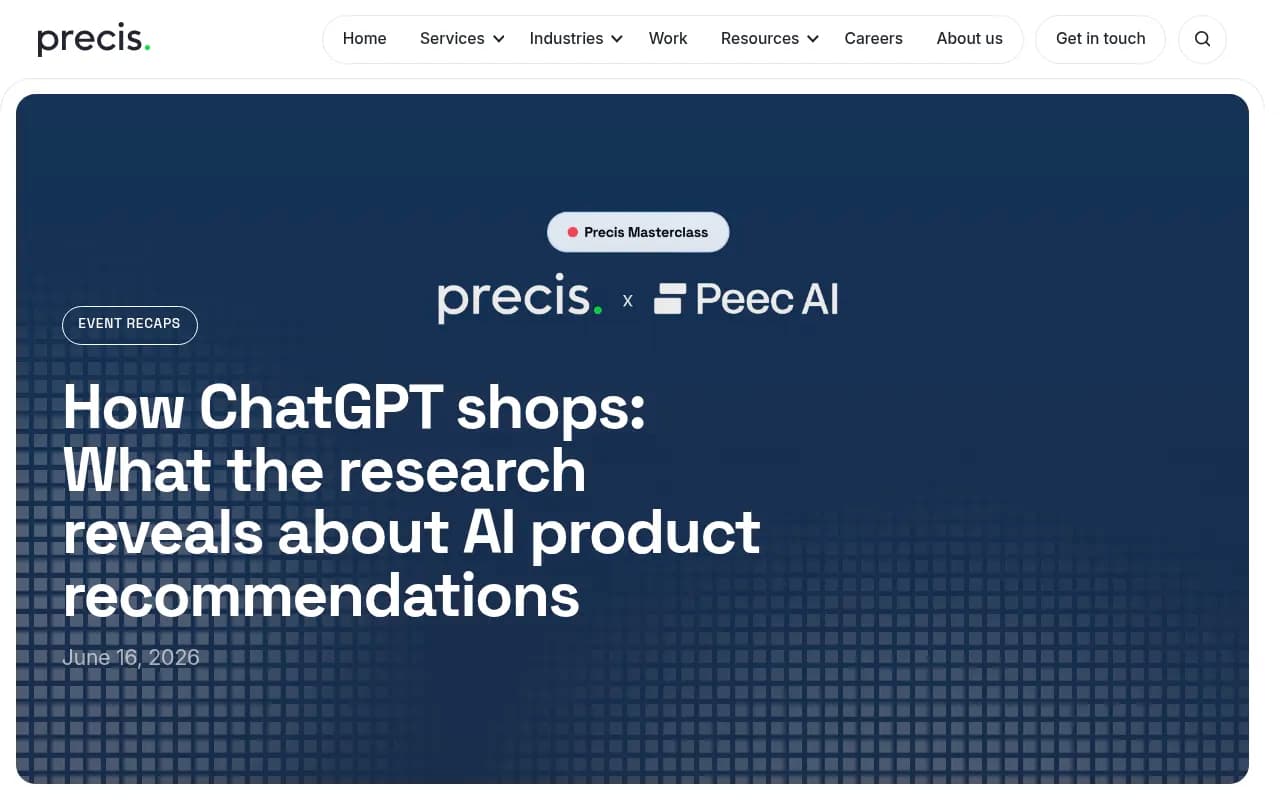
According to research from Precis, based on a Masterclass session with Peec AI's Malte Landwehr, ChatGPT's product carousels don't run on an independent product index. They pull directly from Google Shopping's top 40 organic results, then apply their own re-ranking logic on top of that. If your product isn't already sitting somewhere in that top 40 in Google Shopping, it effectively does not exist in ChatGPT's recommendation set, because there's nothing for OpenAI's re-ranker to work with.
Two details from that research matter a lot for diagnosis:
- ChatGPT only looks at organic Google Shopping results, never paid ads. There's no way to buy your way into a carousel through Google Ads spend. The lever is feed optimization, not ad budget.
- Position in Google Shopping is a factor but not the deciding one. Ranking first in Google Shopping doesn't guarantee the top carousel slot, and ranking fifth doesn't rule you out either. Star ratings act as an additional filter: products with fewer than three stars on the attributes ChatGPT evaluates become effectively invisible in the carousel, regardless of their Google Shopping rank.
That second point trips up a lot of merchants who assume "we rank well in Shopping, so we should show up in ChatGPT." If your review data is thin, outdated, or scored below three stars on the specific attributes ChatGPT checks, you can be ranked well and still get filtered out before the carousel is even assembled.
The second gate: fanout queries introduce new vocabulary
Here's a detail that's easy to miss. When someone asks ChatGPT something like "best espresso machine under $300," ChatGPT doesn't just search that exact phrase. It runs a shopping fanout, generating related sub-queries with their own terminology, attribute names, and comparison angles. If those exact terms don't appear on your product detail page or in your feed, your product is less likely to even get retrieved for consideration, before ranking or star-rating filters ever come into play.
This is a real gap between how most merchants write product titles (brand-first, SKU-code-heavy) and how shoppers and AI fanout queries phrase things (benefit-first, comparison-heavy). If your product feed still reads like a warehouse inventory sheet rather than a comparison-ready description, you're losing at the retrieval stage, which is earlier and harder to diagnose than a ranking problem.
The protocol compliance gate: ACP and UCP
This is the part most AEO and brand-visibility tools genuinely can't help with, because it's a feed-engineering problem, not a content or prompt-monitoring problem. According to AEOsome's analysis, published and re-verified in September 2026, your product feed has to satisfy the technical requirements of OpenAI's Agentic Commerce Protocol and Google's Universal Commerce Protocol before AI agents can recommend or transact your products at all. Brand mention tracking cannot diagnose or fix a non-compliant feed, because the feed rejection happens upstream of anything a mention tracker measures.
The failure modes that show up again and again:
- Unstable variant IDs that change between feed syncs, which breaks the matching AI agents rely on to track a specific SKU over time.
- Malformed price or availability values, which reject the entire row outright rather than just flagging a warning.
- Missing GTINs, which weaken catalog matching and make it harder for Google (and by extension ChatGPT, since it pulls from Google Shopping) to confidently identify your product among near-duplicates.
- Stale stock status, where a product shows as in stock in your feed long after it sold out, which erodes trust signals AI systems use when deciding what to surface.
Separately, Digital Applied's merchant guide flags a specific gate for checkout, not discovery: the Universal Cart Buy button requires the native_commerce boolean attribute per SKU, per Google Merchant Center's own documentation. Without it, a product can still participate in discovery and appear in Universal Cart search results or Gemini shopping cards, but shoppers can't complete checkout without leaving the AI surface entirely. Certain categories, like financial products, recurring billing, age-restricted goods, and pure digital goods, are ineligible for native_commerce: true regardless of how clean the rest of the feed is.
The 2026 diagnostic checklist
Run through these in order. Each layer gates the next one, so there's no point optimizing content if your feed is getting rejected at the technical validation stage.
Layer 1: feed validation
- Confirm your Google Merchant Center feed has zero critical errors, not just warnings. A warning-level issue can still silently suppress a product from the organic pool ChatGPT draws from.
- Check GTIN coverage across your catalog. Missing GTINs weaken catalog matching even when every other field is clean.
- Audit variant IDs for stability across feed syncs. If your platform regenerates IDs on every export, that's a real problem worth fixing at the source.
- Verify price and availability fields match your live site exactly, including currency formatting and stock status, since malformed values get rows rejected outright.
Layer 2: Google Shopping organic presence
- Check whether your products actually appear, and roughly where, in Google Shopping's organic results for your core queries. If you're not visible there, ChatGPT has nothing to re-rank.
- Remember paid Shopping ads don't count. ChatGPT only draws from organic results, so ad spend here is wasted effort for this specific channel.
Layer 3: review and rating data
- Confirm your product review counts and star ratings meet the roughly three-star threshold on the attributes ChatGPT evaluates. Below that, products become functionally invisible in the carousel even with strong Shopping rank.
- If review volume is thin, that's a conversion-rate-optimization problem as much as an AI-visibility one. Fixing it helps both channels.
Layer 4: content and vocabulary match
- Pull a sample of likely shopping fanout queries for your category (comparison phrases, benefit-led phrasing, price-bracket language) and check whether those exact terms appear on your product detail pages and in your feed's title and description fields.
- Rewrite titles and descriptions that still read like internal SKU labels rather than shopper-facing comparisons.
Layer 5: checkout eligibility
- Check whether native_commerce: true is set correctly per eligible SKU, if you want the Buy button in Universal Cart and Gemini shopping cards rather than just discovery-only placement.
- Confirm your product category isn't one of the excluded ones (financial products, recurring billing, age-restricted, pure digital goods) before spending engineering time chasing checkout eligibility that isn't possible for that SKU.
Layer 6: ongoing monitoring
- Separate your brand-mention monitoring from your shopping-feed monitoring. They answer different questions and need different tools.
Tools for each layer of the diagnosis
The mistake most teams make is picking one tool and expecting it to answer every layer of this checklist. It won't, because brand visibility and feed compliance are genuinely different disciplines.
| Tool | What it actually checks | Where it fits in this checklist |
|---|---|---|
| Promptwatch | Brand and product mentions, citation sources, and AI traffic across ChatGPT, Gemini, Perplexity, and more, plus ChatGPT Shopping and Ads Radar tracking for product recommendations and sponsored placements | Layer 6, plus early signal on whether you're showing up at all in conversational shopping answers |
| Google Merchant Center | Native feed validation, warnings, and disapprovals | Layer 1, non-negotiable starting point |
| ZipTie | Deep AI search visibility analysis | Layer 6, general AI visibility context |
| Azoma | Enterprise AI shopping optimization for ChatGPT, Rufus, and other shopping surfaces | Layers 2 through 5, shopping-specific |
| Goodie AI | Agentic commerce optimization for AI shopping surfaces | Layers 2 through 5, shopping-specific |
| ShopOS | GEO best practices tailored for eCommerce brands | Layers 4 and 5, content and vocabulary matching |
For the brand-visibility layer specifically, Promptwatch's Agent Analytics shows you when AI crawlers actually hit your product pages and whether they encounter errors while reading them, which is a useful cross-check if you suspect your feed is technically valid but your product pages themselves have crawl issues blocking the content ChatGPT's fanout queries are looking for.
A quick example of how the layers interact
Say a mid-size home goods brand asks, "why don't our espresso machines ever show up when people ask ChatGPT for recommendations?" The honest answer requires checking all six layers, not just one.
Maybe the feed passes validation cleanly (Layer 1 is fine). Maybe the brand ranks reasonably in Google Shopping for "espresso machine" (Layer 2 is fine too). But if their review average sits at 2.8 stars because of a batch of early manufacturing complaints that never got resolved in the data, Layer 3 quietly filters them out of every carousel regardless of how strong the rest of the feed looks. No amount of content rewriting or crawler-log investigation fixes that. The fix is a review-response and product-quality issue, surfaced by a diagnostic process that most teams never run because they assumed the problem was "AI visibility" in the abstract sense.
That's the core argument for running this checklist in order. Skipping straight to content optimization when the real blocker sits in feed validation or review data wastes weeks.
What to do if you want a broader view of AI shopping tools
The eCommerce AI visibility space moved fast in 2026, and new tools launch specifically around shopping surfaces every month. If you want to compare more options beyond what's listed here, the GEO software directory at bestgeosoftware.com tracks a wider set of platforms across monitoring and content optimization, and the agentic SEO tools directory at agenticseotools.com is worth a look if you're after tools that take action automatically rather than just report numbers.
If this diagnostic work reveals you need outside help, whether that's fixing feed issues, rebuilding product content for fanout matching, or setting up ongoing monitoring across both brand mentions and shopping eligibility, that's a different kind of project than a standard SEO engagement, and it's worth working with a team that understands both the traditional SEO side and the newer AI-search mechanics. 1001 SEO Media works across technical SEO, content production, and GEO, which covers both ends of this particular problem.