Surfer SEO Review 2026
Uses artificial intelligence to identify content gaps and provide actionable optimization suggestions for better search performance.
Summary
- Best for teams who want one workflow for both Google SEO and AI search visibility -- Surfer now optimizes content for traditional search engines AND AI models like ChatGPT, Perplexity, Gemini
- Monitoring-only -- no gap analysis or content optimization like Promptwatch provides for AI search. Surfer focuses on content creation and on-page optimization, not tracking brand mentions or citations across AI models.
- Strong content creation suite with AI writing, real-time optimization scoring, and automatic internal linking
- Pricing starts at $99/mo for individuals, scales to $249/mo and $579/mo for teams needing more prompts and AI articles
- Lacks AI crawler logs, visitor analytics, Reddit/YouTube tracking, and prompt volume data that dedicated GEO platforms offer

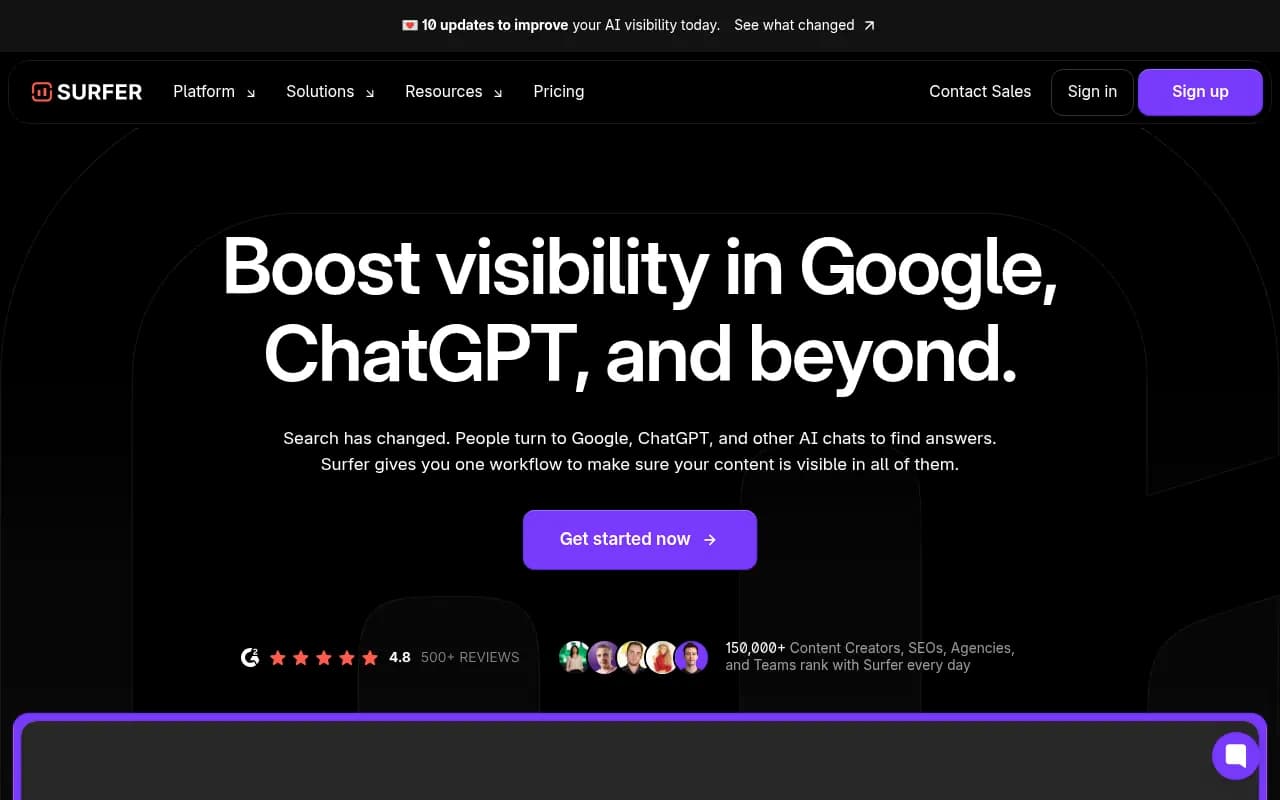
Surfer SEO started as a traditional on-page optimization tool in the mid-2010s and has evolved into one of the most popular content platforms in the SEO world. The company is based in Poland and serves over 150,000 users -- from solo bloggers to enterprise teams at Shopify, FedEx, and L'Oréal. In 2026, Surfer made a significant pivot: it's no longer just about ranking in Google. The platform now positions itself as an "AI Search Optimization" tool, helping content rank in both traditional search engines and AI answer engines like ChatGPT, Claude, Perplexity, and Google's AI Overviews.
The core promise is simple: one workflow to make your content visible everywhere people search. You research keywords, write or generate content with AI, optimize it in real-time using Surfer's Content Score, and publish knowing it's tuned for both Google's algorithm and the context windows of large language models. For content teams juggling SEO and the new reality of AI-driven search, that unified approach is appealing.
But here's the thing: Surfer is fundamentally a content creation and optimization tool, not a monitoring or analytics platform. It helps you write better articles and gives you a score to aim for. It does NOT show you where your brand is being cited in AI responses, which prompts competitors are winning, or how AI models are crawling your site. If you want to track your AI visibility over time and understand what's working (or what's missing), you need a dedicated GEO platform like Promptwatch, which offers Answer Gap Analysis, AI crawler logs, citation tracking, and traffic attribution -- capabilities Surfer doesn't have.
Content Editor: Real-Time Optimization Scoring
Surfer's Content Editor is the heart of the platform. You enter a target keyword, Surfer analyzes the top-ranking pages in Google, and you get a live Content Score (0-100) as you write. The score updates in real-time based on:
- Word count -- how long your article should be compared to competitors
- NLP terms -- semantically related keywords and phrases Google expects to see
- Heading structure -- how many H2s, H3s, and what topics they should cover
- Images -- how many visuals top pages include
- Internal and external links -- linking best practices
You write directly in Surfer's editor (or use the Google Docs, WordPress, or Contentful integrations) and watch your score climb as you hit the targets. It's satisfying and actionable. The NLP term suggestions are particularly strong -- Surfer doesn't just tell you to use a keyword X times, it shows you the semantic context Google is looking for. For example, if you're writing about "content marketing," Surfer might suggest terms like "buyer personas," "content calendar," "distribution channels," and "engagement metrics" because those concepts appear frequently in top-ranking content.
The editor also includes an Outline Builder that scrapes headings from competitors and suggests a structure for your article. You can accept, reject, or modify suggestions. It's a huge time-saver for writers who would otherwise manually analyze 10+ competitor articles.
Surfer AI: Automated Article Generation
In 2023, Surfer launched Surfer AI, an AI writing tool that generates full articles optimized for your target keyword. You provide a keyword, select a tone and point of view, optionally add brand guidelines or custom instructions, and Surfer AI produces a 2,000-3,000 word article in about 10-20 minutes. The output is already optimized -- it hits the Content Score targets, includes NLP terms, and follows the heading structure Surfer recommends.
The quality is solid. Surfer AI doesn't just spin generic content; it researches the SERP, pulls in relevant facts, and structures the article logically. You still need to edit for brand voice, add examples, and fact-check, but it's a strong first draft. For agencies cranking out 50+ articles a month, Surfer AI is a productivity multiplier. One user reported writing 1,975,002 words with Surfer in a year -- that's the scale this tool enables.
Surfer AI also includes a built-in assistant called Surfy that can rewrite sentences, expand sections, add statistics, or change tone on command. You highlight text, type a prompt like "add a statistic to support this claim," and Surfy rewrites it inline. It's faster than switching to ChatGPT.
Pricing for Surfer AI is separate from the base subscription: $29 per article on the Essential plan, $20 per article on Professional, $17 per article on Business. If you're generating 10+ articles a month, the per-article cost adds up quickly.
Auto Internal Links: Automated Link Insertion
One of Surfer's newer features is Auto Internal Links. You connect your website (via sitemap or manual URL list), and Surfer scans your content to identify internal linking opportunities. It suggests where to add links, what anchor text to use, and which pages to link to. You can accept suggestions in bulk or one by one.
This is useful for two reasons: (1) internal linking helps Google understand your site structure and topic clusters, and (2) AI models like ChatGPT and Perplexity also follow internal links when they crawl your site, so a strong internal linking strategy can improve your chances of being cited. Surfer doesn't explain the AI crawling angle in depth, but the feature is there.
AI Search Guidelines: 1-Click Optimization for AI Engines
This is Surfer's big 2026 addition. AI Search Guidelines analyze your content and provide specific recommendations to make it more likely to be cited by AI models. The guidelines cover:
- Entity optimization -- making sure your content mentions the right people, places, brands, and concepts that AI models associate with your topic
- Contextual completeness -- filling gaps where competitors provide more detail
- Structured data -- using schema markup so AI models can parse your content more easily
- Clarity and directness -- rewriting vague or overly promotional language into clear, factual statements
You click "Optimize for AI Search" and Surfer highlights sections that need work. It's a step in the right direction, but it's still surface-level compared to what a dedicated GEO platform does. Surfer doesn't show you which prompts your content is (or isn't) ranking for, how often AI models cite your pages, or what your competitors are doing differently. It's optimization without measurement.
AI Tracker: Basic Monitoring for AI Mentions
Surfer's AI Tracker lets you monitor how often your brand appears in responses from ChatGPT, Perplexity, Gemini, and Google AI Overviews. You enter a list of prompts (e.g., "best project management tools for remote teams"), and Surfer checks whether your brand is mentioned in the AI's response. You get a simple visibility score and can see which prompts you're winning vs. losing.
This is where Surfer's limitations become obvious. The AI Tracker is monitoring-only. It doesn't tell you:
- Why competitors are being cited and you're not (no content gap analysis)
- Which pages on your site are being cited (no page-level tracking)
- How AI models are crawling your site (no crawler logs)
- How much traffic AI search is driving to your site (no visitor analytics)
- What's happening on Reddit or YouTube (no social/video tracking)
- Prompt volumes or difficulty scores (no prioritization data)
For comparison, Promptwatch offers all of these capabilities. It shows you the exact content gaps (Answer Gap Analysis), generates optimized articles to fill those gaps (AI writing agent), tracks which pages are being cited (page-level tracking), monitors AI crawler activity (crawler logs), and attributes traffic back to AI search (visitor analytics). Surfer's AI Tracker is a dashboard that shows you a problem; Promptwatch is a platform that helps you fix it.
Mention Gap and Sentiment Analysis
Surfer recently added two features to the AI Tracker:
- Mention Gap -- shows prompts where competitors are mentioned but you're not
- Sentiment Analysis -- flags whether AI models are framing your brand positively, negatively, or neutrally
These are useful, but again, they're monitoring features. You see the gap, but Surfer doesn't help you close it. You're left to manually figure out what content to create or how to optimize existing pages. Promptwatch's Answer Gap Analysis goes further by showing you the specific topics, angles, and questions your site is missing -- then generates content to fill those gaps.
Workspaces: Multi-Domain Management
Surfer now supports Workspaces, which let you manage multiple domains or brands within one account. Each workspace has its own set of content editors, AI articles, and tracking data. This is aimed at agencies managing 10+ client sites. You can switch between workspaces without logging out, and each workspace can have its own team members with different permission levels.
It's a solid quality-of-life improvement for agencies, though it's not unique -- most enterprise SEO tools offer similar multi-site management.
Integrations: Google Docs, WordPress, Contentful, Zapier
Surfer integrates with:
- Google Docs -- write in Docs and see your Content Score in a sidebar
- WordPress -- publish directly from Surfer to WordPress with one click
- Contentful -- sync content to your headless CMS
- Zapier -- automate workflows (e.g., create a new Content Editor when a keyword is added to a spreadsheet)
- ChatGPT -- use Surfer's data inside ChatGPT via a plugin (though this integration is less robust than the native Surfer AI)
- Surfer API -- build custom integrations or pull data into your own tools
The Google Docs integration is particularly popular with freelance writers who prefer writing in Docs but need real-time SEO feedback. The WordPress integration is a time-saver for solo bloggers and small teams.
Plagiarism Checker and AI Content Detector
Surfer includes a plagiarism checker powered by Copyscape. You can scan your content before publishing to make sure it's original. This is table stakes for any content platform in 2026.
Surfer also offers an AI Content Detector and AI Humanizer. The detector analyzes text and estimates how much of it was written by AI. The humanizer rewrites AI-generated text to sound more natural and pass AI detection tools. These are separate tools (not integrated into the Content Editor), and they're more marketing gimmicks than core features. If you're using Surfer AI to generate content, you probably don't care whether it "sounds like AI" -- you care whether it ranks.
Who Is Surfer For?
Surfer is best for:
- Content teams at SaaS companies, ecommerce brands, and digital publishers who publish 10-50+ articles per month and need a streamlined workflow for research, writing, and optimization. If you're managing a content calendar and working with freelance writers, Surfer's Content Editor and collaboration features are a huge help.
- SEO agencies managing 5-20 client sites who need to produce optimized content at scale. Surfer AI can generate first drafts quickly, and the Content Score gives you a clear deliverable to show clients ("we optimized this article to a 90+ score").
- Solo bloggers and affiliate marketers who want to rank faster without spending hours on manual keyword research and competitor analysis. Surfer automates the tedious parts of SEO so you can focus on writing.
- Teams who care about both Google SEO and AI search visibility and want one tool that handles both. Surfer's AI Search Guidelines and AI Tracker give you a starting point for optimizing for ChatGPT, Perplexity, and Gemini.
Surfer is NOT ideal for:
- Brands who need to track and improve their AI search visibility over time. Surfer's AI Tracker is monitoring-only. If you want to see which prompts you're losing, why competitors are being cited, and how to fix it, you need Promptwatch.
- Teams who need AI crawler logs, traffic attribution, or page-level citation tracking. Surfer doesn't offer these capabilities.
- Brands who want to monitor Reddit, YouTube, or social discussions that influence AI recommendations. Surfer doesn't track these channels.
- Enterprise teams who need custom reporting, API access for large-scale data pulls, or white-label solutions. Surfer's API exists but is limited compared to dedicated SEO platforms like Ahrefs or Semrush.
Pricing and Value
Surfer offers three main plans:
- Essential: $99/mo (annual billing) or $119/mo (monthly) -- 1 site, 360 AI prompts tracked, 50 Content Editors, 5 Surfer AI articles included, basic AI Search Guidelines
- Professional: $249/mo (annual) or $299/mo (monthly) -- 2 sites, 720 AI prompts, 150 Content Editors, 15 Surfer AI articles, advanced AI Search Guidelines, Auto Internal Links
- Business: $579/mo (annual) or $699/mo (monthly) -- 5 sites, 1,440 AI prompts, 350 Content Editors, 30 Surfer AI articles, priority support, API access
All plans include the Content Editor, Outline Builder, plagiarism checker, and integrations. Surfer AI articles are priced separately if you exceed your monthly allotment: $29/article (Essential), $20/article (Professional), $17/article (Business).
There's a 7-day money-back guarantee, but no free trial. You have to commit upfront.
How does this compare to competitors?
- vs. Clearscope ($170-$1,200/mo) -- Clearscope is a direct competitor in the content optimization space. It's more expensive and focuses purely on Google SEO (no AI search features). Surfer is better value if you want AI search optimization.
- vs. Frase ($15-$115/mo) -- Frase is cheaper and includes AI writing, but its optimization scoring is less sophisticated than Surfer's. Frase is better for solo creators on a budget; Surfer is better for teams.
- vs. MarketMuse ($149-$1,500+/mo) -- MarketMuse is an enterprise content intelligence platform with deeper topic modeling and content planning. It's overkill for most teams. Surfer is more accessible and easier to use.
- vs. Promptwatch ($99-$579/mo) -- Promptwatch is a dedicated GEO platform that tracks AI search visibility, provides content gap analysis, generates optimized articles, and monitors AI crawler activity. If your goal is to rank in AI search engines, Promptwatch is the better choice. Surfer is better if you primarily care about Google SEO and want basic AI search monitoring as a bonus.
Strengths
- Real-time Content Score is incredibly useful -- you get instant feedback as you write, and hitting a 90+ score gives you confidence the article will rank.
- NLP term suggestions are accurate and actionable -- Surfer's semantic analysis is one of the best in the industry.
- Surfer AI generates solid first drafts quickly -- it's not perfect, but it's a huge time-saver for high-volume content production.
- Integrations with Google Docs and WordPress are seamless -- writers can stay in their preferred tools and still get Surfer's optimization data.
- Auto Internal Links saves hours of manual work -- internal linking is tedious, and Surfer automates it well.
- AI Search Guidelines are a step in the right direction -- Surfer is one of the first traditional SEO tools to add AI search optimization features.
Limitations
- AI Tracker is monitoring-only -- no content gap analysis, no page-level tracking, no crawler logs, no traffic attribution. If you want to actually improve your AI search visibility (not just monitor it), you need Promptwatch.
- No Reddit or YouTube tracking -- these channels heavily influence AI recommendations, but Surfer doesn't monitor them.
- No prompt volume or difficulty data -- you can't prioritize which prompts to target based on search volume or competition.
- Surfer AI articles cost extra -- the per-article pricing adds up quickly if you're generating 20+ articles a month.
- No free trial -- you have to pay upfront to test the platform, which is a barrier for small teams.
- Limited API and reporting capabilities -- Surfer is not built for enterprise-scale data analysis or custom integrations.
Bottom Line
Surfer SEO is an excellent content optimization platform for teams who want to rank in Google and are starting to think about AI search visibility. The Content Editor, NLP term suggestions, and Surfer AI make it easy to produce high-quality, optimized content at scale. The new AI Search Guidelines and AI Tracker are useful additions, but they're surface-level compared to what dedicated GEO platforms offer.
If your primary goal is Google SEO and you want basic AI search monitoring as a bonus, Surfer is a strong choice. But if you're serious about ranking in ChatGPT, Perplexity, Gemini, and other AI engines -- and you want to track your visibility, identify content gaps, and optimize strategically -- Promptwatch is the better option. Surfer helps you write optimized content; Promptwatch helps you understand what content to write and whether it's working.
Best use case in one sentence: Content teams at SaaS companies, agencies, and publishers who need a streamlined workflow for writing and optimizing 10-50+ articles per month for Google and (to a lesser extent) AI search engines.
Tags:
Frequently asked questions
What is Surfer SEO and what does it do?
How much does Surfer SEO cost per month?
Does Surfer SEO have a free plan or free trial?
Who should use Surfer SEO?
What is the difference between Surfer SEO and traditional SEO tools?
What are the limitations of Surfer SEO for AI search optimization?
Similar and alternative tools to Surfer SEO