Search Party Review 2026
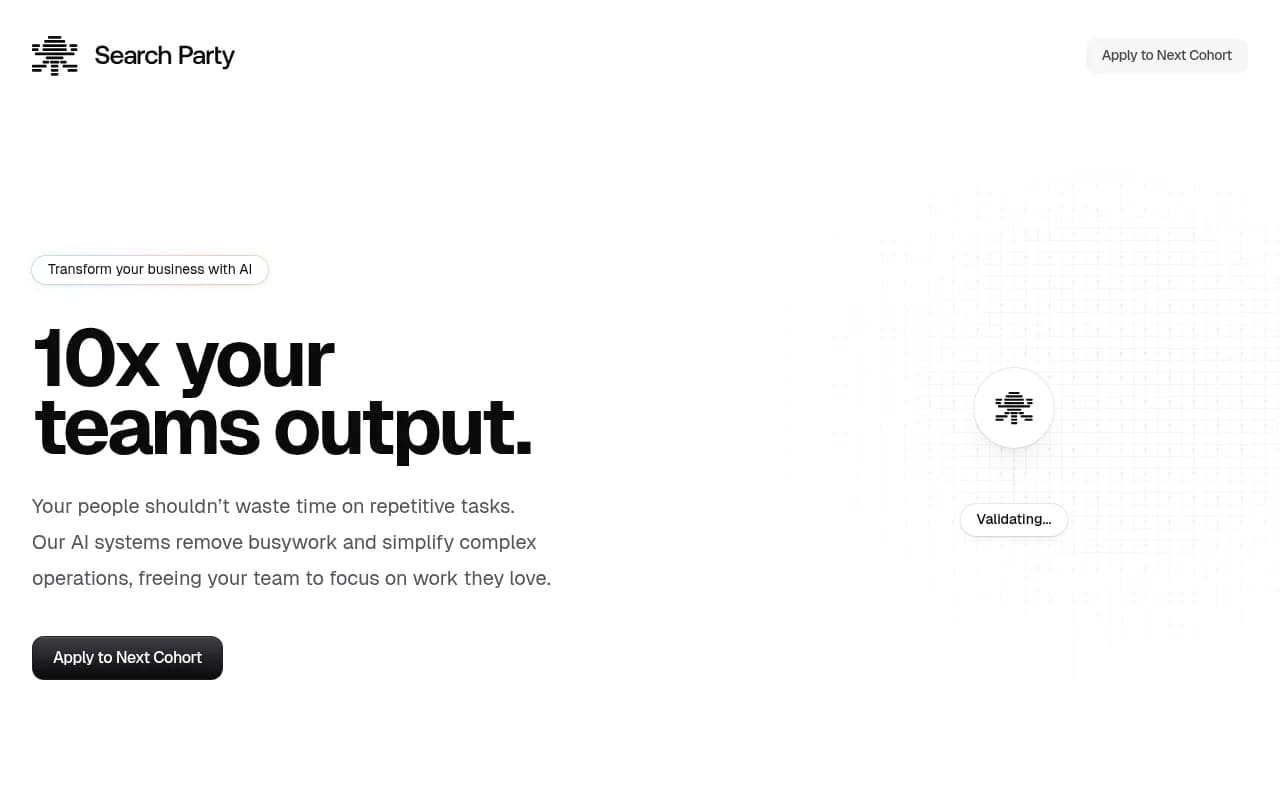
Search Party is an AI implementation consultancy that deploys custom automation systems directly into businesses. Unlike off-the-shelf AI tools, they embed engineering teams to analyze workflows, identify bottlenecks, and build bespoke agentic systems using their DOE Framework. Targets mid-market companies drowning in repetitive tasks across sales, marketing, ops, and engineering.
Key Takeaways
- Search Party is a services firm, not a software product -- they embed engineers into your company to build custom AI automation systems
- Uses a proprietary DOE Framework (Directives, Orchestration, Execution) to ensure 90%+ reliability instead of unpredictable LLM outputs
- Targets mid-market companies with 50-500 employees where headcount is outpacing revenue growth
- Pricing is custom/enterprise only -- expect $50k-$200k+ engagements based on scope and team size
- Best for companies ready to commit serious budget and internal resources to AI transformation, not teams looking for quick SaaS solutions
Search Party positions itself as the antidote to "AI tool fatigue" -- the phenomenon where companies have subscribed to ChatGPT, Claude, Jasper, n8n, and a dozen other AI apps but still haven't moved the productivity needle. Their thesis: most businesses treat AI like software when it's actually intelligence that requires custom orchestration to deliver real value. Instead of selling you another dashboard or chatbot, they send a squad of engineers to live inside your operations for weeks or months, diagnose where time is being wasted, and build automated workflows tailored to your exact processes.
The company runs what they call the "Search Party Protocol" -- a four-phase engagement model starting with a 90-minute validation session to assess ROI potential. If the math works (they claim to only proceed when they see a clear path to 3x+ returns), they move into Bottleneck Mining, where they analyze your metrics to find where headcount growth is outpacing revenue, then survey and interview employees to pinpoint the repetitive, morale-killing tasks crushing efficiency. Phase 2 (Solution Mapping) categorizes opportunities into tiers: instant knowledge systems for unlocking data, smart tools for drafting and prep work, and autonomous agents for fully automated workflows. Phase 3 delivers a prioritized Attack Plan -- not a generic strategy deck, but a concrete roadmap ranked by impact, from quick wins to system-level changes that decouple revenue growth from hiring.
The execution model is "forward deployed" -- they embed builders directly into your team across three verticals: G&A (finance, ops, HR, reporting automation), S&M (lead qualification, outbound, call analysis, proposal generation), and R&D (engineering tooling, product acceleration). This isn't a consulting firm that hands you a PDF and disappears. They stay embedded until the systems are live and your internal team can maintain them.
The DOE Framework (their secret sauce)
Search Party's technical differentiation is the DOE Framework, which they describe as "predictable architecture" designed to make AI behave like a reliable employee instead of a chaotic experiment. It breaks down into three layers:
- Directives (The Rules): Your company's SOPs and business rules become the source of truth. Agents follow your documented processes, not generic training data from the internet. This ensures outputs align with how your business actually operates.
- Orchestration (The Brain): LLMs are used strictly for reasoning and routing -- figuring out what task needs to happen next, not guessing how to execute it. This is the decision layer, not the execution layer.
- Execution (The Hands): Standard, deterministic code handles the actual work. No prompt engineering or hoping the model gets it right. This is where they claim to achieve "high-90s% reliability" instead of the 80-90% accuracy that makes most AI tools unusable for mission-critical work.
The framework is a direct response to the "90% accuracy is 100% useless" problem -- businesses can't run on systems that work most of the time. By separating reasoning from execution and grounding everything in your SOPs, they aim to deliver production-grade reliability.
Who this is actually for
Search Party targets mid-market companies (roughly 50-500 employees) experiencing a specific pain: headcount is growing faster than revenue, teams are buried in admin and coordination work, and leadership knows AI should help but doesn't know where to start. Their ideal customer is a B2B SaaS company, professional services firm, or agency where knowledge work dominates and margins are getting squeezed by operational overhead.
This is NOT for:
- Startups under 20 people (too early, not enough process debt to justify the investment)
- Enterprise companies over 1000 employees (they lack the scale to handle massive orgs)
- Teams looking for a $99/month SaaS tool (this is a six-figure services engagement)
- Companies without executive buy-in (AI transformation requires top-down commitment)
You need a VP or C-level sponsor willing to give Search Party access to employees, data, and internal systems. The engagement requires real collaboration -- they'll interview your team, analyze your workflows, and need engineering resources to integrate their systems with your stack.
What you actually get
The deliverables vary by engagement, but typical outputs include:
- Company Brain: An internal knowledge system that surfaces answers from your docs, Slack, emails, and tribal knowledge. Think of it as a custom-trained assistant that knows your business.
- Sales-to-delivery handoff automation: Eliminates the manual work of transferring context from closed deals to implementation teams. Automatically extracts requirements, creates project briefs, and notifies the right people.
- Support ticket triage: Routes incoming requests to the right team or person based on content analysis, urgency scoring, and historical patterns. Reduces response time and eliminates manual sorting.
- Renewal and expansion opportunity detection: Monitors usage data, support interactions, and account health to flag upsell opportunities before they're obvious. Feeds directly into your CRM.
- Cross-team status dashboards: Aggregates updates from Jira, Asana, Slack, and other tools into a single view so leadership doesn't have to chase status reports.
These aren't off-the-shelf integrations. Each workflow is custom-built for your tools, data structure, and business logic. The tradeoff: high upfront cost and implementation time, but systems that actually fit how you work.
Pricing and engagement model
Search Party doesn't publish pricing, which tells you everything. This is enterprise consulting, not SaaS. Based on comparable AI implementation firms and the scope they describe, expect engagements starting around $50k for a focused pilot (one department, 2-3 workflows) and scaling to $150k-$300k+ for multi-department transformations with embedded teams over 3-6 months.
The validation session is free, but it's a qualification call -- they're assessing whether your company is a fit as much as you're evaluating them. They claim to only proceed if they see a clear path to 3x ROI, which means they're looking for companies with obvious inefficiencies and budget to fix them.
There's no monthly subscription or per-seat pricing. You're paying for engineering time, project management, and the transfer of capabilities to your internal team. Some engagements likely include ongoing support or retainer arrangements, but the core model is project-based.
Integration and technical requirements
Search Party builds on top of your existing stack -- Salesforce, HubSpot, Slack, Jira, Google Workspace, whatever you're already using. They're not replacing your tools, they're connecting them with intelligent automation. The DOE Framework means they're writing custom code, not just chaining together Zapier actions or n8n workflows.
Expect them to need:
- API access to your core systems (CRM, project management, communication tools)
- Read access to internal documentation and knowledge bases
- Ability to deploy code to your infrastructure (cloud accounts, servers, etc.)
- Collaboration with your engineering or IT team for security review and deployment
This isn't a no-code solution. You're getting custom software built by their engineers, which means you need internal technical resources to maintain it long-term or an ongoing relationship with Search Party.
Strengths
- Embedded execution model: They don't just consult, they build. You get working systems, not strategy decks.
- DOE Framework reliability: The separation of reasoning and execution addresses the core problem with most AI tools -- unpredictable outputs. By using deterministic code for execution, they claim 90%+ reliability.
- Bottleneck mining process: The diagnostic phase (employee interviews, workflow analysis, metrics review) ensures they're solving real problems, not building toys.
- Custom fit: Every workflow is tailored to your business, not a generic template. This matters for complex operations where off-the-shelf tools fall short.
- Knowledge transfer: They train your team to maintain and extend the systems, not just hand over a black box.
Limitations
- Price: This is a six-figure investment minimum. Small companies and startups can't afford it.
- Time commitment: Expect 2-6 months from kickoff to live systems. This isn't a quick fix.
- Requires internal resources: Your team needs to participate in interviews, provide data access, and collaborate on implementation. If you're too busy to engage, this won't work.
- Not a product: There's no dashboard to log into, no app to download. You're getting custom code that lives in your infrastructure. If Search Party disappears or the relationship ends, you're maintaining it yourself.
- Scale limitations: They're a services firm, not a platform. They can't handle hundreds of simultaneous clients the way a SaaS company can. Expect waitlists or cohort-based onboarding.
- No transparent pricing: The lack of published rates makes it hard to budget or compare to alternatives without a sales call.
How it compares to alternatives
Search Party competes with:
- AI consulting firms (Accenture, Deloitte AI practices): Search Party is faster and more hands-on, but lacks the enterprise scale and compliance infrastructure of Big 4 firms.
- Automation agencies (Zapier experts, n8n consultants): Search Party builds more sophisticated systems with custom code, not just workflow automation.
- Internal AI teams: Hiring your own AI engineers gives you full control but takes 6-12 months to build capability. Search Party is faster but more expensive per hour.
- AI platforms (LangChain, Dust, Relevance AI): These are tools for building agents yourself. Search Party does the building for you.
The closest comp is probably a boutique AI implementation firm like Invisible Technologies or an AI-focused dev shop, but Search Party's DOE Framework and focus on reliability over experimentation sets them apart.
Bottom line
Search Party is for mid-market companies (50-500 employees) that are drowning in operational overhead and ready to invest six figures in custom AI automation. If you're a B2B SaaS company where headcount is growing faster than revenue, or a professional services firm where billable hours are getting eaten by admin work, and you have executive buy-in plus budget for a multi-month engagement, this is worth exploring. The embedded model and DOE Framework address real problems with AI reliability that off-the-shelf tools don't solve.
But if you're looking for a SaaS product you can sign up for today, or you're a startup without $50k+ to spend, look elsewhere. This is custom engineering, not a subscription. The validation session is free and low-risk -- if you're in the target profile, take the call and see if the ROI math works for your situation.
Tags:
Frequently asked questions
What is Search Party and what does it do?
How much does Search Party cost?
Who is Search Party designed for?
What is the DOE Framework that Search Party uses?
How does Search Party differ from AI software tools like ChatGPT or Claude?
What is the Search Party Protocol engagement process?
Is Search Party a free tool?
What types of automation does Search Party build?
Similar and alternative tools to Search Party