Key takeaways
- Profound is a well-funded enterprise AI visibility platform, but its price point and monitoring-first design leave many content teams looking for alternatives
- Most Profound competitors are also monitoring-only -- they show you where you're invisible but don't help you fix it
- The tools that matter most for content teams in 2026 combine visibility tracking with content gap analysis and actual publishing capabilities
- The right alternative depends on whether your priority is measuring AI visibility, acting on it, or both
- A handful of platforms have closed the loop between tracking and publishing -- those are the ones worth your attention
Profound raised a $35 million Series B from Sequoia Capital, which tells you something about how seriously the market takes AI search visibility. It's a genuinely capable platform. But capability and fit are different things, and for most content teams -- especially those outside the Fortune 500 -- Profound creates as many problems as it solves.
The core issue isn't features. It's that Profound is built around analytics. You get detailed data on how your brand appears in AI-generated answers across ChatGPT, Perplexity, Claude, and Google AI Overviews. What you don't get is a clear path from "we're invisible for this prompt" to "we published something that fixed it." That gap is where content teams lose time.
This guide focuses specifically on alternatives that help content teams act, not just observe. Some are monitoring tools that pair well with a separate content workflow. Others have built the whole loop in one place. I'll be clear about which is which.
Why content teams outgrow Profound (or never fit in the first place)
Profound's positioning is the "read/write operating system for the AI web." The read part is strong. The write part is thinner than the marketing suggests.
For a content team, the workflow looks like this: you discover you're missing from AI answers for a set of high-value prompts, you figure out what content would fill those gaps, you write it, publish it, and then track whether AI models start citing it. Profound handles the first step well. The middle steps -- figuring out what to write, actually writing it, publishing it -- are largely left to you.
That's fine if you have a large team and a separate content operation. It's a real friction point if you're a three-person marketing team or an agency managing 15 clients.
The other common complaint is pricing. Profound's enterprise positioning means costs that don't make sense for mid-market brands or agencies with thin margins. When a monitoring-only tool costs enterprise money, the ROI math gets hard to justify.
The monitoring-only trap
Before getting into specific tools, it's worth naming a pattern that shows up across almost every "Profound alternative" list: most of the alternatives are also monitoring-only.
Otterly.AI, Peec AI, LLMrefs, AthenaHQ, Search Party -- these are all solid tools for tracking AI visibility. But they stop at the dashboard. You see the data, you feel appropriately alarmed about your citation rate, and then you go back to your content team and try to explain what "AI visibility" means and why they should care.
The tools that actually move the needle for content teams are the ones that close the loop. Track what's missing, generate content to fill the gap, publish it, watch citations improve. That cycle is what separates an optimization platform from a monitoring dashboard.
Promptwatch is one of the few platforms that has built this full loop. It surfaces which prompts competitors rank for that you don't, generates articles and listicles grounded in real citation data, and then tracks whether those pages start getting cited. It's not the only option, but it's the clearest example of what "beyond monitoring" actually looks like in practice.

The best Profound alternatives for content teams in 2026
1. Promptwatch -- best for the full track-to-publish loop
If your content team's goal is to actually improve AI citation rates (not just measure them), Promptwatch is the most complete option available. The Answer Gap Analysis shows you exactly which prompts competitors appear for that you don't -- with specific content recommendations, not vague suggestions. The built-in writing agent then generates content based on 880M+ citations analyzed, so what it produces is grounded in what AI models actually cite, not generic SEO filler.
The crawler logs are also genuinely useful for content teams. You can see which pages ChatGPT, Claude, and Perplexity are actually reading, how often they return, and where they hit errors. That tells you which existing content is being considered for citations and which pages are being ignored entirely.
Pricing starts at $99/month for one site and 50 prompts, which puts it within reach of mid-market teams. The Professional plan at $249/month adds crawler logs and multi-location tracking.
2. SE Visible -- best for SEO teams transitioning to GEO
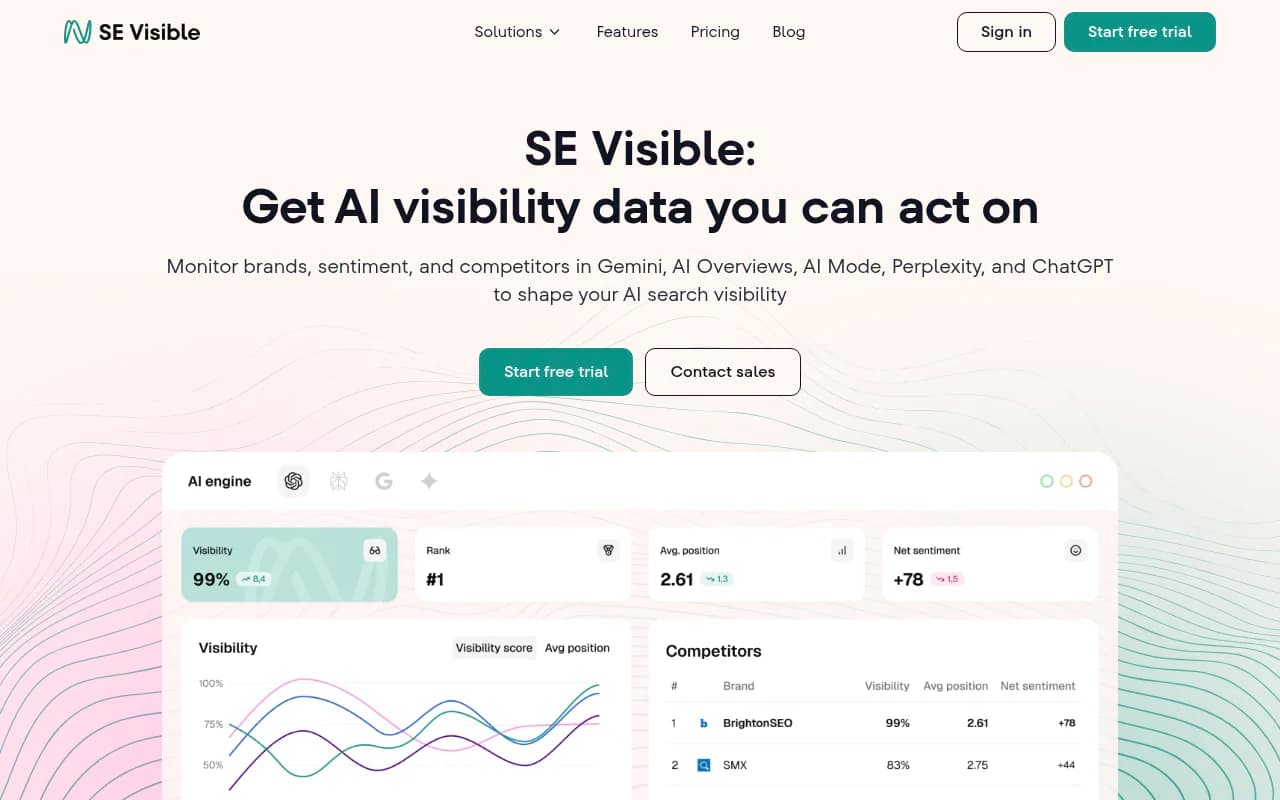
SE Visible is SE Ranking's dedicated AI visibility product. If your team already lives in SE Ranking for traditional SEO, this is the natural extension. It tracks AI Overviews and AI-generated answers alongside organic rankings, so you get a unified view of search performance without managing two separate tools.
The source detection feature is worth calling out -- it identifies which domains and pages AI models are pulling from when they answer prompts in your category. That's useful for content teams trying to understand where to publish and what to optimize.
It's primarily a monitoring and analysis tool, so you'll still need a separate content workflow. But the data quality is strong, and the integration with SE Ranking's broader SEO suite means you're not starting from scratch on keyword and competitive data.
3. Scrunch AI -- best for enterprise teams that want dedicated AI monitoring
Scrunch AI is a structured, enterprise-grade monitoring platform. It doesn't try to be a content tool -- it's focused on giving large teams a clean, reliable view of AI search visibility across multiple models and markets.
The "Shadow Site" technology (their term for how they simulate AI crawler behavior) is technically interesting and gives more accurate visibility data than simple prompt testing. For teams that need to report AI visibility metrics to leadership and need those numbers to be defensible, Scrunch is worth a look.
The tradeoff is that it's expensive and doesn't help you act on what you find. It's a measurement tool, not an optimization tool.
4. Otterly.AI -- best for brand and PR teams on a budget
Otterly.AI is one of the more accessible Profound alternatives. It focuses on brand monitoring in AI answers -- tracking how your brand is mentioned, what sentiment those mentions carry, and how that changes over time.
For PR and brand teams that care about reputation in AI answers more than citation volume, Otterly makes sense. The interface is clean and the pricing is reasonable compared to enterprise alternatives.
It won't help you create content or close visibility gaps. But if your primary question is "what are AI models saying about us?" rather than "how do we get cited more?", Otterly answers that question well.

5. Peec AI -- best for startups and SMBs watching costs
Peec AI starts at around €89/month, which makes it one of the most affordable options for prompt-level AI search analytics. It covers multiple AI models and gives you visibility data at the prompt level -- useful for understanding which specific questions you're winning or losing.
The multi-language support is a genuine differentiator for teams operating in non-English markets. Most Profound alternatives are English-first by default.
The limitation is depth. Peec is good for getting started with AI visibility tracking, but teams that need crawler logs, content gap analysis, or publishing capabilities will hit its ceiling quickly.

6. AthenaHQ -- best for enterprises that need GEO automation
AthenaHQ positions itself as a full GEO platform with AI visibility tracking, automation, and revenue attribution. It's one of the more feature-complete monitoring tools in the market.
The revenue attribution piece is interesting -- it tries to connect AI visibility to actual business outcomes, which is a hard problem most tools ignore. For enterprise teams that need to justify GEO investment to a CFO, that matters.
The gap is content generation. AthenaHQ is strong on measurement and analysis, but it doesn't help you create the content that would improve your visibility scores. You're still on your own for the publishing side.

7. Ahrefs Brand Radar -- best for existing Ahrefs users
If your team already pays for Ahrefs, Brand Radar is the lowest-friction way to add AI visibility tracking. It monitors brand mentions across AI-generated answers and integrates with the backlink and keyword data you're already using.
The limitation is that Brand Radar uses fixed prompts -- you can't customize the questions it tracks, which means you might miss the specific prompts that matter most for your category. There's also no AI traffic attribution, so you can't connect what you see in Brand Radar to actual site traffic.
For teams that want a quick read on AI brand visibility without adding another tool, it's a reasonable starting point. For teams that want to optimize, it's not enough.
8. Whitebox -- best for teams that want automated content fixes
Whitebox is an agentic GEO platform that goes further than most: it doesn't just identify content gaps, it generates and ships fixes automatically. The "agentic" framing is accurate -- it's built around autonomous content updates rather than human-in-the-loop workflows.
For content teams with large existing libraries that need systematic updates for AI visibility, Whitebox is genuinely interesting. The tradeoff is control -- automated content shipping requires a lot of trust in the system, and the output quality needs careful review.
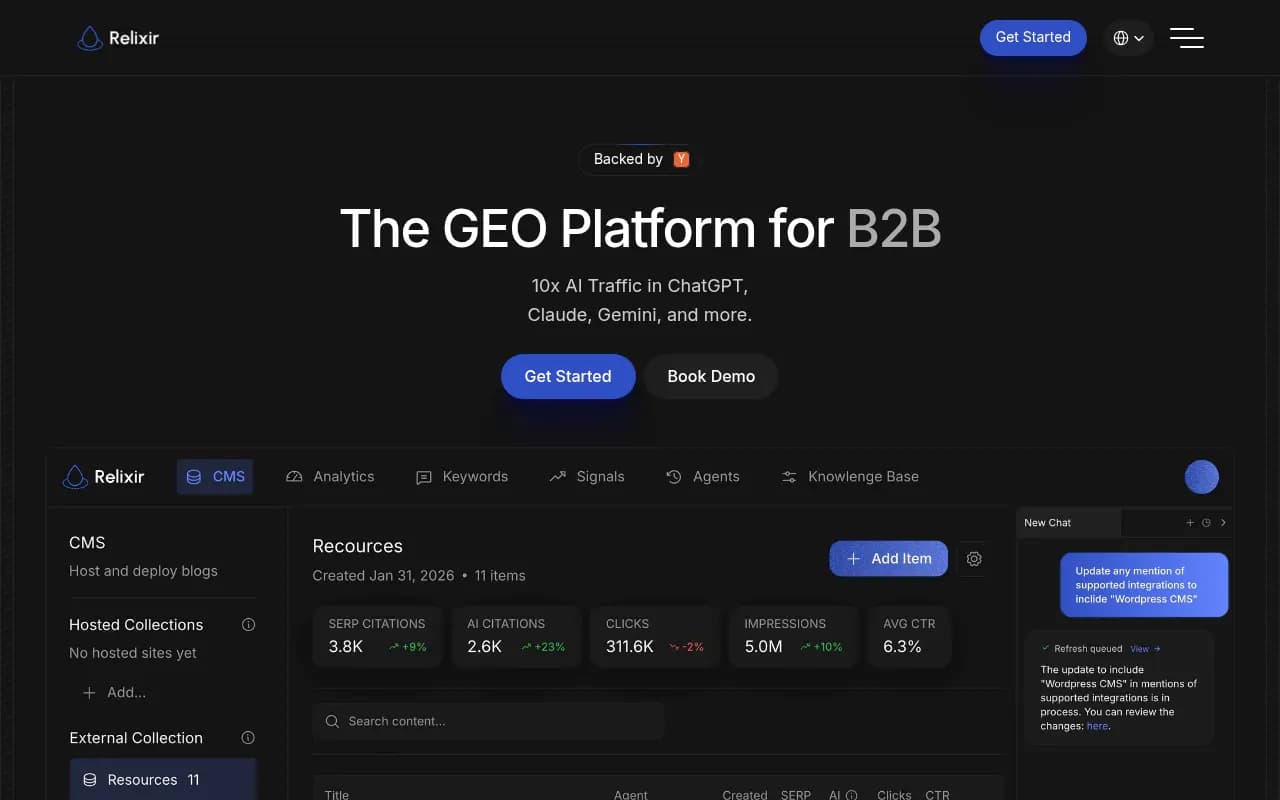
9. Relixir -- best for teams building an AI-native content operation
Relixir combines GEO tracking with an AI-native CMS and autonomous content capabilities. It's built for teams that want to treat AI visibility as a content operation from the ground up, rather than bolting monitoring onto an existing workflow.
The CMS integration means content created for AI citation can be published directly without exporting to another system. For teams starting fresh with AI-first content strategy, that's a meaningful workflow improvement.
Comparison table
| Tool | Monitoring | Content gap analysis | Content generation | Publishing | Best for |
|---|---|---|---|---|---|
| Promptwatch | Yes (10 models) | Yes | Yes (AI writing agent) | Via workflow | Full track-to-publish loop |
| SE Visible | Yes | Partial | No | No | SEO teams adding GEO |
| Scrunch AI | Yes | No | No | No | Enterprise monitoring |
| Otterly.AI | Yes (brand focus) | No | No | No | Brand/PR teams |
| Peec AI | Yes | No | No | No | Startups, SMBs |
| AthenaHQ | Yes | Partial | No | No | Enterprise GEO analytics |
| Ahrefs Brand Radar | Yes (fixed prompts) | No | No | No | Existing Ahrefs users |
| Whitebox | Yes | Yes | Yes (autonomous) | Yes | Large content libraries |
| Relixir | Yes | Yes | Yes | Yes (CMS) | AI-native content ops |
| Profound | Yes | Partial | No | No | Fortune 500 analytics |
What to actually look for when evaluating these tools
Coverage across AI models
The minimum bar in 2026 is tracking ChatGPT, Perplexity, Claude, Gemini, and Google AI Overviews. Tools that only cover one or two models are giving you a partial picture. Bonus points for Grok, DeepSeek, and Meta AI coverage -- those are smaller now but growing.
Prompt customization
Fixed-prompt tools (Ahrefs Brand Radar is the obvious example) are limited because your most important prompts are specific to your category and competitors. You need to be able to define the exact questions your customers are asking and track visibility for those.
The gap between data and action
This is the question that separates useful tools from expensive dashboards: when you find a visibility gap, what does the tool do next? Does it show you what content to create? Does it help you create it? Or does it just show you the gap and leave you to figure out the rest?
Most tools stop at showing you the gap. The ones that help you close it are worth paying more for.
Traffic attribution
AI visibility that doesn't connect to actual traffic and revenue is hard to justify. Look for tools that can attribute site visits and conversions back to AI-generated answers -- either through a code snippet, GSC integration, or server log analysis. Without attribution, you're optimizing for a metric that might not correlate with business outcomes.
Crawler log access
Knowing which pages AI crawlers are actually reading is different from knowing which pages get cited. Crawler logs tell you about the discovery and indexing layer -- which pages are being considered, which are being ignored, and where errors are blocking access. Most monitoring tools don't offer this. It's a meaningful differentiator for technical content teams.
Which tool should you actually use?
The honest answer depends on where you are in your AI visibility journey.
If you're just starting out and want to understand the landscape without a big commitment, Peec AI or Otterly.AI give you a low-cost entry point. You'll get visibility data, you'll understand the problem, and you'll quickly realize you need more.
If you're an SEO team that already uses SE Ranking, SE Visible is the obvious next step. The integration is seamless and you're not learning a new system.
If you're a content team that wants to actually move the needle on AI citation rates -- not just measure them -- the tools worth serious evaluation are Promptwatch (for the full monitoring-to-publishing loop), Whitebox (for autonomous content updates at scale), and Relixir (for teams building AI-native content operations from scratch).
The pattern to avoid is spending money on a monitoring tool and then wondering why your AI visibility scores aren't improving. Monitoring tells you what's wrong. Optimization is what fixes it. Make sure the tool you choose does both, or that you have a clear plan for the part it doesn't cover.
A note on Profound itself
None of this means Profound is a bad tool. For large enterprises with dedicated analytics teams, significant budgets, and existing content operations that just need better data, Profound delivers. The server log analysis (their "Agent Analytics" feature) is genuinely sophisticated, and the breadth of coverage across AI models is strong.
The issue is fit, not quality. Profound is built for teams that have the resources to act on enterprise-grade data. Most content teams don't need enterprise-grade data -- they need a clear signal about what to write next and help writing it. That's a different product.

The market for AI visibility tools is moving fast. The tools that will matter most by the end of 2026 are the ones that close the loop between tracking and publishing. Keep that as your filter when evaluating anything in this space.